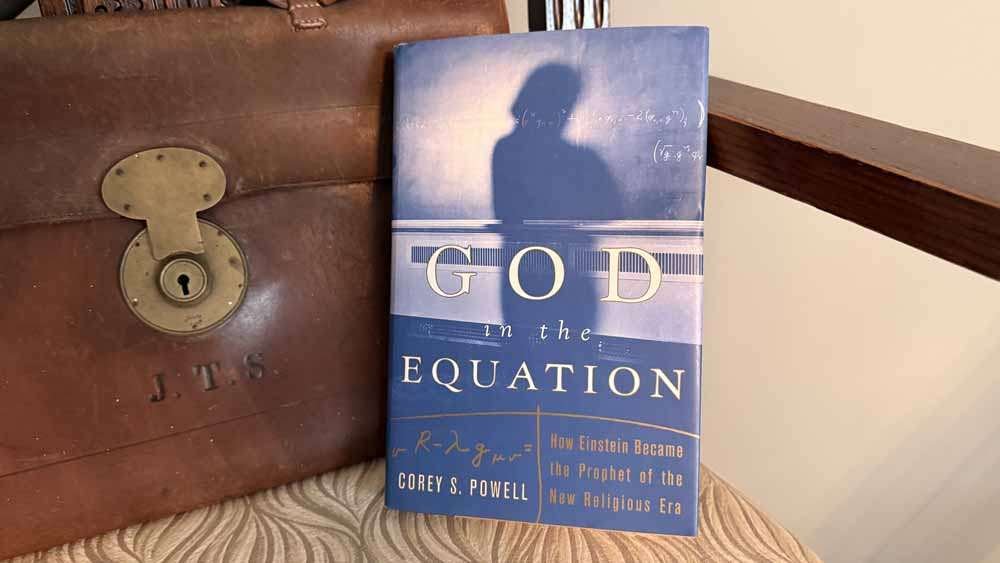
The oldest argument in Western intellectual history isn’t between conservatives and liberals, or even between empiricists and rationalists. It’s between the people who believe the universe has a point and the people who insist it doesn’t. What Corey S. Powell does in God in the Equation — quietly, methodically, without converting to anything — is show that the second group has been running a church all along and just didn’t notice.
That’s not a small claim. It’s the kind of claim that makes both physicists and priests uncomfortable, which is probably a sign Powell is onto something.
Lambda and the Problem That Wouldn’t Go Away
Einstein’s cosmological constant — represented by the Greek letter Lambda — was introduced into his field equations in 1917 to prevent the universe from collapsing under its own gravity. He wanted a static universe, so he put a term in his math to hold it open. When Edwin Hubble’s observations proved the universe was expanding and not static at all, Einstein called Lambda his “biggest blunder” and tried to walk it back. That should have been the end of it.
It wasn’t. The symbol in the relativity equations that stands for God is Lambda — also called the cosmological constant — and Powell shows that Einstein put The Old One into his equations describing the theory of relativity, binding together two spheres of human thought, the spiritual and the scientific, in a way that had never previously been accomplished.
Then the supernovae data from the late 1990s arrived, and Lambda came roaring back. The universe wasn’t just expanding — it was accelerating. Something was pushing it apart. That something, which cosmologists now call dark energy, is Lambda. The “biggest blunder” turned out to be the most prescient thing Einstein ever wrote, and nobody fully understands what it is. Lambda’s ethereal nature is integral to its inspirational appeal. The story of Lambda is the story of the secret faith that keeps sci/religion, and the human spirit, pushing ever onward.
This is where Powell’s central argument comes into focus. Dark energy is real — it fills the universe, it governs cosmic fate — and we have no idea what it is. We can measure its effects. We can fit it into equations. But we cannot explain it from first principles, cannot point to a mechanism, cannot reduce it to particles or fields we already understand. It behaves exactly the way a god would behave in a physicist’s universe: present everywhere, causally dominant, and fundamentally mysterious.
Sci/Religion and the New Priesthood
Powell’s coinage for this emerging worldview is sci/religion, and he uses it without apology. Powell argues that sci/religion offers a religion of rational hope as an alternative to what he calls “old-time religion,” and contends that sci/religion can offer a theory of human consciousness rooted in the interactions of subatomic particles and fields.
That’s a provocative framing, and some readers will find it overwrought. The book’s chapter titles — “The New Priests Bicker in Europe and America,” “Salvation in the Temple of Einstein,” “The Angel of Dark Energy” — are not subtle. Kirkus called it “provocative, securely grounded in contemporary theories of physics, and worth pondering.” John Horgan, author of The End of Science, was more emphatic: Powell, he wrote, had produced “a splendid, startling argument that the greatest religious issue of our time is actually a ‘scientific’ problem.”
But the framing earns its keep if you take it seriously rather than literally. What Powell is describing isn’t a metaphor. He’s identifying a structural homology — the way cosmology, in its current form, performs the same psychological and cultural functions that religion has always performed: providing an account of origins, positing a final state, venerating founding figures, generating awe. The cathedral and the observatory are serving the same human need. The instruments and the vocabulary are different. The hunger is identical.
Einstein as Prophet
The most compelling section of the book traces how Einstein himself understood what he was doing. Einstein was creating a formula for a new kind of “sci/religion,” one in which God was a factor, denoted by the Greek letter Lambda, and one that would pave the way for an entirely new gnostic era in the history of human spirituality. This wasn’t accidental. Einstein famously said, “Everyone who is seriously involved in the pursuit of science becomes convinced that a spirit is manifest in the laws of the universe — a spirit vastly superior to that of man.” He wasn’t making a theological claim in any traditional sense. He wasn’t invoking the God of scripture or commandment. He was pointing at the lawfulness of the universe itself — the fact that it has laws at all, that mathematics describes physical reality with preposterous precision, that the same equations written on a chalkboard in Berlin apply to a galaxy twelve billion light-years away — and saying that this lawfulness was, in itself, something worth revering.
When Einstein said “God does not play dice with the universe,” he wasn’t merely being clever — he was creating a new kind of religion. He called God The Old One. That’s not the God of Genesis or of any catechism. It’s the God of structure, of deep regularity, of the impossible coincidence that the universe is comprehensible at all. Whether you call that God or Lambda or dark energy or the cosmological constant changes nothing about the thing itself.
Where the Book Gets Complicated
God in the Equation has critics on both flanks, which is usually a sign a book is doing something right. Some readers found the language off-putting — phrases like “the redemptive power of sci/religion,” “renowned priests of sci/religion,” and “the sci/religious faithful began to disagree on how to interpret the heavenly messages” appearing throughout. The concern is legitimate: there’s a risk that the metaphor colonizes the science rather than illuminating it, making cosmology seem more theologically fraught than it is, or making religion seem more intellectually respectable than its critics would allow.
Powell is aware of this tension but doesn’t fully resolve it. His argument works best when it’s descriptive — here is how cosmologists actually talk, here is the language of awe and revelation that shows up in their papers and interviews — and becomes more strained when it’s prescriptive, when he argues that sci/religion should fill the void left by organized faith. Whether science can carry the weight of meaning that religion has traditionally borne is a genuinely open question, and Powell doesn’t quite close it.
One critique is that Powell’s view of religion is decidedly outdated, as he missed the resurgence of religion and spirituality in the late 20th century. Despite this, he convincingly shows the ways that science has molded itself into a new faith. That’s a fair verdict. The book reads slightly dated in its assumption that the secular-scientific worldview would simply continue its triumphal march over traditional faith. The twenty-first century had different plans. But the core observation — that cosmology has assumed a quasi-religious function in the lives of educated secular people — is, if anything, truer now than when Powell wrote it.
The Real Question Underneath
Every book about the relationship between science and religion is ultimately a book about whether the universe cares that we’re here. That’s the question behind Lambda, behind dark energy, behind the cosmological constant and the flatness problem and the fine-tuning argument and everything else that fills the footnotes of books like this one. If the universe’s physical constants were even slightly different, atoms couldn’t form, stars couldn’t ignite, complexity couldn’t arise, and you couldn’t be reading this sentence. That’s either a staggering coincidence or it’s telling you something. Powell doesn’t pretend to know which.
What he does instead is something more useful: he shows that the scientists doing this work live inside that question the same way monks lived inside their prayers. The data comes in from the observatories on Mauna Kea. The supernovae light curves get plotted. The cosmological constant re-emerges from the equations like a ghost that won’t stay dead. And somewhere in the middle of all that rigor and precision, the researchers reach a threshold where the mathematics stops being merely descriptive and starts feeling like it’s pointing at something. Not God in any conventional sense. Something. A depth behind the depth.
Powell contends that there is a God — the sum of the energies scattered through the universe — and that science has at last formulated a full-blown spiritual theory, a Church of Lambda. That’s a strong claim, and readers who disagree with it will still find the cosmological history worth the price of admission. God in the Equation is, as Scientific American noted, “a delight to read” that “provides an unusually graceful account of the history of cosmology.” The sci/religion framework you can take or leave. The history of how Lambda disappeared, returned, and changed everything — that’s simply good science writing.
For the reviews of E=mc² by David Bodanis and The Selfish Gene by Richard Dawkins, the territory is adjacent — Einstein’s most famous equation and the biological framework that Dawkins drew from Darwin. Powell’s book is the cosmological chapter of the same ongoing conversation about what the universe is made of and whether any of it adds up to meaning.
It doesn’t answer that. Nothing does. But it’s the right question to be asking, and Powell asks it with more rigor and more honesty than most.
Sources
- Powell, Corey S. God in the Equation: How Einstein Transformed Religion. Free Press, 2003. simonandschuster.com
- Amazon editorial summaries and reader reviews. amazon.com
- Kirkus Reviews blurb, via Barnes & Noble. barnesandnoble.com
- Publishers Weekly review. publishersweekly.com
- Goodreads editions. goodreads.com