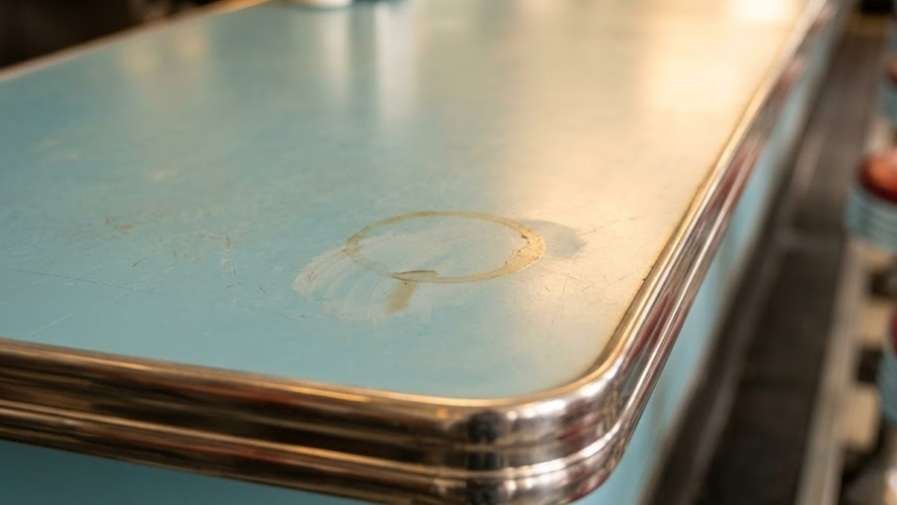
Run your hand along the counter at any old diner on Long Island and you’ll find it: that faintly cool, slightly waxy surface that wipes clean, never stains for long, outlasts the waitresses, outlasts the ownership changes, outlasts the marriages of everyone who’s ever sat in front of it. That’s Formica. And it was never supposed to be there.
It was supposed to be inside electrical motors.
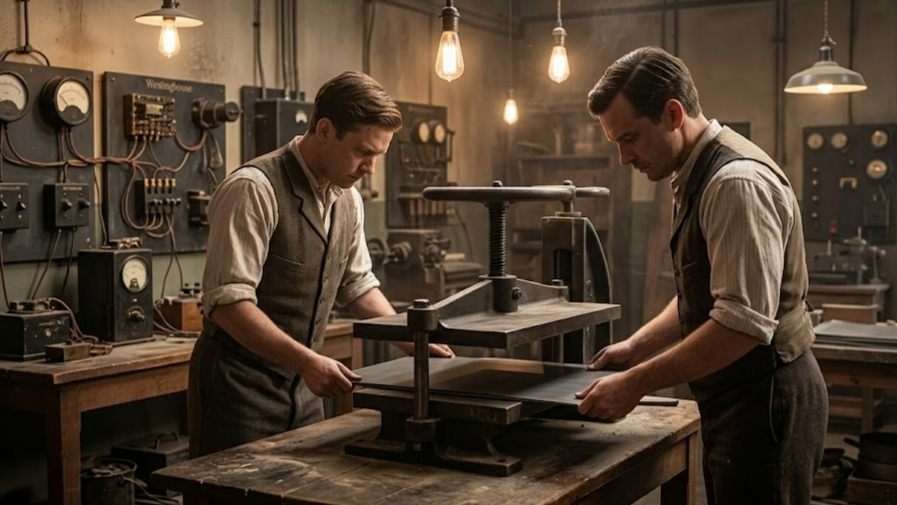
In 1912, a research engineer named Daniel J. O’Conor at Westinghouse Electric in East Pittsburgh was experimenting with Bakelite — the first totally synthetic plastic, invented by Leo Baekeland in 1907 — trying to find a cheaper, more reliable substitute for mica, the naturally occurring mineral used to insulate electrical components. Mica was expensive, increasingly scarce, and geologically inconvenient. O’Conor wrapped kraft paper in liquid Bakelite resin, pressed it flat, and produced a laminate sheet with the same insulating properties. He filed the patent application on February 1, 1913. Westinghouse paid him one dollar for the rights — the customary amount they paid employees for their inventions. Patent No. 1,284,432 was granted November 12, 1918. The product, used “for mica,” was called Formica.
That’s the whole story, except for the part where it ends up under your coffee cup at a diner in Hicksville.
From Commutator Rings to Counter Stools
O’Conor and Herbert A. Faber, the technical sales manager who recognized what the material could become, left Westinghouse in 1913. Convinced that Westinghouse was underselling the potential of their invention, they founded the Formica Insulation Company in Cincinnati with $2,500 from a Kentucky lawyer named J.G. Tomlin. Their first plant opened May 2, 1913. Their first order was commutator V-rings for the Chalmers Motor Company.
They were not thinking about diners. They were thinking about motors, timing gears, radio components, airplane propellers. During World War I, Formica expanded into military applications. By 1917, sales totaled $75,000. By 1932, the company was producing 6,000 gear blanks per day for Chevrolet and other automakers — the same laminate, pressed into automotive timing gears that ran quieter than metal.
The pivot to surfaces came in stages. In 1927, the company patented an opaque barrier sheet that allowed rotogravure printing — suddenly Formica could be printed with wood grain, marble patterns, any decorative surface the market wanted. By 1930, the company was shifting from industrial applications to decorative laminate products. The RMS Queen Mary featured Formica on its interior walls when it launched in 1936. Radio City Music Hall had Formica installations. Cafes and nightclubs were adopting it. The material was colorful, durable, easy to clean, and — crucially — resistant to cigarette burns. That last property matters more than it sounds in a society where everyone smoked.
Then the war happened again. The Formica Insulation Company pivoted back to military production from 1941 to 1945. When it was over, the dam broke.
The Postwar Flood
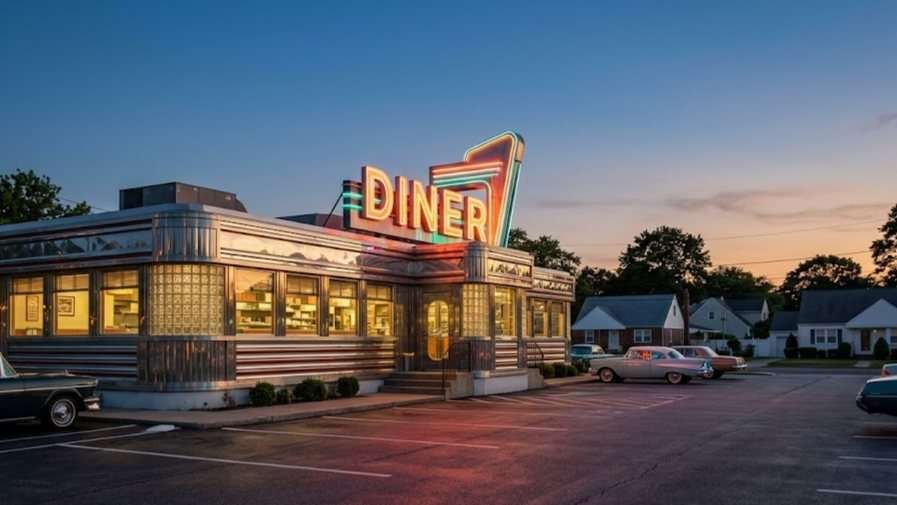
The years between 1946 and 1965 are when Formica became what you think of when you hear the word. Postwar sales reached $24 million. The company advertised aggressively, launched the iconic “Skylark” boomerang pattern designed by industrial designer Brooks Stevens, and positioned the material as the surface of modern American optimism. By the early 1950s, it was estimated that nearly a third of all new American homes contained plastic laminate. The material had escaped the factory floor and landed in the kitchen, the bathroom, the diner, the coffee shop, the lunch counter.
For the diner industry specifically, Formica solved a real operational problem. Pre-war diner counters were often marble, wood, or tile — expensive, porous, hard to maintain under the conditions of a commercial kitchen running sixteen hours a day. Formica wiped clean, resisted heat and moisture, came in dozens of colors and patterns, and could be fabricated into any configuration a prefab diner manufacturer needed.
This is where Kullman enters the picture. The Kullman Dining Car Company — founded by Samuel Kullman in Newark, New Jersey in 1927 — was one of the most significant diner manufacturers in the Northeast, eventually building an estimated 1,500 dining establishments over eighty years. According to the company’s own history, Kullman integrated Formica surfaces extensively in interior designs of the post–World War II era, applying, as one account describes it, “miles of the laminate” — often in baby-blue tones — for modular diner units. Kullman was producing 30 to 40 complete diner units annually by the late 1940s and through the 1950s.
Long Island was a natural market. Nassau and Suffolk counties were experiencing a population explosion driven by Levittown-style suburbanization, the GI Bill, and the defense industry workforce. Grumman Aircraft in Bethpage alone employed 22,000 people on Long Island by 1970. Republic Aviation in Farmingdale added tens of thousands more. These were shift workers, hourly workers, men who clocked out at odd hours and needed a place to eat that wasn’t a white-tablecloth restaurant and wasn’t home.
The diner filled that gap. And inside those diners, Formica covered every horizontal surface that mattered.
The Material That Outlived Its Story
Here is the part that stays with me: the people who ate at those Long Island diner counters in the 1950s and 1960s had no idea they were resting their elbows on a descendant of electrical motor insulation. They didn’t know about O’Conor’s Westinghouse experiments, or the patent that paid him a dollar, or the gear blanks for Chevrolet. Nobody put a plaque on the counter explaining any of this. The Formica just was — clean, cool, endlessly patient.
My father worked a lunch counter before he worked a diner. He knew counters the way other people know cars: by feel, by age, by whether the thing had been cared for. He would have laughed at the idea of Formica starting life as electrical insulation. But that’s the quiet joke built into every diner in America — the surface under your eggs was engineered to protect motors from shorting out, and it ended up outlasting the factories that made those motors.
The boomerang pattern. Baby blue. The faint ghost of cigarette burns that somehow never quite penetrated. Formica has absorbed fifty years of conversation on every Long Island counter it ever covered. It doesn’t remember any of it. That’s also part of what makes it the perfect diner surface — indifferent to everything, equally hospitable to everyone, and built, originally, for something else entirely.
The Conspiracy That Wasn’t
Conspiracy is the wrong word, obviously. O’Conor and Faber were engineers chasing a market. They found one they didn’t expect. American industry has always worked this way — material invented for one purpose, adopted for another, normalized until nobody remembers the origin. Bakelite was supposed to replace shellac in electrical insulation; it ended up in every phone receiver, billiard ball, and jewelry piece of the early twentieth century. Velcro was engineered after a Swiss inventor studied burr hooks under a microscope; it ended up on children’s sneakers.
Formica’s second life as the surface of American diner culture is not a conspiracy. It’s just what happens when a material is durable, cheap enough to mass-produce, and available at the exact moment a new form of eating establishment is being built at scale across the American suburbs.
Still. There is something worth pausing over. The material that carried working-class meals for a generation — the eggs, the coffee, the pie, the cheap steak — began as a solution to a problem in electrical engineering. The men who ate at those counters didn’t design airplanes or work in research departments. They worked on assembly lines, drove trucks, operated heavy equipment. The surface under their lunch was born in a laboratory and made its way to them through a chain of industrial accidents and market decisions they had no part in.
That’s not a conspiracy. It’s just the history of most things people touch every day without thinking about how they got there.
You Might Also Like
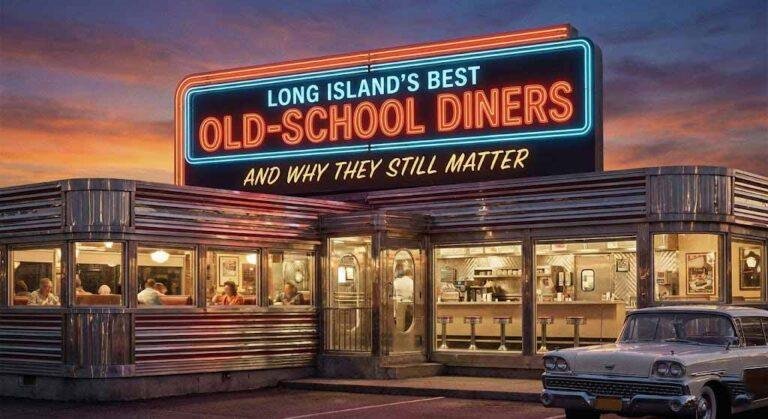
- Long Island’s Best Old-School Diners and Why They Still Matter
- Rum Row and the Freeport Bootleggers: Long Island’s Clandestine War on the Water
- From Lunch Wagons to Legacy — The Evolution of the American Diner
Sources
- Formica Group, History of the Formica® Brand
- Smithsonian Institution, NMAH Archives, The Formica Collection, 1913–2003
- Wikipedia, Formica (plastic) — USPTO Patent No. 1,284,432
- Encyclopedia.com, Formica Corporation
- Wikipedia, Kullman Building Corporation
- Richard J.S. Gutman, American Diner Then and Now (Johns Hopkins University Press), cited in Inc. Magazine
- Grumman employment: RiverheadLOCAL