Certainty is comfortable. It lets you build routines, make plans, trust your own judgment. And then David Hume comes along and pulls the rug out from under every last bit of it — not with hostility, not with the theatrical nihilism of a man who enjoys destruction for its own sake, but with the calm, almost surgical precision of someone who simply followed the evidence wherever it led. The Philosophy of David Hume, edited by V.C. Chappell, collects the essential works and lets Hume speak in full — and what he has to say is as disorienting today as it was in eighteenth-century Edinburgh.
Hume was an empiricist, which means he believed knowledge comes from experience. Not from divine revelation, not from pure reason spinning ideas out of thin air, but from what the senses actually encounter in the world. That sounds reasonable, even obvious. The trouble is that once you follow that premise seriously — as seriously as Hume did — you end up somewhere most people aren’t prepared to go.
Causation Is a Story We Tell Ourselves
The most famous and most unsettling of Hume’s arguments concerns causation — the basic assumption that when one thing happens, it causes another. You drop a glass, it shatters. You press a gas pedal, the car accelerates. We treat causation as a fact woven into the fabric of reality. Hume asked a harder question: where, exactly, did you see that? Not the glass breaking — that you saw. Not the car moving — that you saw too. But the connection between the two events, the invisible thread of necessity that makes one produce the other — that you have never seen, not once in your life.
What we actually observe, Hume argued, is constant conjunction. Event A consistently precedes event B. The mind, habituated to this pattern, begins to expect B whenever it sees A, and it dresses that expectation in the language of necessity. Causation, in other words, is a psychological habit masquerading as a metaphysical truth. It is one of the most radical ideas in the history of philosophy, and Hume delivered it without drama, as if pointing out that your coat is unbuttoned.
The implications are staggering. If causation cannot be verified through experience, then our entire scientific project — built on the premise that causes produce effects reliably, that the future will resemble the past — rests on a foundation that cannot be rationally justified. Hume called this the problem of induction, and he never solved it. Neither has anyone else, not really, though philosophers have been trying for three hundred years.
The Self That Isn’t There
If the causation argument makes you uneasy, Hume’s treatment of personal identity will make you genuinely disoriented. Most of us carry around a quiet assumption that there is a self — some continuous, unified thing called “I” that persists through time, connecting the person who was a child to the person reading these words right now. Hume went looking for it.
He looked the only way he knew how: through experience. And he reported finding, upon introspection, not a unified self but a bundle of perceptions — flashes of sensation, thought, memory, emotion, moving through him in rapid succession. No stable observer standing behind them. No ghost in the machine watching the parade go by. Just the parade itself. The self, he concluded, is not a thing we perceive but a story we construct out of connected perceptions, and we mistake the story for the storyteller.
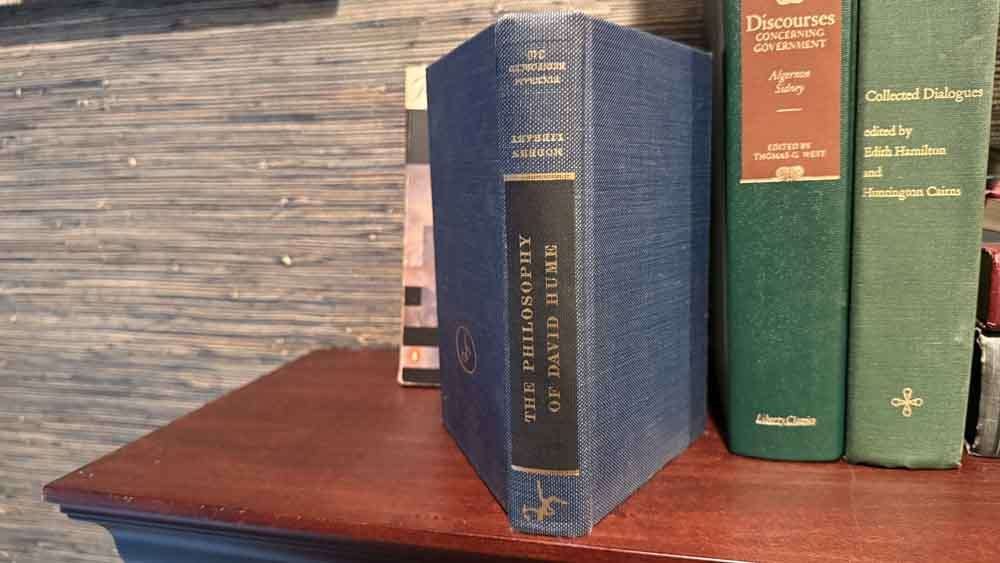
This is a direct ancestor of what cognitive science has been saying for decades — that the unified self is a retrospective narrative the brain generates, not a feature of experience but an interpretation of it. Hume got there in 1739, armed only with a quill pen and a willingness to follow his premises into uncomfortable territory. That edition on the shelf in the photo — the heavy blue Chappell volume — carries that argument inside it with the same patience it has always had, waiting for whoever pulls it down.
Miracles and the Weight of Evidence
Hume’s essay Of Miracles may be the most concentrated piece of philosophical demolition work in the English language. His argument is not that miracles are impossible — he was too careful a thinker to make a claim that strong — but that no testimony for a miracle can ever be sufficient evidence to believe one has occurred. The logic is straightforward: a miracle, by definition, is a violation of the laws of nature, which are established by the most consistent and uniform human experience available. The evidence against any particular miracle is therefore the entire weight of that accumulated experience. For testimony to overcome it, that testimony would have to be more improbable than the miracle itself — meaning it would have to be virtually certain that the witnesses were neither deceived nor deceiving. That bar, Hume observed, is never met.
This is not a screed against religion. It is an application of his empirical method to a specific class of claims, and it is ruthlessly even-handed. He would apply the same standard to any extraordinary claim, religious or secular. What makes it sharp enough to still draw blood is that the logic holds regardless of your sympathies. You either accept that evidence must be proportional to claims, or you accept that credulity has no principled limit.
Why This Matters Beyond the Classroom
It would be easy to read Hume as a destroyer — someone who kicks away the foundations and walks off. That misses what makes him worth reading. Hume was not interested in despair. He acknowledged that we cannot live without assuming causation, without assuming a self, without trusting our senses to some working degree. He simply insisted that we be honest about what those assumptions are: working habits, useful fictions, tools that help us navigate experience, not metaphysical certainties carved into the universe.
There is a kind of intellectual courage in that position. It means giving up the comfort of certainty without giving up the practice of inquiry. It means holding your beliefs a little more lightly, a little more provisionally — open to revision when new evidence arrives, rather than defended past the point that evidence supports them. In an era when everyone from cable news anchors to social media algorithms is in the business of manufacturing certainty, that capacity for calibrated doubt feels less like a philosophical luxury and less like an academic exercise and more like a survival skill.
The Chappell anthology serves as an excellent entry point for exactly this reason — it does not try to soften Hume or tidy him up. It collects his primary texts and lets his arguments work on you directly. Read A Treatise of Human Nature for the causation and self arguments. Read the Enquiries for the more polished versions. Read Of Miracles and feel the precision of it, the way each sentence closes off an escape route. There are also useful secondary essays in the collection that situate Hume within the broader empiricist tradition — Locke before him, Kant’s agitated response after — which helps contextualize just how much ground he covered and how much he disturbed.
Reading Hume Alongside the Wider Tradition
Hume does not make full sense in isolation. He was responding to Locke and Berkeley, both of whom believed experience was the source of knowledge but stopped short of Hume’s more devastating conclusions. And he provoked Immanuel Kant, who claimed Hume woke him from his “dogmatic slumber” — an admission from one of history’s great minds that Hume had identified something that couldn’t simply be ignored. Kant spent the rest of his career building a philosophical architecture that could survive the Humean critique. Whether he succeeded is still debated.
Those who have followed along with other reviews in this series will notice a thread running through Hume that connects directly to Richard Dawkins’ The God Delusion — particularly the demand that extraordinary claims meet an extraordinary evidential burden. Hume preceded Dawkins by two and a half centuries, but the epistemological foundation is the same: experience and evidence, not authority and tradition. And the parallel with Nietzsche’s Thus Spoke Zarathustra is worth noting too — both thinkers arrive, from different directions, at the conclusion that inherited certainties need to be examined rather than inherited. Nietzsche did it with a hammer; Hume did it with a scalpel.
A Final Note on the Book Itself
The Chappell volume is a serious book for serious reading — dense cloth cover, gold lettering on the spine, the kind of object that announces its intentions before you open it. It is not light philosophy. Hume’s prose is clear by the standards of his time, but he is making hard arguments, and he expects you to follow them carefully. That is not a warning so much as a description of the experience. He will slow you down. He will make you stop and think. And if you are honest about what the arguments are actually saying, he will leave you with a few fewer certainties than you walked in with — which, given what certainty costs us when it’s misplaced, is probably a good trade.
You Might Also Like:
- No Exit by Jean-Paul Sartre — The Play That Diagnosed Modern Life Before Modern Life Knew It Was Sick
- The Darwin Wars by Andrew Brown — A Review
Sources:
- Hume, David. A Treatise of Human Nature (1739). https://www.gutenberg.org/ebooks/4705
- Hume, David. An Enquiry Concerning Human Understanding (1748). https://www.gutenberg.org/ebooks/9662
- Chappell, V.C. (ed.). The Philosophy of David Hume. Modern Library. https://www.amazon.com/Philosophy-David-Hume-V-C-Chappell/dp/B0007FUPOK
- Stanford Encyclopedia of Philosophy — David Hume. https://plato.stanford.edu/entries/hume/
- Stanford Encyclopedia of Philosophy — Hume on Causation. https://plato.stanford.edu/entries/hume-causation/
- Stanford Encyclopedia of Philosophy — Hume on Personal Identity. https://plato.stanford.edu/entries/hume/#perIde
- Kant, Immanuel. Prolegomena to Any Future Metaphysics (1783) — on being “woken from dogmatic slumber.” https://www.gutenberg.org/ebooks/52821