My father’s parents came from Greece. My mother’s too. I grew up in Brooklyn hearing about gods and myths and ancient wisdom the way other kids heard about the Yankees — like it was family business, something you inherited whether you wanted it or not. But Plato was never part of that conversation. Plato was for professors, not for a kid from Bay Ridge whose idea of a philosophical debate was arguing in the street about who threw the first punch.
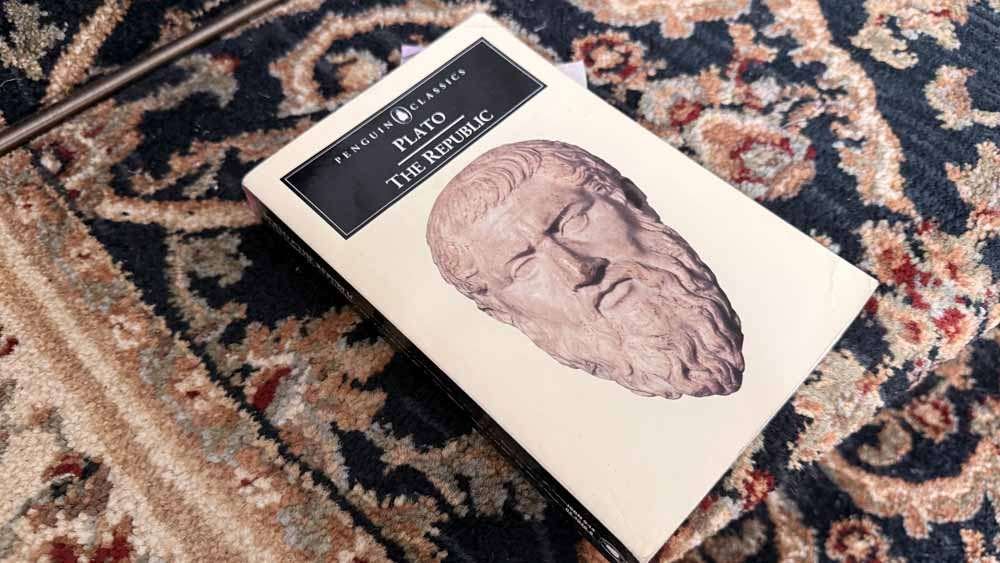
Then I walked into an introductory philosophy class at CW Post and someone handed me The Republic.
I want to be clear about who I was at that point. I had dropped out of high school. I had lived in the streets in ways I am not going to detail here. I had spent years operating under a completely different set of rules than the ones they teach in classrooms. And here was this book — written by a Greek man twenty-four centuries ago — and inside the first fifty pages Socrates was asking questions I had been turning over my entire life without knowing I was doing philosophy. I just thought I was angry.
What the Book Actually Is
People act like The Republic is a political science textbook. It isn’t. It is a long argument about justice — what it is, whether it pays to be just, and what kind of person you have to become to live a truly good life. Socrates is the main character, which is the first interesting thing, because Socrates never wrote anything himself. Everything we know about him comes through Plato, which means you’re always reading the student’s account of the teacher, and you can never be sure where one ends and the other begins.
The dialogue form is the second interesting thing. Plato doesn’t lecture you. He puts Socrates in a room with other people and lets them argue. Thrasymachus — the guy I immediately recognized — shows up early and says justice is whatever is in the interest of the stronger. Might makes right. The powerful define what’s fair, and everybody else falls in line or gets crushed. He says this loudly and with complete confidence.
I had met Thrasymachus in real life many times. He wore different clothes but he always said the same thing.
Socrates doesn’t get rattled. He just starts asking questions. And that is the move. Not arguments. Questions. He gets Thrasymachus to admit things by making him define his own terms, and every time Thrasymachus defines something, Socrates finds the contradiction hiding inside the definition. By the end of it Thrasymachus is half-defeated and mostly sulking, and Socrates hasn’t even raised his voice.
I read that exchange twice in one sitting.
The Cave
The Allegory of the Cave is the most famous section and for good reason — it’s where Plato stops arguing and starts painting. He asks you to imagine prisoners chained in a cave since birth, facing a wall. Behind them is a fire. Between the fire and the prisoners, people carry objects whose shadows are cast onto the wall. The prisoners have never seen anything but these shadows. To them, the shadows are reality.
Then one prisoner gets out. He stumbles into sunlight and it nearly blinds him. He sees real things — trees, sky, the sun — and understands, for the first time, that everything he believed was a shadow. Then he goes back into the cave to tell the others.
They don’t believe him. They think he’s lost his mind. And if he tries to free them, Plato says, they would probably kill him.
That last part landed on me like a dropped engine block.
I had seen that story play out. Not in caves — in neighborhoods. In families. There are people who get out and come back with information about how the game actually works, who’s running it, why the rules are written the way they are, and the response is not gratitude. The response is suspicion. You sound crazy. You think you’re better than us. Sit down. The chains were familiar. The shadow-watching was familiar.
What I had never had before was a name for it. Or a framework that said: this is a condition, it has a cause, and there is a way out. Plato gave me that.
The Just City and Why It’s Impossible
Plato spends a lot of The Republic describing an ideal city — one governed by philosopher-kings, people trained from birth to understand the Good rather than just to want power. The city has three classes: rulers, warriors, and producers. Each does what it is naturally suited for, and justice in the city is each part doing its proper job.
This is where the book gets uncomfortable, because Plato is not describing a democracy. He is describing a meritocracy run by the wisest, with everyone else sorted into their role by ability. He thinks most people are not equipped to govern themselves. He thinks the crowd follows appetite, not reason.
I had complicated feelings about this.
On one hand, I had lived around enough dysfunction to understand the argument. Not everyone who wants power should have it. Not every voice in the room is equally informed. I get that. On the other hand, I had also watched plenty of people with credentials and clean hands make decisions that crushed the people who couldn’t fight back, and they called that order. The philosopher-kings Plato is describing have never existed. What has existed is their simulation — men who believed they were the wisest, acting accordingly.
The Scottish philosopher Alasdair MacIntyre put it bluntly when he wrote that the idea of justice in The Republic only works if you already agree on what kind of human being you’re trying to produce. The whole argument is circular in that way. But the circularity is the point — Plato is not writing a blueprint. He is writing a mirror.
What Socrates Dies For
The Republic is inseparable from the trial of Socrates. Plato wrote it after his teacher was executed by the city of Athens for corrupting the youth and impiety — which really meant: for asking questions that made powerful people look stupid. Socrates was seventy years old when they handed him the hemlock. He drank it.
That fact is somewhere in every page of this book. You are reading a man who watched his teacher die for thinking out loud, and who spent the rest of his life trying to prove that what Socrates died for was true, was worth dying for, and that Athens was wrong. The Republic is philosophy as an act of loyalty. Maybe even as grief.
I wrote about Jacques-Louis David’s The Death of Socrates here — the painting captures that moment with an almost uncomfortable clarity. Socrates with one hand reaching for the cup and the other pointing upward, still mid-argument as the hemlock comes toward him. That image sits with me the same way Plato’s writing does. The man was not afraid of what he knew. That is either crazy or it is the only rational response to having actually understood something true.
What It Did to Me
I finished that class and I registered for another philosophy course. And then another. I eventually got a degree in philosophy from CW Post with a 4.0 GPA — which would have been genuinely funny to anyone who knew me at sixteen. The dropout who couldn’t sit still in high school turned out to be someone who could not get enough of sitting with a hard question and turning it over until it revealed something.
The Republic is not the book that made me agree with everything Plato believed. It is the book that showed me what it looked like to take an idea seriously. To follow it wherever it led, even if it led somewhere uncomfortable. Socrates doesn’t get to conclusions and stop — he keeps pushing. He pushes past the comfortable answer into the one that costs something. I recognized that instinct. I had just never seen it treated as a virtue before.
Kierkegaard did something similar for me later — you can read my thoughts on him here — but Plato was first. Plato was the door.
The philosopher Alfred North Whitehead once wrote that all of Western philosophy is “a series of footnotes to Plato.” I used to think that was hyperbole. I don’t anymore. Not because Plato was right about everything — he wasn’t, and there are things in The Republic that should make you uncomfortable — but because he asked the questions first, and he asked them so cleanly that every philosopher who came after him had to either answer them or explain why they refused to.
That’s what a great book does. Not give you answers. Give you the questions you didn’t know you were already living.
My Greek grandfather couldn’t read. He worked with his hands until they were ruined and then he kept working. I thought about him a lot that semester. He probably would have had no patience for Plato. And also — I don’t know — he might have recognized something in the cave.
You Might Also Like
- Thus Spoke Zarathustra by Friedrich Nietzsche — The Book That Rewired My Understanding of Everything
- No Exit by Jean-Paul Sartre — The Play That Diagnosed Modern Life Before Modern Life Knew It Was Sick
- Rembrandt’s Aristotle with a Bust of Homer — A Portrait of the Mind in Conflict
Sources
- Plato. The Republic. Translated by G.M.A. Grube, revised by C.D.C. Reeve. Hackett Publishing, 1992. https://hackettpublishing.com/the-republic-2
- Whitehead, Alfred North. Process and Reality. Free Press, 1978.
- MacIntyre, Alasdair. After Virtue. University of Notre Dame Press, 1981. https://undpress.nd.edu/9780268035044/after-virtue/
- Stone, I.F. The Trial of Socrates. Little, Brown and Company, 1988. https://www.amazon.com/Trial-Socrates-I-F-Stone/dp/0385260326
- Stanford Encyclopedia of Philosophy — Plato’s Republic. https://plato.stanford.edu/entries/plato-republic/