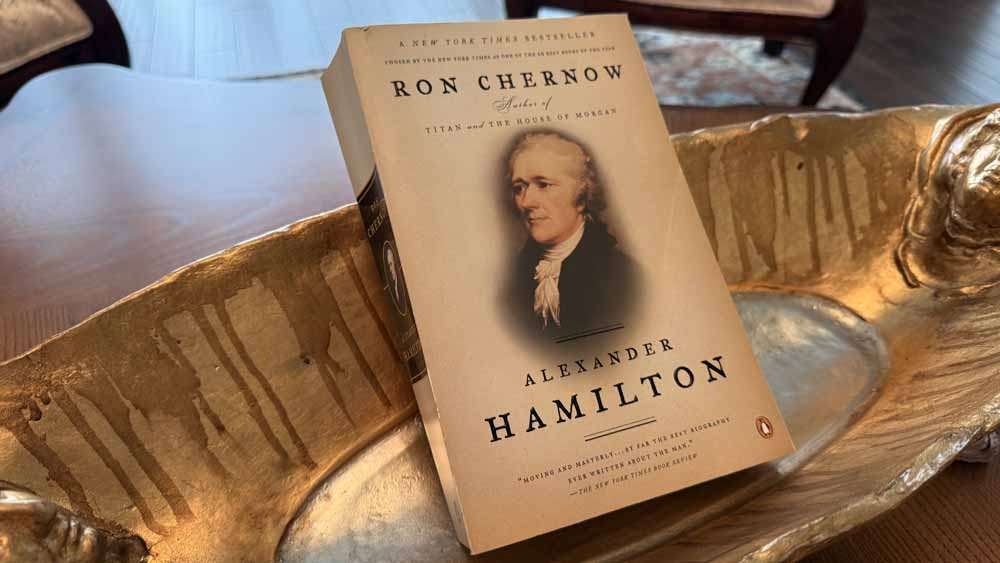
Eight hundred and eighteen pages. That is the first thing you need to understand about Ron Chernow’s Alexander Hamilton, published in 2004 and still, two decades on, the definitive account of a man who has been misread, underestimated, and periodically rescued from obscurity by people who finally looked closely enough at what he actually built. Chernow’s achievement is not just that the book is thorough — though it is exhaustively thorough, drawing from more than 22,000 pages of Hamilton’s papers and archival research on three continents. It’s that the biography finally makes sense of the central paradox of Hamilton’s life: how a man born with every social disadvantage imaginable ended up constructing the financial and governmental architecture that two hundred and twenty years of American history has been running on ever since.
The New York Times Book Review said nobody has captured Hamilton as fully and as beautifully as Chernow. That is not a compliment lightly earned on a subject this contested.
Where He Started
Hamilton was born in 1755 on the island of Nevis in the Caribbean. Illegitimate. His mother, Rachel Faucette, was a divorced woman — which meant her son was not just poor, but legally and socially marked before he could speak. His father, James Hamilton, a Scotsman of vague ambitions, eventually drifted away and disappeared. Rachel died of a fever when Alexander was eleven. By thirteen he was an orphan working as a clerk for a trading house in St. Croix, keeping books, managing accounts, running things well beyond his years.
Chernow is insistent on this origin and what it meant. The biographer notes that Hamilton felt fate had handed him an opportunity to reinvent himself and start life over — but that he never fully left the world of his childhood behind. He was poor. He was illegitimate. He was ashamed of all of those things. And even though he tried so hard to escape, on some level he was always trapped back in the darkness of that boyhood. That tension — between the man he was making himself and the boy he could never entirely outrun — is the engine of the whole book. It never resolves, not even at the duel.
The young Hamilton wrote in a letter from St. Croix, still a teenager: “I wish there was a war.” It wasn’t bravado. It was the calculation of someone who understood that the existing social order had no slot for him, and that chaos might be the only mechanism by which a man with nothing could become something. He was right.
The Speed of the Climb
What Chernow does better than any previous Hamilton biographer is communicate the sheer velocity of the ascent. Hamilton arrived in New York in 1773 at roughly eighteen. Within a year he was writing and publishing revolutionary pamphlets that people assumed had been authored by John Jay or other established figures. Within a few more years he was on Washington’s staff. By the time he was twenty-one he was running the general’s correspondence, drafting letters that shaped American military and diplomatic strategy, functioning as Washington’s most trusted intellectual instrument.
As Chernow explained it, if Washington is the father of the country and Madison the father of the Constitution, then Alexander Hamilton was surely the father of the American government. The distinction matters. The country and the Constitution are the founding documents, the ideals. The government is the thing that has to work on Monday morning — the tax system, the customs service, the coast guard, the national bank, the budget. That is what Hamilton built, from the ground up, as the first Treasury Secretary, in the face of sustained political opposition from men who found his vision of centralized financial power terrifying.
Chernow argues that we live in a Hamiltonian republic through and through, and not a Jeffersonian democracy — and that many of the financial and tax systems Hamilton proposed and put in place as the nation’s first Treasury Secretary are with us today, if in evolved form. Jefferson won the cultural narrative for a long time. Hamilton built the machine the narrative runs on.
The Outsider’s Advantage — and Its Cost
The immigrant’s relationship to ambition is different from the native’s. The native can afford patience. The outsider cannot. Hamilton wrote more, argued more, pushed harder, and made more enemies than any of the other founders precisely because he understood, at some cellular level, that the moment he stopped moving forward he stopped existing as anything other than what he had been born — which was nothing.
Chernow captures this paradox directly: Hamilton had the gravest doubts of all the founders about the wisdom of the masses and wanted elected leaders who would guide them. His optimistic view of America’s potential coexisted with an essentially pessimistic view of human nature. His faith in Americans never quite matched his faith in America itself. This is not the contradiction it first appears to be. A man who built himself from nothing does not trust luck or goodwill or the general decency of crowds. He trusts systems. Institutions. Rules that hold even when the people inside them don’t want them to.
The Reynolds Affair complicates this portrait, and Chernow does not look away from it. Hamilton’s public admission of an extramarital relationship with Maria Reynolds — published to clear himself of the more damaging charge of financial corruption — was a political self-immolation that still astonishes. He chose his reputation for financial probity over every other form of reputation. The man who had built a financial system on trust was not going to let the accusation of misusing public funds stand, even if the truth that cleared him destroyed something else. That is not calculation. That is a man with a hierarchy of values so fixed that he could not bend it even to save himself.
John Adams, who despised him, called him “that bastard brat of a Scottish peddler.” It is one of the most nakedly class-anxious insults in American political history — and it tells you more about Adams than Hamilton.
Chernow as Biographer
Chernow is a financial historian by training — his earlier books covered J.P. Morgan and John D. Rockefeller — and that background matters here. The sections on Hamilton’s financial architecture are not the dry interlude they would be in another biographer’s hands. Chernow understands what Hamilton was actually doing: inventing instruments for a country that had never had a functioning economy before, making bets on the industrial and commercial future of the United States at a time when Jefferson and Madison were still imagining a nation of independent agrarian landholders. Hamilton looked at America and saw New York. He was right about that, too.
Joseph Ellis, author of Founding Brothers, called the biography “a robust full-length portrait, in my view the best ever written, of the most brilliant, charismatic and dangerous founder of them all.” Robert A. Caro, the biographer of Lyndon Johnson, praised Chernow for creating a vivid and compelling portrait of a remarkable man while making a monumental contribution to our understanding of the beginnings of the American Republic. Those are not blurbs from casual admirers. Those are practitioners of the same craft recognizing something done at a level they understand.
Benjamin Schwarz, writing for The Atlantic, offered the sharpest counterpoint — arguing that Chernow’s unfamiliarity with the internal politics of revolutionary America leads to a portrait that is occasionally too sympathetic, too willing to explain away Hamilton’s contradictions rather than hold them open. The criticism has merit. Chernow is clearly an admirer. But the biography is large enough, and honest enough about Hamilton’s failures — the affair, the relentless enemy-making, the final catastrophic duel — that the admiration does not become hagiography.
The Death
Hamilton died at forty-seven, shot by Aaron Burr in a duel in Weehawken, New Jersey on July 11, 1804. He had antagonized Burr for years — publicly, specifically, and without apparent calculation about the consequences. Burr had finally had enough.
The final chapter of the book, which follows Eliza Hamilton through the fifty years she outlived her husband, is something else entirely. She devoted her widowhood to preserving his legacy and his papers, to telling people who he was, to refusing to let the Jeffersonian version of American history bury him. As Chernow is aware, the biography finally accomplishes what Eliza Hamilton spent fifty years trying to do — repair his reputation against the assaults of his political enemies. It took two centuries to get there. Lin-Manuel Miranda read the first few chapters of this biography on vacation in 2008 and told Chernow backstage at a show that he could hear “hip-hop songs rising off the page.” The musical that followed introduced Hamilton to an entirely new generation. But the biography came first, and the biography is the thing that lasts.
Chernow called Hamilton “the human word machine” and estimated he must have produced the maximum number of words a human being can scratch out in forty-nine years. The biography matches that energy. Eight hundred and eighteen pages, and not one of them is wasted.
Read this book. Not because of the musical. Because of the man — and because the America you live in was largely designed by someone whose name you barely knew before you opened it.
You Might Also Like:
On the Origin of Species by Charles Darwin: The Book That Changed Everything We Thought We Knew About Life
The Selfish Gene by Richard Dawkins — The Book That Unlocked Darwin for Me
Five Dialogues by Plato: The Book That Teaches You How to Question Everything
Sources
- Chernow, Ron. Alexander Hamilton. Penguin Press, 2004. penguinrandomhouse.com
- Kirkus Reviews. “Alexander Hamilton.” kirkusreviews.com
- Wikipedia. “Alexander Hamilton (biography).” wikipedia.org
- Book Marks. “Reviews of Alexander Hamilton by Ron Chernow.” bookmarks.reviews
- PBS American Experience. “Alexander Hamilton.” pbs.org
- Goodreads. Ron Chernow Quotes. goodreads.com