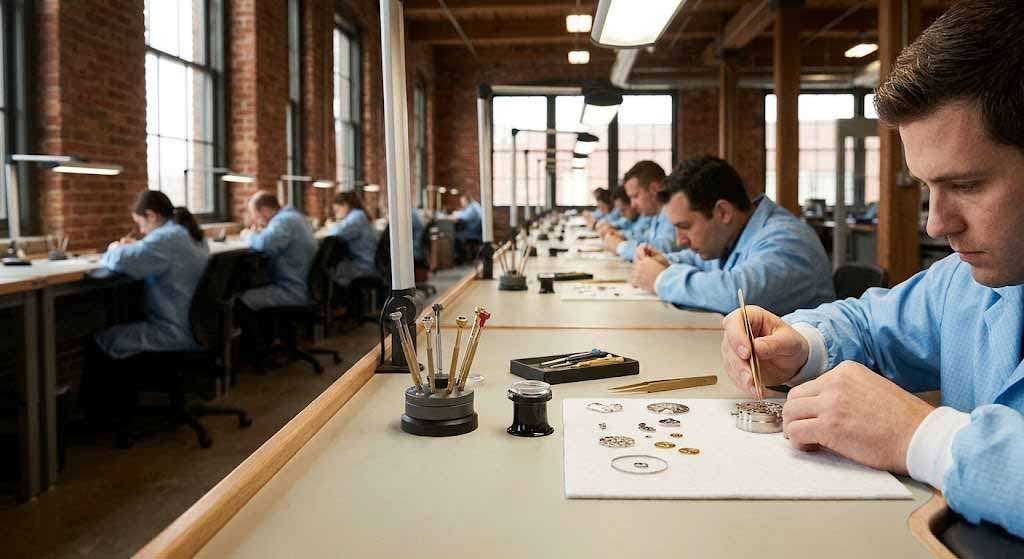
Most American manufacturing hides behind closed doors. You buy the product, you believe the story on the label, and you never see what actually happens between raw material and finished object. Shinola built an exception to that rule on the fifth floor of a century-old brick building in Detroit’s Midtown. They invite visitors in. They put you in a clean room, walk you past the assembly benches, and show you exactly what forty American workers do with Swiss movement kits and a set of tiny tools.
The question worth asking before you go is: what does it mean to make something?
The Argonaut Building and Why Detroit
Shinola’s Detroit headquarters occupies 95,000 square feet inside the historic Argonaut Building, a 1928 structure originally built for General Motors that later housed the College for Creative Studies. The building is a landmark of a city whose manufacturing identity was being rebuilt piece by piece after decades of industrial decline. When Shinola founder Tom Kartsotis chose Detroit in 2011, the choice was both practical and deliberate. Detroit had a workforce ready to be retrained. It had a manufacturing culture in its bones. It had infrastructure at low cost. And it had a story that, attached to a consumer brand trying to make the case for American-made goods, was impossible to replicate anywhere else.
The first watch rolled off the Detroit floor in March 2013 — a Runwell, a clean-faced timepiece named to honor the quality the company was trying to build toward. A limited run of 2,500 sold out in less than a week. On the same day the watches were shipping, the city of Detroit filed for bankruptcy. Shinola ran an ad in the New York Times responding to the headlines that had dismissed the city. They were staying.
More than a decade later, the company employs over 400 people. About 80 of them work in the watchmaking department. By their own count, Shinola has produced more than one million timepieces since 2012. The watch factory they built is the first of its scale in the United States in over fifty years.
What the Tour Looks Like
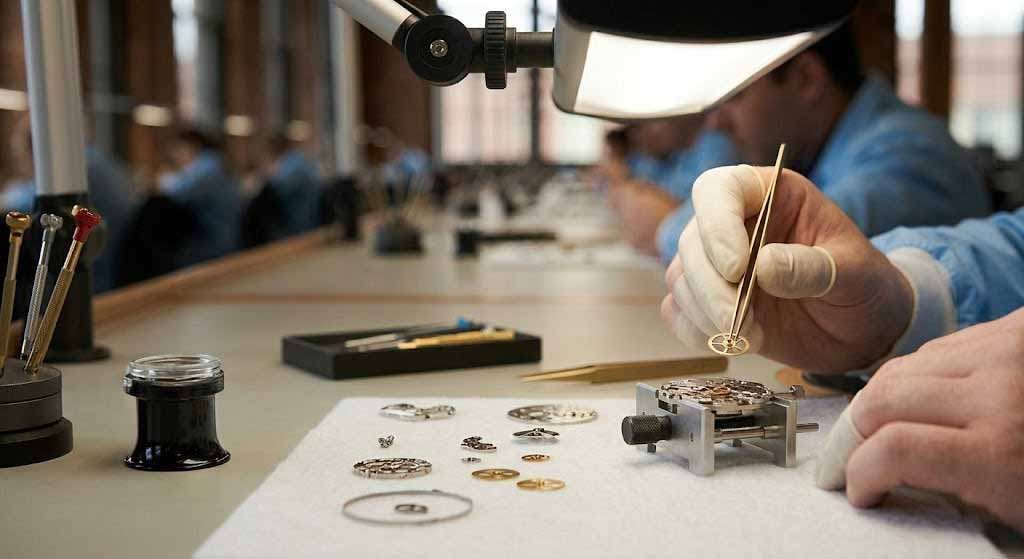
Factory tours at the Argonaut Building have been offered through the Detroit Historical Society and through Shinola directly over the years. Tours are small, regularly sold out, and focused on giving visitors a genuine floor-level view of how the watches are made. You get suited up before entering the assembly area — clean room protocol, to prevent contamination of the mechanical components.
What you see on the assembly floor is skilled hand work. Technicians at individual stations handle the tiny components of a watch movement — mainsprings, gears, balance wheels, jewels — and fit them together with precision tools. Each movement contains between 40 and 100 individual pieces. The assembly requires trained hands and real concentration. It is not a spectator sport. The focus is visible.
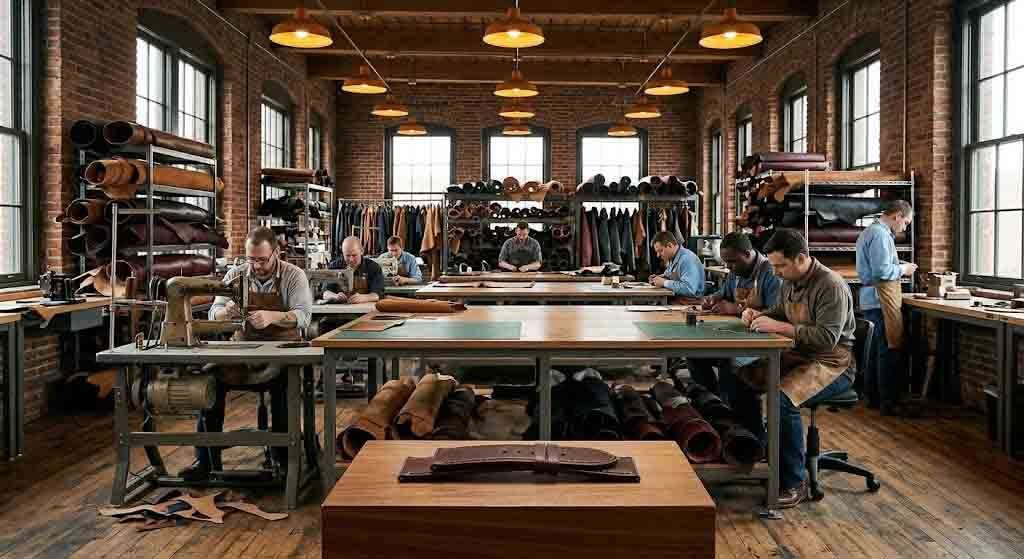
The leather studio is the surprise. Shinola makes the vast majority of its leather goods — watch straps, wallets, bags, accessories — inside the Detroit facility. A team of about 30 artisans works with sourced hides, cutting and stitching and finishing by hand. The smell of the leather room is, by all accounts, as good as you would expect. A master craftsman trains the team in the skills required, and a separate R&D section allows for exploration of new designs. It is quiet, focused work — the kind that shows up in the finished product if you’re paying attention.
The Assembled in America Distinction
Here is where the story requires precision. Shinola does not manufacture its watch movements. The movements — the mechanical heart of the timepiece, the component that keeps time — are sourced from Ronda AG, a Swiss manufacturer that is a partial owner of the company. Each movement kit arrives from Switzerland and is assembled in Detroit.
This distinction matters, and Shinola’s history with it matters too. When the brand launched its “Where American is Made” and “Built in Detroit” marketing campaigns, the Federal Trade Commission investigated. In 2016, the FTC found that certain Shinola watches consisted entirely of foreign parts, and that the “built” claim was functionally equivalent to a “made in USA” claim under federal standards. The FTC’s requirement is that “all or virtually all” of a product’s significant parts and processing be of U.S. origin. Shinola’s watches didn’t meet that standard.
The company was required to change its labeling. The back of Shinola watches now reads “Built in Detroit” with the addition of “Swiss and Imported Parts” below. Founder Tom Kartsotis pushed back on the FTC standard at the time, arguing that the requirement was “almost unattainable” given that many components and raw materials simply aren’t produced in the U.S. at any scale. He was not entirely wrong about the complexity. The same watch movement components that come from Switzerland also incorporate parts from China and Thailand. The global supply chain for precision components doesn’t have a clean on/off switch at the American border.
What Shinola does in Detroit is real: design, final assembly, testing, leather production, strap manufacturing, quality control. They have trained a workforce in skills that were largely absent from American manufacturing. That is not nothing. But the “assembled in USA” distinction and the “made in USA” distinction are genuinely different things, and understanding the difference is part of what a factory tour teaches you that a marketing campaign won’t.
The Detroit Employment Question
The more defensible part of Shinola’s American story is the employment argument. When Kartsotis said the company was a “job creation vehicle and not a ‘Made in America’ play,” he was articulating something real. Detroit in 2011 had an unemployment rate that would have been unthinkable in most American cities. Building a skilled manufacturing workforce there — training people in precision watchmaking, leatherwork, design — was a concrete contribution to an economy that needed it.
The approximately 80 watchmakers in the department, many of whom have been with the company since the beginning, have been trained and promoted from within. The leather team has developed genuine craft skills. Over a decade in, the workforce reflects the kind of institutional knowledge that takes years to build and that disappears quickly when manufacturing leaves a community.
President Obama singled out Shinola during its early years as an example of the kind of domestic manufacturing investment the country needed. The 400-person operation that exists today, in a city that was filing for bankruptcy when the first watch shipped, represents a tangible outcome. Whether that justifies the price premium on a quartz watch assembled with Swiss parts is a question each buyer has to answer for themselves.
After the Tour: What to Know Before You Buy
Shinola’s watch lineup runs from a few hundred dollars to considerably more for their mechanical models. The most common movements are Ronda quartz calibers — reliable, accurate, Swiss-made, and about as exciting mechanically as a Honda Civic. Which is to say: they work, they’ll keep working, and they don’t require servicing every three years. If you want to geek out on mechanical complications, Shinola isn’t your brand. If you want a clean American aesthetic, a well-made dial, and a leather strap that was cut and stitched by hand in Detroit, they deliver on that.
The leather goods are where Shinola’s actual manufacturing story is strongest. Wallets, bags, belts, watch straps — largely cut, stitched, and finished in the Detroit facility, with sourced leathers that are handled by a team that knows the material. A Shinola leather strap costs more than a comparable imported strap, and it’s made by someone who trained for the job. That is a real distinction.
The factory is at 441 West Canfield Street in Detroit, Michigan, housed in the Argonaut Building. Tours through the Detroit Historical Society are the most reliable way to get access to the watch floor specifically. Check detroithistorical.org for availability — they fill up fast, often months in advance.
For a parallel conversation about what it actually means to make something by hand in America — the labor, the materials sourcing, the real distinction between assembled and built — my piece on how to read a leather label covers the terminology that the marketing departments of most brands prefer you don’t know. And for context on the broader American made goods landscape, 15 American Leather Goods Makers You Should Know About in 2026 covers who’s doing it well and at what price point.
Shinola opened its doors because transparency is the brand story. The factory tour delivers on that. You leave knowing exactly what you’re buying, which is more than most brands offer.
Sources
- Shinola About Page
- aBlogtoWatch: “Shinola Celebrates 10th Anniversary: Watches Built in Detroit”
- Truth in Advertising: “Revisiting Shinola’s Made in USA Claims Three Years After FTC Inquiry”
- Detroit News: “FTC: Shinola Not U.S.-Made With Too Many Overseas Parts”
- Quartz: “Shinola’s Founder Shows How Contradictory the FTC’s ‘Made in the USA’ Regulations Are”
- Wristwatch Review: “Visiting Shinola in Detroit”
- Modern Retail: “How Shinola is Emphasizing Its American Design and Manufacturing Roots”
- Business of Fashion: “Shinola’s Message to Swiss Watchmakers: Come to Detroit”
- Detroit Historical Society — Shinola Factory Tour Listings