That is not a complaint. The two a.m. steak-and-eggs is one of civilization’s finer achievements. But it is worth sitting down at the counter of the oldest surviving Norms — on La Cienega Boulevard in West Hollywood, opened in 1957, declared Los Angeles Historic-Cultural Monument number 1090 in 2015 — and asking a straight question: who exactly was all this optimism for?
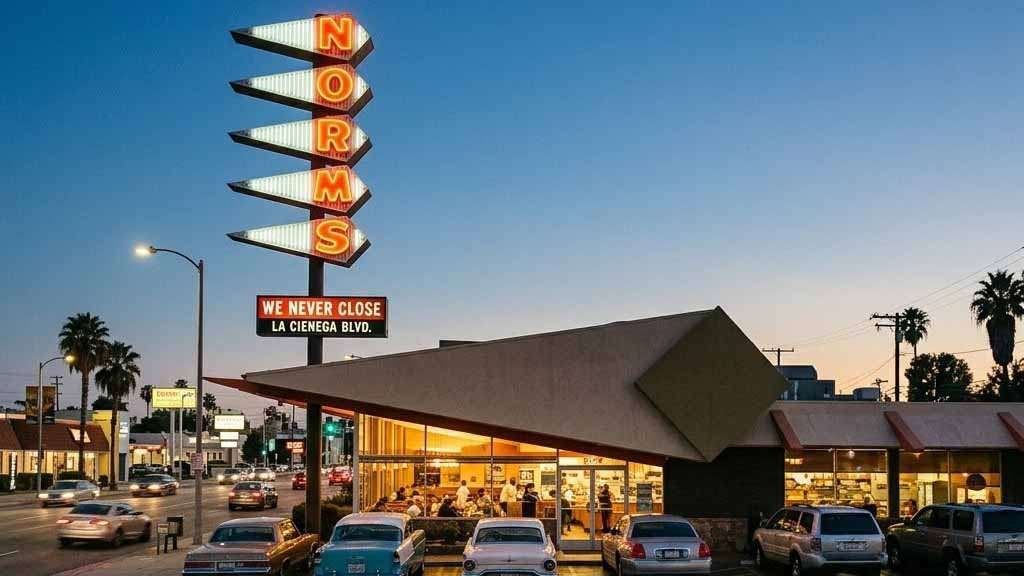
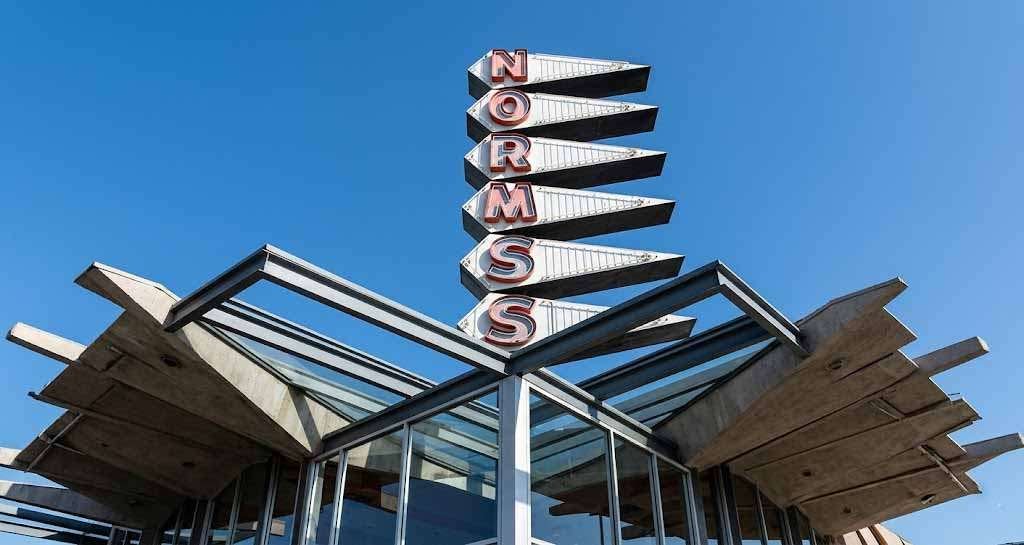
The building looks like a spaceship that decided to stay. The cantilevered roofline juts out over the sidewalk at an angle that makes no structural sense unless you consider that its primary function was not shelter but spectacle. Architects Louis Armet and Eldon Davis of the firm Armet & Davis designed the La Cienega location, and they understood something that most restaurant designers never figure out: the building is the ad. Before your foot hits the door, before you see a menu, the architecture has already told you something. At Norms, it told you that the future was affordable. That jet-age aesthetics belonged to everyone. That you didn’t need a ticket to Cape Canaveral to participate in American progress. You just needed to pull off La Cienega.
That was the promise. It was a beautiful lie, and it was told in steel, neon, and glass.
What Googie Actually Was
The name comes from a coffee shop — Googie’s, on Sunset Boulevard near Schwab’s Pharmacy — designed by architect John Lautner in 1949. The style it named was not an accident. It was a calculated response to the postwar American moment: the car as the primary unit of civilization, the suburb as its habitat, the roadside as its public square. Googie was architecture for people moving at forty miles an hour. It had to be legible at speed.
So it went big. Angular walls. Parabolic rooflines. Zigzagging geometry. Neon that could be read from a block away. Glass walls that erased the boundary between inside and outside. Starbursts. Boomerangs. Shapes borrowed from the vocabulary of aerospace because aerospace was, in the 1950s, what Americans dreamed about. The space race was not just a geopolitical contest — it was a cultural mood. Everything aspirational pointed skyward.
Norms embodied this mood and democratized it. The chain had started in 1949 when Norm Roybark, a used-car salesman with an instinct for volume, opened a small spot near Sunset and Vine. Within a decade he was building Googie temples to the working-class appetite. The La Cienega location — with its sawtooth pennant sign, its cantilevered roofline, its bold glass and steel facade — became the flagship of this enterprise. Armet and Davis allegedly sketched the iconic pennant sign on a napkin. The design philosophy was serious even when the subject was a plate of eggs.
This is the contradiction at the heart of Googie architecture. It applied the formal vocabulary of high modernism — the same language used for airports, corporate towers, world’s fair pavilions — to a place where you could get a patty melt for under two dollars. It was democratizing in its aesthetics. Whether it was democratizing in anything else is a different question.
The Class Gap in the Cantilevered Roof
Here is what the architecture did not show you: the labor structure that kept the lights on.
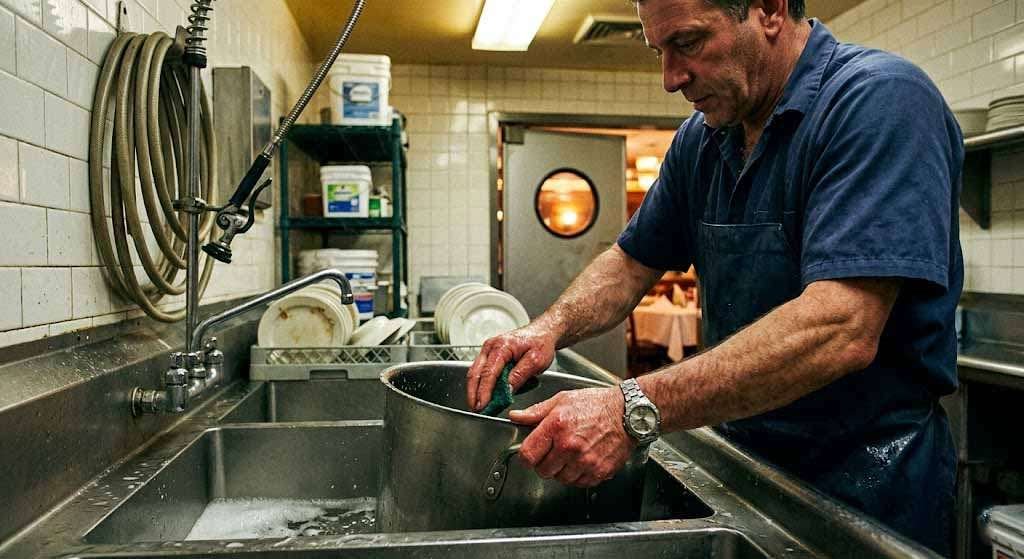
Restaurant work in postwar Los Angeles was, and remained, some of the lowest-compensated work in the American economy. The waitress who refilled your coffee at Norms was working for tips and a base wage that would not have been impressive in any decade. The line cook behind the pass — flipping eggs, working a grill that threw heat like a furnace in July — was doing physical work of the kind that grinds bodies down over a career. The dishwasher in the back, invisible behind the kitchen wall, was making the economics of a ninety-nine-cent breakfast possible by absorbing costs that never appeared on any menu.
The building said: we are all here together, sharing in the bounty of the American future. The pay stub said something different.
This is not a point unique to Norms. It is a point about the entire aesthetic project of mid-century American commercial architecture. Googie promised a classless visual experience. You drove your Chevrolet to the same neon-lit cathedral as the guy in the Cadillac. The parking lot was democratic. The counter was democratic. The stainless steel and the plate glass and the Space Age signage did not discriminate. But the economy behind the building did, and the building was beautiful enough that most people never had to look at the economy.
Edward Ruscha understood this. In 1964, he painted Norms La Cienega on Fire — the building rendered in his trademark deadpan graphic style, the name blazing in the foreground, the whole thing suggesting simultaneously monument and joke. The J. Paul Getty Museum owns the painting now. That detail has a certain poetry to it: the document of a working-class diner consumed by one of the wealthiest institutions in American culture.
What Armet & Davis Actually Built
Separate the politics from the craft for a moment and the craft is stunning.
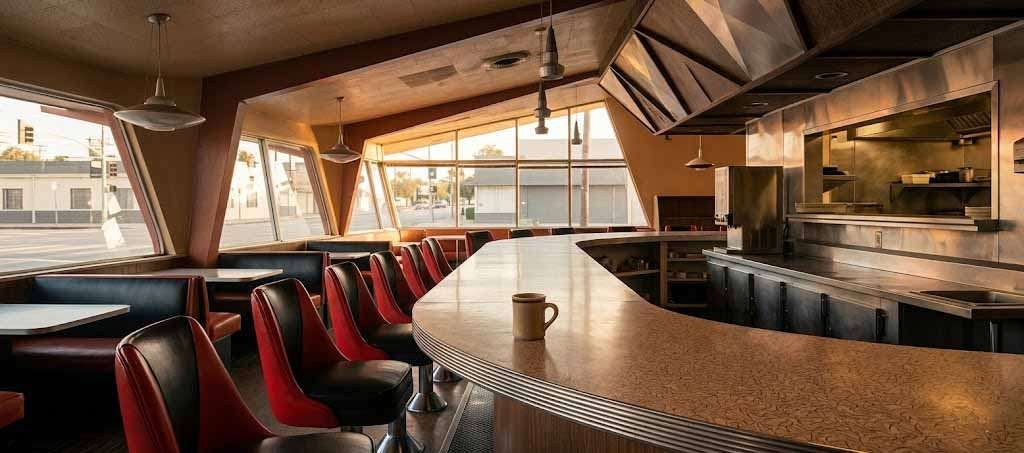
The La Cienega Norms is, according to the L.A. Conservancy, among the most imaginative Googie designs in the nation. The roofline does not merely overhang — it cantilevers dramatically, seemingly defying gravity, an architectural trick that announces confidence in the material and the engineer. The large zigzagging windows break the wall plane in a way that creates movement even when the building is still. Inside, bucket seats and a slanted ceiling continued the visual argument. The sawtooth pennant sign — reportedly sketched on a napkin by Roybark and Davis together — became one of the most recognizable pieces of commercial signage in Los Angeles history.
Armet & Davis were not minor figures. They were the primary architects of the California coffee shop form, the people who took a functional building type — a roadside feeding station — and gave it a formal language. They worked in an era when the distinction between high architecture and commercial architecture was taken seriously by people who wanted that distinction maintained, and they ignored it. A Norms was architecture. A Bob’s Big Boy was architecture. The gas station on the corner was architecture. Everything was architecture, and everything had to communicate.
This was, in its way, a more democratic position than anything the modernist high-priests were taking in their glass towers downtown.
The Monument Problem
In 2015, the City of Los Angeles designated the La Cienega Norms a Historic-Cultural Monument. The designation came after the real estate under the building was sold to new owners, triggering preservation concerns. Colonna, the then-president of Norms, reassured everyone that the restaurant would stay. The building would be protected. The cantilevered roof would cantilever on.
There is something genuinely gratifying about this. There is also something worth examining.
When a city puts a monument designation on a working restaurant, it is doing two things at once. It is acknowledging that the building matters — which, in this case, it does, architecturally and culturally. And it is beginning the process of abstracting the building from its function. The monument is preserved. But monuments are for looking at. Working diners are for feeding people. These are not always the same project.
The Norms chain, it should be noted, was sold by the Roybark family in December 2014 to an investment firm, CapitalSpring — ending three generations of family ownership. Mike Colonna, the new president, described the customer base with the practiced confidence of a man who has taken a marketing survey: “blue collar workers, white collar workers with ties getting a quick lunch, ethnic diversity at every table.” The Googie architecture, he told Los Angeles magazine, was “retro cool” and “a big part of the brand.” He is right on both counts. What he is describing, without putting it in these terms, is the conversion of a class-specific working institution into a lifestyle proposition.
What a Two A.M. Steak and Eggs Costs
This is not a eulogy. Norms is still open. The La Cienega location still serves food twenty-four hours a day. The pennant sign still washes and flashes — one of the only remaining signs in the chain with that original feature. People still sit at the counter. The steak and eggs is still on the menu.
But the distance between the architectural promise and the economic reality was always the most interesting thing about the building, and that distance has not closed. If anything, in a Los Angeles where a dishwasher cannot afford to live within an hour of work, the cantilevered optimism of the roofline reads differently than it did in 1957.
The Googie movement peaked and faded. By the 1970s and 1980s it was unfashionable — too garish, too naive, too much of the era that produced it. It has had a renaissance since, driven partly by nostalgia and partly by genuine appreciation for what it achieved: the application of serious architectural thought to buildings that ordinary people actually used every day. I have more respect for that project than for any number of glass towers that nobody but a security guard ever enters.
The working-class diner deserves good architecture. That is a statement I believe without reservation. The Norms on La Cienega is, on the level of the building, a great piece of American architecture. It belongs in any serious account of what Los Angeles produced in the twentieth century.
The guy who washed the dishes there for thirty years also belongs in that account. His name does not appear on the Historic-Cultural Monument plaque.
That gap — between the roofline and the pay stub, between the neon dream and the back-of-house reality — is not unique to Norms. It is the structural condition of the American diner. I have spent twenty-five years inside that condition myself, at Heritage Diner in Mount Sinai. The coffee-shop form is one of the few remaining institutions in this country that genuinely serves everyone. That is worth honoring. It is also worth seeing clearly.
The building was designed to make you feel like the future belonged to you. Sometimes it almost did.
You Might Also Like:
- The Ride Down 25A: A Historic Motorcycle Journey Along Long Island’s North Shore to The Heritage Diner
- The Flour Beneath the Bread: What Goes Into a Proper Sourdough Loaf
- Deserve’s Got Nothing to Do with It: Why Unforgiven Is the Greatest American Western Ever Made
Sources:
- LA Conservancy — Norms La Cienega: https://www.laconservancy.org/learn/historic-places/norms-la-cienega/
- Wikipedia — Norms Restaurants: https://en.wikipedia.org/wiki/Norms_Restaurants
- Norms Official History: https://norms.com/our-story/
- LAist — History of Googie Architecture: https://laist.com/shows/take-two/the-history-behind-las-exuberant-googie-architecture
- Time Out Los Angeles — Googie Architecture: https://www.timeout.com/los-angeles/things-to-do/googie-los-angeles