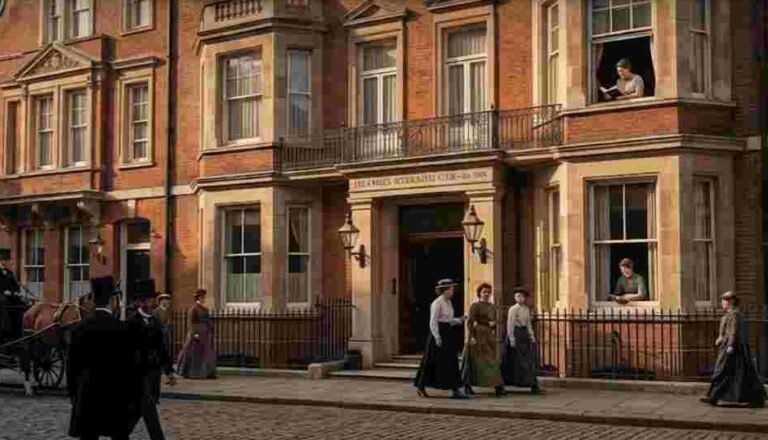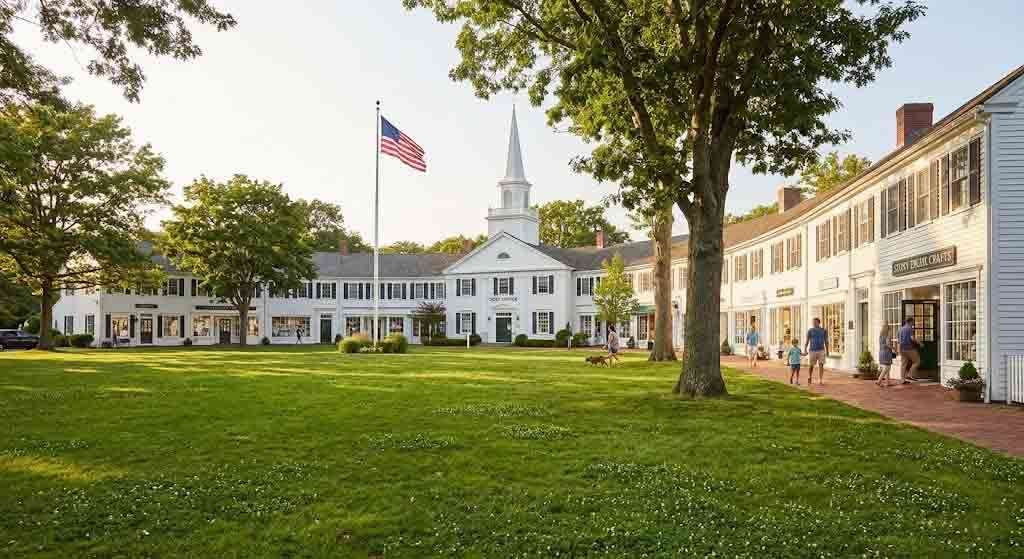
During the Great Depression, while most of Long Island was trying to hold onto what it had, Ward Melville was buying it. Not quietly, not reluctantly — he was buying an entire village. The existing businesses, the buildings they occupied, the roads that connected them, the dirt underneath all of it. Then he relocated thirty-five structures, rerouted the roads, moved a million cubic yards of dirt, opened a vista to the harbor, and rebuilt the whole thing in a Federal colonial style that had never actually existed there. He called it a “living Williamsburg.” The American Institute of Architects was so impressed they held their annual meetings there for years.
The question that rarely gets asked about Stony Brook Village Center — now a beloved North Shore landmark with 35 shops, a mechanical eagle, and a genuine charm that is difficult to dispute — is a simple one: who gave Ward Melville the right to do that?
The Shoe Business Behind the Dream
Ward Melville was not a random rich man with a taste for colonial architecture. He was the CEO of the Melville Corporation, successor to the Melville Shoe Corporation, and by the time he turned his attention to Stony Brook in the late 1930s, the company was on its way to becoming the third-largest retailer in the United States. Its subsidiaries would eventually include CVS Drugs, Marshalls, and KB Toys. He had resources that were not symbolic — they were structural.
The family’s attachment to Stony Brook had started by accident. Frank and Jennie Melville, Ward’s parents, had intended to summer in the Hamptons but boarded the wrong train and ended up in Stony Brook. They loved it, stayed, and began buying property and involving themselves in civic life. Jennie Melville eventually purchased much of the land that the Village Center now occupies. When she died in the summer of 1939, Ward took up her project and radicalized it.
His stated rationale was preservation. The village was struggling under the weight of the Depression, its buildings aging, its businesses marginal. Ward saw — or said he saw — a historic community worth saving. What he built was something more specific than that: a vision of what a colonial New England village should look like, imposed on a place that had its own history, its own buildings, and its own arrangements.
The Night at the Three Village Inn
On January 19, 1940, Ward Melville hosted a dinner at the Three Village Inn. He presented plans drawn up by his architect, Richard Haviland Smythe, for a crescent-shaped Village Center with connected shops organized around a Federalist-style post office — the mechanical eagle with its every-hour wing-flap that has become Stony Brook’s most recognizable feature. The existing businesses would be relocated into the new crescent. The streets would be rerouted. The harbor view would be opened up.
The community voted to approve it. As Ward Melville said to his guests that evening, “The prime reason for such a project as we are considering, is the beauty of the result.”
That sentence deserves a long look. Not preservation. Not economic development. Not community self-determination. Beauty. Ward Melville’s beauty, specifically — a beauty defined by his architect, financed by his shoe fortune, and implemented on land that his family had been acquiring for decades.
The venture proceeded at his personal expense of somewhere between $500,000 and $600,000, depending on the source — roughly $8 to $11 million in today’s terms. He relocated, demolished, or modified thirty-five buildings. He rerouted roads. He moved one million cubic yards of dirt. A two-acre Village Green was created, opening the vista to the harbor. The new Stony Brook Village Center was completed in the summer of 1941, and is now recognized as the first planned shopping center in the United States.

Philanthropy or Real Estate Flex?
The official history of Ward Melville is hagiographic and largely sincere. He deeded the Village Center to his not-for-profit, the Stony Brook Community Fund (later the Ward Melville Heritage Organization), after completion, explicitly to avoid any accusation of personal gain. He restored historic properties dating to the Revolutionary War — the Stony Brook Grist Mill, the Thompson House, the Brewster House — and deeded those too. He donated land to what became Stony Brook University. By most measures, he gave more to the North Shore than he took from it.
And yet. The thirty-five buildings he relocated or demolished contained people’s livelihoods as they existed, not as Ward Melville imagined they should look. The architectural “consistency” he imposed — the white clapboard, the bluestone walkways, the cast-iron lampposts, the Federal style applied wholesale to structures that had no such heritage — was a decision made not by the community but for it. The community voted on the plan, yes. But the plan was Melville’s. The choices were Melville’s. The aesthetics were Melville’s.
This is a pattern that appears in North Shore real estate history with some regularity: a wealthy individual with genuine civic feeling and a specific aesthetic preference uses his resources to shape a community in ways that, had he been less wealthy, would have required broad democratic process. The community benefits. The community also loses something — the organic, imperfect, owned quality of a place that developed on its own terms.
What Got Replaced
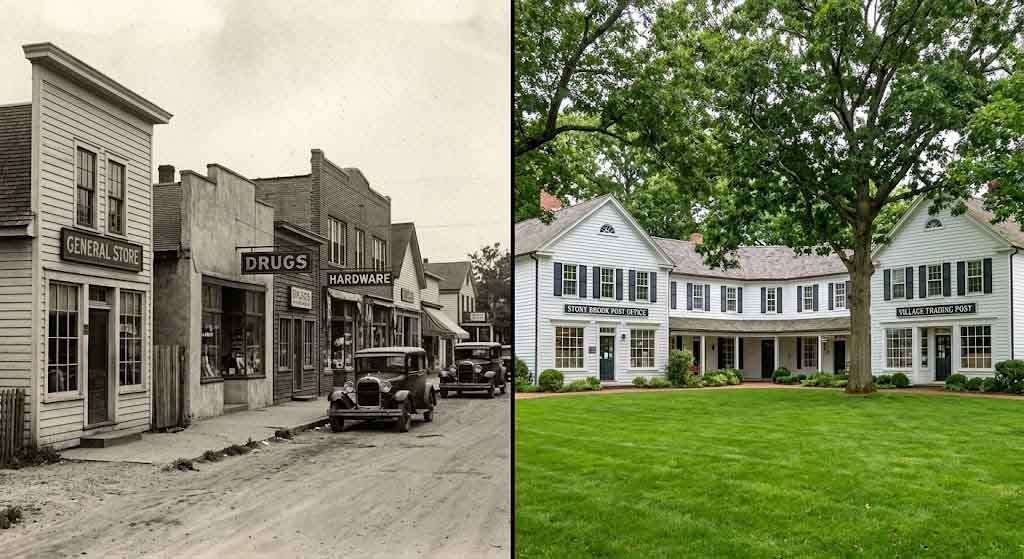
Before Melville’s renovation, Stony Brook’s commercial center was a collection of independent buildings with businesses on the ground floors and residences above — a configuration common to working communities across Long Island and New England in the early twentieth century. These were not architecturally significant, by most accounts, and many were in poor condition. The Depression had not been kind.
But they were the community’s actual built environment. The feed store and the general store and the hardware shop that occupied those buildings had histories that did not fit the Federal colonial frame. When they moved into the crescent, they moved into a costume. The Long Island Museum of American Art, History, and Carriages — another Melville beneficiary, located just off the Village Green — holds archives of the area as it existed before 1941. The contrast between what Stony Brook was and what Melville made it into is not subtle.
This is not, to be clear, an argument that the Village Center should not have been built. It is a beautiful place. On a September afternoon with the harbor visible past the Village Green and the eagle flapping on the hour, it is genuinely affecting. The Jazz Loft, the Three Village Inn, the Mill, the Museum — the cultural ecosystem Melville’s philanthropy created and sustained is real and valuable.
The question is whether beauty, imposed by private wealth on a community that voted yes but couldn’t have voted no in any meaningful sense, constitutes philanthropy or something more complicated.
The Stony Brook Model and What It Means for the Market
Ward Melville died in 1977. His wife Dorothy continued the work until her death in 1989. The Ward Melville Heritage Organization, the nonprofit that now stewards the village and its properties, operates with genuine public benefit as its mission. It maintains the Grist Mill, the wetlands preserve, the historic houses, the summer concert series. The organization that runs the Village Center today is not an extractive operation.
But the model Melville created — private wealth reshaping community aesthetics and geography in ways that the community then internalizes as its own heritage — has had successors that are less civic-minded. Planned communities, lifestyle centers, “curated” downtowns from Long Island to the Hudson Valley are full of people who learned from Ward Melville without inheriting his commitment to deeding it all back.
The North Shore real estate market today is partly priced on the charm that Melville manufactured. Buyers looking in the Three Village area are drawn, in part, by a village aesthetic that has the feel of history but the structure of real estate development. That is not a criticism of the neighborhood — it is a clarification of what they are buying.
Paola Meyer, Associate Broker at Realty Connect USA, works with buyers navigating exactly this dynamic. “The Three Villages command a premium that is partly school district, partly commute, and partly something harder to define — a sense of place that took decades and significant private investment to create,” Meyer notes. “Buyers should understand that a lot of what they’re responding to was built intentionally. That doesn’t make it less real, but it does make it worth knowing.” Browse current North Shore listings at heritagediner.com/properties/.
The Eagle Faces the Wrong Way
There is a detail about the Stony Brook Village Center that has always felt like the most honest thing about it. When the hand-carved Federal eagle was installed atop the Post Office, someone noticed that it faced the opposite direction from the eagle on a United States quarter. The carver, Friedrich Wilhelm Ringwald, had made it face left instead of right.
When this was brought to Ward Melville’s attention, he sent back two words: Leave it.
That response has been celebrated ever since as charming eccentricity. It might also be read as the instinct of a man who understood, somewhere underneath all the civic virtue, that what he had built was his own thing. A version of a place, constructed at his expense, facing the direction he chose. A “living Williamsburg” — but Williamsburg, it bears noting, was also a reconstruction, paid for by John D. Rockefeller Jr., according to his vision of what colonial Virginia should have looked like.
The eagle faces the wrong way. The beauty of the result is real. Both things are true, and the gap between them is worth sitting with the next time you walk down the crescent on a Sunday afternoon.
You Might Also Like: – The 1699 Stony Brook Grist Mill: Where Water, Grain, and Commerce Built Long Island’s North Shore – The Culper Ring of Setauket: How a Village on Long Island’s North Shore Outmaneuvered the British Empire – The Craftsman Home Revival on Long Island: Architecture, History, and Market Value
Sources: – Ward Melville Heritage Organization, About Us: wmho.org/about-ward-melville-heritage-foundation – Stony Brook Village Center, WMHO: wmho.org/attractions/stony-brook-village-center – Stony Brook Village Center, Wikipedia: en.wikipedia.org/wiki/Stony_Brook_Village_Center – Stony Brook Village Center Audio Tour / Post Office history: stonybrookvillage.com – TBR News Media, WMHO 80th Anniversary Feature: tbrnewsmedia.com – Long Island Museum of American Art, History, and Carriages: longislandmuseum.org
Tags: real estate, north shore, history, long island