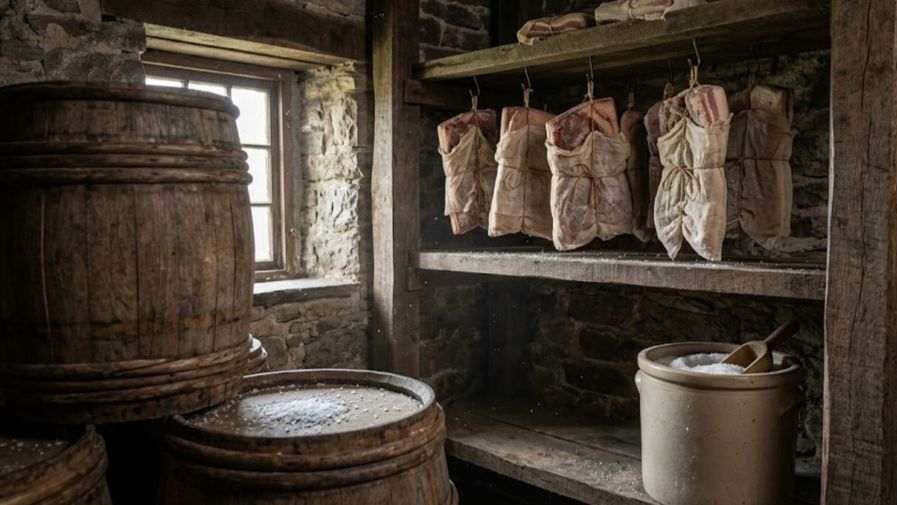
Before refrigeration, whaling ships leaving Greenport didn’t carry fresh anything. They carried cured meat, salt fish, and hardtack. The voyages ran three to four years on the open ocean. You solved the food problem before you left the harbor, or you solved it badly somewhere in the South Pacific.
Someone built the smokehouses. Someone knew the brine ratios. That knowledge didn’t vanish — it migrated into North Fork farmhouse kitchens and nobody wrote it down properly.
Greenport at Peak Whaling
Greenport was a whaling port of genuine consequence. First settled in 1640 as part of Southold, the village developed into a major maritime hub from roughly 1795 through 1860, with 24 whaling ships undertaking 103 documented voyages. By the 1850s, Greenport ranked 17th among American whaling ports — a significant position in an industry that, at its 1847 peak, produced 672,971 barrels of whale oil from Long Island ports alone. The profits built up the town fast: a population of around 500 in 1840 grew to over 1,800 by 1870. The First National Bank of Greenport was chartered in 1864 — the first such bank on Long Island.
The Long Island Rail Road had extended its line to Greenport in 1844, enabling efficient transport of whale products to New York City markets. The village had shipyards operated by families like the Mitchells and Hiram Bishop, constructing whalers, schooners, steamers, and oyster sloops. There were hotels, boarding houses, taverns, fish factories. The waterfront at peak was a working industrial space.
What the historical record is less explicit about — but what the logic of provisioning makes inevitable — is the shore-side infrastructure for preparing food for those voyages.
The Provisioning Problem
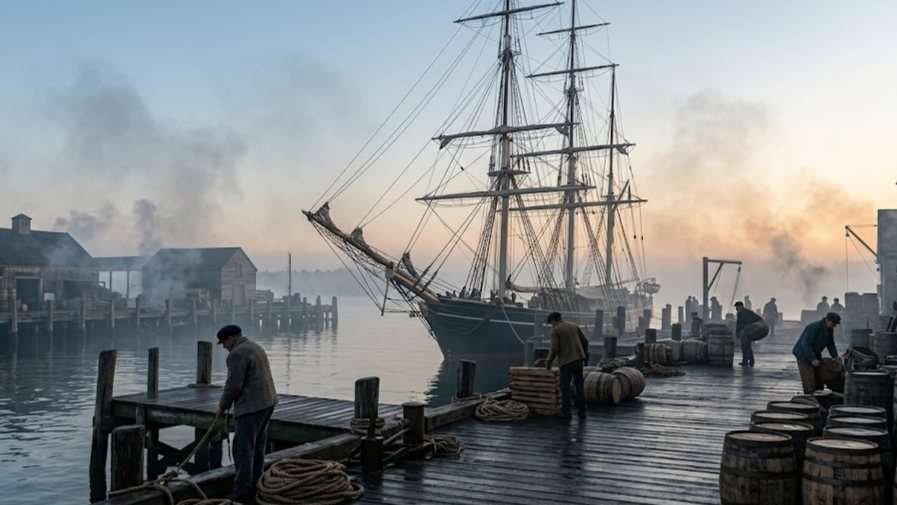
The New Bedford Whaling Museum’s research on shipboard life makes the dietary picture plain: whalers carried salted beef (known as “salt horse”), salted pork, hard biscuit, beans, rice, molasses. No fresh meat after the first days out of port. The largest vessels might carry livestock for the captain’s table — killed and consumed early. Everything else was salt-preserved or dried.
The provisioning for a three-year whaling voyage represented a significant logistical undertaking, and the work happened ashore. Ships needed hundreds of pounds of salt-cured pork and beef prepared before departure. Salt was bought in bulk, the dry-rubbing and brining done in facilities near the waterfront. Smoking was an alternative and complementary preservation method — harder to transport than salt meat but more palatable over long periods.
Greenport’s waterfront supported multiple wharves and adjacent commercial operations. The Suffolk County historical record shows the village in its 1850s prime had shipyards, several hotels and inns, fish factories, and an extensive network of trades supporting maritime operations. “Port chandlery” — the supplying of ships — was a substantial business; the Greenport walking tour records note that William D. Corey of Webb and Corey operated “a major port chandlery.”
Manifest after manifest from Long Island whaling ships shows casks of salt meat, barrels of pork, dried goods in quantity. Someone in Greenport was producing or sourcing those casks in volume. The infrastructure for commercial-scale curing would have been a practical necessity.
What the Record Doesn’t Say
Here’s where intellectual honesty requires a flag: documented physical evidence of a specific commercial smokehouse structure in Greenport during the whaling peak is not the same as proven existence. The village chronologies note commercial operations along the waterfront but don’t itemize every outbuilding or processing facility from the 1820s through 1860s. Property records from that era exist at the Suffolk County Clerk’s office and in historical society collections, but a systematic survey of which structures served as smokehouses versus general warehousing hasn’t been published in accessible sources.
What can be said confidently: the provisioning activity happened at scale. It was economically central. Shore-side curing and smoking operations were standard practice at major American whaling ports including New Bedford and Nantucket. The absence of a surviving detailed Greenport record doesn’t mean the operations didn’t exist — it means the documentation, if it survives, is in archives that haven’t been synthesized for public consumption.
The Cold Spring Harbor Whaling Museum holds ship manifests and provisioning records from Long Island whaling vessels. The Suffolk County Historical Society’s collections hold additional documentary evidence of waterfront commerce. The East End Seaport Museum in Greenport maintains records of the maritime era. A researcher with access to those primary sources and time to work through them would likely turn up more than what’s been published so far.
The Knowledge Migration
The more interesting question — and harder to answer — is whether any of the curing knowledge those operations represented survived into the twentieth century.
The North Fork was, until relatively recently, agricultural and maritime working land. Farm families in Southold, Mattituck, Cutchogue, and East Marion preserved food as a matter of practical necessity well into the mid-twentieth century. Cellar storage, root vegetables, pickled goods, smoked meats — these were functioning household technologies, not heritage affectations. The farmhouse food practices of the East End were descended from European immigrant and indigenous traditions going back centuries, and they were still in use in working kitchens within living memory of people now elderly on the North Fork.
The Peconic Estuary’s own food history — which I wrote about in the context of eel spearing and smoked eel as a lost winter survival food — suggests a continuous tradition of smoking and curing fish that remained alive well into the twentieth century. If eel-smoking knowledge persisted, the parallel tradition for pork and beef curing almost certainly did as well, carried forward in the same farmhouse contexts.
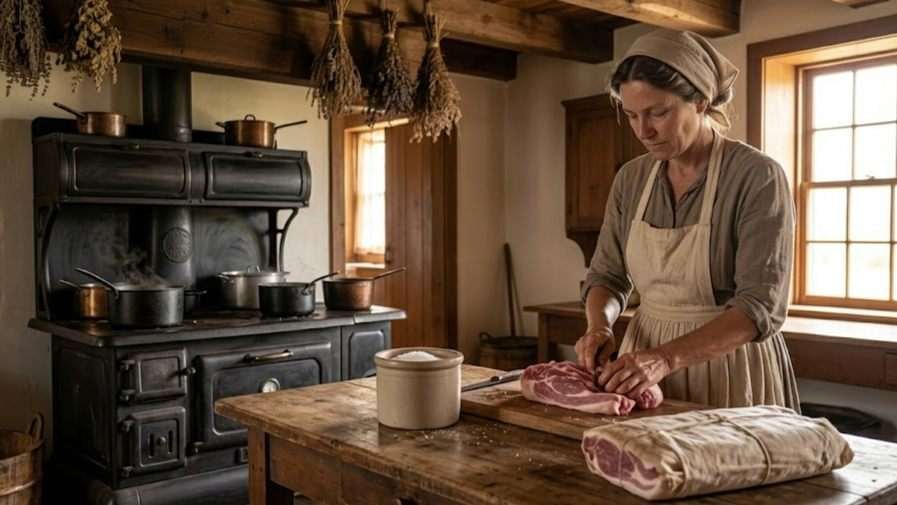
The brine ratios — the proportions of salt, saltpeter, sugar, and spice that made a cured product shelf-stable — were transmitted the same way all kitchen knowledge was transmitted before the standardization of recipe publishing: orally, demonstrated, adjusted by season and available materials. That knowledge doesn’t appear in any archive. It was in someone’s hands and head.
Why the Food World Ignores This
The culinary archaeology of the North Fork is systematically underdocumented. The region has enormous contemporary visibility for its wine and hospitality industry, which has little institutional reason to look backward at shore-side saltmeat provisioning from 1835. The scholarship on whaling history focuses, reasonably, on the economics, the labor practices, the cultural dimensions of the industry — not on what was packed into barrels before the ships left the dock.
Food history on the East End skews toward what’s appetizing to tell: clam chowder at the life-saving stations, Shinnecock corn mush, Depression-era baking without butter. These are real and worth recovering. But the industrial-scale curing operation that made Greenport’s whaling economy function is harder to romanticize. It was dirty, salt-heavy, labor-intensive work. The men and women who did it are not named in any document I’ve found.
That’s the culinary archaeology angle nobody pursues because it’s not glamorous. The smokehouses, if they existed as dedicated structures — and the logic of the provisioning industry strongly suggests they did — were not architectural landmarks. They were working buildings, functional and forgettable. When the whaling industry collapsed in the 1860s with depleted whale stocks, petroleum alternatives, and Civil War disruption, those buildings were repurposed or demolished. The knowledge they housed went with the people who carried it.
Some of it didn’t entirely disappear. It became the home-curing practice in farmhouse kitchens that survived until refrigeration made it optional. It’s there, in the margins of the twentieth century’s North Fork, if someone is willing to go looking through the right records and talk to the right people before that generation is entirely gone.
You Might Also Like
- Eel Spearing and Smoked Eel: A Lost Winter Survival Food of the Peconic Estuary
- The Forgotten Montauk Surfman’s Chowder: Cooking with Seawater at the 1800s Life-Saving Stations
- The Raid on Fort St. George: How Eighty Men, Eight Whaleboats, and One Audacious Commander Changed the War on Long Island
Sources
- Grokipedia, Greenport, Suffolk County, New York
- Suffolk Times Archives, Greenport at 175: A Look at Business Here
- Suffolk Times, North Fork History Project: An Epic Saga of East End Whaling
- Jhonatan Bonilla, Long Island and the Whaling Industry
- Greenport Historic District Walking Tour, greenportwalkingtour.org
- New Bedford Whaling Museum, Life Aboard
- National Maritime Museum Cornwall, A Ship’s Meat Cask
- Cold Spring Harbor Whaling Museum: cshwhalingmuseum.org
- East End Seaport Museum: eastendseaport.org