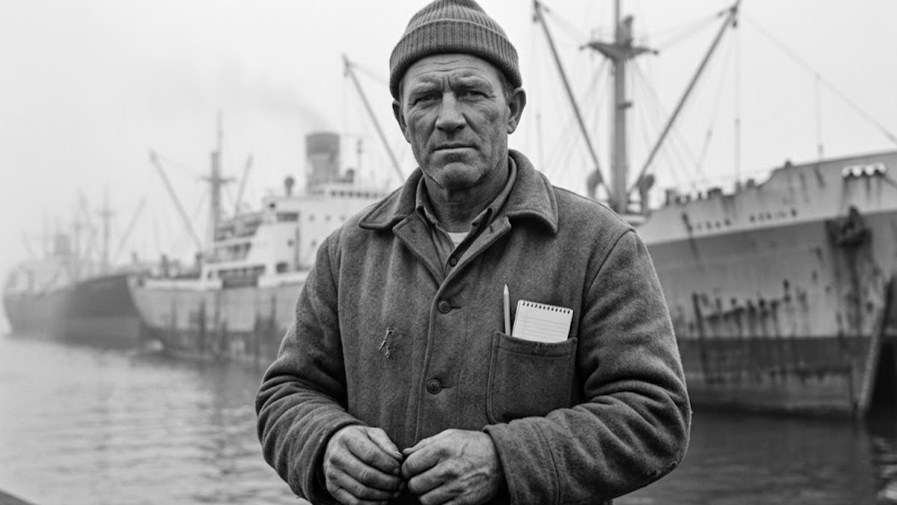
Eric Hoffer never owned a desk. He wrote The True Believer on scraps of paper during breaks on the San Francisco docks, in railroad yards waiting for freights, in farm fields during lunch. He once said: “My writing is done in railroad yards while waiting for a freight, in the fields while waiting for a truck, and at noon after lunch.” He mailed the manuscript to Harper & Brothers in a brown paper parcel without making a copy first. Nobody at the publishing house had seen him. They sent Norman Thomas — the former Socialist presidential candidate — to verify that this longshoreman existed and was what he claimed to be.
He existed. He was what he claimed to be.
And he would have understood the diner immediately — the counter as the great leveler, the place where the man with no fixed address and the man who owns the building eat the same eggs.
What Hoffer Actually Said
Published in March 1951, The True Believer: Thoughts on the Nature of Mass Movements made Hoffer famous almost overnight. President Eisenhower cited it at one of the earliest televised press conferences. Arthur Schlesinger Jr. called it “a brilliant and original inquiry.” The New York Times called Hoffer a genius capable of “amazing insights into history.”
His central thesis was this: mass movements — whether religious, political, or nationalist — are fueled not by the most desperate people but by the frustrated poor: people who have enough to want more, enough self-awareness to feel the gap between what they have and what they believe they deserve. In §113 of the book, Hoffer summarized his argument in a single sentence: “A movement is pioneered by men of words, materialized by fanatics and consolidated by men of actions.” The frustrated poor are the fuel. The true believer — the fanatic — is the match.
But what rarely gets discussed is the corollary Hoffer embeds in that analysis. The truly desperate — the abjectly poor — rarely join mass movements at all. They’re too busy surviving. They don’t have the psychic surplus required for ideological commitment. They eat, they work, they sleep. The diner is their institution, not the rally.
The Regular’s Stool
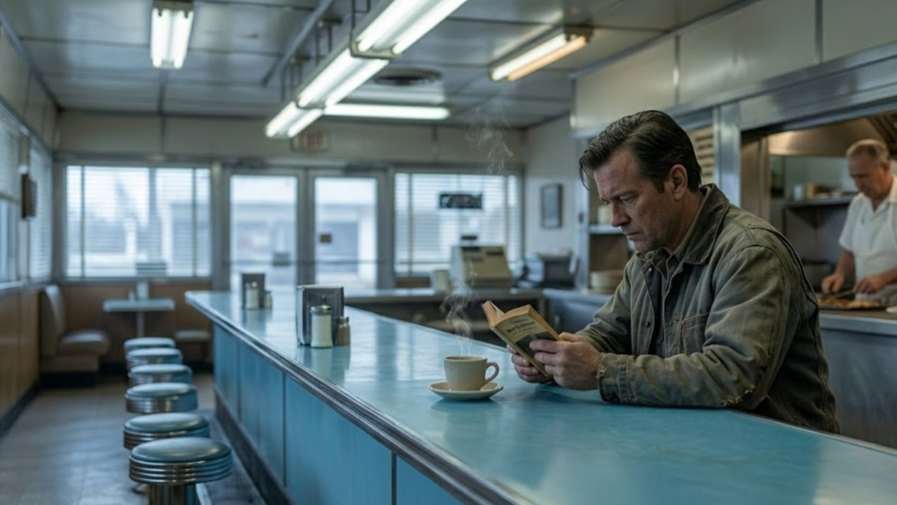
Hoffer argued that ritual and routine are stabilizing forces for people without institutional belonging. The man who has no guild, no church, no strong family network, no organizational anchor — he finds his substitute in the repeatable. The same route to work. The same bar stool. The same order, placed without looking at the menu.
The diner counter is exactly this. It’s not food service. It’s social infrastructure for people who don’t have a lot of other infrastructure. The regular doesn’t come for the eggs. He comes because the waitress already knows what he wants, because nobody asks him questions he can’t answer, because the seat is his in the same way that anything not legally owned can still be somebody’s.
Hoffer understood the psychology of this without ever theorizing the diner specifically. In Working and Thinking on the Waterfront (1969), his diary of a year on the San Francisco docks, he described the longshoremen around him as men who worked extraordinarily hard and wanted, in the hours they weren’t working, to be left alone with uncomplicated comforts. Not elevated. Not saved. Left alone with coffee and a newspaper and a clear sense of what the day was going to be.
I’ve thought about this a lot standing behind a counter myself — the people who come in at 6:15 every Tuesday and Thursday, order the same thing, sit in the same seat, are gone in forty minutes. They are not, in Hoffer’s terms, true believers. They are not frustrated idealists seeking a cause to absorb their thwarted ambitions. They’re people who have found something that works and come back to it. The diner gives them that. Uncomplicated. Predictable. Theirs.
Long Island’s Industrial Working Class
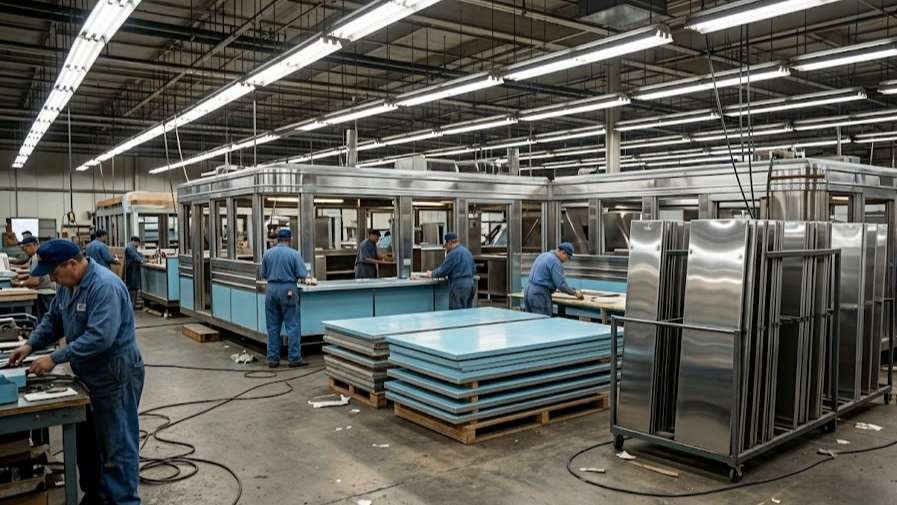
Hoffer’s framework maps most precisely onto a specific demographic history. On Long Island in the 1950s and 1960s, the defense industry workforce was enormous. Grumman Aircraft in Bethpage employed 22,000 people by 1970 — the largest single employer in Nassau County. Republic Aviation in Farmingdale employed tens of thousands more. These were machinists, assembly line workers, sheet metal fabricators. Men who worked shifts and ate meals at non-standard hours.
The diners of Nassau County — and the ones that followed the suburban sprawl into Suffolk — existed largely for this workforce. Early, late, anytime. No reservations. No dress code. No minimum. You sat, you ordered, you ate, you left. The counter was specifically designed for people eating alone or with one other person, people without time to spare, people who wanted the transaction completed efficiently so they could get back to the thing they’d come from or the thing they were going back to.
This is the counter stool economy Hoffer, without knowing it, described: the working-class institution that is not church, not union hall, not tavern, but that serves some of the same functions as all three — community, routine, the comfortable fiction that someone knows who you are.
The New York Times reported in 1951 that there were 6,000 diners across the United States, serving 2.4 million customers daily. That’s a significant portion of the working population. Not one of those customers went to a diner to join a movement. They went because the alternative was eating alone somewhere worse.
The Substitute for Self
Hoffer wrote in The True Believer: “Faith in a holy cause is to a considerable extent a substitute for the lost faith in ourselves.” That’s his thesis sentence, and it’s arresting. But the diner doesn’t ask for faith. The diner asks for a menu order.
That’s the thing Hoffer’s framework illuminates by contrast. The diner is the institution you go to when you’re not looking for a cause. It doesn’t recruit. It doesn’t transform. It doesn’t demand loyalty beyond the loyalty of returning. It accommodates everyone from the Grumman machinist to the railroad brakeman to the philosophy student who dropped out of high school and is reading Nietzsche at the counter on his break. That last one is less hypothetical than it sounds — I’ve been that person at a counter, though not in that decade.
The diner, in this reading, is the anti-mass-movement. It is the place working people go precisely when they have no interest in being organized into anything larger than themselves. The eggs are good. The coffee is hot. Nobody asks what you believe.
What Eisenhower’s Favorite Book Gets Right About the Counter
The irony of Hoffer’s celebrity is worth noting. A longshoreman — a man who never had a phone, lived alone in a small apartment overlooking the San Francisco docks, and was suspicious of institutions — became the favorite author of a sitting American president. Eisenhower cited The True Believer as essential reading. LBJ consulted Hoffer at the White House. CBS correspondent Eric Sevareid called him “a national resource.”
None of this changed Hoffer. He kept working the docks until mandatory retirement at sixty-five. He didn’t take his fame to a lecture tour. He kept writing in notebooks, kept showing up to work, kept eating wherever the docks put him near.
He was, in that sense, exactly the kind of person who belongs at a diner counter — not the person who joins movements, but the person who does the work, eats the meal, and goes home to read.
Hoffer died in 1983 in his small San Francisco apartment, overlooking the docks where he had worked for twenty-five years. He left behind nine books, more than 100 notebooks, and no prescription for how to live. He would have been suspicious of anyone who tried to turn his work into one.
The counter is still there. The eggs are still the same. Nobody has put a plaque on the stool.
You Might Also Like
- Thus Spoke Zarathustra by Friedrich Nietzsche — The Book That Rewired My Understanding of Everything
- No Exit by Jean-Paul Sartre — The Play That Diagnosed Modern Life Before Modern Life Knew It Was Sick
- Long Island’s Best Old-School Diners and Why They Still Matter
Sources
- Eric Hoffer, The True Believer: Thoughts on the Nature of Mass Movements (Harper & Row, 1951)
- Eric Hoffer, Working and Thinking on the Waterfront (Harper & Row, 1969)
- Tom Bethell, Eric Hoffer: The Longshoreman Philosopher (Hoover Institution Press, 2012)
- Hoover Institution, The Longshoreman Philosopher
- Britannica, Eric Hoffer
- Wikipedia, Eric Hoffer
- New York Times, September 23, 1951 — 6,000 U.S. diners figure, cited in multiple diner history sources