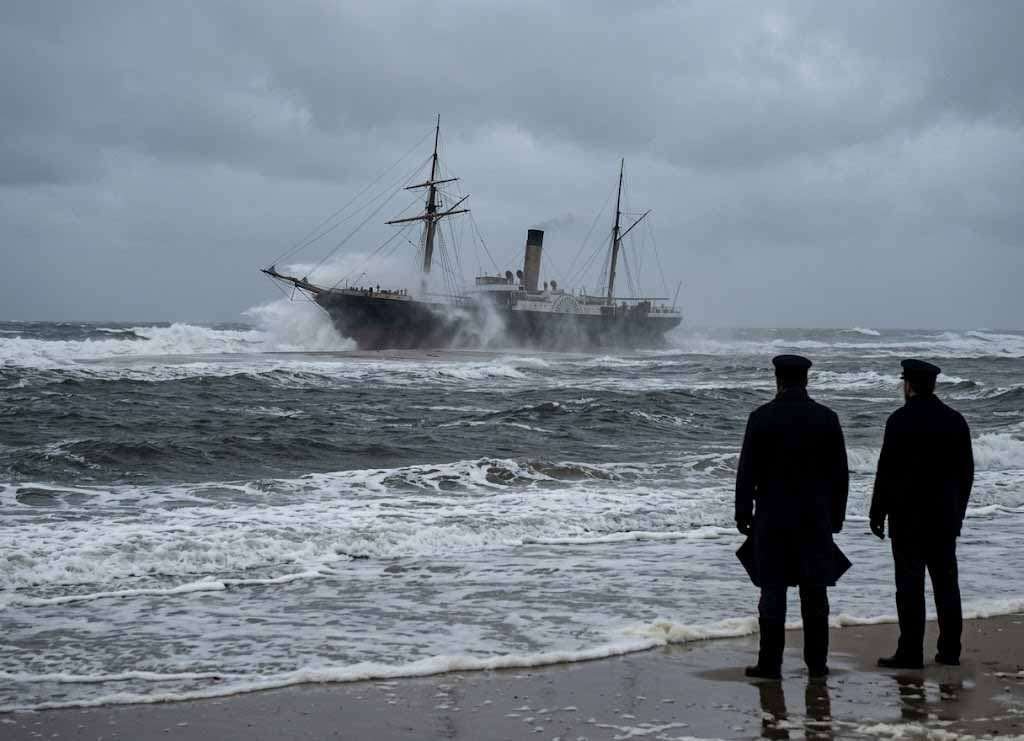
Thirty-two people drowned in full view of the beach. That’s the number that mattered. Not the storm surge. Not the failing rigging. The beach was right there — close enough that witnesses on shore could see the passengers clinging to the masts, could hear what some later described as screaming that carried across the water. And the men who were supposed to save them either weren’t there, weren’t trained, or weren’t equipped to do the job.
That was December 11, 1876. The ship was the Circassian, a British cargo steamer that had run aground on the outer bar off Fire Island. The death toll and the fury that followed it didn’t just produce headlines. They produced the United States Life-Saving Service — the direct ancestor of today’s Coast Guard.
Long Island was where American maritime rescue grew up. And the wreck of the Circassian was its most brutal lesson.
A Ship Already Living on Borrowed Time
The Circassian had a complicated history before she ever hit that sandbar. She was a steamship built in Liverpool in 1856, and by the time she made her final voyage she had already survived one previous wreck — grounding off Fire Island in 1870, salvaged and returned to service. That first grounding should have told someone something. The approaches to New York Harbor through the outer bars of Long Island’s south shore were among the most dangerous stretches of water on the Atlantic seaboard. Sailors called them the Graveyard of the Atlantic’s northern cousin. The sandbars shifted with every storm. The currents ran contrary. The fog came without warning.
On December 10, 1876, the Circassian was loaded with a general cargo and a crew of approximately 70 men when she ran aground a second time on the Fire Island bar, caught in a violent winter gale. She held together through the night. By morning, the storm had moderated enough that rescue seemed possible. This was the window. And this is where the system failed.
The Life-Saving Station Problem
There were Life-Saving Stations along the Fire Island coast. The federal government had been funding them since 1848, when Congress first appropriated money for the construction of small stations stocked with boats and equipment along the northeastern coastline. The idea was that local volunteers — surfmen, as they were called — would man the boats in emergencies and pull survivors through the surf.
The idea was sound. The execution was a disaster waiting to happen.
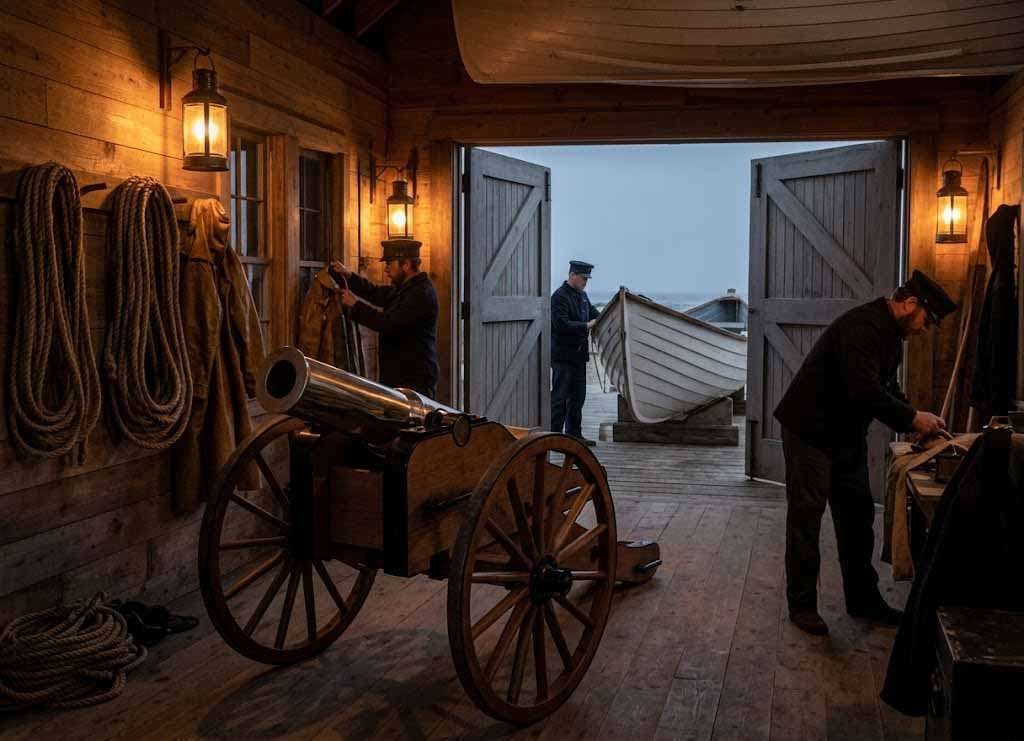
By the 1870s, the stations were chronically understaffed, poorly equipped, and supervised by keepers who were often political appointees rather than experienced mariners. The Revenue Marine Bureau, which administered the stations, had allowed the entire system to calcify into a network of buildings full of equipment that nobody maintained and nobody was properly trained to use. The surfmen who were supposed to respond were volunteers who might or might not show up, might or might not know how to operate a Lyle gun — the line-throwing cannon that was the primary rescue tool — and might or might not be physically capable of launching a surfboat in heavy seas.
When the Circassian went aground, the nearest station keeper was absent. This was not unusual. The stations were only officially staffed during the winter storm season, and even then, oversight was lax enough that keepers regularly left their posts. By the time capable surfmen organized a response, the window had narrowed.
The ship held together long enough for 34 of her crew to eventually be saved. But 32 died — some swept away in the surf during failed rescue attempts, some lost when sections of the hull finally gave way. The rescue effort was improvised, delayed, and incomplete. And it happened in front of witnesses.
Congress Reads the Coroner’s Report
The wreck of the Circassian was not an isolated tragedy. The south shore of Long Island had been swallowing ships for centuries, and the federal response had always been the same: post-disaster inquiry, temporary outrage, slow institutional inertia. But the Circassian came at a particular political moment.
Sumner Increase Kimball had just been appointed chief of the Revenue Marine Bureau in 1871, and he was the kind of bureaucrat who understood that an agency’s survival depended on performance. He had already begun pushing for reforms — professional surfmen paid regular wages rather than per-rescue, year-round staffing, standardized training, equipment inspections. The Circassian disaster handed him exactly the political ammunition he needed.
Congressional hearings in the winter of 1876–77 produced testimony that made the volunteer system look exactly like what it was: an underfunded patchwork kept alive by inertia and patronage. Witnesses described absent keepers, deteriorated equipment, and surfmen who had never drilled with the apparatus they were supposed to deploy. The numbers were simple and damning. Thirty-two dead. Shore within sight.
In 1878, Congress reorganized the entire coastal rescue apparatus into the United States Life-Saving Service, an independent agency with Kimball at its head. The new service required professional, paid surfmen at every station on a year-round basis. It mandated regular drills — crews practiced with the surfboat and the Lyle gun on fixed schedules, logged in station journals that inspectors actually reviewed. It created a merit-based promotion system, a professional culture, and a uniform standard of response that had never existed under the volunteer patchwork.
The Circassian wreck didn’t create these ideas. Kimball had been developing them for years. But the political will to fund and implement them came from thirty-two names nobody remembered as individuals — only as a total.
What the Long Island Stations Actually Looked Like
The Life-Saving Service that emerged after 1878 planted stations roughly every few miles along the south shore of Long Island, from Rockaway to Montauk. Each was staffed by a keeper — now required to be a competent surfman rather than a political favorite — and six to eight permanent surfmen who lived at or near the station during the active season.
The routine was relentless. Every clear night, surfmen walked patrol beats between stations, scanning the water for distress signals. They carried a Coston flare to signal any vessel that appeared to be standing into danger. They met their counterpart from the neighboring station at a halfway point called a halfway house, exchanged numbered bronze disks as proof of patrol, and walked back. In fog, they carried signal horns and rang them at intervals. In storm, they walked anyway.
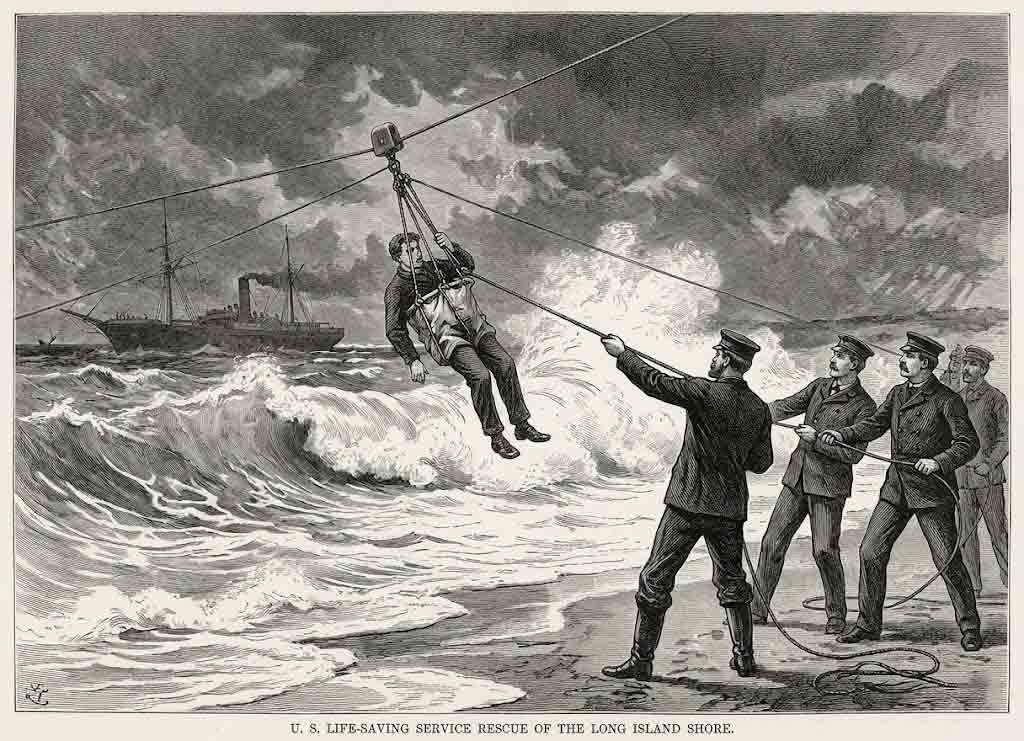
When a wreck was sighted, the response was drilled to the point of reflex. The Lyle gun — a small bronze cannon that fired a weighted projectile trailing a thin line — was the first tool. If conditions allowed, surfmen tried to establish a line to the wreck, rig a breeches buoy (essentially a life ring fitted with canvas shorts), and haul survivors to shore one at a time. If the surf was too heavy for a line approach, they launched a surfboat into waves that would send most recreational boaters running for the dock.
The men who did this work were mostly drawn from local fishing and maritime communities. Fire Island, Jones Beach, the barrier beaches of Suffolk County — these were places where men grew up in boats, where the sea wasn’t abstract, where the mathematics of surf and current were as familiar as the walk to a neighbor’s house. The professionalization of the Life-Saving Service didn’t replace that local knowledge. It organized it, funded it, and gave it an institutional structure that survived individual absences and political winds.
I’ve written before about the forgotten recipe tradition of the Montauk surfman’s stations — those men cooked and ate and slept between patrols, and the foodways that developed inside those stations were their own kind of cultural artifact. The food was the human texture of a professional life organized entirely around violent weather and sudden death.
The Ledger of the Long Island Shore
The Circassian wreck sits in a longer history of Long Island maritime disasters that produced institutional change. I covered the wreck of the Lexington in 1840 — the Long Island Sound steamship fire that killed more than 130 people and forced Congress to begin regulating passenger vessel safety. The pattern was the same then: disaster, outrage, hearings, reform. The difference is the scale of time between catastrophe and institutional response. With the Lexington, it took years and more disasters to produce lasting change. With the Circassian, the reform came within two years, in part because Kimball was already in position and in part because the image of survivors visible from shore proved politically indelible.
This is the brutal arithmetic of preventable tragedy. The political will to fix a broken system almost never materializes from abstract risk assessments or engineering reports. It materializes from body counts. Thirty-two was enough. Barely.
The United States Life-Saving Service operated as an independent agency until 1915, when it was merged with the Revenue Cutter Service to form the United States Coast Guard. Kimball served as superintendent until 1915, a tenure of more than forty years. He is one of the genuinely important figures in American maritime history, and he is almost entirely forgotten outside of specialist circles. His name doesn’t appear on any Long Island monument I’ve ever encountered. The Circassian itself is a footnote in most histories of the era.
But the stations he built still define the shape of rescue work along this coastline. The protocols he standardized — the regular patrol, the drill schedule, the equipment inspection, the merit system — became the operational foundation of the Coast Guard that exists today.
What Survives
Several of the original Life-Saving Service stations along Long Island’s barrier beaches still stand, though few serve their original purpose. The Fire Island Lighthouse complex at the western end of Fire Island National Seashore contains the remains of one of the original Gilded Age stations. Others have been converted to private residences or repurposed for park administration.
The Lyle gun, the surfboat, the breeches buoy — most of this equipment is in museums now, or in private collections, handled carefully by people who understand their historical weight. Fire Island National Seashore maintains interpretive materials on the Life-Saving Service era, and the station records — those meticulously kept daily journals — survive in the National Archives, a bureaucratic paper trail that Kimball insisted upon precisely because he understood that accountability required documentation.
What doesn’t survive is any memorial to the thirty-two who drowned. No marker on the beach at Fire Island names them. The sandbar where the Circassian broke apart is unmarked. The ship herself is scattered in pieces somewhere offshore, her boilers long since buried under decades of shifting sand.
The survivors of the Circassian — the thirty-four who made it — gave testimony that contributed to the congressional hearings that produced the Life-Saving Service. Their names are in the record too, though you’d need to go to an archive to find them.
Thirty-two people died close enough to shore that people on the beach could hear it happen. That’s the fact that changed things. Not the storm. Not the ship’s history. Not the inadequacy of the volunteer system, which was well documented before the Circassian ever went aground. What changed things was the specific, visible, undeniable proximity of the failure.
Sometimes that’s what it takes.
You Might Also Like
- The Wreck of the Lexington: The 1840 Steamship Fire That Changed American Maritime Law Forever
- The Forgotten Montauk Surfman’s Chowder: Cooking with Seawater at the 1800s Life-Saving Stations
- Rum Row and the Freeport Bootleggers: Long Island’s Clandestine War on the Water
Sources
- Shanks, Ralph, and Wick York. The U.S. Life-Saving Service: Heroes, Rescues and Architecture of the Early Coast Guard. Costano Books, 1996. archive.org
- United States Life-Saving Service Annual Reports, 1876–1915. National Archives. archives.gov
- Cipra, David L. “The U.S. Life-Saving Service.” National Park Service. nps.gov
- “Wreck of the Circassian.” Brooklyn Daily Eagle, December 1876. Chronicling America. chroniclingamerica.loc.gov
- United States Coast Guard Historian’s Office. “History of the U.S. Life-Saving Service.” history.uscg.mil