
DISCLAIMER: This post is a speculative reconstruction of a debate that never formally occurred. All positions attributed to Sagan and Polkinghorne are drawn exclusively from their published works and documented public statements. No quotes, positions, or arguments have been invented. This is intellectual history in the conditional tense — grounded, but not literal.
In 1994, two books appeared that might as well have been written in direct reply to each other, though their authors almost certainly never compared notes. Carl Sagan’s Pale Blue Dot arrived in October — a meditation on human smallness set against the indifferent vastness of space, an argument that the cosmos needs no author to be magnificent. That same year, John Polkinghorne published The Faith of a Physicist, the text of his Gifford Lectures at the University of Edinburgh, in which a Cambridge quantum physicist turned Anglican priest argued the precise opposite: that the universe’s comprehensibility is itself the most powerful evidence that something like mind underlies it. Two men. One cosmos. Irreconcilable conclusions.
They never formally debated. That is a loss worth mourning.
Two Lives Shaped by the Same Sky
Carl Sagan came to the cosmos through Brooklyn, through a boyhood in Bensonhurst where the library became his first telescope. He arrived at Cornell in 1968, and it was from Ithaca that he spent the better part of three decades arguing — with a patience and clarity that bordered on the evangelical — that the universe is under no obligation to comfort us and that this is precisely what makes it so extraordinary. His visits to Brookhaven National Laboratory on Long Island, documented in Keay Davidson’s biography, placed him at the edges of high-energy physics experiments that were probing matter at its most fundamental — the same frontier that would preoccupy Polkinghorne on the other side of the Atlantic. The irony is tight: the same particle physics that deepened Sagan’s secular awe was, for men like Polkinghorne, the most fertile ground for theological argument.
Polkinghorne’s life ran in an almost symmetrically opposite arc. He spent twenty-five years at Cambridge as a professor of mathematical physics, worked on quantum field theory, contributed to the understanding of quarks, and was made a Fellow of the Royal Society in 1974. Then, at forty-nine, he resigned his chair to study for the priesthood, becoming an ordained Anglican priest in 1982. He described the decision not as a repudiation of science but as an extension of the same truth-seeking habit. As he put it in interviews throughout the 1990s, both science and theology are “trading in motivated beliefs” — the motivations differ, but the underlying epistemological seriousness is the same. Where Sagan saw a cosmos liberated from the need for an author, Polkinghorne saw one that seemed suspiciously well-configured for the emergence of beings capable of understanding it. He called this the “fine-tuning” problem, and he did not think science alone had answered it.
The Fine-Tuning Argument: Where Physics Meets Theology
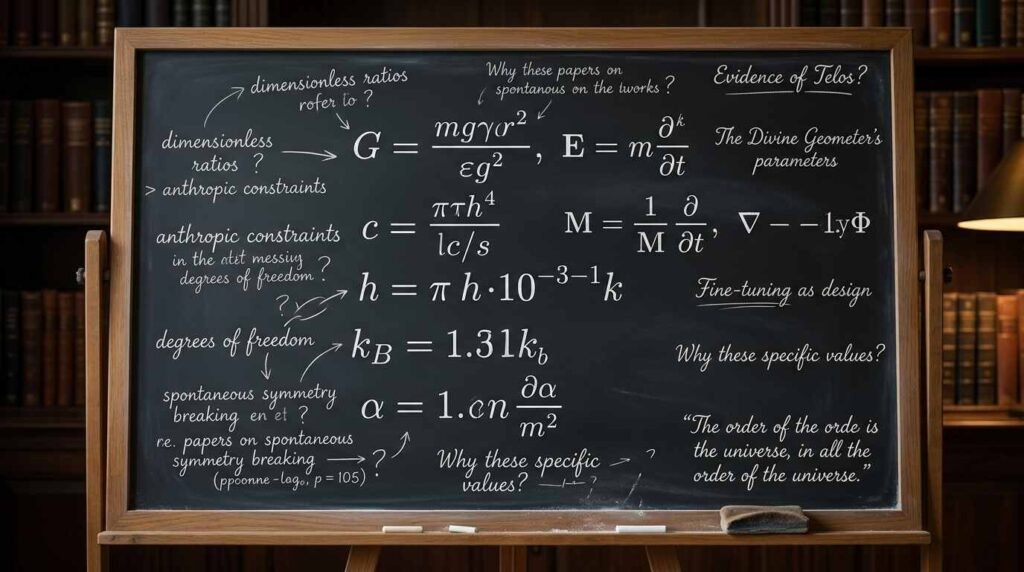
The specific scientific terrain on which this debate would have played out was not abstract. Brandon Carter’s 1974 paper at an International Astronomical Union symposium — where he introduced what he called the “anthropic principle” — had established that the fundamental constants of physics appear calibrated within extraordinarily narrow ranges for a universe capable of producing complexity, chemistry, and eventually life. Change the gravitational constant by a fraction; stars do not form. Alter the ratio of the electromagnetic force to gravity; stellar evolution collapses. The universe appears, in the language of physicists, improbably fine-tuned.
Sagan was aware of these arguments and consistently skeptical of the theological conclusions drawn from them. In The Demon-Haunted World (1996), he was explicit: the appearance of design is not evidence of design, and the history of science is largely a story of apparent purposefulness dissolving under rigorous examination. He would have invoked the anthropic observation itself — we can only observe a universe compatible with observers, so of course the constants look right from where we’re standing. This is the selection effect argument, and it is logically airtight as far as it goes.
Polkinghorne accepted the selection effect but did not find it satisfying. In The Faith of a Physicist, he pressed the question further: why is there a universe at all whose constants fall anywhere? The multiverse hypothesis — an infinite ensemble of universes with randomly varying constants — he acknowledged as physically possible, but pointed out that it carries its own metaphysical freight. You have traded one enormous explanatory commitment (a creator) for another (an infinite plurality of unobservable universes). Neither is scientifically checkable. The debate, he argued, was never really between science and religion — it was between two equally unprovable metaphysical frameworks. He preferred the one that also made sense of human consciousness, moral experience, and the unreasonable effectiveness of mathematics. Sagan would have called that a preference, not an argument. Polkinghorne would have agreed, and then asked what kind of preference it was and why it mattered.
What Comprehensibility Requires
The heart of Polkinghorne’s challenge to Sagan — the one Sagan’s published work does not fully answer — was what the philosopher Eugene Wigner called “the unreasonable effectiveness of mathematics in the natural sciences.” Mathematicians working in pure abstraction, with no reference to the physical world, produce structures that physicists subsequently discover describe nature with uncanny precision. Riemannian geometry, developed in the nineteenth century as a purely theoretical exercise, turned out to be exactly the mathematical language Einstein needed for general relativity. Complex numbers, invented as an algebraic convenience, are indispensable to quantum mechanics. Polkinghorne argued that this is not something a purely materialist account handles gracefully. The universe is not just orderly — it is orderly in a way that human minds, themselves products of that universe, are capable of grasping. That match between the structure of the world and the structure of mathematical thought is, for him, a theological datum as much as a scientific one.
I wrote about this territory in the context of Karl Popper and the demarcation problem — the question of what distinguishes science from non-science — in an earlier post, The Demarcation Problem: Karl Popper, Falsifiability, and the Boundary Between Science and Pseudoscience. The question Polkinghorne is raising exists just beyond Popper’s boundary: it is not science, but it is not pseudoscience either. It is a metaphysical question that science generates without being able to resolve. Sagan tended to be impatient with questions at that edge. Polkinghorne camped there deliberately.
Sagan’s rebuttal, true to form, would have been ecological rather than logical. The history of gaps in human knowledge — the places where “God” was inserted as explanation — is a history of those gaps being closed by science. Consciousness, disease, weather, the origin of species: every one of these was once a theological placeholder. Sagan would have asked why the fine-tuning argument should fare any better than its predecessors. His bet was on the explanatory power of natural processes over sufficient time and scale, a bet he placed with full knowledge that it might not pay off in his lifetime. He was comfortable with open questions. The Cosmos series and Pale Blue Dot alike rest on the premise that wonder in the face of the unknown is not an argument for anything except continuing to look.

The Long Island Thread: Physics at Brookhaven
There is a specifically Long Island dimension to this intellectual history that deserves attention. Brookhaven National Laboratory, established in 1947 at the former site of Camp Upton in Upton, NY — about forty miles east of Mount Sinai along Route 25A — was one of the world’s leading particle physics research centers throughout the second half of the twentieth century. Sagan’s documented associations with the laboratory, in the context of his broader work in astrophysics and planetary science, placed him in proximity to exactly the kind of high-energy physics that raised the fine-tuning questions. The ISABELLE project and later the Relativistic Heavy Ion Collider at Brookhaven were probing matter at the scales where the fundamental constants themselves become visible as parameters rather than givens. Whether or not Sagan discussed the theological implications of that work during his Long Island visits, the questions those experiments raised were precisely the ones Polkinghorne spent his post-scientific career examining. Long Island’s North Shore, which has its own long relationship with scientific institutions — from Cold Spring Harbor Laboratory to Stony Brook University — has always sat closer to these debates than its geography suggests.
I covered some of this scientific history in The Boltzmann Brain Paradox: When Statistical Physics Predicts You Shouldn’t Exist, which circles the same territory from a different angle: the question of what statistical physics actually commits us to believing about the universe’s improbability.
On the Comprehensibility of the Cosmos
Both men, it should be said, shared something that is easy to miss when the debate is framed as science versus religion: an absolute refusal to treat the universe as ordinary. Sagan’s secular awe and Polkinghorne’s theological conviction were both responses to the same overwhelming fact — that there is something rather than nothing, that the something is law-governed rather than arbitrary, and that creatures like us, assembled from stellar debris over billions of years, have somehow become capable of understanding the laws. Where they parted was on what that fact implies.
Sagan’s answer: it implies nothing except that we are very lucky and very fragile, and that our responsibility is to each other and to this small world. Polkinghorne’s answer: it implies something deeply purposive, something that the language of luck does not adequately capture. As he said in an interview with the PBS program Religion and Ethics NewsWeekly in 1998: “Science is very successful and very important… It’s very limited also. And it can tell you some things. And there are things that we need to know which science can’t tell us about.”
The debate Sagan would have made, had he lived past December 1996, would have turned on exactly that word: limited. He accepted limitation. He didn’t think it pointed anywhere in particular. For Sagan, the right response to the edge of scientific knowledge was patience and continued inquiry. Polkinghorne thought that patience, sustained long enough, eventually runs into questions that are not scientific questions at all — and that those questions deserve answers, not just deferral.
Why This Debate Still Matters
What is striking, looking back from this distance, is that neither man was arguing in bad faith, and neither was ignorant of the other’s position. Sagan read widely in philosophy of religion and engaged its arguments seriously enough to reject them on the merits. Polkinghorne was a practicing scientist who understood quantum field theory at a level most theologians could not access, and who was not trying to smuggle creationism through the back door of fine-tuning. This was not the debate between Richard Dawkins and a fundamentalist. This was two men of genuine intellectual stature, both steeped in the physics of the twentieth century, drawing opposite conclusions from the same data.
The distinction matters because the easiest version of the science-religion debate — empirical evidence on one side, dogmatic faith on the other — doesn’t describe what Sagan and Polkinghorne were actually doing. Both were doing what the philosopher of science David Hume called “natural religion”: reasoning from the observable character of the universe toward conclusions about its underlying nature. Hume himself concluded that such reasoning was essentially indeterminate — neither theism nor atheism could be decisively established from the evidence of design alone. Sagan embraced that indeterminacy and drew atheistic conclusions. Polkinghorne embraced it and drew theistic ones. Hume, characteristically, would have told them both they were overreaching.
The deeper question — which neither book fully resolves and which the debate would have sharpened — is whether the comprehensibility of the universe is a brute fact or a fact that requires explanation. Physicists will work on the multiverse. Theologians will develop the anthropic argument. Philosophers will watch both and take notes. And somewhere in the archive of what is possible in human thought, two books published in the same year in 1994 sit next to each other on a shelf, disagreeing entirely about what the same universe means. That is not a problem to be solved. It is a condition to be inhabited.
You Might Also Like
- The Fermi Paradox and the Great Filter
- Paradigm Shifts in Modern Astrophysics
- The Demarcation Problem: Karl Popper, Falsifiability, and the Boundary Between Science and Pseudoscience
Sources
- Sagan, C. (1994). Pale Blue Dot. Random House.
- Sagan, C. (1996). The Demon-Haunted World. Random House.
- Polkinghorne, J. (1994). The Faith of a Physicist. Princeton University Press.
- Polkinghorne, J. (1994). Quarks, Chaos and Christianity. Crossroad Publishing.
- Davidson, K. (1999). Carl Sagan: A Life. Wiley.
- Carter, B. (1974). “Large Number Coincidences and the Anthropic Principle in Cosmology.” IAU Symposium 63.
- Wigner, E. (1960). “The Unreasonable Effectiveness of Mathematics in the Natural Sciences.” Communications on Pure and Applied Mathematics, 13(1).
- Brookhaven National Laboratory. Historical archives. bnl.gov
- PBS Religion & Ethics NewsWeekly. (1998, May 8). Sir John Polkinghorne on Science and Theology.
- On Being Project. John Polkinghorne: Quarks and Creation.
- Carl Sagan Institute, Cornell University. Memories of Carl Sagan. (2025).