Walk up to a diner counter and say, “Two eggs.” The next question comes back in a second: “How do you want them?” The answer sounds like a language of its own, and a few missteps can end in a plate you did not want.
Here is a plain glossary, with what happens on the griddle for each. A caution up front: names shift from one place to another, and a cook’s idea of medium may not match yours. When in doubt, describe the yolk.
Fried eggs
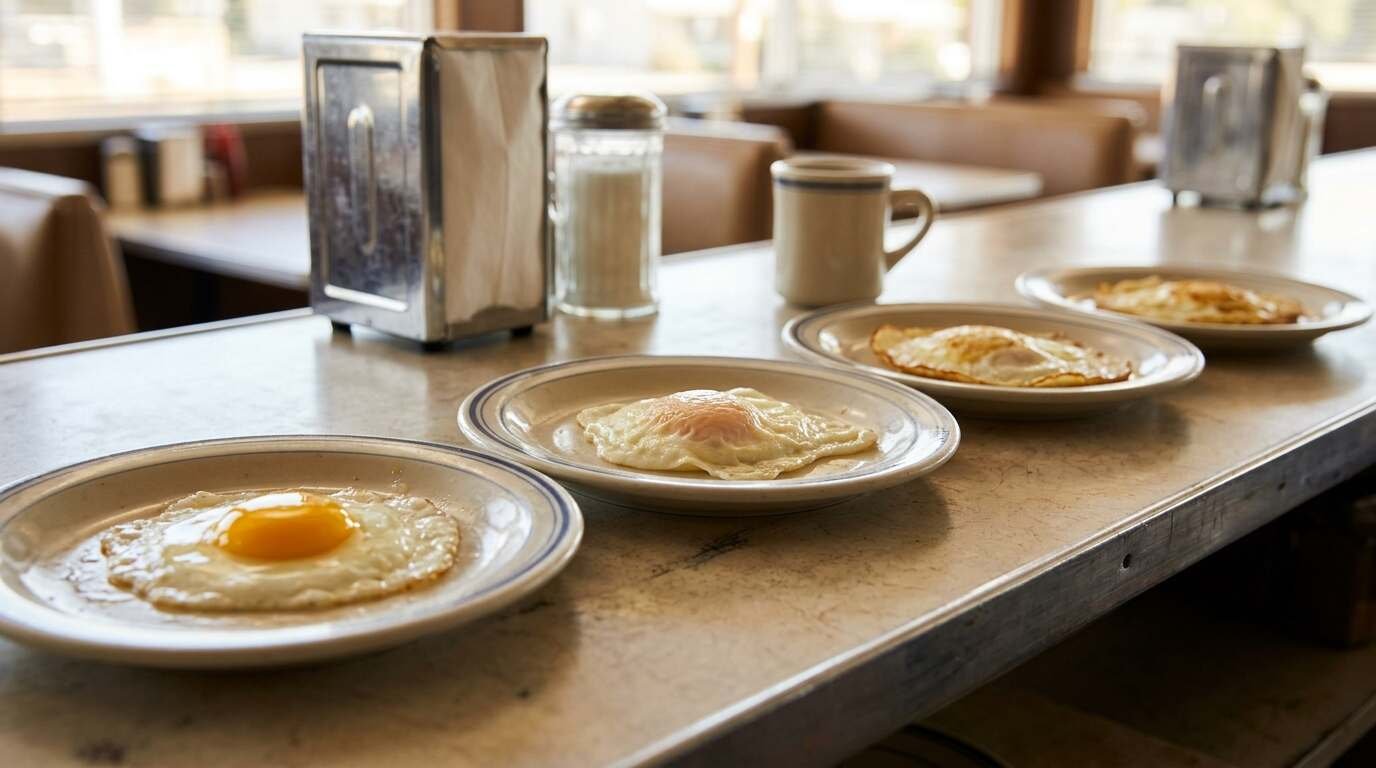
Sunny-side up. Cooked on one side only, never flipped. The white is set, the yolk is liquid and bright. Cooks often cover the pan briefly to firm the top of the white.
Over easy. Flipped carefully near the end, then cooked for a few seconds. The white is set on both sides and the yolk is still runny.
Over medium. Flipped and cooked a bit longer. The yolk is thick and jammy in the center, neither liquid nor firm.
Over hard. Flipped and cooked until the yolk is solid all the way through. Cooks usually break the yolk in the pan to cook it faster.
Basted. Cooked in the pan with hot fat or a splash of water spooned over or steamed under a lid, so the top of the white sets without flipping. The result is tender and the yolk stays runny.
Scrambled
Soft scrambled. Cooked slowly over low heat with constant stirring, forming small, creamy curds. Moist and custardy.
Scrambled hard or dry. Cooked until the curds are firm and no liquid remains.
Most diner scrambles fall between the two. A good cook adds a splash of milk or a pat of butter and pulls the eggs off the heat while they still look slightly wet, since residual heat finishes them.
Poached, boiled and others. Poached. Cooked gently in barely simmering water, with a soft yolk and a white that holds together. Poached eggs sit on toast and corned beef hash.
Soft-boiled. Boiled in the shell for a few minutes, with a set white and a runny yolk, usually served in an egg cup.
Hard-boiled. Boiled in the shell until the yolk is solid.
Omelet. Beaten eggs cooked flat in a skillet and folded around a filling, set but tender. The Western omelet, with ham, peppers and onion, is a diner classic.
How to order what you want
If the name does not get you there, describe the yolk. “Over medium, but with the yolk still a little runny” tells the cook what you mean. A server will relay it. Simple preferences, like “no brown edges” or “whites well set,” are routine.
Do not be shy about sending an egg back if it is not what you ordered. A good cook wants the plate to be right.
A food safety note. Eggs with runny yolks are not fully cooked. The USDA advises cooking eggs until both the yolk and the white are firm, and it notes that people at higher risk of foodborne illness, including older adults, young children, pregnant women and those with weakened immune systems, should take particular care. If that applies to you or the person you are cooking for, order over hard or hard scrambled.
Check the current USDA guidance for details. Many people eat soft eggs without a problem, but the advice is there for a reason.
A few more terms you may hear
Dippy eggs are soft-boiled or very soft fried eggs meant for dipping toast. Scrambled with means eggs scrambled together with a named ingredient such as cheese, ham or peppers. Egg whites only means the yolks are left out entirely, which changes the texture and calls for a nonstick pan and a little extra fat.
Regional names crop up. What one kitchen calls a basted egg, another may call a steamed egg, and some places use different shorthand on the ticket. The cook behind the counter knows the house rules.
Making them at home. A nonstick or well-seasoned skillet, medium-low heat and fresh eggs give the best fried eggs. Crack each egg into a small bowl first, to catch shell and keep the yolk intact. For over-easy, slide a flexible spatula fully under the egg and flip in one movement.
The more you practice, the more instinct takes over. After a week of breakfasts, you will order without thinking.
Egg orders by timing
Speed is part of the craft. A sunny-side-up egg is among the quickest orders, ready in about three minutes. Over easy needs a little more care for the flip. Poached eggs take a few minutes in simmering water and are usually made ahead on busy mornings and held warm.
Omelets need more skill than any of them. A good one is set but not browned, with a smooth surface and a soft interior. That takes heat control and a quick wrist. If you order one at a diner, give the kitchen a few extra minutes and enjoy the wait.
The griddle view
On a busy morning, the cook is running a dozen tickets at once and reading each by its notes. Short, clear orders help. “Two over easy, wheat toast, home fries” takes a second. Specific requests are welcome, but the clearer you are, the closer the plate lands to what you pictured.
Practice makes the flip. If flipping scares you, practice with a cheap carton of eggs and a nonstick pan. Keep the heat low, use plenty of fat, and slide the spatula in a single smooth motion. Even a broken yolk is edible, and the cook who has broken a few learns what the pan is telling them.