Some links in this post are Amazon affiliate links. As an Amazon Associate, Heritage Diner earns from qualifying purchases at no extra cost to you.
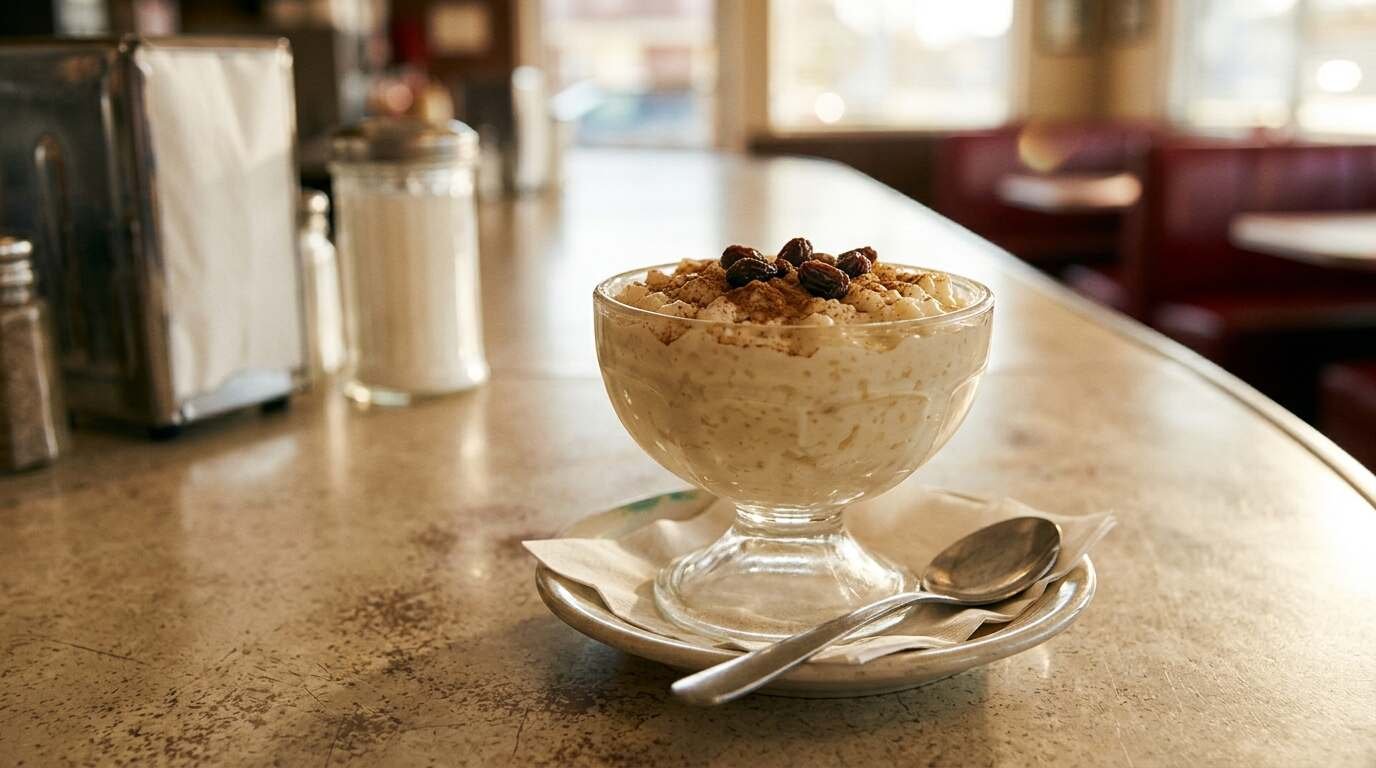
There was a time when a diner dessert case held three things without fail: a pie or two, a layer cake under glass, and a row of small bowls of rice pudding, cold and trembling. Nobody photographed them. People ate them with a spoon and a cup of coffee, and went back to work.
The recipe is so plain it barely counts as one. Rice cooked slowly in sweetened milk until the grains give up their starch and the whole pot turns creamy. All the skill is in patience.
What you need
The ratio is the part to memorize. A common starting point is half a cup of rice to four cups of whole milk, with about a third of a cup of sugar, a pinch of salt and a teaspoon of vanilla. Cinnamon goes on top, and raisins are optional.
Medium-grain white rice, the kind sold for risotto or sushi, gives the creamiest result because it is high in the starch that thickens the milk. Long-grain rice works, too, with a firmer texture and a looser pudding. Rinsing the rice is a matter of taste; unrinsed rice yields a thicker pudding.
- 1/2 cup white rice
- 4 cups whole milk
- 1/3 cup sugar
- Pinch of salt
- 1 teaspoon vanilla extract
- Cinnamon, and raisins if you like
Why the old pudding tasted the way it did. Part of the pleasure of a diner rice pudding was how little it asked of you. It was cooked in volume, in a heavy pot, with whole milk and ordinary sugar, then ladled into cups and chilled. There was no garnish, no brûlée, no drizzle. That plainness is the point. The flavor comes from milk, rice and time.
That is also opinion, and a nostalgic one. Plenty of diners still keep the pudding going, and plenty of home cooks make a version that beats any memory. But the stripped-down method is still a good teacher. Learn it, and every variation you try later makes more sense.
Pick the right pot
Milk scorches on the bottom of a thin pot in moments. Reach for a heavy-bottomed saucepan, about three quarts, with plenty of headroom, because milk foams up and boils over if you look away. A heavy-bottom saucepan spreads the heat evenly, and a flat-edged spatula lets you scrape the corners.
Baked or stovetop?. Some cooks prefer to bake rice pudding in a low oven, around 300 degrees F, in a covered dish with milk, rice and sugar for an hour or more. The result is hands-off and gives a lightly caramelized top. The stovetop version, by contrast, gives you a creamier, looser pudding and lets you control it with a spoon.
For a diner-style bowl, stovetop wins on creaminess. The constant stirring releases starch from the grains into the milk, and that is what makes the texture. If you want to cook while doing other things, the oven is a perfectly good way to go.
Cook it low and slow
Put the rice, milk, sugar and salt in the pot and bring it to a bare simmer over medium heat, stirring so nothing sticks. Then turn the heat down to low. You want an occasional lazy bubble, not a boil.
Stir every few minutes, more often as it thickens. Expect thirty-five to forty-five minutes. The milk will reduce, the rice will swell and soften, and the whole thing will look like a loose porridge. It should coat a spoon but still look a little too thin, because it firms as it cools.
Taste a grain of rice. It should be fully tender with no chalky center. If it is still firm and the pot is thick, add a splash more milk and continue.
Rice pudding and food safety. A pot of milk and rice is a friendly environment for bacteria if it sits too long at room temperature. The standard guidance is to refrigerate perishable food within two hours, or within one hour if the room is hot. For a big pot, divide the pudding into shallow containers so it cools quickly, instead of leaving it in a deep pot where the center stays warm for hours.
Leftover cooked rice in particular deserves quick handling. Cool it promptly, keep it cold, and do not leave it sitting out overnight. If you are serving the pudding at a party, set the bowl over a larger bowl of ice, and discard anything that has been out for more than two hours.
Finish with vanilla, and an egg yolk if you like
Take the pot off the heat and stir in the vanilla. Add the vanilla at the end because heat drives off its fragrance.
For a richer, custardy pudding, whisk a yolk with a few spoonfuls of the hot rice, then stir that mixture back into the pot over very low heat for a minute or two. Gradually warming the yolk, called tempering, keeps it from scrambling. Do not boil it afterward.
A knob of butter at the end adds gloss. Some cooks stir in a splash of cream. Keep it simple on the first try and add extras once you know the base.
Chill it, and serve it right. Spoon the pudding into a shallow container or individual cups, and press plastic wrap against the surface to stop a skin from forming. Cool it on the counter for a short while, then move it to the refrigerator. Food safety guidance says to refrigerate dairy-based leftovers within two hours of cooking.
Cold pudding is firmer. Warm pudding is looser and softer. Both are good. If it set too tight, stir in a spoonful of milk before serving. Dust with cinnamon and add raisins that you plumped in warm water or a little hot tea.
Properly refrigerated, rice pudding keeps for about three to four days.
Flavor changes worth trying
Once the base is easy, there is a lot of room to play. Swap a cup of the milk for evaporated milk for a deeper, cooked-milk flavor. Add a strip of lemon or orange peel while it simmers. Stir in a spoonful of maple syrup in place of some sugar, a pinch of nutmeg, or a little ground cardamom.
Fold in raisins, dried cranberries or chopped dates at the end. If you like them plump, soak them in warm water for ten minutes first and drain. For a richer dessert, whip a little cream and fold it in just before serving, once the pudding has chilled.
Resist adding too many things at once. A pudding that tastes of four spices tastes of none of them.
Scaling up, scaling down
The ratio holds as you grow the batch. Double everything for a crowd and use a larger pot, giving yourself extra time because a bigger volume takes longer to thicken. A pot that is too full will boil over, so leave a few inches of room.
For a single serving, a small saucepan and a few tablespoons of rice will do. Watch the heat closely, because a small amount of milk reduces fast and burns just as quickly. Stir often and taste the rice for doneness.
Leftover pudding makes a decent breakfast, or a topping for baked fruit. It does not freeze well, as the texture turns watery when thawed.
Common mistakes.
- Scorched bottom: the heat was too high or the pot too thin.
- Gluey pudding: it cooked too long without enough milk, or the rice was overcooked. Loosen it with milk.
- Watery pudding: it needed more simmering, or the heat was too low to reduce the milk.
- Grainy rice: the pudding was not cooked long enough. Keep going until the grains are fully soft.
There is no rule that says you cannot flavor it. A strip of lemon peel simmered in the pot, or a cardamom pod, is a quiet upgrade. Remove it before serving.