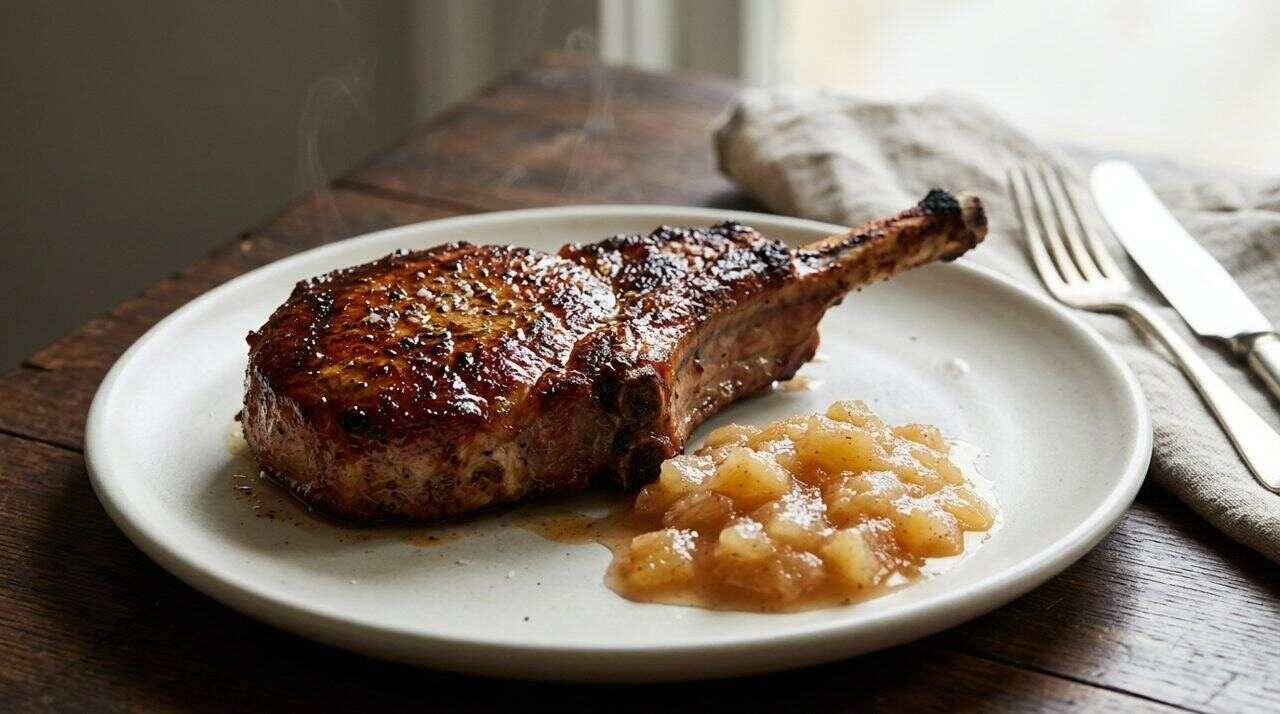
A pork chop and a pot of applesauce make one of the oldest pairings on the American dinner table, and the reason it lasts is mostly physical: rich, salty, browned meat against something cool, tart and soft. The trouble sits in the pan. A chop has very little margin between juicy and dry, and the usual home result is a gray, tight slab that needs the applesauce for rescue rather than contrast.
The method below is assembled from published technique rather than from any one kitchen’s recipe. It borrows the brine, the sear and the pull temperature from America’s Test Kitchen’s thick-cut pork chop recipe, the safety numbers from USDA guidance as reported by CIDRAP, and the applesauce from a Mississippi State University Extension recipe. Each step is explained so the reasoning can survive a change of pan, chop or stove.
Why a lean chop needs a brine
Pork has grown leaner over the decades, and lean meat forgives nothing. According to the notes on the America’s Test Kitchen recipe, today’s pork is very lean, which is the reason that recipe uses a short, concentrated brine: it seasons the meat and promotes browning during the sear. The same page describes the brining liquid in a related recipe as improving the flavor and gaining a desirable degree of caramelization.
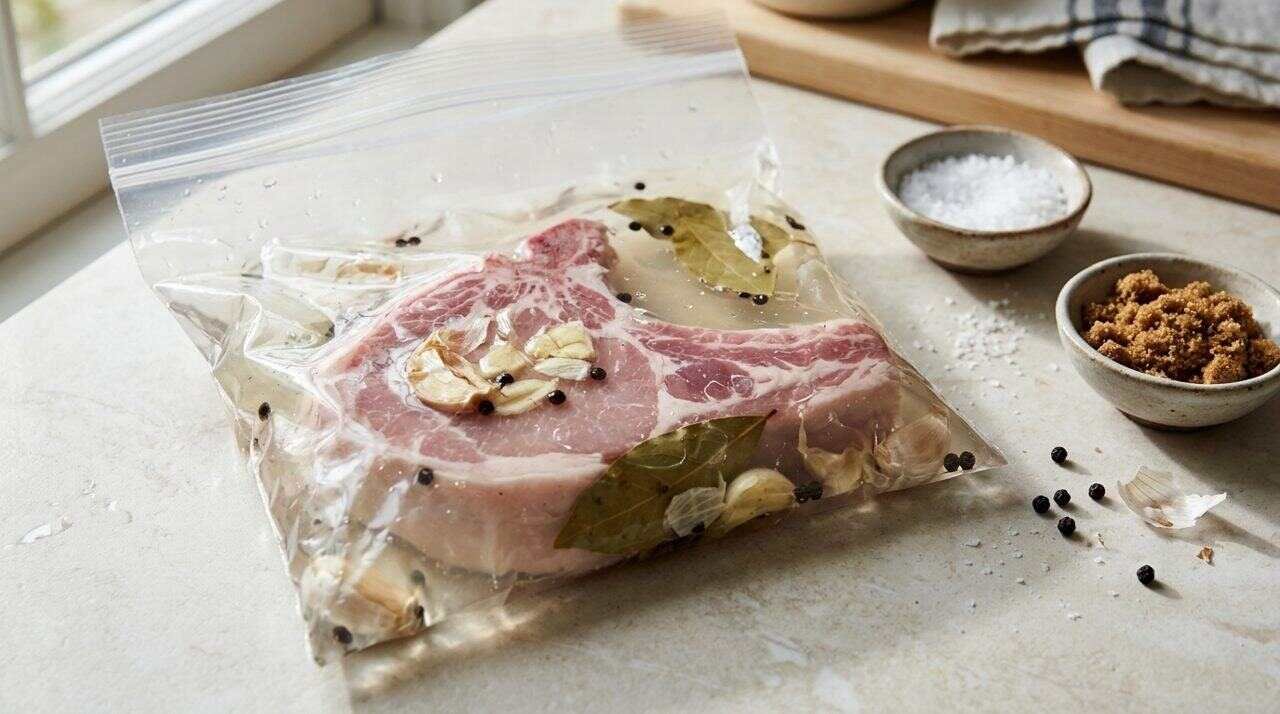
The brine is not complicated. Salt and brown sugar dissolve in hot water, aromatics go in, cold water follows, and the liquid cools before the chops swim in it. The chops sit in the refrigerator for about an hour, turned once. Longer is not better here; the sourced method is built around one hour, and a chop left overnight in a brine this strong is a different and saltier experiment.
The sugar earns its place
The sourced recipe puts brown sugar in the brine for exactly this reason: it is there to help the chops brown in a two-minute sear, not to make them sweet. That is why the chops come out of the bag and straight onto paper towels. A wet surface cannot brown, a point taken up in the next section, so the drying matters as much as the soaking.
Ingredients
For four bone-in rib or loin chops about 1½ inches thick (roughly 12 ounces each, matching the sourced method):
- ¾ cup dark brown sugar, lightly packed
- ½ cup kosher salt (or ¼ cup table salt)
- 2 cups hot water and 4 cups cold water
- Optional brine aromatics: 10 crushed garlic cloves, 4 crumbled bay leaves, 8 whole cloves, 3 tablespoons crushed black peppercorns
- 2 tablespoons vegetable oil
- Applesauce (recipe below), warm or cool
A heavy 12-inch skillet handles four chops without crowding. Crowding drops the pan temperature and floods the surface with steam, which is the fastest way to a pale chop.
Method
- Dissolve the sugar and salt in the 2 cups of hot water in a gallon zipper-lock bag. Add any aromatics and the 4 cups of cold water, then let the liquid cool to room temperature.
- Add the chops, press out the air, seal, and refrigerate for about 1 hour, turning the bag once.
- Heat the oven to 450°F with a shallow pan on the lower-middle rack.
- Pull the chops from the brine and dry them thoroughly with paper towels. If dinner is delayed, wipe off the brine, set the chops on a wire rack over a sheet pan, and refrigerate uncovered for up to 3 hours.
- Heat the oil in the skillet over high heat until it shimmers but does not smoke, about 2 minutes.
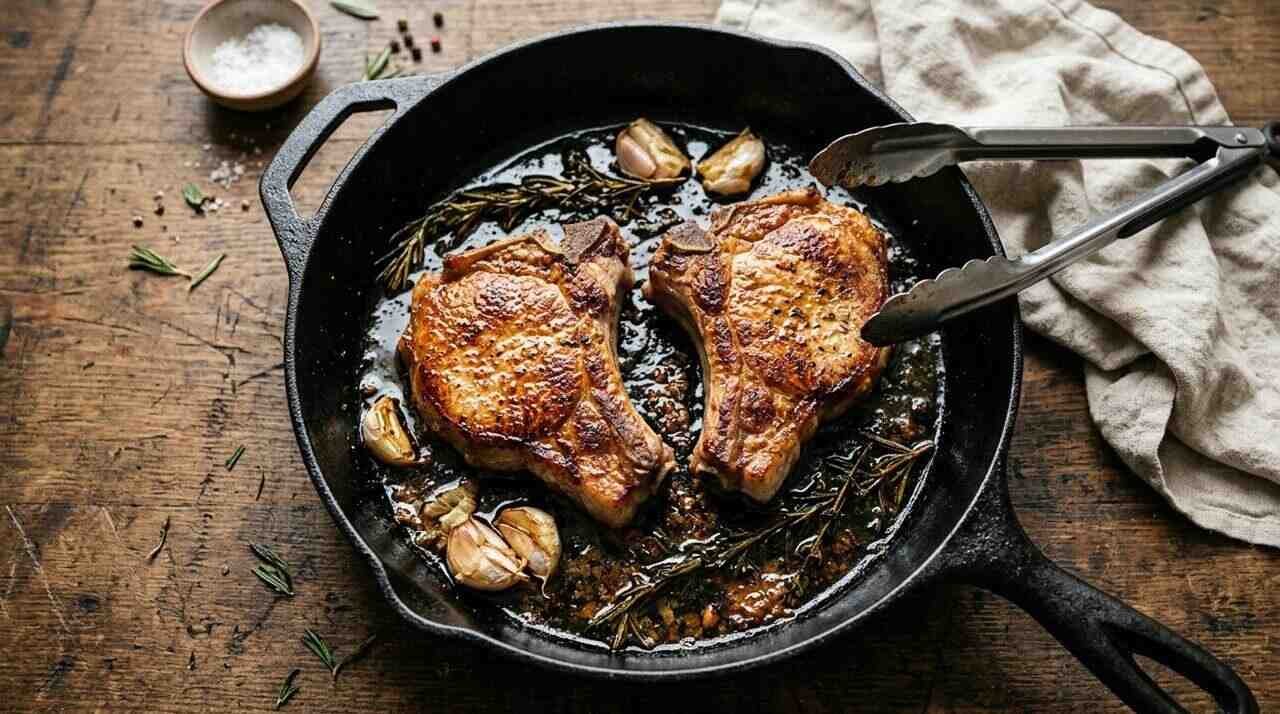
- Sear the chops about 2 minutes until well browned, turn with tongs, and sear about 2 minutes on the second side.
- Move the chops to the preheated pan and roast 8 to 10 minutes, turning once halfway, until an instant-read thermometer in the center reads 125 to 127°F.
- Transfer to a platter, tent loosely with foil, and rest about 5 minutes. The center climbs to about 145°F while the chops sit.
Those times belong to a chop 1½ inches thick. A thinner chop reaches the same temperatures sooner, so the thermometer, not the clock, decides when to pull it. The sourced method says to tent loosely; wrapping the foil tight steams the crust the sear just built.
What the sear does, and what it does not
Searing has a reputation for sealing in juices. According to Wikipedia’s entry on searing, the idea goes back to Liebig around 1850 and was embraced by Escoffier, and experiments from the 1930s found that seared roasts lost the same amount of moisture or more. The entry credits Harold McGee’s On Food and Cooking for that account. Browning earns its place for flavor, not for waterproofing.
Flavor requires a dry surface. The same entry gives about 150°C (300°F) as the surface temperature needed for a brown crust, and notes that water boils near 100°C and holds a wet surface below that line. Modernist Cuisine’s account of the Maillard reaction makes the same point from the other side: very wet food stays at or below the boiling point of water, which blocks the reaction. Hence the towels, the hot oil and the single layer of chops.
The reaction itself is the one that happens when amino acids and sugars meet heat. It also tends to move faster under alkaline conditions, according to the Maillard reaction entry, which is why pretzels get a lye bath. A chop does not need baking soda. The sugar in the brine and the heat of the pan are enough.
Applesauce
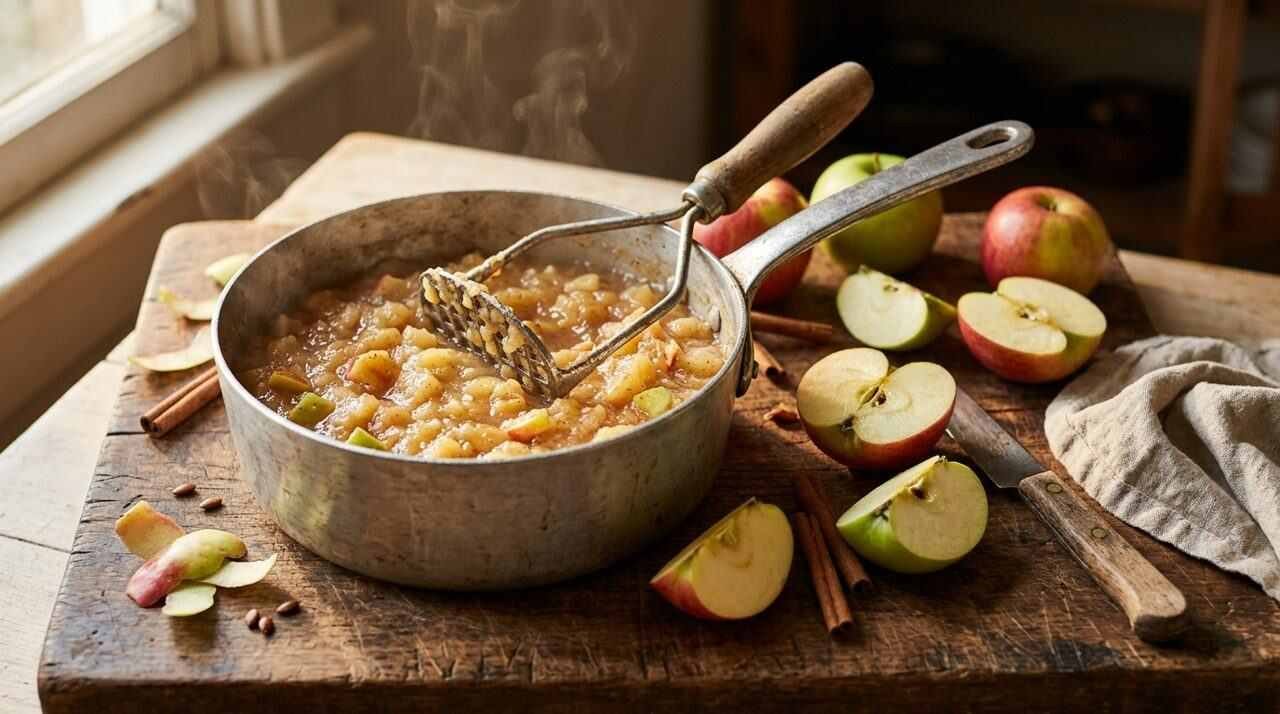
The Mississippi State recipe is plain: 7 apples, quartered; ½ cup water; ¼ cup sugar stirred in after cooking until it dissolves; cinnamon if wanted, adjusted to taste. The apples and water come to a boil, then drop to low, covered, and simmer 15 to 20 minutes, until tender, with an occasional stir. The page notes that imperfect or slightly bruised apples work well, which suits a sauce that is going to be mashed anyway.
The source does not specify an apple variety or say how to mash. Two choices follow from that. A mix of one tart and one sweeter apple gives a sauce that reads as fruit rather than syrup, and a potato masher leaves some texture. That texture matters beside a crusted chop; a smooth puree can read as baby food next to something with a bark.
Cooking the sauce before the chops go in the brine is simplest. It keeps in the refrigerator and tastes better cool or at room temperature than hot, which also leaves the stove free for the sear.
Timing the plate
The sequence is easier to run backward from the table. The brine takes about an hour of waiting and almost no work, so it is the natural first job, and the applesauce can simmer during it: 15 to 20 minutes on the stove, then cooling on the counter. After the chops come out of the brine and get dried, the active cooking is brief, with two minutes per side in the skillet and 8 to 10 minutes in the oven. The 5-minute rest is the window for a pan sauce, a vegetable, or setting the table.
Because the Mississippi State recipe yields ten half-cup servings from seven apples, a single batch of sauce covers the chops with plenty left over for breakfast the next morning. The sauce also halves cleanly if only two chops are on the menu.
Doneness and pink pork
Pulling a chop at 125 to 127°F sounds alarming until the rest is counted. On May 24, 2011, the USDA announced that whole cuts of pork can be cooked to 145°F, followed by a 3-minute rest, rather than 160°F, according to CIDRAP’s report. The sourced method rests the chops about 5 minutes, which clears that bar if the center reaches 145°F. Ground pork is a different matter; it stays at 160°F.
The same report records the agency saying color is not a reliable safety indicator, because pork cooked to 145°F may still be pink. A thermometer in the thickest part of the meat is the check. Slightly blushing, juicy meat at 145°F is the intended result, not a mistake.
One more reason for the low pull temperature: the test kitchen’s explanation is that the chops finish cooking while resting, which lets the juices redistribute and helps keep them moist. Carryover heat is doing real work during those 5 minutes, so slicing early undoes the careful part of the process.
A quick pan sauce and the plate
The skillet holds the best part of the dinner after the chops leave it. The citrus variation of the America’s Test Kitchen recipe pours off most of the fat, returns the pan to medium-high heat, adds a puree of molasses, lime, orange juice, garlic and chipotle, scrapes up the browned bits, simmers about 2 minutes until syrupy, and whisks in cold butter a piece at a time. The method transfers to other liquids: the same scrape-simmer-butter sequence works with cider or stock, though no tested ratios for those come from the sources here, so tasting is the guide.
On the plate, the applesauce goes beside the chop instead of over it, so the crust stays crisp until the fork gets there. Mashed potatoes, a pile of green beans or buttered egg noodles fill the rest of the plate.
Useful gear
- ThermoWorks Thermapen ONE instant-read thermometer: a practical item related to this topic. See it on Amazon (affiliate link)
As an Amazon Associate I earn from qualifying purchases. A commission may be earned if you buy through this link, at no extra cost to you.
Cut the meat away from the bone in one piece, and let the thermometer, not the clock, set the pace the next time around.
Sources
- America’s Test Kitchen: Pan-Seared, Oven-Roasted Thick-Cut Pork Chops
- America’s Test Kitchen: Thick-Cut Pork Chops with Spicy Citrus Pan Sauce
- CIDRAP: USDA 145 degrees is safe temp for pork
- Mississippi State University Extension: How to Make Homemade Applesauce
- Modernist Cuisine: The Maillard Reaction
- Wikipedia: Searing
- Wikipedia: Maillard reaction