Flash-frozen at a catering kitchen near Chicago, shipped to a distribution center, thawed for about a day and then reheated onboard by flight attendants: that is the route United Airlines’ new Chicago Patty Melt travels before anyone takes a bite. Chef Jeff Mauro, the name on the sandwich, laid out the process in a Reddit AMA that The Bulkhead Seat summarized in July. On October 10, the Live and Let’s Fly blog published what happened when a passenger actually ordered one.
The verdict was mixed, and the details make a better cooking lesson than most recipes do. A patty melt is five things working at once: beef, onions, cheese, bread and heat. Take one away and the sandwich goes quiet.
The Review That Makes the Case for Cooking It at Home
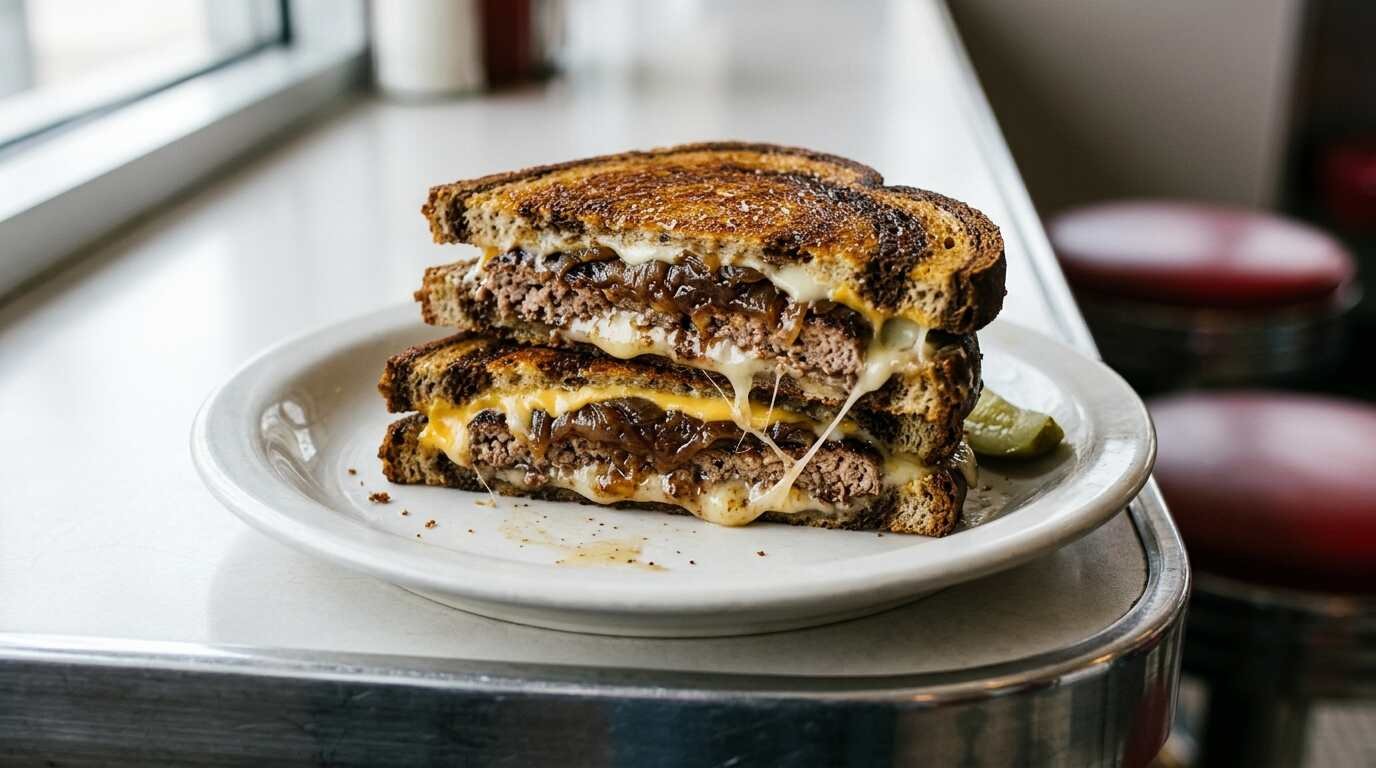
United’s Bistro on Board menu lists the $12 sandwich as a Certified Angus Beef pub burger with Mauro Provisions Black Powder Rub and mild craft giardiniera, topped with caramelized onions and American cheese on marbled rye. Reviewer Matthew Klint praised the beef patty, then ran through the rest. There was hardly any giardiniera, he could not find the caramelized onions, and the marbled rye, in his words, was “dried out and lukewarm”. He added that he wants to see the sandwich reworked rather than dropped, since the burger itself is already good.
Mauro’s side of the story, as The Bulkhead Seat reported it, is a lesson in cooking under constraints. He chose American cheese over the traditional Swiss because it melts more consistently through the catering process. Recipes for in-flight food call for roughly 10 to 12 percent more seasoning, because taste buds dull in the air. His kitchen partner uses replica aircraft ovens to simulate the onboard heating, and he says he has eaten at least a dozen of the sandwiches on flights with only one letdown, which he blamed on a production issue.
None of that is a complaint about the chef. It is a description of a sandwich that has to survive a freezer, a truck and a galley oven. A flat-top griddle at home has none of those problems. The sandwich goes from pan to plate in a minute, and every part of it can be hot at the same moment.
Where the Melt Came From, and How It Became a Menu Hack
Origin stories for the patty melt come with the usual diner fog. Wikipedia’s entry notes that several culinary writers credit Los Angeles restaurateur Tiny Naylor, with dates ranging anywhere from 1930 to 1959 depending on the source, and that it was on the menu at Tiny Naylor’s by the early 1950s. Even if Naylor did not invent it, the entry says he and his family spread it through their restaurants and those where they worked, including Du-par’s. Saveur’s account has his son Biff claiming the rye-bread version took shape after his father moved to Los Angeles following World War II.
The sandwich’s modern reputation owes a lot to being easy to make well. In a 2020 Taste essay, Anna Hezel admitted she had long filed it as a “slightly crustier, slightly less glamorous version of a hamburger” until a Brooklyn diner changed her mind. The same piece describes Phoenicia Diner’s pimento cheese patty melt, a Southern twist that became a menu fixture there.
Chains have caught on, too. Five Guys announced on August 30, 2024 that its Patty Melt, born as a customer hack that amounted to a grilled cheese with a patty added, would become an official item at 194 locations starting September 1, 2024. And National Patty Melt Day, for the record, lands every February 7.
Four Failures and the Griddle Fix for Each
Every complaint in the airline review has a direct answer in a home kitchen. The table below pairs each one with the fix.
| What went wrong onboard | What the griddle does about it |
|---|---|
| Onions hard to find | Cook two large onions down until about a cup remains, so the layer is visible and thick. |
| Rye dried out | Butter each slice edge to edge and toast it to order, then serve within a minute or two. |
| Lukewarm throughout | Cook the patty until a thermometer reads 160°F, then assemble and griddle while everything is hot. |
| Cheese melts unevenly | Layer American against one slice of bread and Swiss under the top slice, so both melt from the edges inward. |
The cheese choice deserves a second look. Swiss gives the sandwich its classic nutty edge, while American melts almost on contact. Using one slice of each gets the flavor of the first and the reliability Mauro wanted from the second.
The onions are the other place where shortcuts show. The slow chemistry behind them is covered in this earlier piece on cheese pull and caramelized onions, and a full recipe card sits in the original griddled rye patty melt post. The version below is built around fixing the airline’s problems, so it leans on a different cheese pairing and a thinner patty.
How to Make a Diner Patty Melt at Home
Serves 2 | Active time: about 20 minutes | Total: about 50 minutes, mostly onions
The video below walks through a classic version from start to finish, including the onion stage and the griddle build. Sip and Feast’s written recipe cooks its onions for roughly 30 minutes, which matches the timing here.
Ingredients
- 2 large yellow onions, thinly sliced
- 2 tablespoons unsalted butter, for the onions
- 12 ounces 80/20 ground beef
- ½ teaspoon kosher salt, plus a pinch for the onions
- ¼ teaspoon black pepper
- 1 teaspoon Worcestershire sauce
- 4 slices rye bread, about ½ inch thick (marbled or seeded)
- 2 slices American cheese
- 2 slices Swiss cheese
- 2 tablespoons softened butter, for the bread
- Optional: a spoonful of drained mild giardiniera per sandwich, for the Chicago accent
Method
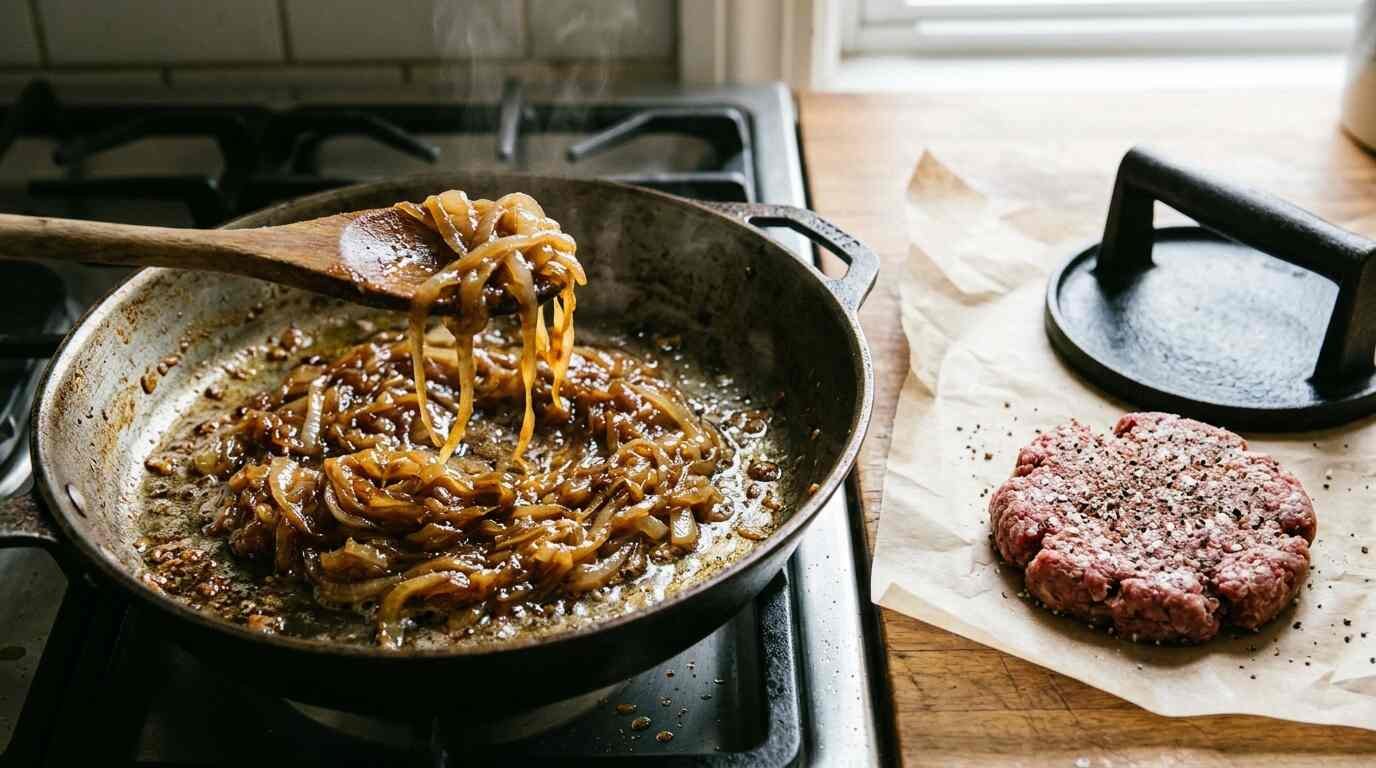
- Melt the onion butter in a wide skillet over medium-low heat. Add the onions and a pinch of salt. Stir every few minutes for 25 to 30 minutes, until deep gold and jammy. If they stick, add a splash of water and lower the heat. Set aside.
- Mix the beef with the salt, pepper and Worcestershire. Divide into two portions and press each flat, about ⅓ to ½ inch thick and slightly wider than a slice of bread. Patties shrink as they cook, which is why Food Network’s James Briscione tells cooks to shape them larger than the bread.
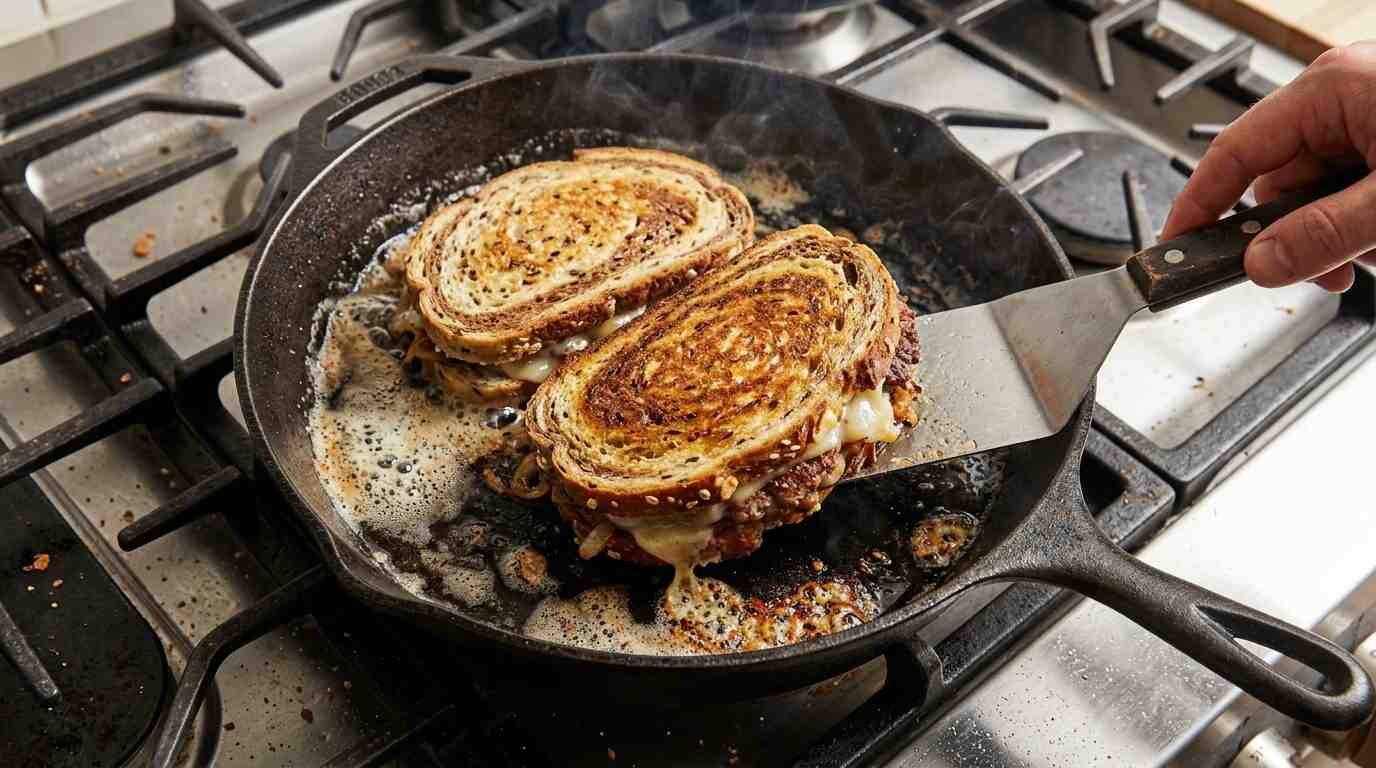
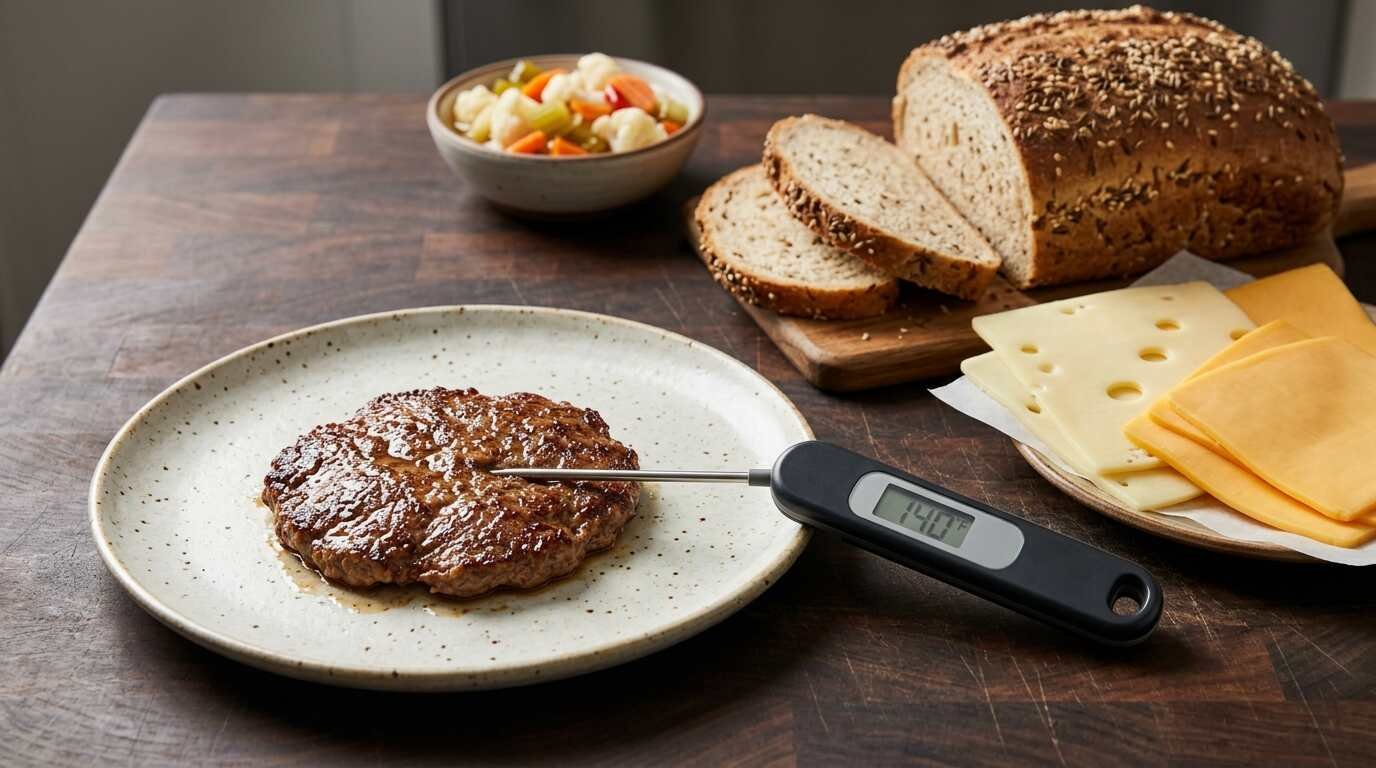
- Heat a cast-iron skillet over medium-high. Sear the patties 2 to 3 minutes per side until deeply browned, and confirm 160°F in the center with a thermometer. Move them to a plate. Leave the browned bits in the pan.
- Drop the heat to medium. Butter one side of each rye slice, then lay two slices butter-side down in the skillet.
- Build in this order: a slice of American on each bread slice, a patty, a generous pile of onions, a slice of Swiss. Top with the remaining bread, butter-side up.
- Press down gently with a wide turner and cook about 3 minutes, until the bottom is deep golden. Flip in one confident motion and cook another 2 to 3 minutes, until the cheese has fully melted.
- Rest for one minute, cut on the diagonal and serve while the crust still crackles.
A short list of variations keeps the base recipe flexible. Pimento cheese spread on the bread follows Phoenicia Diner’s lead. A swipe of mayonnaise on the outside of the bread, in place of butter, browns just as well. And a handful of giardiniera is the nearest thing to the airline version, only with the vegetables actually in the sandwich.
Gear That Earns Its Counter Space
None of this requires a restaurant kitchen, but four tools make the method easier to repeat. Each product below is a real listing, confirmed on Amazon.
- Lodge Pre-Seasoned Cast Iron Skillet, 12 Inches holds the steady heat that browns a thin patty and then toasts the rye in the same pan. See it on Amazon (affiliate link)
- Lodge Pre-Seasoned Cast Iron Burger Press, 6.25 Inches flattens patties evenly and can weigh the sandwich down on the griddle. See it on Amazon (affiliate link)
- OXO Good Grips Stainless Steel Flexible Turner, Medium has a thin flexible edge that slides under a loaded sandwich for the flip. See it on Amazon (affiliate link)
- ThermoWorks Thermapen ONE Instant-Read Thermometer confirms the 160°F center on a thin patty in seconds. See it on Amazon (affiliate link)
As an Amazon Associate I earn from qualifying purchases. A commission may be earned if you buy through this link, at no extra cost to you.
Patty Melt Questions
Is a patty melt just a burger on rye? Close, but descriptions vary. Wikipedia notes it is variously described as a cheeseburger served on sliced bread or as a grilled cheese with a patty and fried onions. The griddle method, where everything cooks together and fuses into one piece, is what separates it from a plain burger.
Swiss or American cheese? Swiss is the traditional choice and gives a nutty flavor. American melts more consistently, which is why Mauro picked it for the airline sandwich. One slice of each covers both bases.
What temperature should the patty reach? The federal food safety chart lists 160°F as the minimum internal temperature for ground beef. A thin patty gets there fast, so check early.
Can the onions be made ahead? Yes. Cooked onions keep in a sealed container in the refrigerator for a few days and reheat gently in a skillet before the sandwich is built.
What bread works if rye is hard to find? Sourdough is the most common stand-in, as long as the slices are sturdy enough to take a press on a hot pan.
You Might Also Like
- The Club Sandwich’s Missing Club: Why the Most Ordered Diner Triple-Decker Has No Verified Origin
- How a Jersey joint started pulling in numbers that would embarrass a mid-size hotel
- White Manna: The Mechanics of the Hackensack Slider
This is for informational purposes only — consult a licensed attorney or financial advisor for your specific situation.
Sources
- Taste Test: Jeff Mauro’s Chicago Patty Melt on United Airlines review, Live and Let’s Fly, Oct. 10, 2026
- Jeff Mauro Shares Secrets Behind United’s New Patty Melt in Impromptu Reddit AMA, The Bulkhead Seat, July 6, 2026
- Patty melt, Wikipedia
- Deconstructing the Perfect Patty Melt, Saveur
- Melt On, Patty Melt, Taste, Feb. 26, 2020
- Five Guys Introduces Patty Melt at Select Locations, Aug. 30, 2024
- It’s National Patty Melt Day, The Nibble
- How to Get Your Burger Fix Without a Grill, Food Network
- Patty Melt recipe, Sip and Feast
- The Best Patty Melt You’ll Ever Make, Sip and Feast on YouTube
- Cook to a Safe Minimum Internal Temperature, FoodSafety.gov