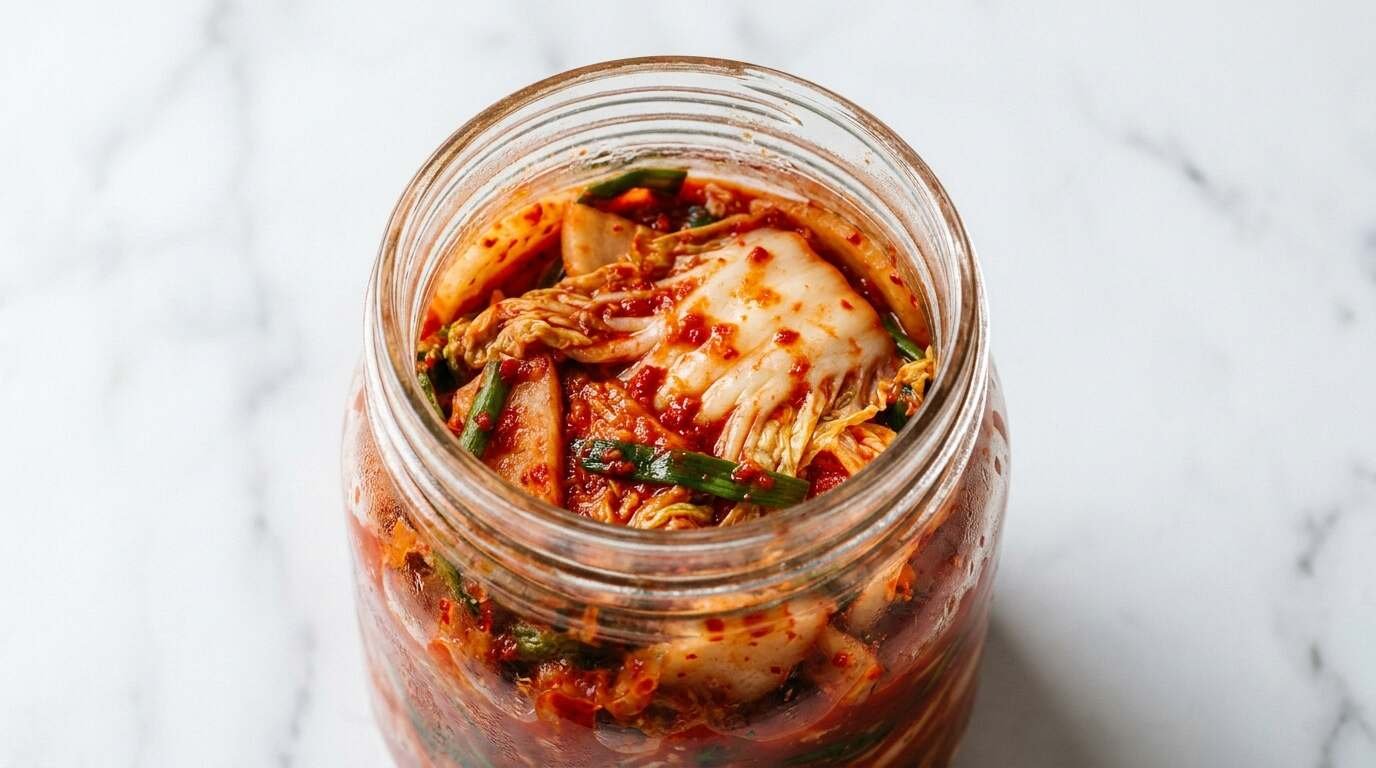
Walk the perimeter of any decent supermarket now and the language has changed. Jars of kimchi wear words that used to belong to clinical journals. Bottles of kombucha promise live cultures and a happier gut. A tub of yogurt advertises billions of organisms with the confidence of a pharmacy. The fermented-foods aisle has learned to talk like a research institute, and somewhere in the translation from laboratory to label, a great deal of careful scientific hedging quietly fell out.
I want to draw a line here, because it matters and almost nobody draws it cleanly. There is real science behind fermented foods. There is also a marketing apparatus that has sprinted far past what that science actually established, selling certainty where researchers offer only promise. Pulling those two apart is the whole job, and it is worth doing for anyone who wants to eat thoughtfully without being quietly sold a story.
What the Best Study Actually Found
The piece of evidence most often invoked, usually without anyone naming it, came out of Stanford. Researchers there ran a clinical trial pitting two diets against each other over ten weeks. Thirty-six healthy adults were randomly sorted into a group eating lots of fermented foods, including yogurt, kefir, fermented cottage cheese, kimchi, other fermented vegetables, vegetable brine drinks, and kombucha, against a group loading up on dietary fiber. The result, published in the journal Cell, was striking enough to travel the world: the fermented-foods group showed an increase in the diversity of their gut microbes and a measurable drop in markers of inflammation, with larger servings producing stronger effects. The high-fiber group, somewhat to the researchers’ surprise, showed little of either.
That is a genuine, well-designed finding, and it deserves respect. It is also a long way from what the supermarket label implies. Thirty-six people, ten weeks, healthy adults, two crude markers. The study opened a door; it did not furnish the room. The lead researchers said as much, calling for far more work on how different diets, probiotics, and prebiotics affect different populations. Science, when it is being honest, talks like that. Marketing never does.

The Phrase With No Definition
Consider the two most powerful words on the entire shelf: gut health. They sound medical. They feel measurable. They are neither. A 2025 review in the journal Advances in Nutrition, authored by the same Stanford group behind the fermentation research, stated the matter with unusual bluntness. The term gut health, the authors wrote, has no regulatory, medical, or scientific definition. It is a colloquial stand-in for the vague absence of disease or the easing of uncomfortable symptoms. Phrases like gut friendly and balanced gut, the review noted, are not defined by any regulatory framework and are not consistently supported by research outcomes.
This is the hinge of the whole problem. When a word means nothing precise, it can be attached to anything and disproven by nothing. A product cannot fail to deliver gut health, because gut health was never a target you could miss. The phrase functions less as a claim than as a mood, and moods do not have to clear the bar that claims do. The review went further, pointing out that foods marketed with terms like gut friendly may contain no live microbes or probiotics at all, nor any ingredient that current science would recognize as benefiting the microbiome.
Probiotic, Live, Active, and the Gaps Between Them
Even the more technical-sounding terms hide trapdoors. A probiotic, in the strict scientific sense, is a live microorganism that confers a health benefit when consumed in adequate amounts, and that definition carries two demands most labels ignore: a specific strain and a specific dose. Benefits demonstrated for one bacterial strain do not transfer to another simply because both are bacteria. A product can shout live cultures while saying nothing about which cultures, how many, or whether they survive the trip through stomach acid to anywhere they might do something. Many fermented foods are pasteurized after fermentation for shelf stability, which kills the organisms outright, leaving a jar that tastes fermented and contains nothing alive.
So the careful eater faces a stack of distinctions the marketing deliberately blurs. Fermented does not guarantee live. Live does not guarantee probiotic. Probiotic does not guarantee the particular strain and dose that any benefit was ever measured for. Each of those gaps is a place where the label can be technically truthful and functionally misleading, and the consumer, reasonably trusting the words, walks out with a product doing far less than the packaging suggested.
What Is Reasonable to Believe
None of this means fermented foods are a scam, and I want to be careful not to overcorrect into cynicism. The honest position sits in the uncomfortable middle. It is reasonable, based on current evidence, to think that regularly eating a variety of genuinely fermented foods that still contain live microbes may support microbial diversity and could modestly temper inflammation in healthy people. Those are real, if tentative, conclusions. Humans have fermented food for millennia for good reasons, and the traditional versions, the ones bubbling in a crock rather than pasteurized into silence, are the ones the research actually studied.
What is not reasonable is to believe a specific jar will fix your digestion, sharpen your immune system, or deliver the nebulous prize of gut health, simply because the label said so. The review I keep returning to put the tension plainly: the gap between scientific research and marketing claims, compounded by the absence of labeling standards, leaves consumers disoriented. The fix is not to stop eating fermented foods. It is to read the words as advertising rather than evidence, and to keep the bar where the scientists keep it.

Eating Thoughtfully Without Being Sold
The practical posture is straightforward once you stop expecting the package to be honest. Favor traditionally fermented products kept in the refrigerated section, since heat-stable shelf placement often signals pasteurization. Treat variety as the goal rather than any single miracle food, which happens to be what the Stanford trial rewarded. Ignore the word natural, which means nothing, and be skeptical of any number of billions of organisms presented without a strain name attached. And hold the marketing claims at arm’s length, not because the food is worthless, but because the food was never the thing being oversold. The story around it was.
There is an older, slower virtue buried in all of this, the same one that separates a real loaf from a factory imitation. Fermentation rewards patience and tradition, which is exactly why it resists the quick promises stamped on its packaging. I wrote about that virtue in my piece on patience as the ingredient nobody is selling, and about the genuine biology beneath the trend in my look at the soil microbiome and nutrient density. Eat the kimchi. Enjoy the kefir. Just keep your trust calibrated to the science rather than the slogan.
You Might Also Like
- Gut Health 101: The Simple 3-Step Plan for a Happier Tummy
- The Soil Microbiome: How Regenerative Organic Farming Affects Nutrient Density
- Protein Leverage Hypothesis: Why Your Body Might Be Tricking You Into Overeating Carbs
Sources
- Advances in Nutrition (2025) — Unpacking Food Fermentation: Clinically Relevant Tools for Fermented Food Identification and Consumption (Gardner, Sonnenburg, et al.)
- Advances in Nutrition — full text of the 2025 fermentation review
- New Atlas — coverage of the Stanford fermented-foods vs. high-fiber trial (published in Cell)
- MLO Online — Fermented food diet lowers inflammation and increases microbiome diversity (Stanford Medicine)
- Stanford Medicine — FeFiFo study overview