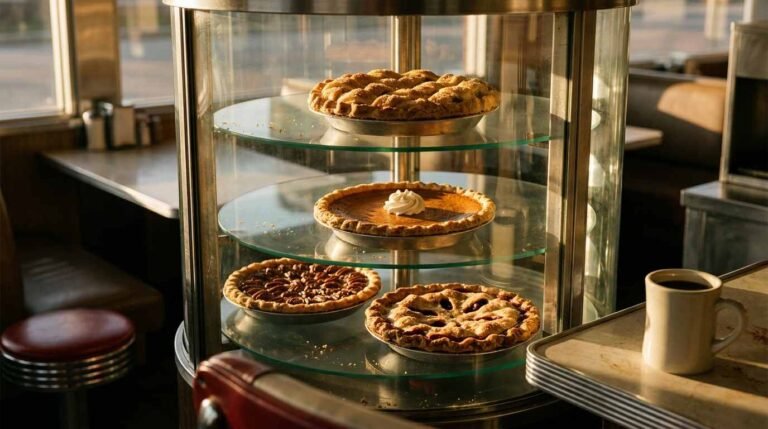
A nickel bought a slice of pie in 1912, and the hand that took the coin belonged to no one. Drop five cents into a slot beside a small glass window, turn a chrome handle, and the door released — custard pie, baked beans, a ham sandwich on white, already plated and waiting behind the glass like a museum case that happened to serve lunch. No cashier, no waiter, no kitchen in sight. The food simply appeared, replenished from behind the wall by staff the customer never saw, and that invisibility was the entire point.
The Automat wasn’t a gimmick bolted onto a restaurant. It was a restaurant built around a machine, and the machine was built around a very specific anxiety: the fear, common to the industrializing city, that human hands touching your food introduced some kind of risk — hygienic, social, moral — that chrome and glass did not. Horn & Hardart, the Philadelphia partnership that brought the concept to the United States after studying a German coin-operated restaurant called Quisisana, opened its first American Automat in Philadelphia in 1902 and brought it to New York a decade later, planting a Times Square location that would become one of the most photographed restaurants in the city’s history.
A Machine That Solved a Labor Problem by Pretending It Didn’t Have One
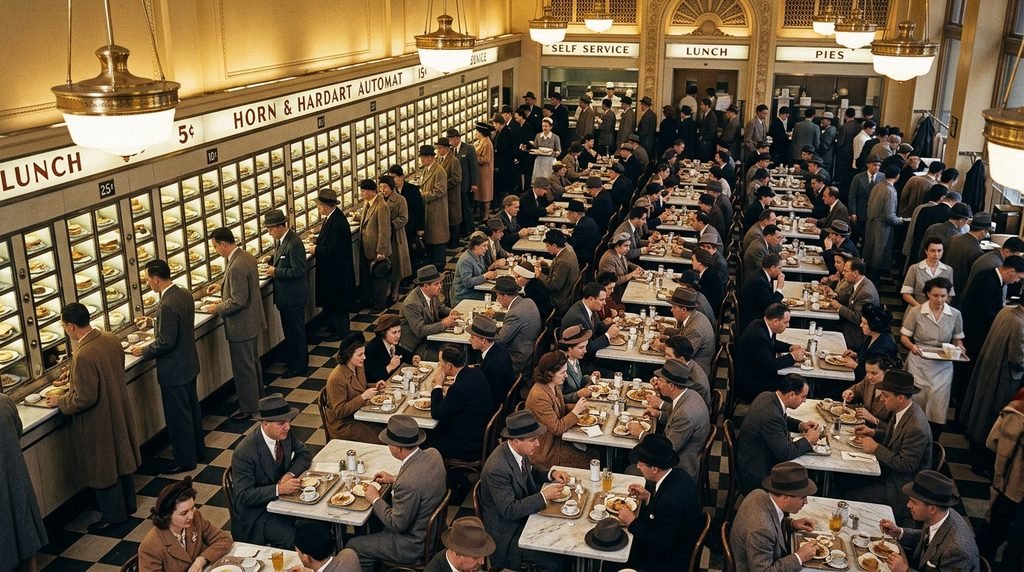
The genius of the Automat, and its central deception, was that it looked automated while running almost entirely on human labor. Behind every wall of little windows stood a kitchen staffed by cooks, dishwashers, and the people — mostly women, in the early decades — whose job was to restock the compartments from the rear before anyone up front noticed a gap. The customer-facing fiction was mechanical perfection: food that arrived without a visible supply chain. The backstage reality was an assembly line as intricate as any factory floor, timed to the rhythm of lunch rushes and dinner crowds, where a slow restock meant an empty window and a disappointed nickel-holder standing in front of glass with nothing behind it.
This sleight of hand mattered because it let Horn & Hardart sell something no full-service restaurant could: dignity at a discount. A stenographer, a factory hand, a Wall Street runner — anyone with a nickel — could eat the same baked macaroni, from the same case, with the same small ceremony of turning the handle, as the man in the next booth over. There was no table service to tip, no waiter to judge the cheapness of the order, no host to seat you by the quality of your coat. The machine didn’t care who you were. For a city sorting its population by income at every other storefront, that indifference was close to radical.
The Coffee Dolphins and the Architecture of Theater
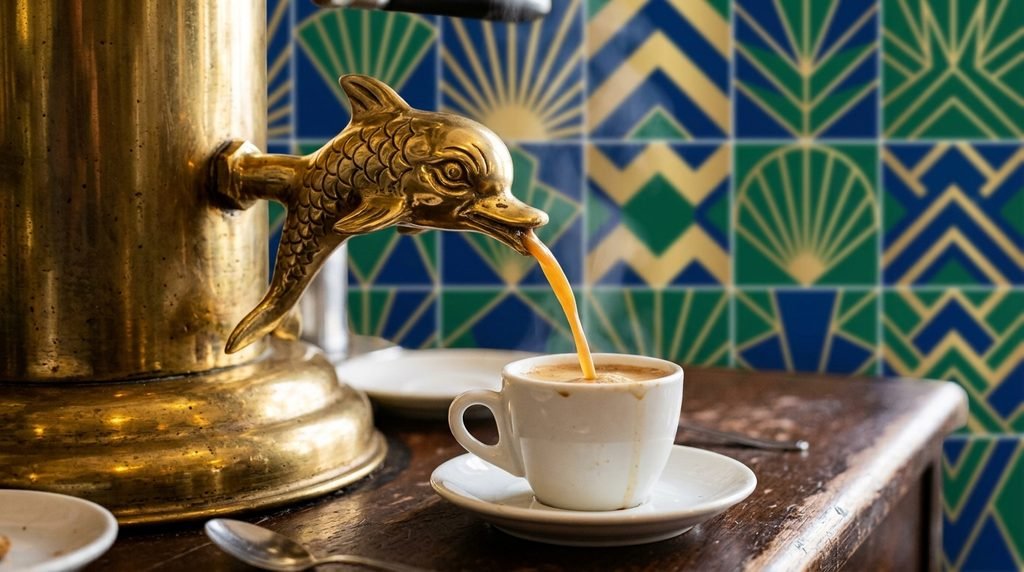
Horn & Hardart understood that the mechanism itself needed to be beautiful, not merely functional, and the company spent accordingly. Locations were built with marble floors, art deco fixtures, and — most famously — spigots shaped like dolphin heads that poured coffee into a cup in a single, satisfying arc. The dolphin spouts weren’t necessary. A straight pipe would have moved the same coffee. But a company selling the experience of mechanized dining needed the mechanism to feel like spectacle, not like deprivation, and a brass dolphin pouring your five-cent coffee did something a cardboard cup never could: it told you that cheap didn’t mean joyless.
That theatrical instinct extended to the coin changers, usually staffed by a cashier perched in a glass booth at the entrance, converting dollar bills into the nickels the machines required with a speed and showmanship that became its own small performance. Visitors described watching the exchange the way they’d describe watching a card trick — fingers moving too fast to track, coins stacking in neat towers, the whole transaction finished before the customer had fully processed what just happened.
Peak Automat and the Numbers That Made It Work
By the 1930s and 40s, Horn & Hardart operated dozens of Automats across New York and Philadelphia, serving what the company estimated at hundreds of thousands of meals daily across its locations at the format’s height. The economics depended on volume and turnover in a way that modern fast food would recognize instantly: thin margins per plate, offset by enormous throughput, in locations positioned at the densest pedestrian intersections a city could offer. Times Square. Herald Square. The financial district at lunch hour. Horn & Hardart didn’t chase foot traffic — it planted itself directly in the river of it and let the current do the marketing.
The format also depended on central commissary kitchens that prepared food for multiple locations, an operational structure that modern chains would later formalize and scale into what the industry now calls commissary-based fast food. The Automat’s engineers were solving the same problem Ray Kroc would solve a generation later at McDonald’s: how to deliver a consistent product at speed, without requiring a skilled cook at every location. Horn & Hardart simply solved it with vending mechanisms instead of standardized griddle procedures, and got there first by half a century.
Why the Wall of Windows Couldn’t Survive the Car
The Automat’s decline wasn’t a single failure but a slow mismatch between a format built for dense pedestrian cities and a country reorganizing itself around the automobile and the suburb. A restaurant that depended on walk-up volume in Manhattan’s densest corridors had no answer for a customer base dispersing into Levittown and its countless imitators, where the car, not the sidewalk, delivered the lunch crowd. Fast food chains built for the drive-thru — requiring a window, a car line, and a parking lot instead of a subway stop — inherited the exact customer Horn & Hardart had spent sixty years training to expect fast, cheap, anonymous service. The company had taught America to want exactly the thing the suburbs would deliver through a different machine entirely.
Rising labor costs squeezed the model from the other direction. The invisible army restocking the windows got more expensive to employ just as the visible premise of the format — speed without a cashier — got cheaper to replicate through other means. By the late 1960s, Horn & Hardart was converting Automats into Burger King franchises, an irony that essentially writes its own headline: the restaurant that invented the aesthetic of automated fast food lost to a company that automated the kitchen instead of the dining room. The last New York Automat, on 42nd Street, closed its doors in 1991.
What the Format Actually Predicted
Strip away the dolphin spouts and the nickel slots, and the Automat’s real innovation reads as prophecy rather than nostalgia. It decoupled the experience of selecting food from the labor of serving it, which is precisely the bet every self-checkout kiosk, QR-code menu, and app-based ordering system has made since. It used architecture and small ceremony — the handle, the glass, the arc of poured coffee — to make a transaction feel like an event, the same bet a well-designed drive-thru lane or a Vegas buffet line still makes today. And it proved that Americans would trade the comfort of being served by a person for the comfort of not being judged by one, a trade the self-checkout line reaffirms every single day with vastly less brass.
The diner survived where the Automat didn’t, and the difference is instructive. A diner kept the counter, the stool, the short-order cook calling out tickets, the waitress who remembers how someone takes their coffee — all the human friction the Automat had tried to engineer away. It turns out that friction, deployed carefully, is a feature. The Automat removed the person and sold efficiency. The diner kept the person and sold familiarity. Both were right about something, which is why one still exists mostly in photographs and the other is still open for breakfast.