Nobody in the film appears to hurry, and that is the unsettling part. A short clip from 1971, passed around online under the title Spider, shows Kenneth S. Osgood working the grill at a diner in Laconia, New Hampshire, and its YouTube description sets the scene as 2 a.m. with a room of inebriated customers. Orders stack up. Plates leave the counter. The man at the center never seems to break a sweat, which is how an obituary quoted by Laughing Squid explains his nickname: it came from “his ability to multi-task.”
What the clip really demonstrates is sequencing, and sequencing is the one skill a home cook can steal outright. Every breakfast plate is three timelines braided together, and the cook who knows which one starts first wins. The methods below come from published testing by America’s Test Kitchen, adapted for a home stove. They are not a record of what any particular diner does, and the post says so wherever the difference matters.
Eggs: Salt Early, Pull Early
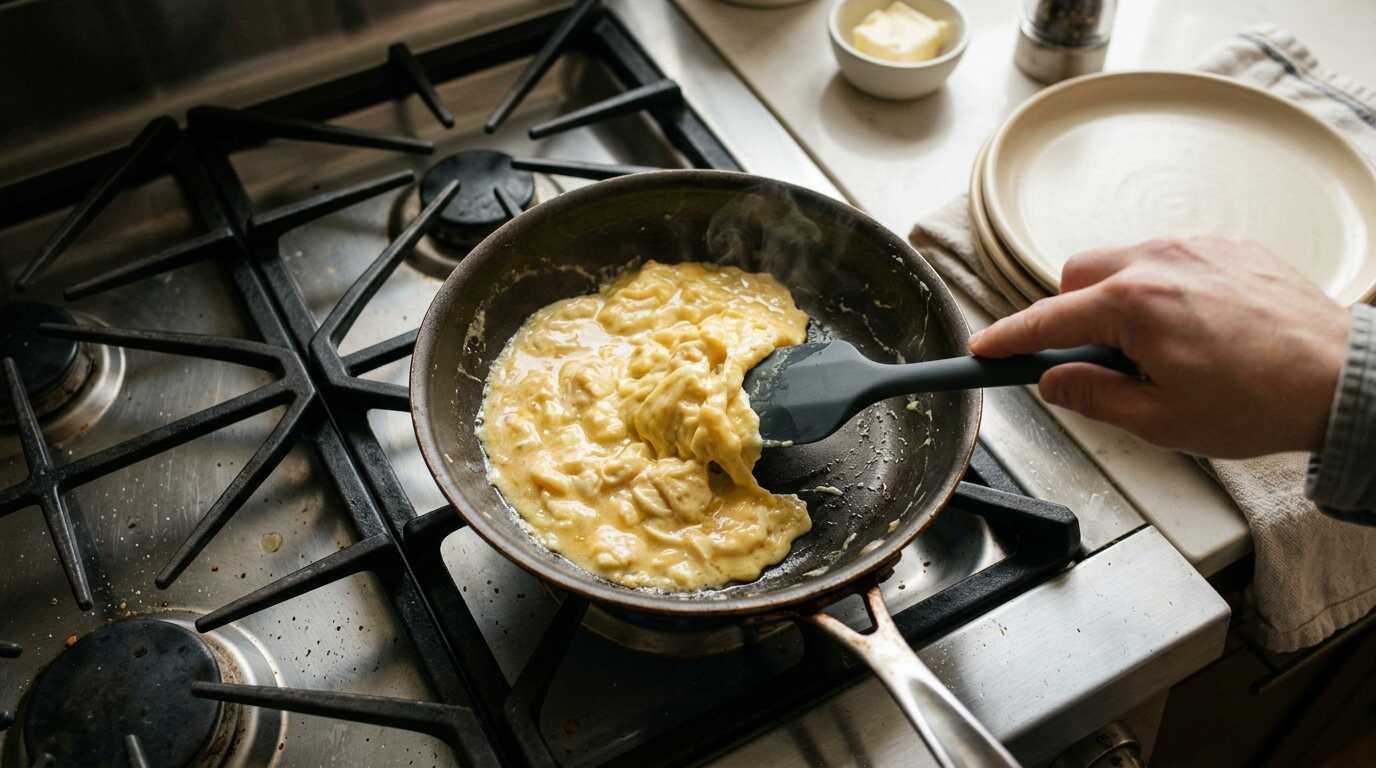
Scrambled eggs fail in one of two directions: rubbery or weeping. America’s Test Kitchen’s six-tip guide to scrambled eggs steers between the two with a handful of small, specific moves.
Start with salt. The test kitchen salts the raw eggs before they touch the pan, because salt loosens egg proteins and keeps the curds tender. Beat with a fork until just combined, not a whisk, so the proteins don’t unfold too early. Use half-and-half, which the article prefers to milk (it can weep) and heavy cream (it makes the eggs dense), and add two extra yolks to eight eggs for richness and a little insurance against overcooking.
Heat does the rest. Begin over medium-high, scraping the bottom and sides of the pan until the spatula leaves a trail, then drop to low and fold the eggs over themselves. A smaller skillet helps too: for two servings, the guide suggests four eggs, one extra yolk and an 8-inch pan, which keeps the layer thick. Pull the pan while the eggs are “clumped and just slightly wet,” because carryover heat finishes the job on the plate.
Fried eggs are a different discipline, with their own flat-top temperature logic, and the diner fried egg science guide covers them in full.
Home Fries: Dry Surface, Hot Pan
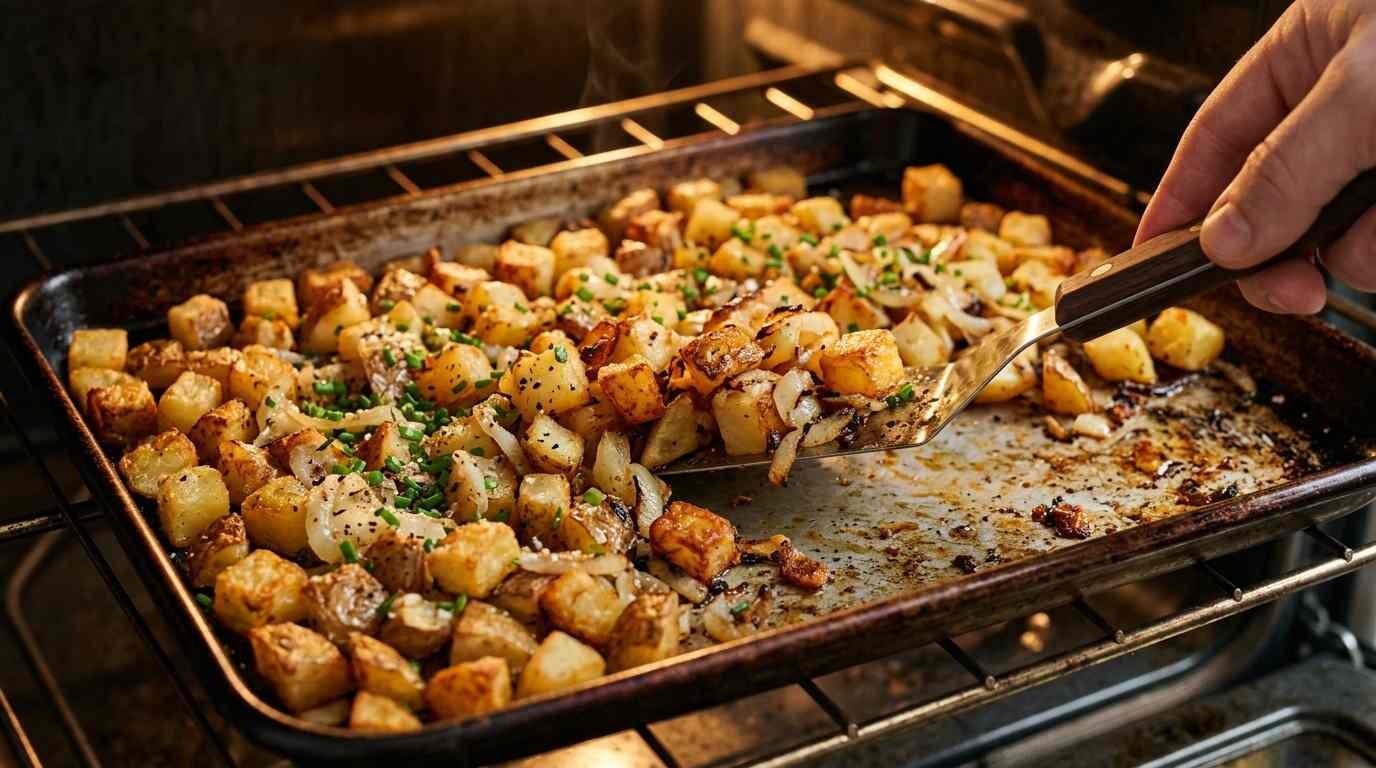
Good home fries are crisp outside and tender inside, and the ATK method gets there by treating the potato before the pan ever heats. It also departs from a flat-top in one respect: it roasts on a preheated baking sheet in a 500°F oven instead of frying on a griddle.
The sequence is exact. Peel 3½ pounds of russets and cut them into ¾-inch dice. Boil them in 10 cups of water with ½ teaspoon of baking soda for just 1 minute, then drain. Return the potatoes to the dry pot over low heat and shake for about 2 minutes until the surface moisture evaporates. Off the heat, add butter, salt and a pinch of cayenne and mix for about 30 seconds, until the potatoes wear a thick, starchy paste.
Then comes the hot sheet. Spread the potatoes over a baking sheet that has been heating on the lowest oven rack, drizzled with 2 tablespoons of oil, and roast for 15 minutes. Turn them with a thin metal spatula, clear a patch in the center for the onions, and roast 15 more. One final scrape and stir, then 5 to 10 minutes more, until the potatoes are well browned and the onions have softened. Chives go in last.
Cast iron fans have their own take on the same dish, and the cast iron versus carbon steel skillet guide helps decide which pan earns the stovetop.
Pancakes: Leave the Lumps Alone
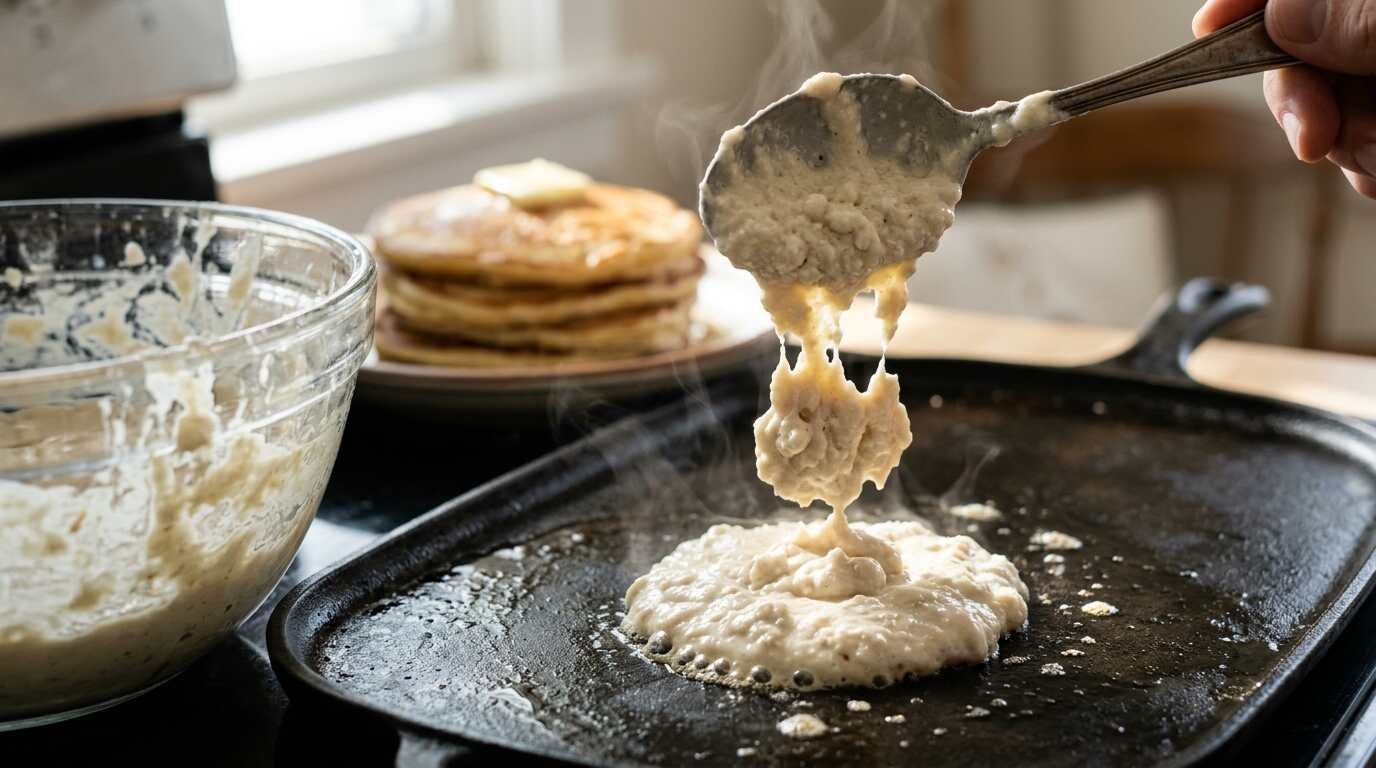
Pancake batter rewards restraint. America’s Test Kitchen’s “secret to fluffy pancakes” piece makes the case in a single sentence:
“Overstirring the batter deflates it and overdevelops gluten.”
America’s Test Kitchen
The practical rules follow from it. Keep the batter lumpy, because smooth batter is overmixed batter, and overmixing knocks out the air that makes a pancake rise. Then let it rest at least 10 minutes. The wait gives the flour time to absorb liquid, which dissolves the lumps on its own, and lets the leavener spread air evenly through the bowl. Swapping milk for buttermilk adds more lift: its acid reacts with baking soda to make extra carbon dioxide, and its thicker body holds air bubbles while the cakes cook.
The ATK piece does not give griddle temperature or flipping timing, so those details stay out of this post. For a full recipe with timings and the butter-crisped edge, the fluffy buttermilk pancake recipe is the place to go.
One Plate, Three Clocks
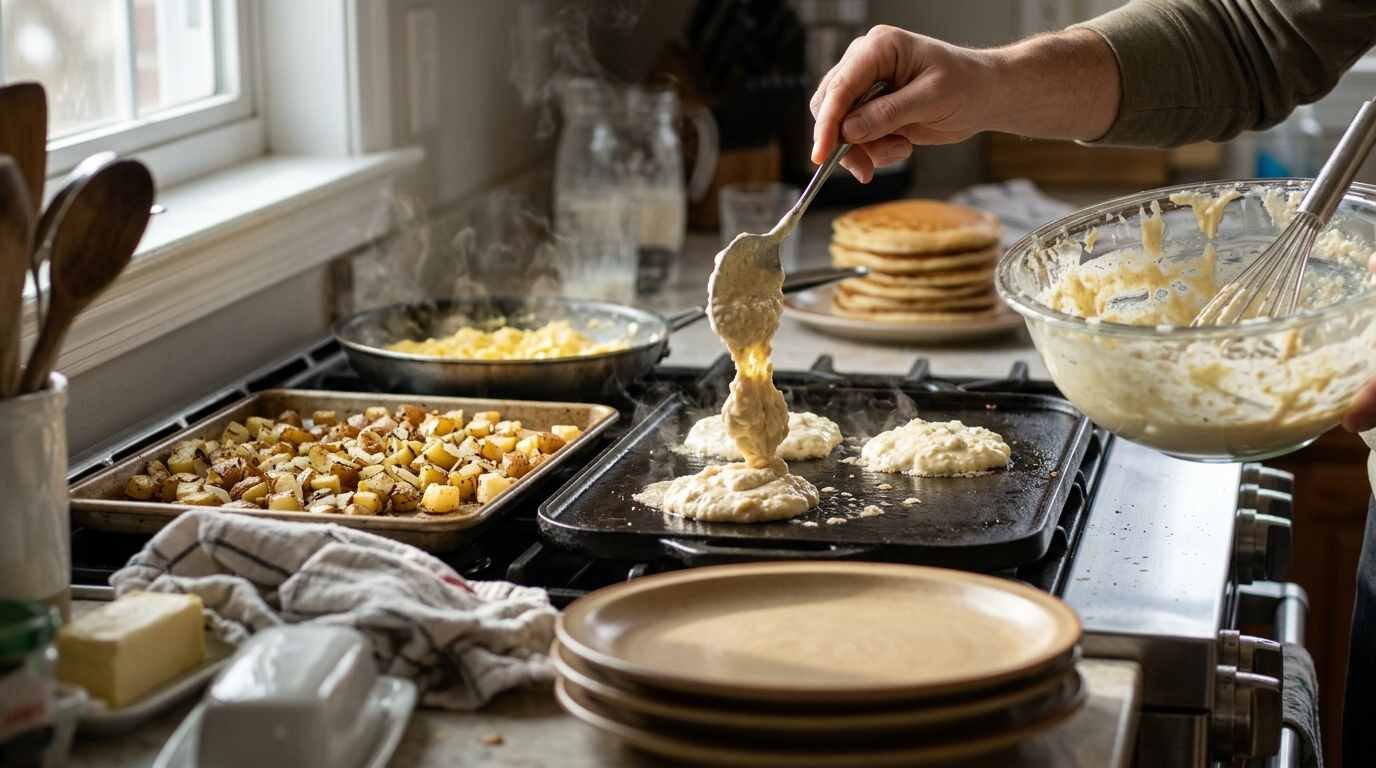
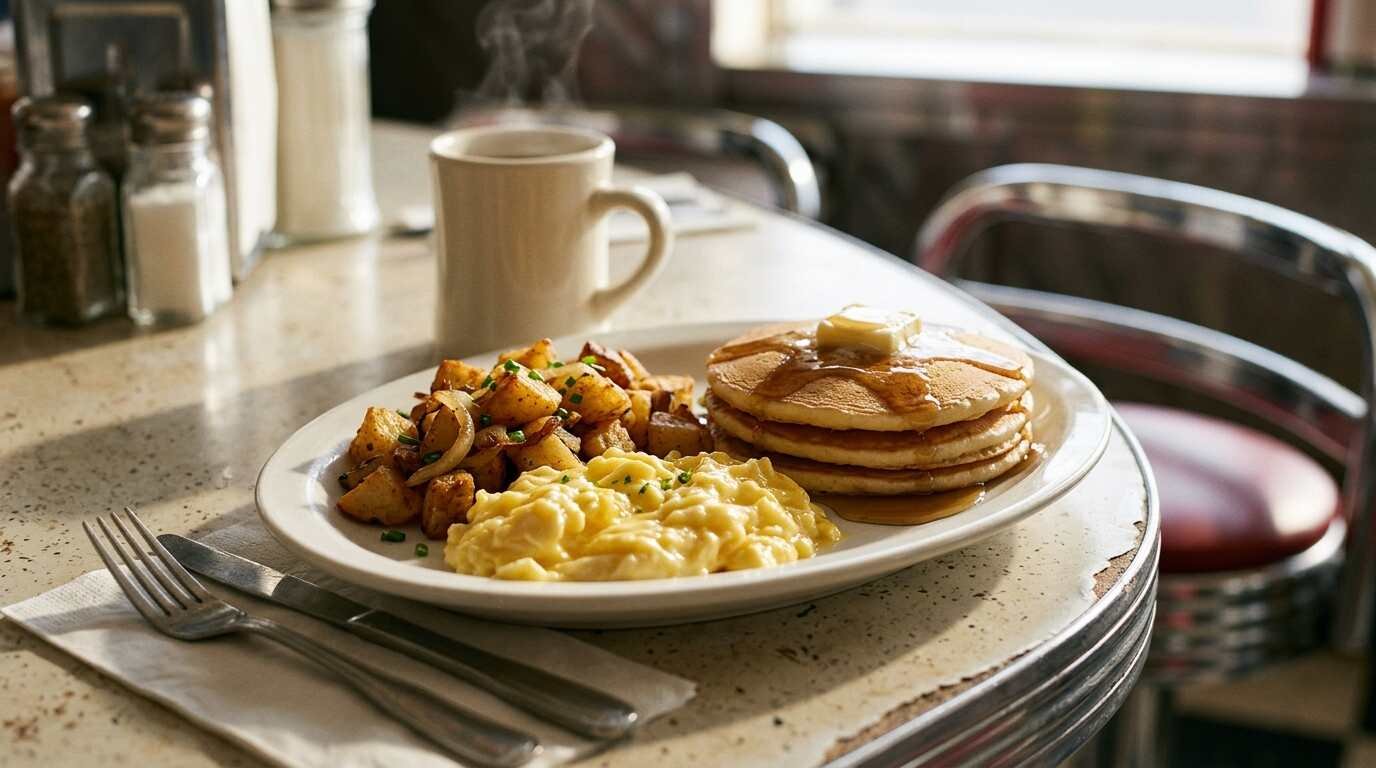
The line cook’s real edge is the order of operations, and the same logic scales down to a kitchen for two. Home fries need the longest: roughly 35 to 40 minutes in the oven once the parboil and drying are done, going by the ATK timings above. Pancake batter needs its 10-minute rest, which fits neatly inside that window. Eggs take minutes and are the most perishable, so they go last, straight onto warm plates.
That order is planning advice built on the published timings, not a quotation from any one source. Adjust it to your oven and your pans.
| Dish | Key move | Timing | Source |
|---|---|---|---|
| Scrambled eggs | Salt the raw eggs, start medium-high, finish on low | Pull while “just slightly wet” | ATK scrambled egg tips |
| Home fries | Parboil 1 minute, dry 2 minutes, roast on a 500°F sheet | 15 + 15 + 5 to 10 minutes in the oven | ATK home fries |
| Pancakes | Keep lumps, rest the batter | At least 10 minutes | ATK pancake secrets |
For plating order and the full assembly, the step-by-step diner breakfast platter guide pairs well with this one, and the crispy corned beef hash makes a worthy swap for the potatoes.
Questions People Ask
Why salt scrambled eggs before cooking them? According to America’s Test Kitchen, salt loosens the egg proteins, which keeps the curds tender.
Do I need a flat-top griddle for home fries? Not for the ATK method. It roasts the potatoes on a baking sheet that has preheated with the oven at 500°F.
Should pancake batter be smooth? No. The ATK guidance is to leave it lumpy and let it rest at least 10 minutes, after which the lumps dissolve as the flour absorbs liquid.
Is half-and-half better than milk in scrambled eggs? ATK’s article prefers it, since milk can weep and heavy cream makes the eggs dense.
Who was the cook in the viral 1971 video? Scout Magazine identifies him as Kenneth S. Osgood of Laconia, New Hampshire, known as “Spider.” The sources reviewed do not name the filmmaker.
Sources
- Scout Magazine — Smoke Break: the 1971 moves of a New Hampshire short order cook
- Laughing Squid — Short Order Cook Moves at Incredible Speed
- YouTube — “Spider” (embedded by both articles above)
- America’s Test Kitchen — Home Fries
- America’s Test Kitchen — 6 Tips for the Best Scrambled Eggs
- America’s Test Kitchen — What’s the Secret to Fluffy Pancakes?