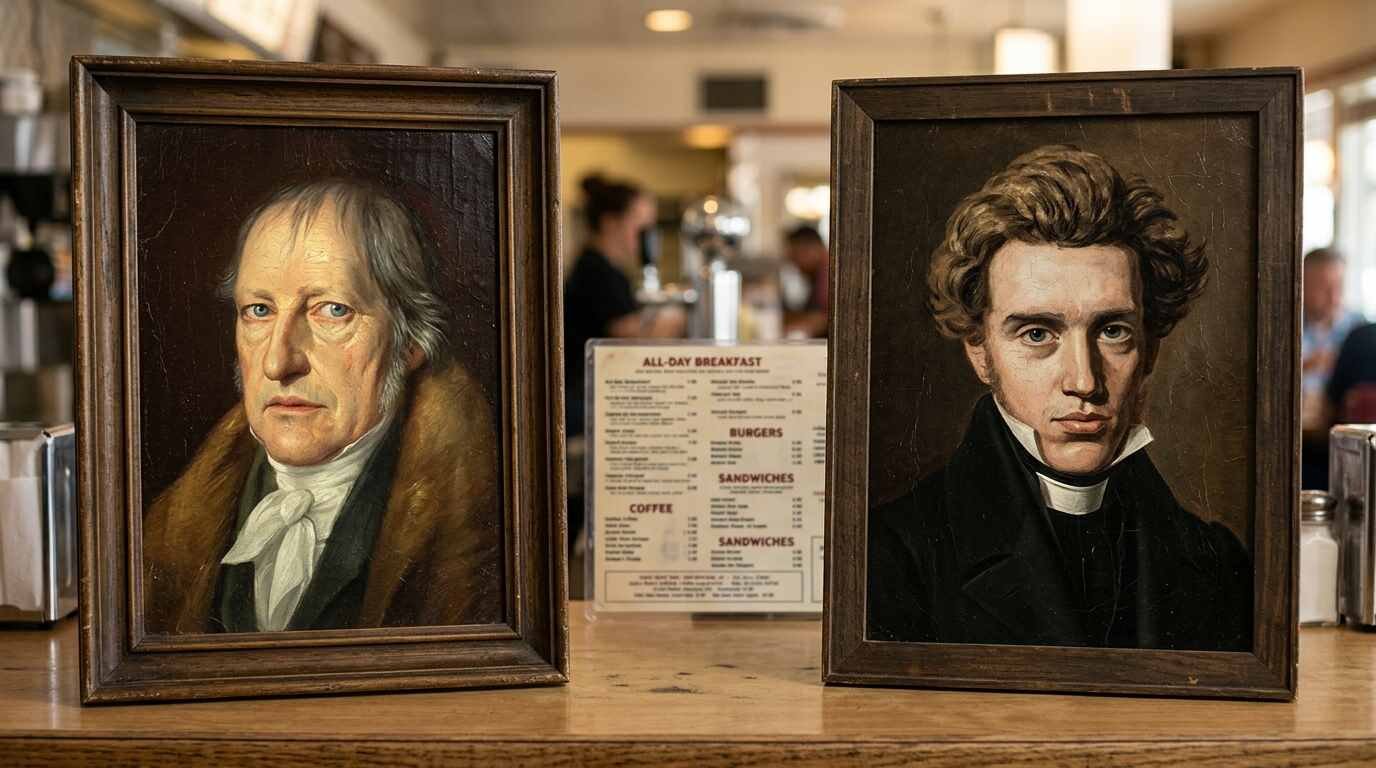
There is a moment that happens at every diner counter — this one included — when a customer picks up the menu, scans it for thirty seconds, and then orders whatever they always order. The menu is a ritual, not a decision. The choice was made before they sat down. Georg Wilhelm Friedrich Hegel, I am fairly certain, would have found this philosophically intolerable. Søren Kierkegaard would have found it proof of everything he’d been saying all along.
The two men never shared a meal. They barely shared an era — Kierkegaard arrived in Berlin in 1841, eighteen years after Hegel’s death, specifically to attend Friedrich Schelling’s lectures at the University of Berlin, where Schelling was publicly dismantling Hegel’s legacy. Kierkegaard came loaded for bear. His notebooks from that Berlin winter, preserved and edited by Howard and Edna Hong in Søren Kierkegaard’s Journals and Papers, are a record of a young man building his case against a dead philosopher who, infuriatingly, could not be cross-examined. What they document is something more than academic disagreement: it’s personal. Kierkegaard found Hegel’s system not merely wrong but offensive — an act of intellectual hubris that tried to swallow the individual whole.
Set them both down on counter stools at 7 AM and hand them laminated menus. The confrontation that follows tells you more about their philosophies than any seminar.
Hegel Orders the Synthesis
Hegel’s central move — the one Kierkegaard could not forgive — is the dialectic. Thesis meets antithesis, and from the collision emerges synthesis, a higher unity that Aufhebung — that beautiful untranslatable German word — simultaneously cancels, preserves, and lifts to a new level. It’s the operating logic of his Phenomenology of Spirit, and according to Robert Pippin’s close reading in Hegel’s Practical Philosophy (Cambridge University Press, 2008), it extends naturally into the domain of desire and consumption. Hegel thought self-consciousness itself emerged through the encounter with the other — we become aware of ourselves by recognizing what we are not, by the resistance things offer to our wanting them.
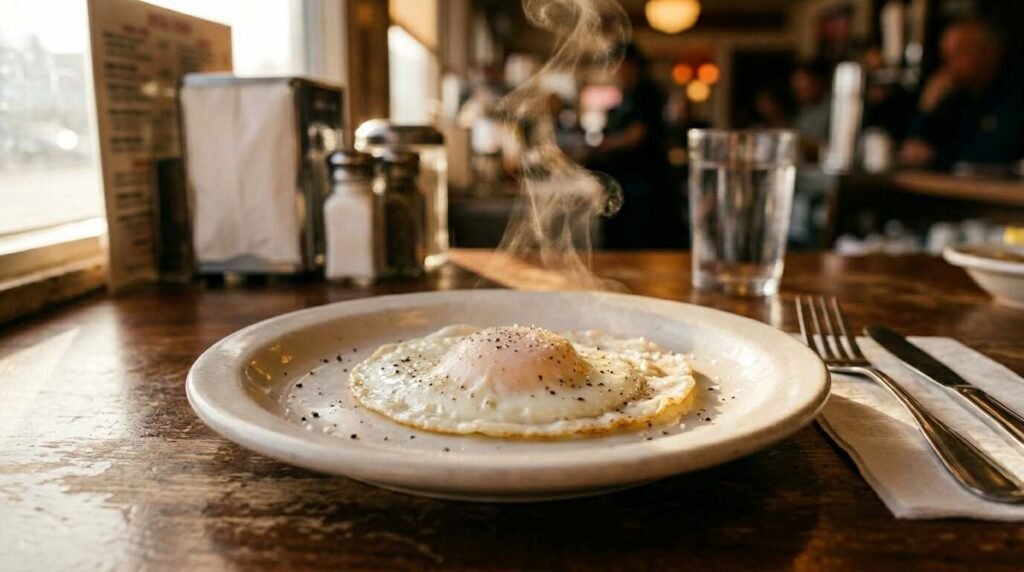
Apply this to breakfast: over easy versus sunny-side up is not merely a preference. It is a dialectical tension. Over easy (controlled, committed, the yolk sealed behind a membrane of cooked white) represents one pole. Sunny-side up (exposed, vulnerable, the yolk trembling and unresolved) is the antithesis. Hegel, consistent with his system, would demand the synthesis — perhaps a basted egg, where the yolk is neither fully sealed nor left entirely raw, but holds both conditions simultaneously in a higher unity achieved through steam.
I am not being entirely facetious. Hegel genuinely believed that apparent contradictions resolve into higher unities — that the job of reason is to move through contradiction rather than pick a side. A menu presenting over easy or sunny-side up would strike him as a false binary. The short-order cook’s refusal to commit — “I can do it however you want” — would be the most Hegelian thing in the room.
Why Kierkegaard Would Have Ordered Black Coffee
Kierkegaard’s weapon against Hegel was the individual. Specifically: the individual’s irreducibility to any system, no matter how elegant. In his Berlin journals he wrote with barely concealed fury about Hegel’s attempt to make the concrete particular vanish into abstract universality. Hegel, Kierkegaard believed, had built a magnificent palace of thought and then somehow neglected to leave room in it for any actual people.
The leap of faith — Kierkegaard’s famous counter-move — is precisely what Hegel’s system cannot accommodate. For Hegel, faith is a stage of consciousness to be sublated, overcome, lifted into the clarity of Absolute Knowledge. For Kierkegaard, it is the only authentic response to a universe that never resolves into clarity. You cannot think your way into faith; you can only jump.
At the counter, Kierkegaard would not have been reading the menu at all. He would have looked at it, experienced what he called Angest — that anxious vertigo of too much freedom — and ordered black coffee. Not because he doesn’t eat, but because the act of choosing eggs reveals your metaphysics. Kierkegaard’s three stages of existence — the aesthetic, the ethical, and the religious — map uncomfortably well onto three ways of ordering breakfast. The aesthetic man orders whatever sounds best right now. The ethical man orders the same thing every time, out of discipline and habit. The religious man sits with the menu and feels the weight of his freedom before doing anything at all.
Kierkegaard, one suspects, would have felt that weight for longer than the waitress had patience for.
The Counter as Democratic Space
There is a particular social architecture to a diner counter that both philosophers would have registered, though they would have read it differently. The counter flattens hierarchy in a way the dining room does not. A booth implies privacy, negotiated space, a chosen company. The counter is public — you sit beside whoever happens to arrive.
This matters historically. The Long Island diner counter during the postwar decades was genuinely democratic territory. The Benson Diner in Selden, documented in Michael Engl’s research at the Long Island Studies Institute at Hofstra University, was the kind of place where the electrician and the insurance salesman ate identical plates of eggs twenty minutes apart without ceremony. The Newsday archives from the 1970s capture this quality of Long Island’s counter-stool culture explicitly — the diner as a classless space that the suburb, with all its status-marking architecture, quietly depended on.
Hegel would read the counter as Geist — Spirit — working through democratic institutions, the social becoming conscious of its own movement toward freedom. The counter proves his point: the particular identities (electrician, insurance salesman) are Aufhebung-ed into a higher unity (diner customer), which is itself a stage in the unfolding of collective self-consciousness. He would have found this satisfying.
Kierkegaard would have found it lonely. The democratic leveling of the counter was also, for him, the erasure of the individual — what he called the leveling tendency of mass society, which he criticized in The Present Age with a ferocity that sounds remarkably contemporary. The counter produces not genuine community but the illusion of it: fifty strangers eating side by side, none of them genuinely encountering the other. Kierkegaard would have seen every diner in America as an emblem of what he feared.
On the Menu as False Choice
Here is where it gets philosophically interesting: neither of them would have been satisfied with the menu as written.
Hegel’s system implies that every apparent either/or conceals a hidden both/and. The menu’s structure — eggs or pancakes, over easy or scrambled — presents choices as exclusive when they are actually complementary moments in a larger unity. A properly Hegelian diner would offer not a menu but a dialectical progression: you begin with coffee (thesis: alertness, wakefulness), you are offered something sweet (antithesis: pleasure, the body’s desire), and the synthesis arrives as the eggs — protein resolving the tension between stimulation and satisfaction. The diner’s actual menu, which lists everything simultaneously without progression, strikes the Hegelian as chaotic. It presents the moments of the dialectic out of order and without relation.
Kierkegaard’s critique is different. For him, the menu is a structure of what he might call despair: the despair of infinite possibility. When everything is available, when you can have the steak or the oatmeal or the Belgian waffle, the freedom becomes its own kind of trap. The menu produces not liberation but paralysis — what he diagnosed as the sickness of the age, the too-many-choices problem that the 19th century was only beginning to feel and the 21st century has made into an epidemic. His prescription was not fewer choices but a different relationship to choosing: choosing yourself, committing, becoming a particular individual who has made a particular decision and accepted its consequences.
This has always struck me as the thing Kierkegaard was actually arguing for: not that choice is impossible, but that most people choose without actually choosing. They drift into a selection. The menu becomes a mirror of the life they’re already living without having decided to live it.

The Phenomenology of the Short-Order Cook
Neither philosopher ever spent time in a professional kitchen, which is their loss. The short-order cook is, in certain respects, a living refutation of both of them.
Against Hegel: the cook has no interest in synthesis. When three tickets come in simultaneously — one over easy, one scrambled, one poached — the cook does not seek a higher unity. The cook executes. The particular demands of each order are honored in their particularity. The flat-top is not a dialectical space. It is a space of radical attention to the concrete.
Against Kierkegaard: the cook has made a prior decision — to cook these eggs, for these customers, at this hour — and every subsequent choice flows from that commitment without anxiety. The religious stage, if there is one in a kitchen, is not a leap into the unknown. It’s the decision to show up at 5:30 AM and do the same thing exceptionally, over and over, until it has the quality of a vocation.
I’ve thought about this more than I probably should, standing behind my own counter at Heritage Diner for the better part of twenty-five years. There is something to the cook’s relationship to repetition that neither of them fully accounted for. The eggs are different every morning — different customers, different conversations, different light coming through the same east-facing windows. And they are the same every morning. The synthesis that matters isn’t between over easy and sunny-side up. It’s between the sameness of the work and the difference of each day within it.
Hegel might call that Spirit becoming conscious of itself through habit. Kierkegaard might call it the religious stage in its working clothes. They would probably still argue about it. That’s all right. The coffee would stay warm.
What Your Breakfast Order Actually Reveals
The question in the title is only half a joke. Hegel would have ordered something that synthesized, something that acknowledged both sides of the binary without being enslaved to either. The basted egg, or perhaps a dish that combined eggs with something unexpected — the kind of choice that disrupts the menu’s false categories.
Kierkegaard would have ordered the black coffee and sat with the menu until the anxiety resolved into either authentic choice or a graceful capitulation to whatever the waitress recommended. He believed in the particular, which meant he would have needed a particular reason for any particular thing.
The diner counter has been hearing these arguments for a hundred years, in the language not of philosophy but of breakfast. Every morning someone comes in who needs to be talked into something — who sits with the menu as if the right answer is in there if they look long enough. Every morning someone else sits down and orders the same thing they’ve had for thirty years, and has figured out something that neither Hegel nor Kierkegaard entirely managed: that the repetition of a genuine choice is not a failure of freedom. It’s what freedom looks like when it grows up.
I wrote about this kind of daily commitment — the philosophy built into routine rather than against it — in my piece on Rodin’s The Thinker, and it keeps coming back to me whenever someone can’t decide between the eggs.
You Might Also Like
God Is Dead, Prove It: Kierkegaard vs. Nietzsche and the Fight That Never Happened
The Philosophy of History by Georg Wilhelm Friedrich Hegel
What Is It Like to Be a Brain? The Philosophical War Between Reductionism and Emergence
Sources
Søren Kierkegaard, Journals and Papers, Vol. 5, edited by Howard V. Hong and Edna H. Hong. Indiana University Press, 1978. iupress.indiana.edu
Robert Pippin, Hegel’s Practical Philosophy: Rational Agency as Ethical Life. Cambridge University Press, 2008. cambridge.org
G.W.F. Hegel, Phenomenology of Spirit, trans. A.V. Miller. Oxford University Press, 1977.
Michael Engl’s documentation at the Long Island Studies Institute, Hofstra University. hofstra.edu
Newsday Long Island diner archives, searchable via Hofstra University Library digital collections. hofstra.edu/library