An emperor built himself a retirement palace. He grew cabbages. Centuries later, the walls are still standing and people are living inside them. The emperor is not mentioned.
Not often, anyway. The residents of Diocletian’s Palace — all three thousand of them, living and working within a structure covering roughly 38,000 square meters of the historic core of Split — are not, in the main, spending much time thinking about Diocletian. They are buying groceries and arguing about parking and raising children and doing what people do when they live somewhere, which is inhabit it rather than contemplate it. The palace is their address. It is only the visitor who insists on treating it as a monument.
This is a failure of the visitor’s imagination, and also its most useful corrective.
What the UNESCO Listing Doesn’t Capture
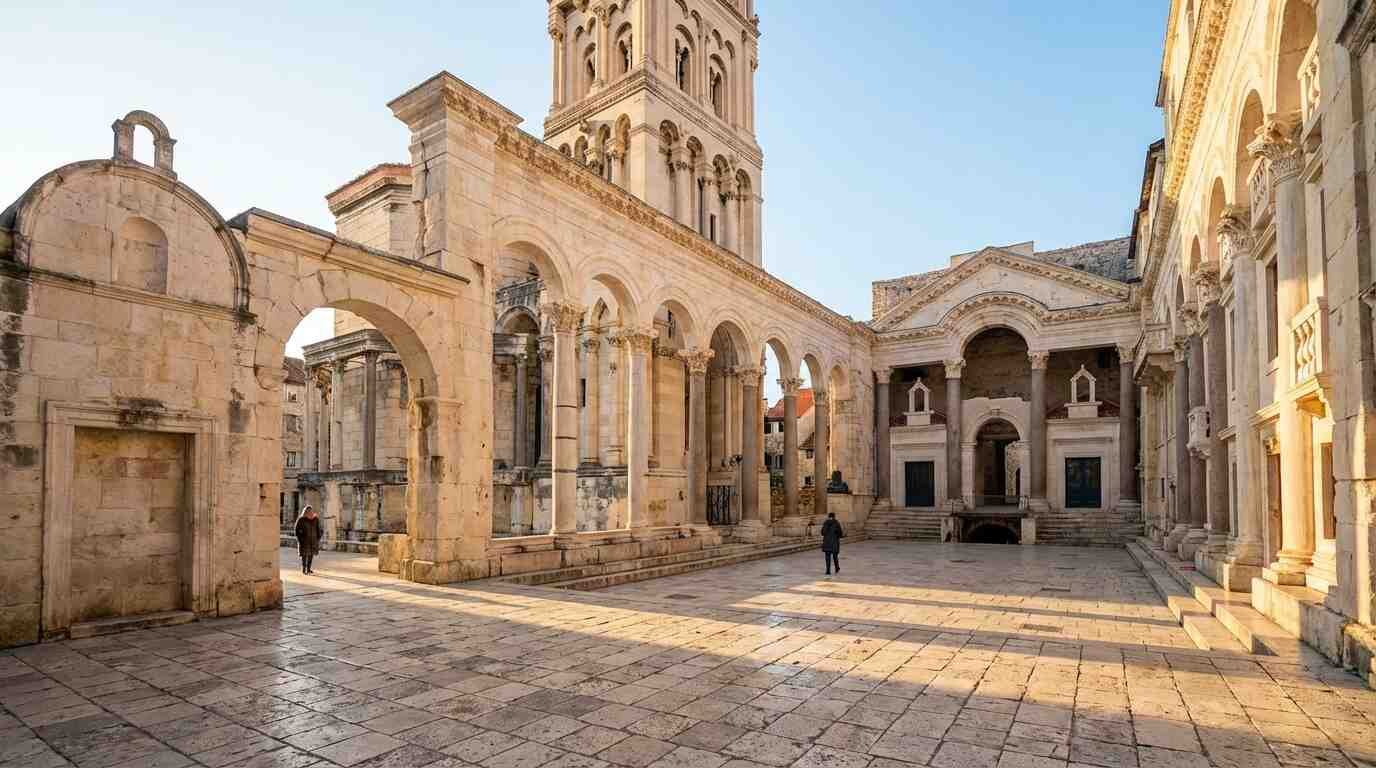
Diocletian’s Palace is a UNESCO World Heritage Site, listed since 1979 as part of the historic city of Split. The official documentation describes it as one of the most complete surviving examples of late Roman architecture, built between approximately 295 and 305 AD as a fortified retirement residence for Emperor Diocletian following his abdication. The site covers three hectares within Split’s historic center. The walls stand between seventeen and twenty-eight meters high. The palace originally contained temples, apartments, a mausoleum, and enough infrastructure to function as a small city — which is what it became, organically, when the Roman administrative structure collapsed and the local population moved inside the walls for protection.
What the UNESCO listing does not capture, because UNESCO listings are not written to capture it, is the specific quality of the Peristyle — the central courtyard of the palace complex — on a November morning when there are four other people visible and three of them are locals going somewhere with purpose, and the fourth is a man in a visibility vest sweeping the ancient stone with a broom. The columns are Corinthian. The proportions are Roman imperial. The sweeper is listening to something through an earbud. This combination, which is jarring only if you approach the palace as a monument rather than a neighborhood, is actually the most Roman thing about the place.
On Abdication
Diocletian abdicated in 305 AD — the first Roman emperor to voluntarily relinquish power and survive the decision. The historical circumstances are complex: co-emperors, political pressure, possibly deteriorating health, possibly genuine exhaustion with the mechanisms of power. He retired to the palace he had spent a decade building in his home province of Dalmatia, on the Adriatic coast, near the city of Salona where he was born.
The historian Lactantius, writing in De Mortibus Persecutorum, records that when a delegation came to urge Diocletian to return to power, he refused, and reportedly mentioned his garden. The specific crop cited in historical record — cabbages — has become, over the centuries, the most human detail attached to the most powerful man in the world at that moment. An emperor, declining empire, in favor of vegetables.
Marcus Aurelius, who preceded Diocletian by roughly a century and never got the option of abdication, spent his entire reign writing to himself about the vanity of power and the permanence of nothing. “Think of yourself as dead. You have lived your life. Now take what’s left and live it properly.” He wrote this while still emperor, still managing wars, still responsible for an administration of millions. Diocletian managed to actually do what Aurelius theorized — to step back from the mechanism and live on a human scale. Whether the cabbages were a philosophical statement or simply what the ground yielded, they are the right final image.
November in Split
The tourists leave Split in October. By November, the city — which in summer is one of the most visited sites on the Adriatic, with cruise ships depositing thousands of visitors daily into the Peristyle for forty-five minutes before moving on — becomes something approximating itself. The fish market outside the Golden Gate operates at six in the morning. Old women sell lavender sachets from folding tables. The restaurants that remain open serve food that has nothing to do with the tourist season, which is the most reliable indicator of quality available to the traveler.
Much of the residential fabric within Diocletian’s Palace is available for short-term rental — the people who live there have understood, correctly, that visitors will pay a premium to sleep inside a Roman emperor’s retirement home. An apartment on the second floor of a building incorporating a section of the original palace’s eastern wall puts you in direct contact with stone approximately 1,700 years old. The Wi-Fi password is written on a card by the kitchen sink. Both facts are equally true, which is what the palace has always been: ancient structure, contemporary life, neither waiting for the other.
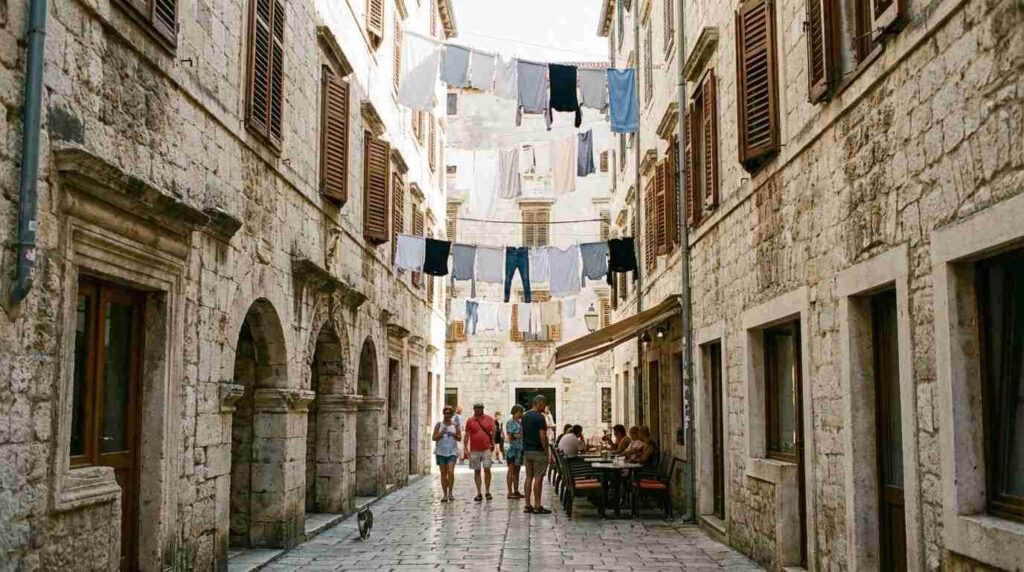
The archaeologist Jerko Marasović, whose scholarship on the palace complex is foundational to its modern understanding, has documented the extraordinary layering of the site — medieval, Renaissance, and contemporary additions built into, onto, and through the Roman structure over seventeen centuries. The palace is not preserved in amber. It has been continuously inhabited, continuously modified, continuously alive in the way that places are alive when people actually need them. This is unusual. Most ancient sites of this scale are ruins in the precise sense — uninhabited, managed, visited. Diocletian’s Palace is inhabited, which means it is also argued over, renovated badly in certain sections, and strung with laundry between columns that once held imperial weight.
The Peristyle at 7 AM
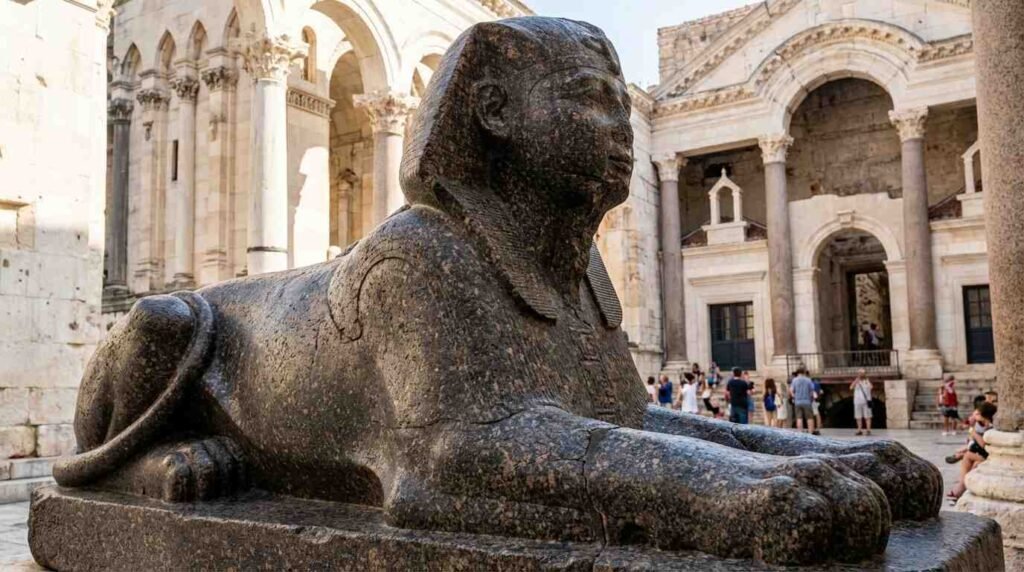
The light in November comes late and horizontal. At seven in the morning the Peristyle is empty stone. Pigeons. The sphinxes — Egyptian granite, brought from Aswan specifically for the palace, two of the original four still largely intact — sit in their niches with an expression of institutional patience. They have been sitting there longer than the Roman Empire lasted. They have been sitting there longer than Christianity as an institutional structure has existed.
Whatever a visitor brings to this space in the form of thoughts about legacy and impermanence, the sphinxes are not moved.
The mausoleum that Diocletian built for himself became, in the 7th century, the Cathedral of Saint Domnius — one of the more pointed reversals in the history of religion: the man who persecuted Christians buried in a building converted to their worship. The columns that held imperial ceremony now hold a Christian nave. The change is total and the stones record no opinion on the matter.
Aurelius, Book IX: “Loss is nothing else but change, and change is Nature’s delight.” He was writing about death, but the category expands. The Peristyle at seven in the morning, before the tourist groups arrive and the tour guides begin explaining the pronaus, is simply a courtyard where people walk through on their way to work. The Roman emperor is six feet below the cathedral floor, in the form of whatever the centuries have left of him. The courtyard continues.
On Legacy
Diocletian did not build the palace to be visited. He built it to live in — specifically, to live in after having spent twenty years managing the largest administrative system in the world. What he got, instead of a dignified retirement residence sealed appropriately on his death, was a building that has never stopped being used. Medieval residents built their houses inside the imperial apartments. Ottoman soldiers defended the walls. Venetian merchants built loggias against the Roman foundations. Nineteenth-century architects came to measure the proportions and brought what they measured back to influence European neoclassicism — Robert Adam’s 1764 survey of the palace directly influenced his subsequent work in Britain, which influenced American Federal architecture, which is how Diocletian’s retirement home in Dalmatia ended up affecting the look of government buildings in Washington, D.C.
He was trying to stop. The building kept going.
What Remains
The substructures beneath the palace — the vaulted basement halls used as storage during its imperial occupation and later as a dump for everything the medieval residents needed to be rid of, including in some cases the medieval residents themselves — have been excavated, stabilized, and are now accessible to visitors for a modest fee. The vaulting is original. The scale, underground, gives the palace’s dimensions in a different register: not the elegant colonnades of the Peristyle, but the working bones of the thing, the utilitarian infrastructure of empire that no one made beautiful because beauty was not the point.
Down there, the abstraction falls away. This is just stone. Old stone, carefully laid, doing the job it was built to do — holding up what’s above it. The palace has not survived because it was exceptional architecture, though it was. It has survived because it was useful — first as an imperial residence, then as a fortress, then as a city. Things that remain useful are rarely destroyed entirely.
Marcus Aurelius left behind the Meditations, which he did not intend to publish and which survived only by accident of manuscript history. He left behind an empire, which did not survive him by long in the form he maintained it. Diocletian left behind a building, which his successors found useful to inhabit, and which the peoples of seventeen subsequent centuries found useful to inhabit, and which three thousand people currently call home.
The ruin sits there regardless. It has no opinion about what is done with it. It does not require awe, or reverence, or a theory about impermanence. On a November morning in Split, before the fish market closes and the children go to school inside walls that Diocletian’s engineers constructed from Brač Island limestone, the palace is simply the neighborhood.
The most Roman thing about it, finally, is this: it was built to last, and it has lasted, and the reason it has lasted is that people found it more useful to live inside than to admire from outside.
An emperor grew cabbages. His walls are still standing.
You Might Also Like: The Hudson Valley in Reverse: Why You Should Start in Beacon and Work Your Way South
Sources
- UNESCO World Heritage listing for the Historic Complex of Split with Diocletian’s Palace: whc.unesco.org/en/list/97
- City of Split official documentation: visitsplit.com
- Lactantius. De Mortibus Persecutorum. (J.L. Creed translation, Oxford University Press, 1984)
- Marasović, Jerko and Tomislav. Diocletian’s Palace. Zrinski, 1968; subsequent scholarship via Split City Museum
- Adam, Robert. Ruins of the Palace of the Emperor Diocletian at Spalatro in Dalmatia. 1764.
- Marcus Aurelius. Meditations. (Gregory Hays translation, Modern Library, 2002)