Golden Corral has confirmed that at least six of its restaurants closed during 2026, according to Restaurant Dive, which reported the confirmation on October 16 after USA TODAY coverage two days earlier. The Raleigh, North Carolina, buffet chain also has new restaurants in the pipeline, and the two facts sit side by side in the company’s own account of the year.
The closures are a small share of a large system. They arrive, though, at a moment when the all-you-can-eat format is being tested by labor costs, shifting dining habits and rising food prices, and the way Golden Corral is responding says a good deal about where the buffet is heading.
What the company has confirmed
Restaurant Dive reported that Golden Corral acknowledged closing at least six locations this year. The article does not name the sites. The company described attrition as “higher than normal” and said the reasons “vary and are specific to the individual franchise entities that operated the locations,” according to the same report.
That wording points to a structural fact about the brand. Golden Corral says about 99 percent of its restaurants are owned by franchisees, so a closure usually reflects the circumstances of one operating company rather than a decision made in Raleigh. A franchisee may face a lease expiring, a building in need of repair, a retirement, or a staffing shortage that no amount of corporate support can solve.
The company also said several of the closed locations will likely reopen under new franchise ownership, and that it is “very committed to working with our franchisees to transfer ownership” to other franchise entities or company operations, per Restaurant Dive. A closed sign on the door, in other words, is not always the end of a Golden Corral in that town.
The numbers give the larger picture. Golden Corral’s franchise disclosure document lists 362 locations in 2023 and 348 at the end of 2025, with a net loss of four franchised units in 2025, as Restaurant Dive noted. The chain opened its first restaurant in Fayetteville, North Carolina, in 1973, and a spring report on franchisee closures put its footprint at about 340 locations in the United States and Puerto Rico.
Closures reported by local outlets
Two closures earlier in the year show how varied the circumstances are. In Alton, Illinois, the restaurant at 350 Homer M. Adams Parkway closed permanently on April 23, a week before the April 30 date the franchisee had announced, according to a report carried by Yahoo Finance. The report attributed the decision to staffing after years of intermittent closures and reopenings.
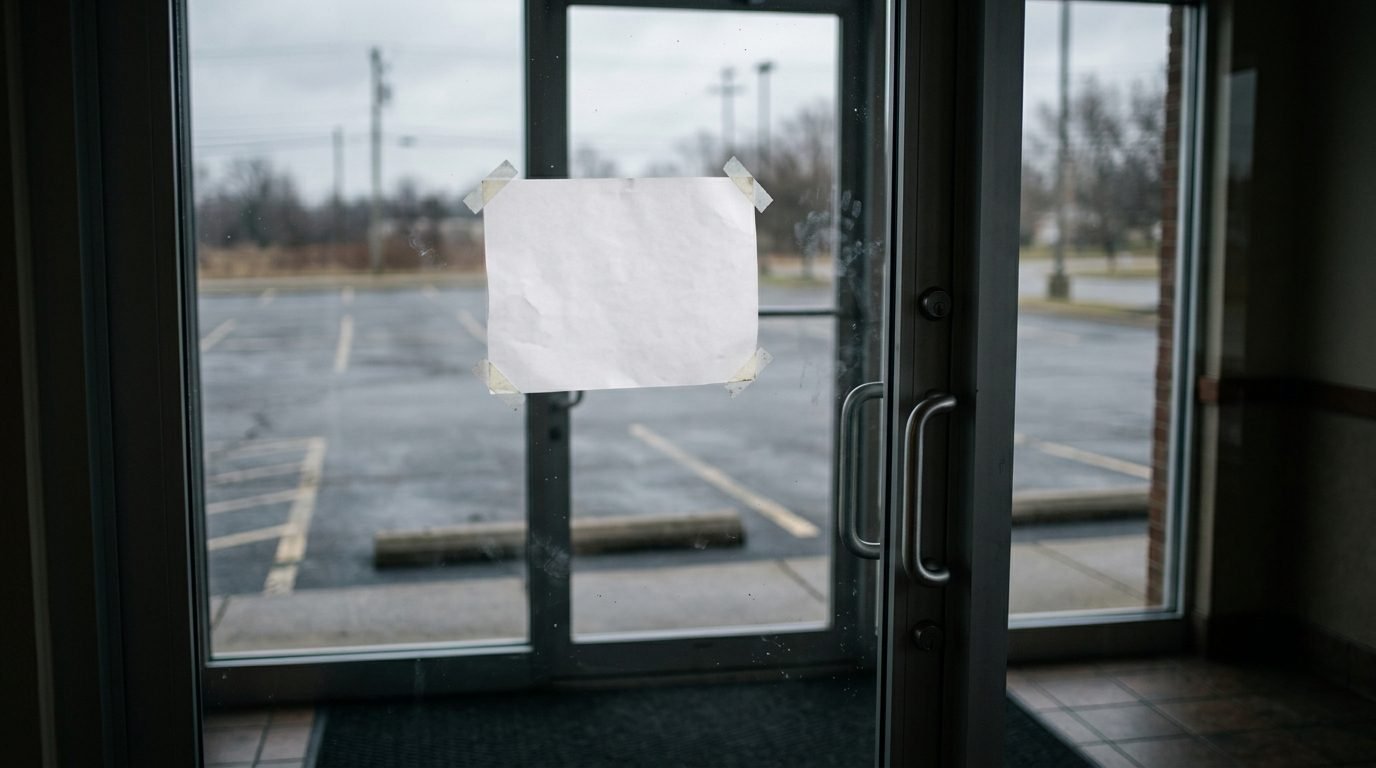
A note on the door read: “We are truly sorry, but we are no longer able to keep this store staffed enough to properly serve our valued guests.” A manager told reporters that local employees would be offered positions at other Golden Corral locations, per the same account.
In Canton, Ohio, the restaurant at 4910 Dressler Road NW closed on February 1 after opening in 2002. About 50 people worked there, and some were expected to move to the Akron location. The franchise owner told the reporter, “It’s sad. We had a really good run here,” according to the report. The owner does not own the building and said equipment might be sold.
Both stories share a detail that tends to get lost in closure headlines: workers were being moved to nearby Golden Corral restaurants, which points to experienced staff staying with the brand.
Why franchise ownership shapes the story
Because nearly every restaurant is independently owned, Golden Corral’s closures do not follow a single pattern. The spring report on the Alton and Canton restaurants described a store locator that, as of April 24, listed 41 permanently closed and five temporarily closed locations, per Yahoo Finance. A locator is a blunt instrument, since it can carry sites that closed years ago, and the figure should not be read as a count of 2026 closures.
The system has weathered a harder stretch before. Eat This, Not That reported in April 2021 that the chain operated 305 restaurants, down from 490 before 2020, with CEO Lance Trenary saying 40 locations had switched to cafeteria-style service with servers. Two large franchisees filed for bankruptcy during that period. Golden Corral is, by that standard, a chain that has reorganized around its operators before.
The present attrition is far milder than that episode. It is also uneven, and it falls on the individual families and companies who run the buildings. Their decisions about whether to renew, sell or hand over a restaurant make up most of what shows up as a closure on the map.

New restaurants under development
While the closures were being confirmed, the company was also talking up growth. A company news release dated April 30 and republished by a local news outlet said six restaurants are in development. Knoxville, Tennessee, and Kissimmee, Florida, are under construction. Baytown, Texas; St. Petersburg, Florida; Spanish Fort, Alabama; and San Juan, Puerto Rico, are in pre-construction. The release also pointed to recent momentum in Fresno, California; Port Richey, Florida; and Bowling Green, Kentucky, along with continued multi-unit development in Puerto Rico.
Restaurant Dive’s October report repeated that six new restaurants are under development, with locations opening in Texas, Florida, Alabama and Puerto Rico, and quoted the company as saying “Additional development opportunities and growth initiatives are underway for 2027.” Verdict Foodservice confirmed the six-restaurant pipeline in its own coverage on May 1.
Trenary said the company is “committed to working in lockstep with our franchisees to expand access to Golden Corral for new guests and communities,” per the release.
The company is also sweetening the terms for new operators. The release listed reimbursement of 3 percent of year-one sales, 2 percent of year-two sales and 1 percent of year-three sales, a $5,000 grand opening marketing credit, and up to $45,000 in reimbursed manager training expenses. Those are the company’s own figures, published in a paid release, and they indicate how much emphasis is being put on lowering the cost of getting a restaurant open.
Smaller buildings and new formats
The traditional Golden Corral is large. FinanceBuzz put the standard unit at about 11,000 square feet with seating for up to 400, while newer designs run about 6,500 to 7,000 square feet with roughly 250 seats, and another design measures about 8,500 square feet. According to the same report, the smaller restaurants keep the 160-item buffet and add dedicated areas for to-go orders, delivery pickups and weigh-and-pay service.
The company’s development options now include second-generation restaurant spaces, retail conversions and travel centers, per the April release. FinanceBuzz added that airports and college campuses are under consideration, and that a “kit-of-parts” approach lets a franchisee choose a format to suit the building.
Efficiency has been a theme for years. When the company unveiled a prototype in Greensboro, North Carolina, in late 2017, Trenary told Nation’s Restaurant News the projection was for “3 percent lower labor cost in this restaurant.” Time-motion studies had shown prep staff spending too long moving between coolers, storage and the prep area, and the redesign aimed to keep each station’s work within about four to five feet.
Not every experiment has stuck. Restaurant Dive reported that Golden Corral Favorites, a fast-casual concept that opened last year, underperformed, reportedly because customers expected a full buffet, and it closed earlier in 2026. The concept began as Homeward Kitchen in Southern Pines, North Carolina, in late 2023, per FinanceBuzz.
How buffet economics work
A buffet depends on averages. The Hustle analyzed 30 buffets in 2024 and found an average price of about $20, with roughly $19 of each $20 absorbed by overhead and about $1, or 5 percent, left as net profit. Those are estimates drawn from a broad sample, and individual restaurants vary.
Light eaters subsidize heavy ones. By the article’s model, a guest who eats a modest plate costs the restaurant well under the ticket price, an average guest leaves a thin margin, and the guest who returns to the carving station repeatedly produces a loss. The system works only when the room holds enough of each.
Drinks do much of the balancing. The same analysis said a fountain refill costing about 12 cents sells for $2, a markup of roughly 1,500 percent. That helps explain why value campaigns often focus on drinks and children’s meals rather than the main buffet.
Golden Corral’s summer campaign followed that logic. Its America $2.50 Value Deals, tied to the country’s 250th anniversary, include a $2.50 Kids Weekend Breakfast Buffet, $2.50 beverages and $2.50 discounts on lunch and takeout, and they run through the end of 2026, per Restaurant Dive.
Labor is the other lever. According to The Hustle, a typical restaurant cook serves about 25 customers an hour, while a buffet cook may prepare food for 200. That ratio is the reason a staffing gap, like the one cited in Alton, can undermine a buffet faster than it would a menu-driven restaurant. Waste adds pressure, with estimated losses of 5 to 25 percent on any given dish.
A format under pressure, and interest in it
The long arc has been unkind to buffets. The Hustle reported that the number of buffets fell 26 percent between 1998 and 2024, while the total number of United States restaurants rose 22 percent, and that more than 1,300 buffets closed over 20 years. The pandemic then accelerated the shift. FSR Magazine described communal self-serve buffets as drawing scrutiny during the pandemic, and noted that table service and food brought from the line made newer models more labor-intensive.
Restaurant Dive suggested Golden Corral faces challenges similar to those of midscale and fine-dining concepts over the past three years, citing Datassential for the finding that consumers increasingly favor convenient, faster concepts. Technomic data cited in the spring report showed Top 500 chain restaurant sales growing 3 percent in 2025, down from 3.5 percent in 2024, which Yahoo Finance described as the slowest growth outside the pandemic since the Great Recession.
There is a counterweight. The company and Restaurant Dive both cite Yelp data showing searches for “all-you-can-eat buffet near me” rose 252 percent from September 2024 to August 2025. Interest in the format, in other words, has not disappeared, even as the operators who serve it adjust their buildings, their staffing and their menus.
For diners, the practical result is a patchwork. Some Golden Corral restaurants have closed, some will probably reopen under new owners, and a handful of new, smaller ones are heading toward construction in Tennessee, Florida, Texas, Alabama and Puerto Rico.
For informational purposes only; consult a licensed attorney or financial advisor.
Sources
- Restaurant Dive, Golden Corral faces uptick in closures (Oct. 16, 2026)
- Yahoo Finance, 53-year-old dining chain franchisees close stores, no bankruptcy
- Golden Corral news release via Taos News (PR Newswire), April 30, 2026
- Verdict Foodservice, Golden Corral to add six locations (May 1, 2026)
- FinanceBuzz, Golden Corral making big changes (updated Sept. 21, 2026)
- The Hustle, The economics of all-you-can-eat buffets (June 24, 2024)
- FSR Magazine, COVID-19 fallout: a new way to buffet
- Eat This, Not That, Golden Corral closed locations (April 13, 2021)
- Nation’s Restaurant News, Golden Corral prototype focuses on efficiencies (Jan. 3, 2018)