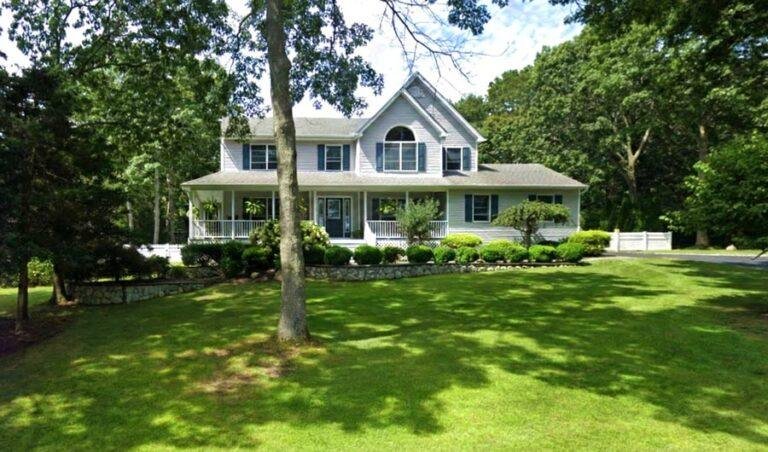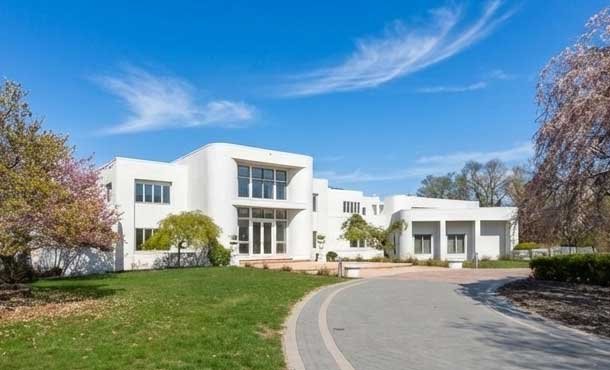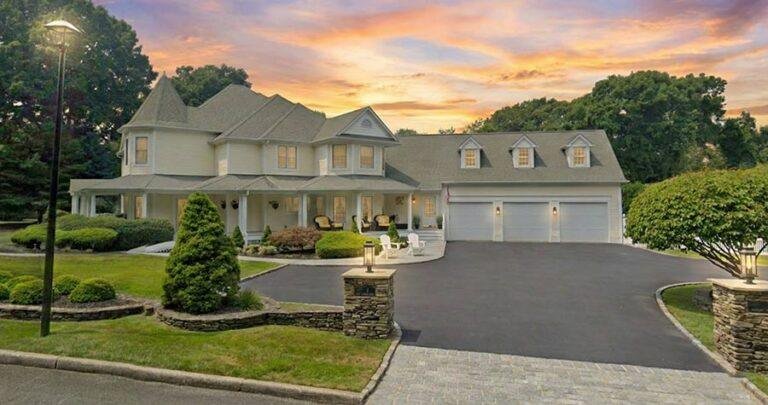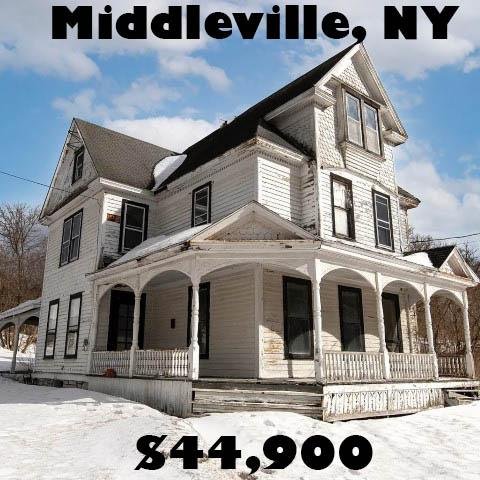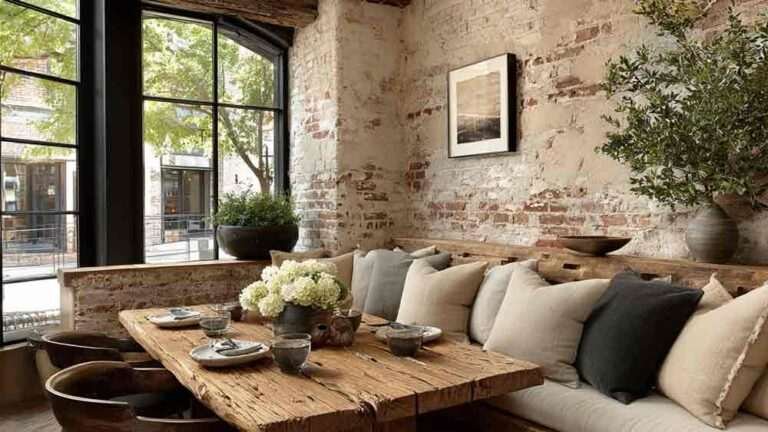

On Long Island’s North Shore, where Colonial-era farmhouses sit within walking distance of mid-century Cape Cods and pre-war brick storefronts, there is an argument hiding in the walls themselves. Not a political argument, not a sentimental one — a thermodynamic one. The thick stone foundations of a 1730s Setauket homestead or the dense masonry of a turn-of-the-century Port Jefferson storefront are doing something that no curtain-wall glass tower in Manhattan can replicate without enormous mechanical intervention: they are breathing with the climate rather than fighting against it.
The sustainability conversation in real estate has been captured, for the better part of two decades, by renderings of sleek glass skyscrapers wrapped in LEED certifications and press releases. But the data tells a different story. The buildings and construction sector accounts for roughly 40% of global carbon emissions, according to the United Nations Environment Programme — and a growing body of research suggests that the most radical climate strategy available to developers, investors, and homeowners may not involve building anything new at all (UNEP, 2023).
Architect Carl Elefante, past president of the American Institute of Architects, distilled this idea into a phrase that has become a mantra among preservationists and climate scientists alike: the greenest building is the one that is already built. In 2025, Elefante expanded this thesis into a full-length work, Going for Zero: Decarbonizing the Built Environment on the Path to Our Urban Future, which argues that the path to net-zero emissions runs directly through the adaptive reuse and preservation of existing structures (National Trust for Historic Preservation, 2025).
For those of us who live and work on Long Island’s North Shore — and particularly for anyone evaluating real estate here — the implications are enormous.
The Physics of Old Walls: Understanding Thermal Mass
Before the invention of central air conditioning, builders understood something fundamental about the relationship between materials and comfort. They built with stone, brick, clay, and dense timber — materials with high thermal mass, meaning they absorb heat slowly during the day and release it gradually at night. The result was an interior environment that resisted the wild temperature swings of the exterior world without a single kilowatt of mechanical assistance.
Thermal mass operates on a principle engineers call thermal lag: the delay between when heat hits the outside surface of a wall and when it reaches the interior. A thick stone wall might have a thermal lag of eight to twelve hours, which means the peak afternoon heat doesn’t reach your living room until late evening, when outdoor temperatures have already dropped and natural ventilation can carry the warmth away. In moderate climates with meaningful diurnal temperature ranges — exactly the kind of climate found across Long Island’s coastal corridor — this effect can dramatically reduce the need for both heating and cooling (YourHome, Australian Government).
A 2020 study published in Cogent Engineering tested this directly, comparing rooms in the same building constructed with traditional 40-centimeter clay-brick walls against rooms built with modern 10-centimeter concrete block. The results were unambiguous: the old construction methods produced significantly more stable indoor temperatures and lower energy consumption during both summer and winter conditions (Tandfonline, 2020). A parallel study from San Antonio, Texas, examining inherent energy-efficient features in historic structures, confirmed that high thermal mass materials like limestone and brick reduce indoor temperatures and improve thermal comfort compared to lightweight modern alternatives (ScienceDirect, 2024).
Modern glass-and-steel construction inverts this entire logic. Glass is a poor insulator with virtually no thermal mass. Fully glazed facades absorb solar radiation with extraordinary efficiency and trap it indoors — the greenhouse effect, rendered in architectural form. Research consistently shows that carbon emissions from air-conditioned glass offices run approximately 60% higher than those from offices with natural or mechanical ventilation (The Conversation, 2019). Former New York Mayor Bill de Blasio went so far as to declare that glass-and-steel skyscrapers “have no place in our city or our Earth anymore.”
The irony is sharp: the buildings we celebrate as icons of modernity are thermodynamic liabilities, while the old brick storefronts and stone farmhouses we sometimes dismiss as outdated are performing passive climate regulation that engineers now spend millions trying to replicate.
Embodied Carbon: The Hidden Ledger of Demolition
The energy story of a building does not begin when someone flips a light switch. It begins in the quarry, the kiln, the foundry, and the forest. Every building represents an enormous investment of what researchers call embodied carbon — the cumulative greenhouse gas emissions generated through the extraction, manufacturing, transportation, and assembly of its materials.
Concrete and steel, the backbone of modern construction, are among the most carbon-intensive materials on the planet. Cement manufacturing alone accounts for approximately 4% of global emissions. When a building is demolished, that entire embodied carbon investment is forfeited — dumped, often literally, into a landfill. The Carbon Trust estimates that 13% of global construction-sector emissions come specifically from construction and demolition activities, with operational emissions accounting for the remaining 27% (Carbon Trust, 2025).
Research commissioned by Historic England examined the whole-life carbon emissions of a typical Victorian terrace house across three scenarios: do nothing, refurbish, or demolish and rebuild. The refurbishment option produced construction-related embodied emissions of just 1.2 tonnes of CO₂ equivalent — roughly 2% of the building’s total 60-year emissions. Demolition and new construction generated 16.35 tonnes, or 28% of total lifetime emissions. The refurbished building, despite being centuries old, actually produced lower lifecycle carbon emissions than the brand-new replacement (Historic England, 2019).
The case of the proposed demolition of the Marks & Spencer building at 458 Oxford Street in London made this calculus viscerally real: analysis estimated that constructing the proposed replacement would release nearly 40,000 tonnes of CO₂ into the atmosphere — the equivalent of driving a car 99 million miles.
The National Trust for Historic Preservation’s landmark 2011 Preservation Green Lab study confirmed that building reuse almost always offers environmental savings over demolition and new construction when comparing structures of similar size and functionality. The savings ranged from 4% to 46%, and critically, the study found that a new building constructed to be 30% more energy-efficient than an average existing building would take between 10 and 80 years to overcome the negative climate impacts generated during its own construction (Heritage BC, 2023).
That is not a rounding error. That is a generational carbon debt.
The Real Estate Equation: Why Preservation Is a Value Play
For buyers, sellers, and investors across Long Island’s North Shore, this data reshapes the calculus of property valuation in ways that are only beginning to be understood. Historic and character-rich buildings are not just aesthetically desirable — they are increasingly recognized as climate-resilient assets with structural advantages that no new construction can retroactively acquire.
A PlaceEconomics study of Saratoga Springs found that properties in designated historic districts averaged 2.5 times the assessed value per acre compared to the rest of the city (The Craftsman Blog, 2025). In San Antonio, over a 15-year period between 1998 and 2013, homes in historic districts appreciated 139% while comparable properties outside those districts gained only 68% — a pattern that held even during market downturns. In Austin, Texas, the Swedish Hill Historic District has appreciated more than any other ZIP code in the metro area since 2000, with average sale prices rising nearly ninefold. It was one of the few neighborhoods where values continued to climb between 2024 and 2025, a period when luxury inventory grew and sales declined across every major Texas metro (The Real Deal, 2026).
On Long Island’s North Shore, where organizations like Preservation Long Island have championed the protection of historic structures since 1948, the correlation between heritage character and property value is woven into the landscape itself. The pre-war homes of Cold Spring Harbor, the Colonial architecture of Setauket, the dense village fabric of Port Jefferson — these are not liabilities on a balance sheet. They are appreciating assets backed by physics, scarcity, and an increasingly climate-conscious buyer pool.
Autodesk, the global leader in architectural design software, has projected that 90% of real estate development in the coming decade will focus on renovating and reusing existing structures rather than building new (Autodesk, 2025). For the North Shore market, where inventory is already constrained and character-rich housing stock defines neighborhood identity, this trajectory is significant. The homes and commercial buildings that survive from earlier eras are not relics — they are infrastructure.
Adaptive Reuse: The Climate Strategy Hiding in Plain Sight
The most compelling climate projects rarely make architectural magazines. They are not the glass-wrapped towers with rooftop gardens and press kits. They are quieter: a Victorian storefront in Port Jefferson retrofitted with modern insulation behind its original brick facade. A pre-war farmhouse in Stony Brook fitted with a high-efficiency heat pump while its dense plaster walls continue to passively regulate temperature. A mid-century commercial building along Route 25A adapted for new retail use rather than leveled for a strip-mall replacement.
Adaptive reuse — the practice of repurposing existing buildings for new functions while preserving their structural and historical character — is now recognized as one of the most effective carbon reduction strategies available to the built environment. The American Institute of Architects estimates that renovation and reuse projects typically save between 50% and 75% of the embodied carbon emissions compared to constructing a new building. The Trust Building in Los Angeles, where over 95% of the original structure was retained during renovation, demonstrated how this works at scale: concrete and steel, the two most carbon-intensive components, make up 70% to 80% of most buildings’ structural mass, and preserving them eliminates the need for the most emissions-heavy new materials (USGBC-LA, 2022).
For a region like Long Island’s North Shore, where the architectural character of villages and hamlets is central to both community identity and property values, adaptive reuse is not an abstract sustainability concept — it is the market’s revealed preference. Buyers on the North Shore consistently pay premiums for the kind of architectural density and material quality that cannot be replicated in new construction. Thick plaster walls, hardwood floors milled from old-growth timber, hand-laid brick foundations — these features are simultaneously aesthetic assets, thermal mass advantages, and embodied carbon reserves.
The Philosophical Layer: Why the Old Endures
There is a deeper current running beneath the data, one that anyone who has spent decades working with their hands will recognize intuitively. The German philosopher Martin Heidegger wrote about the way certain objects and structures gather meaning through use — how a tool that has been handled for years becomes part of the world in a way that a factory-fresh replacement never can. He called this quality Zuhandenheit, or readiness-to-hand: the sense that something has been shaped by time into its truest form.
Old buildings possess this quality. The patina on a brownstone stoop, the slight bow in a centuries-old floor joist, the way light falls through hand-poured glass — these are not defects. They are evidence of endurance. And endurance, it turns out, is exactly what climate strategy demands. Not the brittle efficiency of a curtain-wall system engineered for a 30-year lifespan, but the slow, compounding resilience of materials that were built to last for centuries.
This is something I think about often at The Heritage Diner, where my father and I opened the doors 25 years ago in Mount Sinai. A restaurant that endures for a quarter century does so not by chasing trends but by investing in fundamentals — quality ingredients, honest preparation, consistency that compounds over time. It is the same principle that makes a hand-stitched English bridle leather briefcase from my workshop at Marcellino NY grow more beautiful with each year of use rather than deteriorating like its synthetic alternatives. Preservation, whether of a building, a business, or a craft, is not a refusal to evolve. It is an insistence that what endures has earned the right to continue.
The North Shore Advantage: Where Climate and Character Converge
Long Island’s North Shore sits at a unique intersection of climate opportunity and architectural inheritance. The region’s moderate maritime climate — warm summers, cold winters, and meaningful temperature swings between day and night — is precisely the kind of environment where thermal mass provides the greatest passive benefit. The area’s housing stock, with its significant proportion of pre-war and mid-century construction using dense masonry, stone, and heavy timber framing, represents an existing infrastructure of climate-responsive building that no new development can match.
Organizations like Preservation Long Island, which has protected historic sites and advocated for preservation across the region since 1948, are not simply guarding nostalgia. They are — whether they frame it this way or not — protecting a carbon reserve. Every pre-war home in Setauket, every brick storefront in Northport, every stone foundation along the North Shore harbors tens of thousands of pounds of embodied carbon that would be released into the atmosphere if that structure were demolished and replaced.
For the luxury real estate market in particular, the convergence of sustainability consciousness and heritage desirability is creating a new category of buyer: one who understands that a restored 1920s Colonial with retrofitted systems represents both a superior investment and a lower carbon footprint than a spec-built glass-and-composite contemporary of equivalent square footage. These buyers are not trading modernity for charm. They are recognizing that true modernity — the kind informed by climate science rather than marketing — often looks like a well-maintained old building.
Building the Future by Preserving the Past
The argument for heritage as a climate strategy is not sentimental. It is structural, thermodynamic, and financial. It is backed by data from Historic England, the National Trust for Historic Preservation, the United Nations Environment Programme, the Carbon Leadership Forum, and a growing body of academic research spanning three decades. The buildings that have already been built — the ones absorbing and releasing heat through their thick walls, the ones whose embodied carbon was invested decades or centuries ago, the ones whose material quality cannot be replicated at modern price points — are not obstacles to a sustainable future. They are its foundation.
For Long Island’s North Shore, this is not a theoretical proposition. It is a market reality unfolding in real time. The buyers paying premiums for historic district properties are not just buying charm. They are buying thermal mass, embodied carbon reserves, architectural scarcity, and the kind of material integrity that appreciates precisely because it cannot be manufactured.
The greenest building is the one that is already built. On the North Shore, those buildings are still standing. The question is whether we have the foresight to keep them that way.
Sources
- United Nations Environment Programme. Building Materials and the Climate: Constructing a New Future. UNEP, 2023. https://www.unep.org/resources/report/building-materials-and-climate-constructing-new-future
- National Trust for Historic Preservation. “Going for Zero: A Q&A with Carl Elefante.” 2025. https://savingplaces.org/stories/carl-elefante-qa
- The Carbon Trust. “Building Decarbonisation in the Construction Sector.” 2025. https://www.carbontrust.com/news-and-insights/insights/building-decarbonisation-in-the-construction-sector
- Historic England. “Investing in Heritage to Avoid Embodied Carbon Emissions.” Heritage Counts. https://historicengland.org.uk/research/heritage-counts/heritage-and-environment/avoiding-embodied-carbon-production/
- Heritage BC. “Climate Adaptation: Rehabilitation/Existing vs Demolition/New-Build.” 2023. https://heritagebc.ca/learning-centre/climate-sustainability/climate-adaptation-report/comparison-rehabilitation-existing-vs-demolition-new-build/
- Schoenefeldt, Henrik. “Glass Skyscrapers: A Great Environmental Folly That Could Have Been Avoided.” The Conversation, 2019. https://theconversation.com/glass-skyscrapers-a-great-environmental-folly-that-could-have-been-avoided-116461
- YourHome, Australian Government. “Thermal Mass.” https://www.yourhome.gov.au/passive-design/thermal-mass
- USGBC-LA. “Historic Preservation Is Also Carbon Preservation.” 2022. https://usgbc-la.org/2021/11/16/historic-preservation-is-also-carbon-preservation/
- Preservation Long Island. https://preservationlongisland.org/
- Sidler, Scott. “The Secret Value of Historic Homes.” The Craftsman Blog, 2025. https://thecraftsmanblog.com/the-secret-value-of-historic-homes/
- The Real Deal. “Do Historic Luxury Homes Hold Value Better?” 2026. https://therealdeal.com/magazine/february-2026/test-of-time/
- Autodesk. “Adaptive Reuse: 8 Examples of Giving Buildings New Life.” https://www.autodesk.com/design-make/articles/adaptive-reuse
- National Trust for Historic Preservation. “Making the Case for Adaptive Reuse.” https://savingplaces.org/stories/making-the-case-for-adaptive-reuse
- Tandfonline. “The Impact of Thermal Mass on Building Energy Consumption.” Cogent Engineering, 2020. https://www.tandfonline.com/doi/full/10.1080/23311916.2020.1804092
- Corporate Knights. “Is It Possible to Build a More Sustainable Glass Building?” 2022. https://corporateknights.com/built-environment/shattered-glass/