There is a moment, unrepeatable and diagnostic, that separates a person who owns luxury goods from a person who understands them. It happens not in the showroom, not under the halogen theater of a Madison Avenue boutique, but later—alone, in a quiet room—when you slide your hand inside a bag or briefcase and your fingertips meet the lining. In that half-second of tactile communion, the entire philosophy of the maker is revealed. Is it the plush, almost breathing warmth of genuine Italian calf suede, that velvety nap produced by buffing the flesh side of a young hide to a fineness that borders on the biological? Or is it something else—something smoother, cooler, eerily uniform? Something that feels almost right, the way a very good synthetic rose looks almost real until you lean in and discover it has no scent at all?
That “something else” is microfiber. And the luxury industry’s quiet, decades-long migration toward it—while charging you the same escalating prices—represents one of the most consequential and least discussed material substitutions in the history of high-end goods. As someone who has spent nearly three decades hand-stitching English bridle leather briefcases in a workshop on Long Island, who has sourced calf suede from tanneries across Italy and rejected more hides than most brands will ever see, I find this substitution not merely disappointing. I find it philosophically dishonest. It is the material equivalent of a diner replacing butter with margarine and hoping nobody notices—something I would never permit in twenty-five years of running The Heritage Diner in Mount Sinai, and something I will never permit at Marcellino NY.
The Anatomy of a Lining: What You’re Actually Paying For
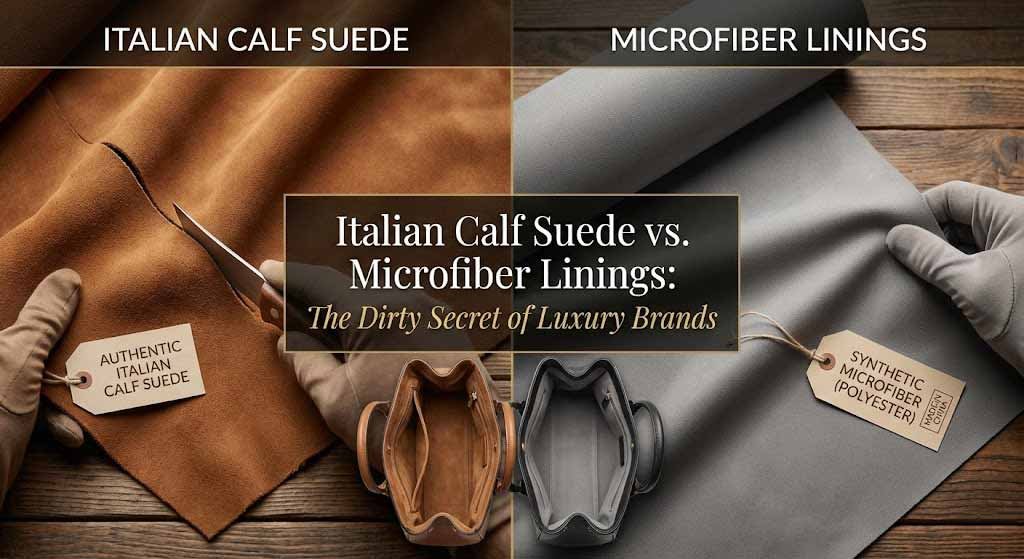
To understand the deception, you must first understand the material. Italian calf suede is not a fabric. It is the flesh side of a young bovine hide—typically from calves under twelve months old—that has been vegetable-tanned and then buffed to raise a directional nap of extraordinary softness (Leather Working Group, 2023). The tanning process alone can take thirty to sixty days, using natural tannins derived from oak, chestnut, and mimosa bark—the same organic compounds that give fine wine its astringency and structure. The result is a surface that is soft without being fragile, absorbent without being weak, and capable of developing a patina over decades of use that deepens its character rather than diminishing it.
Microfiber, by contrast, is a petroleum-derived polyester engineered at the molecular level to mimic the feel of suede. Its fibers are typically less than one denier in diameter—finer than human hair—and woven into a uniform, stain-resistant textile that is, by every measurable standard, easier and cheaper to produce (International Textile Manufacturers Federation, 2024). Alcantara, the most recognized brand of synthetic microsuede, is a blend of approximately 68% polyester and 32% polyurethane. It was originally developed for automotive interiors. Let that settle: the material lining your four-figure handbag was engineered for car seats.
The cost differential is staggering. Premium Italian calf suede, sourced from tanneries in the Santa Croce sull’Arno district of Tuscany—where 98% of Italy’s vegetable-tanned leather is produced—can run several times the price per square foot of even high-quality microfiber. When you multiply that across thousands of units in a global production run, the savings for a major luxury house are enormous. And when margins are under pressure—as they demonstrably are—the temptation to make the switch becomes almost gravitational.
The Margin Squeeze: Why the Industry Turned to Synthetics
The numbers tell a damning story. According to a joint study by Bain & Company and the Italian luxury industry association Altagamma, operating margins across the personal luxury goods sector have eroded significantly in recent years, declining from a peak of roughly 23% in 2012 to approximately 15–16% in 2025 (Bain & Company, 2025). Leather goods and footwear categories have been hit particularly hard, declining by as much as 5–7% in a single year, pressured by consumer pushback against the 50–70% price increases that major brands implemented between 2019 and 2024. The active luxury consumer base has contracted by approximately 70 million people since 2022, with aspirational buyers—those most sensitive to perceived value—leading the exodus.
In this environment, the interior of a bag is the first place costs get cut. It is the unseen architecture, the place where a brand gambles that its customers are paying for the logo on the outside, not the integrity within. It is the same calculation that a lesser restaurateur makes when he switches from fresh-squeezed orange juice to concentrate, or when a real estate developer substitutes engineered hardwood for solid oak in a luxury spec home. The exterior presentation remains immaculate. The substance is hollowed out. And for a while, perhaps a long while, nobody notices. Until someone does.
At Marcellino NY, I have watched this trend with the disciplined attention of a man who understands that the lining of a briefcase is not a secondary detail—it is the surface that touches the client’s documents, laptop, and personal effects every single day. It is the interior landscape of the object. As I have often said to clients who visit my workshop, if a diner served you a beautiful steak on a paper plate, you would question the entire operation. The lining is the plate.
The Tactile Lie: How Microfiber Fails the Hand Test
The marketing language surrounding microfiber linings is carefully calibrated to obscure the substitution. Terms like “micro-suede,” “alcantara,” “suede-like microfiber,” and “technical textile” are deployed with surgical precision to create an aura of innovation rather than economy. Some brands have successfully reframed the substitution as a feature, emphasizing stain resistance, ease of cleaning, and uniformity of color—qualities that are, admittedly, genuine advantages of synthetic materials.
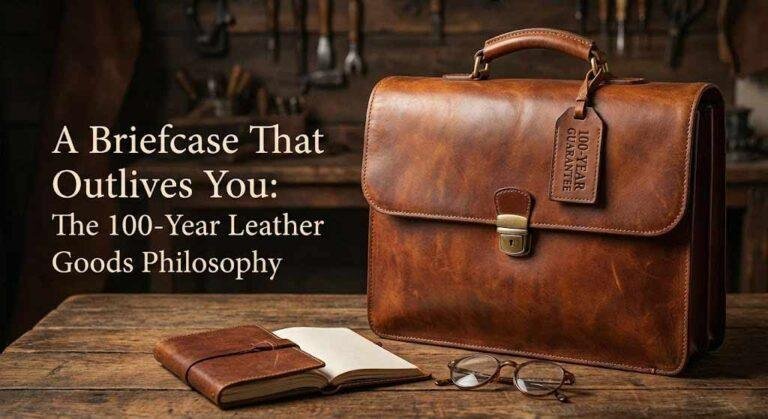
But here is where the tactile lie begins. Microfiber does not breathe. It does not age. It does not develop a patina. It does not absorb the subtle oils from your hands and slowly, over years, become more beautiful and more distinctly yours. It arrives in the same state in which it will depart. In ten years, a microfiber-lined bag will feel exactly as it did on the day of purchase—which sounds appealing only if you have never experienced the alternative. A genuine Italian calf suede lining, by contrast, becomes a record of its own use. It softens. It molds to the shapes of the objects it cradles. It tells time. In this way, it mirrors the English bridle leather I use for the exteriors of every Marcellino briefcase—a material that is hot-stuffed with tallows and waxes during finishing, that begins its life stiff and dignified and, over years of faithful use, develops a richness and depth that no factory can replicate.
There is a parallel in the culinary world that I think about often, after twenty-five years behind the scenes at The Heritage Diner on Route 25A. The difference between a cast-iron skillet and a nonstick pan is not merely functional. The nonstick pan is easier to clean, lighter to lift, more “convenient” by every rational metric. But the cast-iron skillet accumulates seasoning. It carries the memory of every meal. It improves with time and becomes, eventually, irreplaceable. The diner regulars who have been coming to Heritage since we opened our doors on that same stretch of North Shore road—they understand this. They are not coming for convenience. They are coming for the accumulated depth of something real.
The Marcellino Standard: Why I Will Never Make the Switch
When I founded Marcellino NY, I made a decision that has cost me money every single year since: every briefcase and bag that leaves my workshop will be lined with genuine Italian calf suede, sourced from the finest tanneries I can identify. Not pig suede, which is coarser and less consistent. Not sheepskin suede, which is lighter but less durable. And certainly not microfiber, regardless of how convincingly it has been engineered to mimic the real thing.
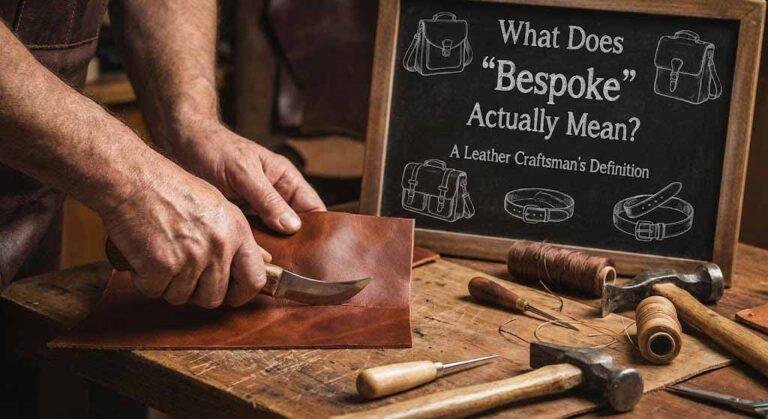
This is not nostalgia. It is a material philosophy rooted in the same principles that govern every aspect of my work—from the selection of English bridle leather hides to the hand-stitching of every seam to the solid brass hardware that fastens each closure. The philosophy is simple: the unseen details define the masterpiece. A briefcase is an intimate object. It accompanies a lawyer to the courtroom, a surgeon to the hospital, a creative director to the boardroom. The hand reaches inside dozens of times a day. That point of contact—lining against skin—should be as considered and as honest as the exterior that faces the world.
I offer my clients a curated selection of calf suede colors, each chosen to complement the exterior leather and the personality of the piece. Upon special request, I can source sheepskin suede for those who prefer an even lighter, more velvety hand-feel. But the baseline is always genuine. Always natural. Always a material that will be more beautiful in ten years than it is today. This commitment is identical in spirit to how Paola and I approach our work in Mount Sinai real estate—where we understand that the lasting value of a property, like the lasting value of a handcrafted object, is determined not by what the listing photographs show, but by what the buyer discovers after moving in.
The Consumer’s Burden: How to Identify What You’re Actually Touching
For the discerning buyer navigating the current market, identification is both essential and surprisingly difficult. Luxury brands are not required to specify the composition of their interior linings with the granularity they apply to exterior materials. A product description might proudly announce “full-grain calfskin exterior” while quietly noting “textile lining” or “microfiber interior” in smaller type—or omitting the lining material entirely.
Here is how to tell the difference. Genuine suede has an irregular, slightly inconsistent nap. Run your finger across it and the color shifts directionally, lighter in one direction, darker in the other—a phenomenon caused by the natural alignment of the buffed fibers. The surface has warmth; it absorbs heat from your hand almost immediately. It also has a faint, organic scent—not the chemical neutrality of polyester, but the quiet, tanned-earth smell of an animal hide that has been transformed by plant-based tannins over weeks of patient immersion.
Microfiber, even the finest Alcantara, has a preternatural uniformity. The nap is consistent across the entire surface. The color shift, if present at all, is muted and mechanical. The material feels cool to the touch and warms slowly. And there is no scent—or rather, the faint, petroleum-adjacent scent of new synthetics, which dissipates within weeks. For any serious collector or professional who uses a briefcase or bag daily, this distinction matters. It is the difference between a tool that participates in your life and a tool that merely accompanies it.
The Broader Reckoning: Authenticity in an Age of Substitution
The microfiber lining issue is a microcosm of a much larger cultural tension—one that I see playing out simultaneously across every domain I work in. In the restaurant world, it manifests as the slow creep of pre-made components into kitchens that once prepared everything from scratch. In real estate, it appears in the proliferation of “luxury” developments that deploy surface-level finishes—quartz countertops, engineered flooring, spray-foam insulation—to justify premium prices while cutting structural corners that only an inspector or a decade of occupancy will reveal. In the leather goods industry, it is the systematic replacement of natural materials with synthetics that are marketed as improvements rather than economies.
The Bain-Altagamma study projects that the luxury industry will return to moderate growth in 2026, but with an important caveat: success will increasingly depend on “product credibility” and “brand equity” rather than price increases alone (Bain & Company, 2025). This language is revealing. It is an implicit admission that the industry has been coasting on brand momentum while quietly eroding the material foundations that built those brands in the first place.
For the independent maker—the craftsman working from a workshop rather than a corporate headquarters—this reckoning is an opportunity. It is the same opportunity that has sustained The Heritage Diner for over two decades on the North Shore of Long Island while chains have come and gone from the same commercial corridors. It is the opportunity to offer something that cannot be synthesized, scaled, or replicated by algorithm: the irreducible quality of genuine materials shaped by a human hand for a specific human being.
What the Lining Tells You About Everything Else
When Heidegger wrote about the nature of tools in Being and Time, he distinguished between objects that are merely “present-at-hand”—observed but not engaged with—and those that are “ready-to-hand,” so deeply integrated into our daily practice that they become extensions of ourselves (Heidegger, 1927). A well-made briefcase, lined in genuine suede and built from leather that will outlive its owner, is an object that crosses this threshold. It ceases to be a commodity and becomes a companion. It accrues meaning through use. It is the opposite of disposable.
The lining of a luxury bag is the most honest surface it possesses. The exterior is a public performance—logo, hardware, the theater of brand recognition. The interior is a private conversation between the object and its owner. When a brand lines that interior with petroleum-based polyester and charges you several thousand dollars for the privilege, it is telling you something important about its values—and, perhaps more uncomfortably, about what it believes your values to be. It is betting that you will not notice. It is betting that the logo is enough.
I have spent my career making a different bet. I am betting that the person who commissions a Marcellino briefcase—the attorney, the physician, the executive, the collector—is someone who reaches inside and pays attention. Someone who understands, as every seasoned diner regular understands and as every thoughtful homebuyer on the North Shore understands, that the unseen details are not secondary to the experience. They are the experience. The lining is not a footnote. It is the thesis.
References:
Bain & Company & Altagamma. (2025). Luxury Goods Worldwide Market Study. Bain & Company.
Heidegger, M. (1927). Being and Time. Max Niemeyer Verlag.
International Textile Manufacturers Federation. (2024). Global Textile Industry Report.
Leather Working Group. (2023). Environmental Audit Protocol for Leather Manufacturing.
Vera Pelle Consortium. (2024). Italian Vegetable Tanned Leather: Standards and Production Methods. Pelle al Vegetale.
YouTube Resources:
How Leather Is Made — The Chemistry of Leather Tanning (PBS Reactions): https://www.youtube.com/watch?v=9z7MQBqk98Y
Vegetable Tanning: The Art of Traditional Leathercraft (Pelle al Vegetale Consortium): https://www.youtube.com/watch?v=GmSCUHJqMFo