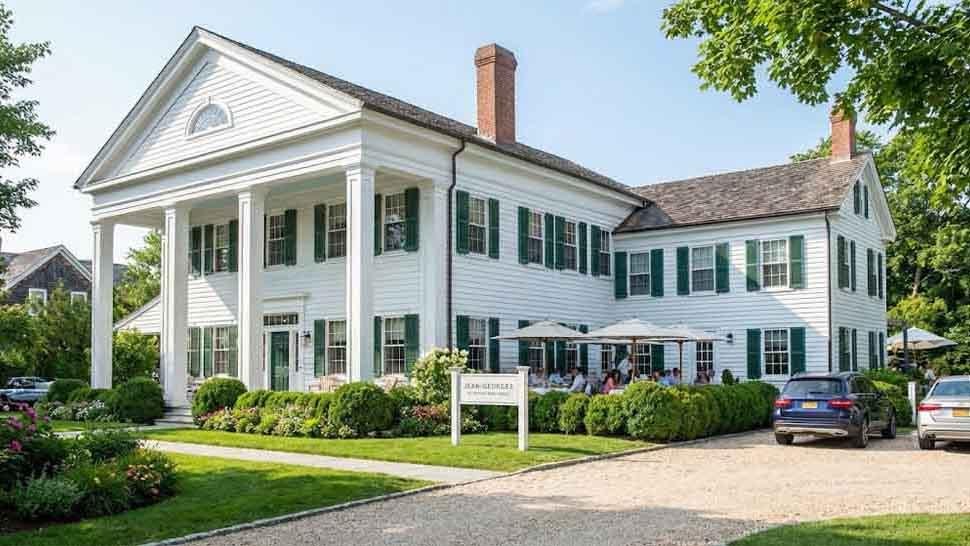
Whaling money built this house. In 1842, when Sag Harbor was the fourth-largest port in the world and the scent of rendered blubber still hung over the South Fork, Judge Abraham Topping Rose commissioned a Greek Revival mansion at the crossroads of downtown Bridgehampton. Rose was the son of a Revolutionary War surgeon, a Yale-educated lawyer who had practiced in Manhattan before returning to the land his grandfather Abraham Topping had purchased from the Hulberts a generation earlier. The three-acre site he chose sat at what remains, nearly two centuries later, the beating heart of the village. Today, that mansion serves as the architectural anchor of Topping Rose House, the Hamptons’ only full-service luxury hotel — and the home of one of Jean-Georges Vongerichten’s most compelling culinary outposts. Jean-Georges at Topping Rose House is not simply a restaurant inside a hotel. It is a property-wide philosophy of seasonal eating, local sourcing, and that rare Hamptons commodity: restraint wedded to excellence (Social Life Magazine, 2025; Topping Rose House, 2025).
The Building: From Judge’s Residence to Culinary Landmark
The trajectory of 1 Bridgehampton-Sag Harbor Turnpike reads like a compressed history of Long Island itself. Judge Rose and his wife Eliza Van Gelder raised six children within its original walls through the 1850s. After Rose’s death in 1857, the property passed to the Corwith family as a summer residence, maintaining its stature as one of the village’s most distinguished addresses. By the 1930s, the building had reinvented itself as the Bull’s Head Inn, a bar and grill run by Mrs. Carpenter that served locals and passing travelers for decades (Dan’s Papers, 2025). That transformation — from private aristocratic home to public gathering place — set the trajectory for everything that followed.
The modern chapter began in 2011, when investors Bill Campbell and Simon Critchell acquired the property and engaged Roger Ferris + Partners for an ambitious restoration. The architectural challenge was formidable: how to preserve the proportions, rhythm, and dignity of an antebellum mansion while adding contemporary structures that could function as a 22-room luxury hotel. Ferris’s solution placed two new buildings — the Studio for events and the Cottage Complex for guest rooms — alongside the meticulously restored main house, sinking all support facilities below grade to maintain the original estate’s visual scale (Roger Ferris + Partners, 2013). Champalimaud Design handled the interiors, producing spaces refined enough to earn Best Boutique Hotel and Best Hotel Suite honors at the Hospitality Design Awards (Champalimaud Design, 2013). The hotel officially opened in 2013, initially with chef Tom Colicchio overseeing the restaurant and broader food operations.
Jean-Georges Vongerichten: The Architect of Modern American Dining
Understanding why Jean-Georges at Topping Rose House matters requires understanding the man behind the name. Born in 1957 on the outskirts of Strasbourg in France’s Alsace region, Vongerichten grew up in a household where his mother and grandmother cooked daily for the nearly fifty employees of the family’s coal business. His culinary awakening came at sixteen, when his parents took him to the three-Michelin-starred Auberge de l’Ill for his birthday. He apprenticed under Paul Haeberlin, then trained with Paul Bocuse and Louis Outhier at L’Oasis in southern France before spending years cooking across Southeast Asia — at the Oriental Hotel in Bangkok, the Meridien in Singapore, the Mandarin in Hong Kong. Those years in Asia fundamentally reshaped his palate, replacing heavy stocks and cream-based sauces with the vivid precision of ginger, lemongrass, lime leaf, and coconut (Wikipedia, 2026; Fortune, 2024).
Vongerichten arrived in America in 1985 and earned four stars from the New York Times as executive chef at Lafayette in the Drake Hotel at just twenty-nine years old. His first independent venture, the bistro JoJo, opened on Manhattan’s Upper East Side in 1991 with $20,000 borrowed from financier Phil Suarez and was immediately named Best New Restaurant of the Year. His eponymous flagship, Jean-Georges, maintained three Michelin stars and four New York Times stars for years — placing it among a rarefied handful of restaurants on the planet. As of 2025, Vongerichten oversees more than sixty restaurants across the globe, from the Tin Building at South Street Seaport to outposts in Tokyo, Kyoto, London, Marrakesh, and São Paulo. His James Beard Awards include Best Chef and Outstanding Restaurant. New York magazine wrote in 2005 that no single chef had more profoundly shaped the way New Yorkers dine out over the preceding two decades (Fortune, 2024; The Chef’s Connection, 2017).
The Takeover: Beach-Chic Replaces White Tablecloths
When Tom Colicchio departed Topping Rose House in 2015, the property pivoted to Vongerichten’s vision. The transition was more than a chef swap — it was a philosophical recalibration. Vongerichten stripped the white tablecloths from the dining room, sanded the oak tables to expose their natural grain, and reimagined the space as something deliberately less formal but no less ambitious. His directive was unmistakable: this restaurant should feel like the Hamptons actually feel in summer — barefoot, windswept, salt-licked — not like an imported Manhattan supper club (Hamptons Magazine, 2016).
The kitchen pivoted toward a seafood-centric menu driven by hyper-local sourcing. Vongerichten discovered an escargot farm five miles from the property and built a dish around it. He partnered with fishermen whose boats work the waters between Montauk and Shinnecock to source the day’s catch. The property’s own one-acre farm, maintained year-round on the grounds of the estate, supplies herbs, lettuces, root vegetables, and seasonal produce directly to the kitchen — a closed loop of growth and preparation that collapses the distance between soil and plate to a matter of footsteps (Topping Rose House, 2025; OpenTable, 2025).
The Menu: Seasonal Intelligence on Every Plate
Jean-Georges at Topping Rose House operates year-round for breakfast, lunch, and dinner, with weekend brunch service and a Champagne Studio open on weekends during summer months. Executive Chef Paul Eschbach runs daily operations under Vongerichten’s overarching direction, while Chef Ryan Murphy brings Michelin-starred precision to a menu that refuses to sacrifice approachability for technique.
The culinary language here synthesizes Vongerichten’s French foundation, his Asian inflections, and the agricultural bounty of Long Island’s East End. Signature dishes rotate with the seasons but maintain the chef’s hallmark: clean, intense flavors achieved through vegetable juices, fruit essences, light broths, and herbal vinaigrettes rather than traditional stocks and heavy creams. The tuna tartare — a Vongerichten signature across his empire — appears alongside crispy salt-and-pepper calamari, burrata with seasonal accompaniments, and a lobster roll that draws on the nearby Atlantic’s harvest. Dinner entrées typically range from the mid-$30s to $72, reflecting both the quality of ingredients and the setting (Toast, 2025; Yelp, 2026). The bar program stocks top-shelf spirits alongside local herbs and produce, with seasonal cocktails crafted by the house mixology team. The Topping Rose Rosé has become something of a signature pour, best enjoyed on the patio as the East End light goes amber.
The Design: Where Zinc Meets Reclaimed Wood
Interior designer Wolfgang Ludes shaped the restaurant’s visual identity around a principle of understated modern elegance — a deliberate counterpoint to the Greek Revival grandeur of the main house. Zinc and marble accent surfaces of stone and reclaimed wood, creating a textural dialogue between industrial precision and organic warmth. Lighting designer Hervé Descottes employed ceramic and wicker shades alongside Edison-style fixtures to produce what can only be described as a controlled glow — warm enough for intimacy, bright enough for reading the menu, and atmospheric enough that the transition from afternoon lunch to evening dinner feels like a natural deepening rather than an abrupt mood shift (OpenTable, 2025; Hamptons.com, 2023).
The spatial vocabulary extends across multiple settings: a formal dining room of approximately 75 seats, a full bar and lounge available for semi-private events and meetings, expansive porch and patio seating with long communal farm tables for larger parties, and a fully restored nineteenth-century barn that accommodates private dining, ceremonies, and celebrations for up to 100 guests. The property also offers a heated outdoor pool, a Farmaesthetics spa with four treatment rooms, and complimentary Lexus house cars for guest transportation — details that, taken together, create an integrated hospitality ecosystem rather than a hotel that merely contains a restaurant (Topping Rose House, 2025; U.S. News Travel, 2025).
Community, Events, and the Wider Hamptons Conversation
Jean-Georges at Topping Rose House has evolved into a cultural node on the East End. The annual Bridge at Topping Rose House — now entering its fifth year in 2025 — pairs Vongerichten’s brunch with a curated exhibition of rare vintage automobiles from Bridgehampton’s storied road racing era (1949–1953), with ticket proceeds benefiting local nonprofit organizations (The Bridge, 2025; 27East, 2025). In 2024, Rosewood Mayakoba staged a two-night culinary residency at the property, raising more than $10,000 for Centro Educativo K’iin Beh, a bilingual school in Playa del Carmen (Rosewood Hotels, 2024). In August 2025, the DUNE by Jean-Georges team from The Ocean Club, a Four Seasons Resort in the Bahamas, conducted an exclusive two-night takeover celebrating 25 years of the restaurant’s operation — bringing Executive Chef Lester Dean’s island-inspired plates to Bridgehampton’s farm-country setting (Four Seasons Press, 2025).
These collaborations speak to something deeper than event programming. They position Topping Rose House as a place where culinary traditions intersect, where the local and the global hold equal weight at the table. For Bridgehampton — a community that could easily calcify into seasonal exclusivity — this kind of cultural porosity matters. It is the difference between a restaurant that serves the wealthy and one that enriches the place where it stands.
Contact, Hours, and Essential Details
Address: 1 Bridgehampton-Sag Harbor Turnpike, Bridgehampton, NY 11932
Phone: (631) 808-2000
Website: toppingrosehouse.com
Reservations: Available via Resy or by calling the restaurant directly
Online Ordering: Available via Toast
Hours:
- Monday–Saturday: 9:00 AM – 9:30 PM
- Sunday: 12:00 PM – 9:30 PM
- Breakfast: Daily, 8:00 AM – 10:30 AM (walk-ins welcome)
Cuisine: Contemporary American with French and Asian influences, farm-to-table
Price Range: $$$$
Amenities: Full bar and lounge, outdoor patio seating, private dining in restored barn, wheelchair accessible, BYO wine (corkage fee), gluten-free options, free Wi-Fi, valet and lot parking
Social Media: @toppingrosehouse on Instagram
Getting There: LIE/495 East to Exit 70 (Eastport/Manorville), right onto Route 111 South to the end, left onto Route 27 East — Topping Rose House is on the left after passing through downtown Bridgehampton. Accessible via Bridgehampton LIRR Station and Hampton Jitney bus stop.
Peter from the Heritage Diner has watched plenty of restaurants come and go across Long Island’s North Shore and South Fork over the past quarter century. The ones that last share a common trait: they understand that a building carries memory, that food carries geography, and that hospitality carries obligation. Jean-Georges Vongerichten understood this when he peeled the white tablecloths off the oak and let the grain speak for itself. Judge Abraham Topping Rose understood it in 1842 when he built a house worthy of the crossroads it occupied. Topping Rose House, in its current form, honors both of those instincts — the impulse to build something permanent and the wisdom to keep it breathing.