
Bourbon has always been America’s most honest confession. It doesn’t pretend to be French wine or Scottish single malt. It is corn and char and patience, born in the South, refined over decades of trial and failure, and ultimately defined by the land that produces it. What Colin Spoelman and David Haskell understood when they founded Kings County Distillery in 2010 is that New York City—the most dense, contentious, creatively electrified borough on the eastern seaboard—had something to say about whiskey. Something that had gone unsaid since Prohibition padlocked the last barrel in 1933. What followed became one of the most compelling origin stories in American craft spirits: the resurrection of New York City whiskey, told in copper stills, open fermentation, and the particular patience required to age bourbon in a borough that never sleeps.
Twenty-five years behind the line at The Heritage Diner have taught me something that no culinary school can: longevity is not the product of luck. It is the product of daily recommitment to a standard that most people abandon the moment it becomes inconvenient. When I look at Kings County Distillery—now in its fifteenth year of production, operating out of the storied Paymaster Building at the Brooklyn Navy Yard—I recognize that same architecture of conviction. Different medium, same discipline.
From a 325-Square-Foot Room to a Navy Yard Monument
Spoelman, a Yale-educated architect and theatre student who grew up in Harlan County, Kentucky, arrived in New York holding something most transplants don’t: a genetic memory of moonshine. His hometown was dry, but bootleggers operated openly when he was in high school, and the culture of illicit distilling was as much a part of the landscape as the coal seams beneath it. When he began bringing mason jars of Kentucky moonshine back to Brooklyn for friends, the reception was immediate and enthusiastic. The idea crystallized: why import when you can make?
He partnered with college roommate David Haskell, and the two began navigating a newly liberalized New York State microdistillery licensing framework. In April 2010, Kings County officially opened in a 325-square-foot warehouse in East Williamsburg—the smallest licensed commercial distillery in the United States—running five 24-liter stainless steel stills seven days a week, sixteen hours a day. The first product was unaged corn whiskey, a moonshine that sold out almost immediately.
The scale was absurd by any industrial measure. But the commitment was absolute, and that is exactly the kind of detail that separates the maker from the pretender.
In 2012, they relocated to the Paymaster Building in the Brooklyn Navy Yard—a 123-year-old brick structure where sailors once lined up to collect their wages, situated just steps from the site of the legendary Brooklyn Whiskey Wars of the 1860s, when competing distilleries and the federal government waged open commercial warfare over tax enforcement. The symmetry was not lost on Spoelman, a man who writes books about whiskey history as readily as he makes the spirit itself. His published works include The Guide to Urban Moonshining, Dead Distillers, and the recent The Bourbon Drinker’s Companion, a distillery-by-distillery travelogue through American whiskey country.
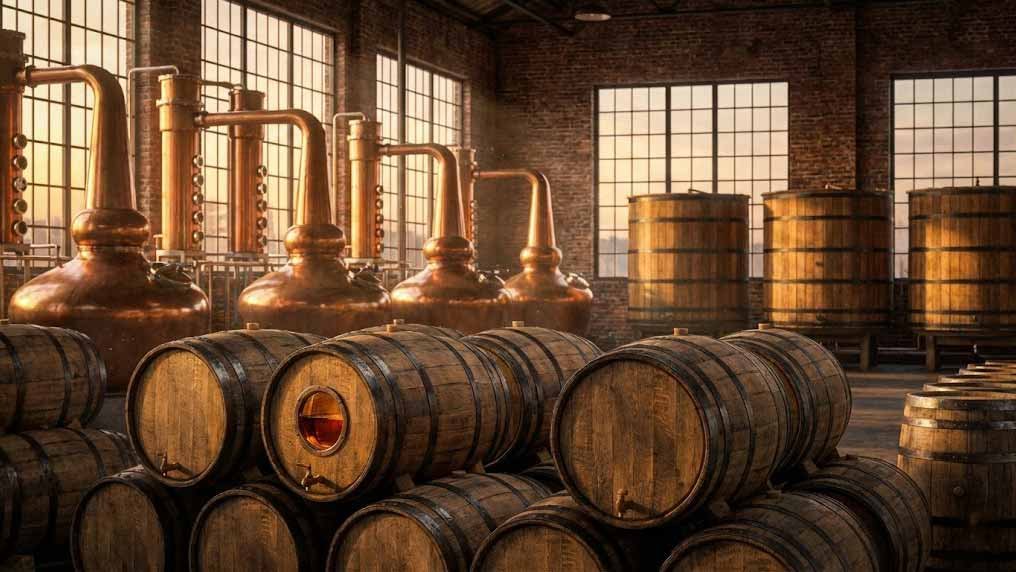
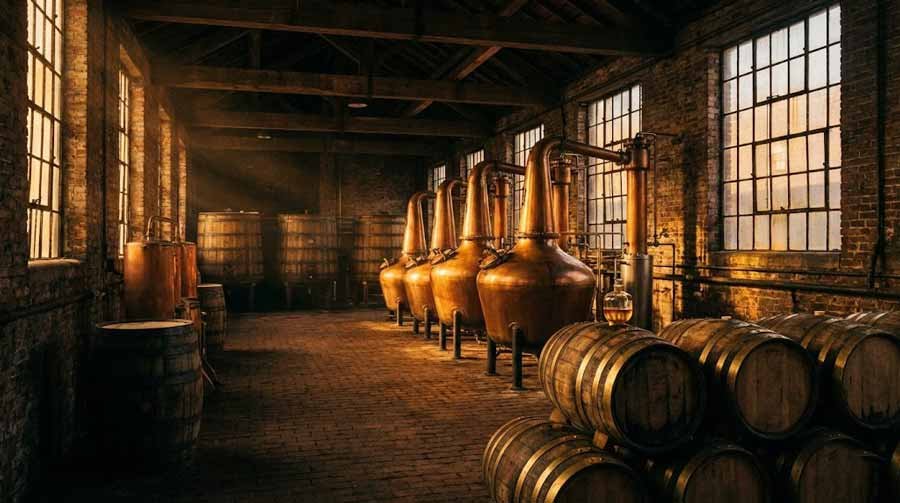
The Paymaster Building gave Kings County room to breathe—and to age. Scottish copper pot stills were imported and installed. Wooden fermenters were built locally by Isseks Brothers. A small corn and barley patch was planted onsite. The operation became, in Spoelman’s words, a model of “sustainable and traditional whiskey production” in one of the world’s most modern cities.
The Philosophy of Process Over Recipe
There is a sentence Spoelman has repeated in various interviews that I find quietly profound: “The flavor comes from the process, not the recipe.” A leather craftsman hears something analogous in that claim. At Marcellino NY, I work with English bridle leather from heritage tanneries—J&E Sedgwick among them—and the material’s character is not determined by the hide alone. It is the oak bark tannage, the months of slow pit processing, the hand-stuffing of wax and grease, the years of use that develop the patina. The recipe—hide, tannin, time—is simple. The process is everything.
Kings County operates the same way. They use Scottish copper pot stills, the kind more common to Scotch production than American bourbon. They employ open fermentation, which exposes the mash to ambient yeasts and microorganisms, creating complexity that closed, controlled fermentation cannot replicate. They source organic corn from upstate New York and malted barley from the United Kingdom. The result is a lineup of whiskeys that are unmistakably American in spirit but international in technique—and that is precisely what makes them interesting.
Spoelman described this philosophy in a 2024 interview with Alcohol Professor: his approach was to take “a broad expansive view of whiskey” and make it in the American tradition “with an international appreciation and outlook.” That is not hedging. That is the aesthetic position of a craftsman who has thought hard about what he is making and why.
The Whiskey Portfolio: Range Without Dilution
Kings County currently produces ten artisan whiskeys, each distinct, none derivative. The flagship Straight Bourbon—made from New York State organic corn and UK malted barley, aged in new American oak charred barrels—is the anchor of the lineup and the spirit that first put the distillery on the national map. Eric Asimov of the New York Times named it the number-two craft bourbon in the country.
The Peated Bourbon is the distillery’s most audacious expression: a spirit that conforms to American bourbon standards but is made with peat-smoked malted barley, producing a Scotch-like depth that has no real precedent in the American whiskey canon. It earned a Gold Medal at the 2025 San Francisco World Spirits Competition, one of the most respected evaluation bodies in the industry.
The Bottled-in-Bond Bourbon—which must by federal law be the product of a single distilling season, from a single distillery, aged at least four years, and bottled at exactly 100 proof—has won Double Gold at the San Francisco World Spirits Competition in multiple consecutive years, including 2020 and 2023, as well as a Double Gold at the 2025 competition. This is not coincidence. This is consistency.
Beyond bourbon, the distillery produces an Empire Rye, a collaborative project with other New York craft distillers to establish a formal standard of identity for New York-made rye whiskey—a category that once dominated the American market before Prohibition obliterated it. There is also a Coffee Whiskey, a Chocolate Whiskey (made with cacao husks from the Mast Brothers chocolate factory, which shares the Brooklyn Navy Yard), a Barrel Strength Bourbon, a Single Malt, and a Honey Moonshine infused with honeycomb from Brooklyn Grange, the rooftop farm operating within the Navy Yard itself. The entire ecosystem of production is localized to a degree that would have seemed impossible when Spoelman first walked into that East Williamsburg warehouse with five stills and a Kentucky accent.
The Gatehouses: Where the Public Meets the Proof
In 2016, Kings County opened The Gatehouses—a tasting room and cocktail bar occupying the historic 1896 stone entrance to the Brooklyn Navy Yard at the Sands Street Gate. The space is open seven days a week: Monday through Thursday from 2:00 PM to 10:00 PM, Friday and Saturday from 12:00 PM to midnight, and Sunday from 12:00 PM to 10:00 PM.
The experience is deliberately unglamorous in the way that all serious craft operations are unglamorous. No tickets required. No velvet ropes. Just whiskey flights, cocktails, New York wine and beer, snacks, and the distillery tour that has become a signature offering—a guided walk through the distillation floor and barrel aging rooms that functions as both a sensory education and a history lesson. The tour is run in-depth, covering fermentation science, barrel aging chemistry, and the legal and cultural history of American whiskey.
National Geographic’s coverage of notable New York City mixologists highlighted The Gatehouses specifically for its contribution to the city’s cocktail culture. The Flatiron Room in Manhattan features Kings County’s Peated Bourbon as part of their curated New Yorkers Whiskey Flight. Equinox Hotels have placed Kings County’s 200ml Straight Bourbon in their hotel rooms. The distillery’s footprint now spans thirty states and six countries.
For those planning a visit from Long Island’s North Shore, the Brooklyn Navy Yard is approximately ninety minutes from Mount Sinai via the Long Island Expressway—a drive worth making for the full distillery tour experience. There is a particular satisfaction in watching something made from scratch in a place this storied, the same satisfaction that draws buyers to properties on the North Shore waterfront with histories deeper than their listing dates.
Awards That Validate, Not Define
The accolades accumulated by Kings County Distillery over fifteen years are extensive enough to constitute their own documentary record of American craft spirits history. The American Distilling Institute named them Distillery of the Year in 2016. The New Orleans Spirits Competition, held during Tales of the Cocktail—the industry’s most intellectually rigorous annual convening—named them Distillery of the Year again in 2023. In the same competition, their Rye Whiskey and Barrel Strength Bourbon each won Best in Category.
The San Francisco World Spirits Competition, the most competitive international evaluation in the spirits world, has awarded Kings County Double Gold medals in consecutive years across multiple expressions. In 2025 alone, the Bottled-in-Bond Bourbon earned Double Gold and the Peated Bourbon earned Gold. The ASCOT Awards have given Double Platinum to both the Barrel Strength Bourbon (2021) and the Bottled-in-Bond (2022). The American Craft Spirits Association has honored them with Gold in Innovation for the Peated Rye.
What matters here is not the length of the list. It is what the list represents: that a distillery founded in a 325-square-foot room, by two men with no distilling background, operating in a borough nobody associated with whiskey production, sustained its commitment long enough to build a portfolio that now competes at the highest levels of international evaluation. That is the rarest kind of arc in any craft industry.
Spoelman’s own framing of the awards is instructive. Speaking to The Spirits Business in 2023, he described Kings County as “a nerdier, geekier distillery”—and suggested the recognition from the Tales of the Cocktail community, which has “always been a little quirky, a little intellectual,” was perhaps an inevitable alignment. I think of that description often. The Heritage Diner has never been the loudest restaurant on the North Shore. It has been the most consistent. There is a market for that, and it is not the most fashionable market—but it is the most loyal.
The Brooklyn Whiskey Wars and the Long Memory of Place
One of the quietly remarkable aspects of Kings County’s location is its proximity to the Brooklyn Whiskey Wars of the 1860s—a period when the waterfront distillery district engaged in open commercial and sometimes physical conflict over federal tax enforcement following the Civil War. The Excise Act of 1862 imposed the first federal tax on distilled spirits, and Brooklyn’s distillers, among the most productive in the country at the time, became both the targets and the resisters of that enforcement.
Spoelman knows this history intimately—he has written about it. Choosing to operate in the Brooklyn Navy Yard, within walking distance of where that conflict played out, is not accidental. It is a statement about continuity, about the long conversation between a place and the things it produces. The Paymaster Building, where sailors once collected wages, now ages bourbon in new American oak. The whiskey takes on the character of its environment—or at least, the character its makers bring to that environment.
Real estate teaches you to think this way. A property on the North Shore does not become valuable merely because of its current square footage or its most recent renovation. It carries the sediment of every generation that lived there, and the discerning buyer understands that what they are purchasing includes that invisible archive. Kings County Distillery is, in part, a physical argument that Brooklyn’s industrial history is not dead—it is aging in barrels, slowly concentrating into something worth tasting.
The Craft Distilling Movement and What It Actually Means
When Kings County opened in 2010, they were the first distillery in New York City since Prohibition. Today, there are dozens. The craft spirits movement that followed has produced extraordinary spirits and considerable fraud in equal measure—the practice of purchasing bulk whiskey from large industrial distilleries and labeling it with artisanal branding has become endemic enough to constitute a genuine consumer protection issue.
Kings County’s position on this is unambiguous and worth stating plainly: they have never sold whiskey made from any outside source. Every spirit they bottle was mashed, fermented, distilled, and aged onsite in Brooklyn. The wooden fermenters were built locally. The stills are Scottish copper. The grain is New York organic. The commitment is total.
Spoelman has articulated why this matters: “By excluding the commercial side of the business, and focusing on ‘do it by sense, do it by taste’, I ended up with a very different approach and product.” That is the craftsman’s position. It is the same position I hold at Marcellino NY when someone asks why I won’t substitute bonded thread for saddle-stitched linen or nylon-tanned leather for English bridle stock. The commitment to method is not marketing. It is the reason the product is worth anything at all.
Whiskey Advocate named Kings County part of “America’s New Whiskey Rebellion”—a designation that captures the political dimensions of what craft distilling actually represents: the reclamation of production from industrial consolidation, the insistence that regional character and artisanal method have commercial viability, the argument that American consumers will pay for authenticity when they can actually taste the difference.
They can. And they do.
A Distillery Worth the Drive
Fifteen years in, Kings County Distillery is no longer a scrappy experiment. It is an institution—one of America’s most decorated craft distilleries, operating from a 123-year-old building in one of Brooklyn’s most historically dense industrial sites, producing ten expressions of American whiskey that have won international recognition while refusing to compromise the methods that earned it.
The Gatehouses tasting room is open daily, no reservation required. Tours of the distillery run regularly and are worth scheduling. The retail operation carries the full lineup, including limited and distillery-exclusive releases not available through standard distribution.
What lingers after a visit to Kings County—after the flight of bourbon and peated whiskey and Empire Rye, after the copper still and the wooden fermenter and the stacked barrels—is the same feeling that lingers after a long dinner at a table worth sitting at. The sense that something was made by someone who cared, in a place with a history, using methods that required more effort than shortcuts would allow. That is not a small thing. In a world increasingly optimized for convenience, it is a very large thing indeed.
Kings County Distillery 299 Sands Street, Building 121 (Distillery/Production) The Gatehouses, Sands Street Gate (Tasting Room & Cocktail Bar) Brooklyn Navy Yard, Brooklyn, NY 11201
Website: kingscountydistillery.com Phone: (347) 689-4211
Tasting Room Hours: Monday–Thursday: 2:00 PM – 10:00 PM Friday: 2:00 PM – 12:00 AM Saturday: 12:00 PM – 12:00 AM Sunday: 12:00 PM – 10:00 PM
Tours: Available regularly; walk-ins welcome. Book via the website. Retail: Available onsite and through distribution in 30 states.