Native Americans called Long Island by several names. Two of the most ancient — Sewanhacky and Wamponomon — translate loosely to “the place of shells.” Not a metaphor. A literal description. When the Algonquin-speaking tribes of the island walked these shores thousands of years before European contact, the shell mounds they left behind rose like small hills along the bays and coves of the North Shore and South Shore alike. The quahog — Mercenaria mercenaria, the hard-shell clam — was not just food. It was currency, ceremony, and sustenance rolled into one ridged, chalky vessel. The word “quahog” itself descends from the Narragansett word poquauhock, and the tribes that harvested this bivalve from Long Island Sound and the Great South Bay did so by treading barefoot through tidal flats, feeling for the telltale firmness underfoot. They ate the meat, carved the shell into wampum, and built a food culture around the clam that would outlast them by centuries.
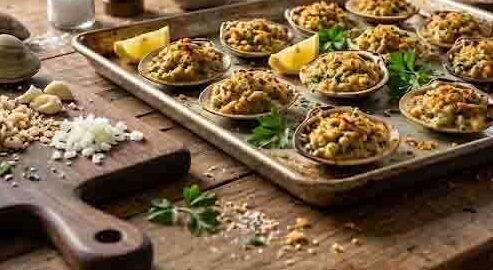
What we call a “baked clam” today — that briny, buttery, golden-topped jewel served at every clam bar and Italian-American table from Setauket to Sag Harbor — is in direct lineage with that ancient practice. The shell is the same. The tidal mud is the same. What Portuguese and Italian immigrants added in the late 19th and early 20th centuries was breadcrumb, garlic, and heat. The rest was already there.
This is a masterclass in doing it right.
Know Your Clam: The Quahog Hierarchy
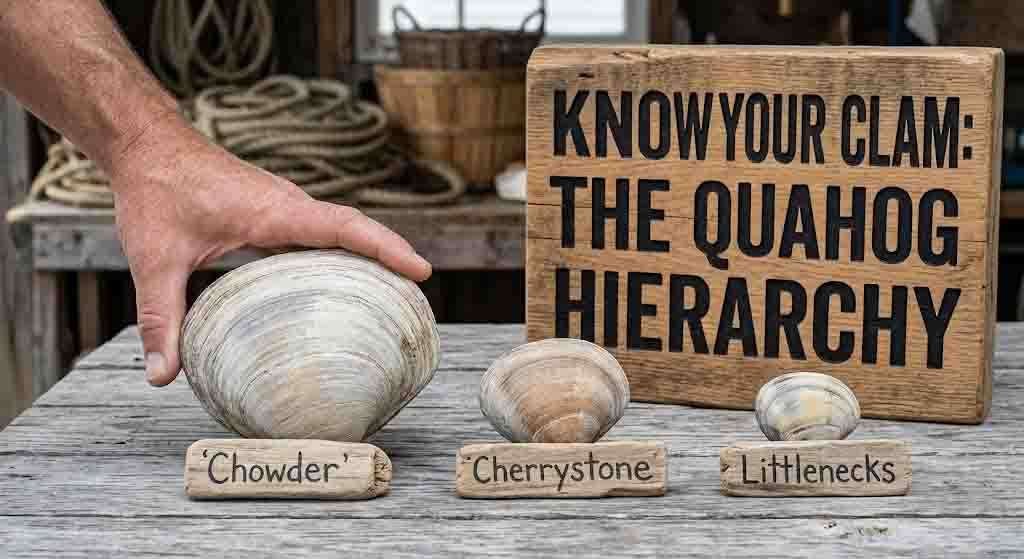
Not all hard-shell clams are equal, and the distinction matters enormously when you’re deciding how to cook them. The hard clam is sold at different sizes, each with its own culinary destiny.
Littlenecks are the smallest and most tender — they belong raw on the half shell with a squeeze of lemon, or barely steamed in a brothy white wine. Topnecks sit just above them in size and can go either way. Cherrystones are the middle children: meaty enough for grilling or baking, tender enough to eat with minimal fuss. These are excellent for a quick baked clam when you want a lighter result.
Then there are the quahogs — sometimes called chowder clams — the largest and most assertive of the clan. Their meat is dense, mineral-rich, and deeply flavored, with a toughness that rules out eating them raw. This toughness is not a flaw. It is a feature. When properly steamed, chopped, and folded into a well-seasoned stuffing, the quahog delivers a depth of flavor that the smaller clams simply cannot match. The briny intensity that comes from a properly prepared quahog stuffing — soaked in its own reserved cooking liquid, layered with aromatics and bread — is one of the great flavors of the Eastern Seaboard.
For a true Long Island baked clam masterclass, you want to work with a combination: cherrystones for the presentation shells and a portion of larger quahog meat for the stuffing itself. This gives you the right shell size for a composed presentation and maximum flavor in the filling.
Sourcing: Where Long Island’s Clams Live
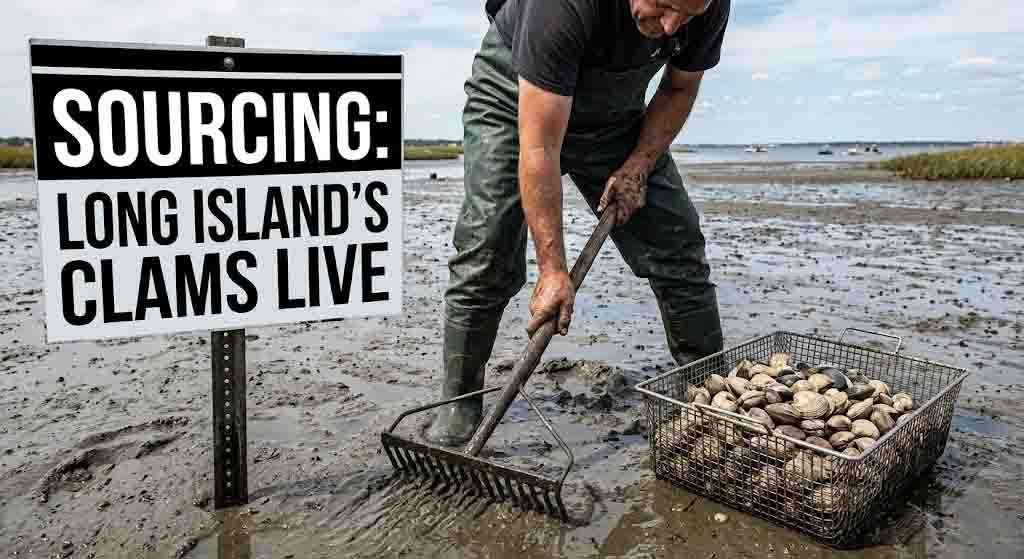
The quahog is most abundant along a corridor running roughly from Cape Cod down through Long Island Sound to New Jersey, and Long Island sits squarely in the center of that range. The North Shore bays, coves, and tidal flats — including Cold Spring Harbor, Oyster Bay, and the waters around Mount Sinai Harbor — have historically supported both commercial and recreational clamming. The South Shore’s Great South Bay remains one of the most productive hard clam beds on the East Coast.
If you are sourcing for cooking rather than digging yourself, the standard of excellence is simple: buy local, buy live, buy from a fish market you trust. Shells should be tightly closed or close firmly when tapped. The clam should smell of ocean, not of anything else. When you steam them open, a dead clam will refuse to open — discard it without hesitation.
On Long Island’s North Shore, fish markets at Port Jefferson, Northport, and Cold Spring Harbor routinely carry fresh local cherrystones and chowder clams, particularly in season. The closer to the water you buy, the better the clam.
The Steam: Why This Step Defines the Dish
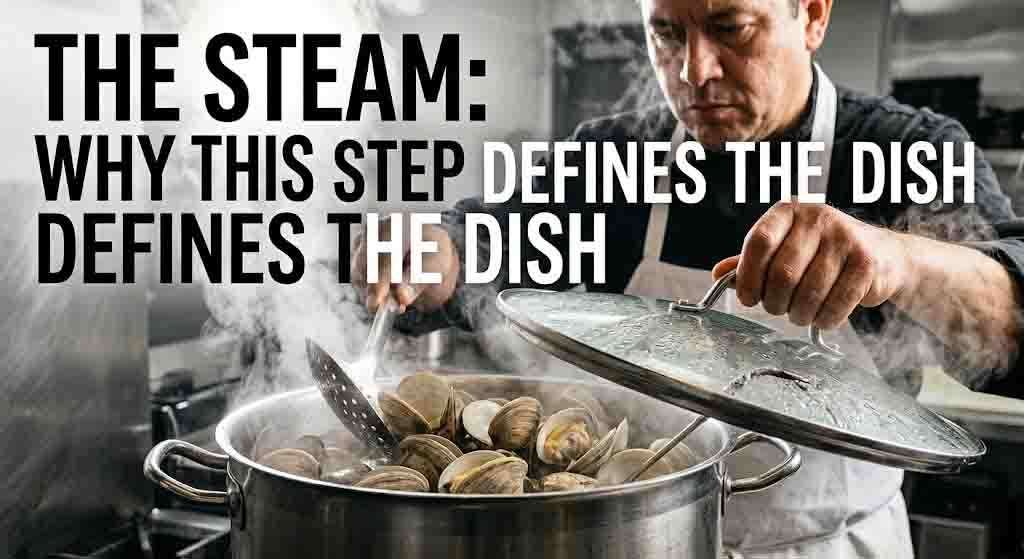
Most home cooks approach the steaming stage as a preliminary inconvenience — something to get past on the way to the real cooking. This is the wrong framing entirely. The steam is where the flavor base of the entire dish is created.
Fill a large pot with about an inch of water — plain, unsalted. Bring it to a rolling boil, then add your scrubbed clams in a single layer if possible. Cover with a lid left slightly ajar to let steam escape. The moment the shells crack open, begin watching them closely. Pull them the instant they open. This is not a step where patience is rewarded by more time. Overcooking at this stage turns the clam meat rubbery and diminishes its natural sweetness — you will spend the rest of the recipe trying to compensate for damage done in the first five minutes.
The liquid left in the pot after steaming is not cooking water. It is concentrated clam broth, salted by the sea and loaded with mineral depth. Reserve every drop. You will use it to hydrate your bread stuffing, and it will carry the flavor of the ocean into every bite of the finished dish. This is the single step that separates a flat, one-dimensional baked clam from one with actual soul.
Let the clams cool until you can handle them. Carefully break or separate the shell halves — cherrystones will yield two clean halves — and reserve the prettier, more intact shells for serving. Remove the meat from the shell and place it on a clean cutting board.
The Chop: The Most Underestimated Technique
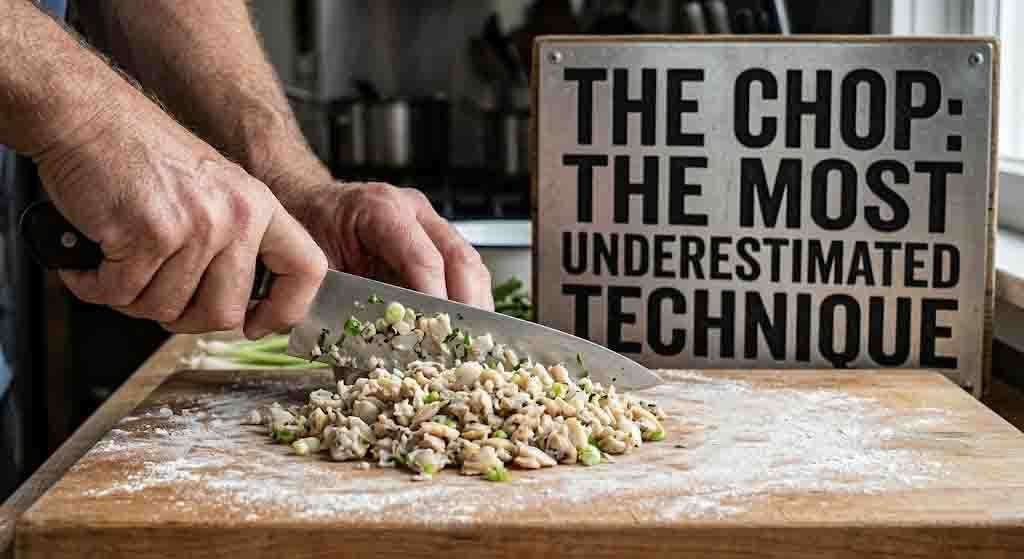
The way you cut the clam meat is not trivial. It is, in fact, the technical heart of the preparation — the point where most home recipes go wrong by simply running everything through a food processor and producing a paste that bakes into something dense and undistinguished.
The clam meat should be chopped by hand with a sharp knife. The goal is a medium-fine dice: small enough that the meat integrates into the stuffing and distributes evenly, large enough that you still encounter recognizable pieces of clam in each bite. The texture contrast between the soft bread stuffing and the slightly firm, chewy pieces of clam is where the pleasure of the dish lives.
Start by removing any tough, dark-edged outer portions of the larger quahog meat if you’re using chowder clams — these can be chewy in an unpleasant way if left in large pieces. The white, plump interior meat is what you’re after. Lay it flat and use a rocking motion with your knife, working it into a rough, uneven mince. Deliberately leave some variation in the size of the pieces. The lack of uniformity is a virtue here, not a failure of technique.
Do not use a food processor for the clam meat under any circumstances. The machine does not understand texture. It understands only destruction.
Building the Stuffing: The Architecture of a Great Baked Clam
The stuffing is where the cook’s personality enters the dish, and where Long Island’s particular flavor identity diverges slightly from the Rhode Island stuffie tradition. The classic Long Island baked clam leans Italian-American: garlic, parsley, Parmesan or Pecorino, and breadcrumb. It is cleaner, brighter, and more herb-forward than the Portuguese-influenced New England stuffie, which often incorporates chouriço and bell pepper.
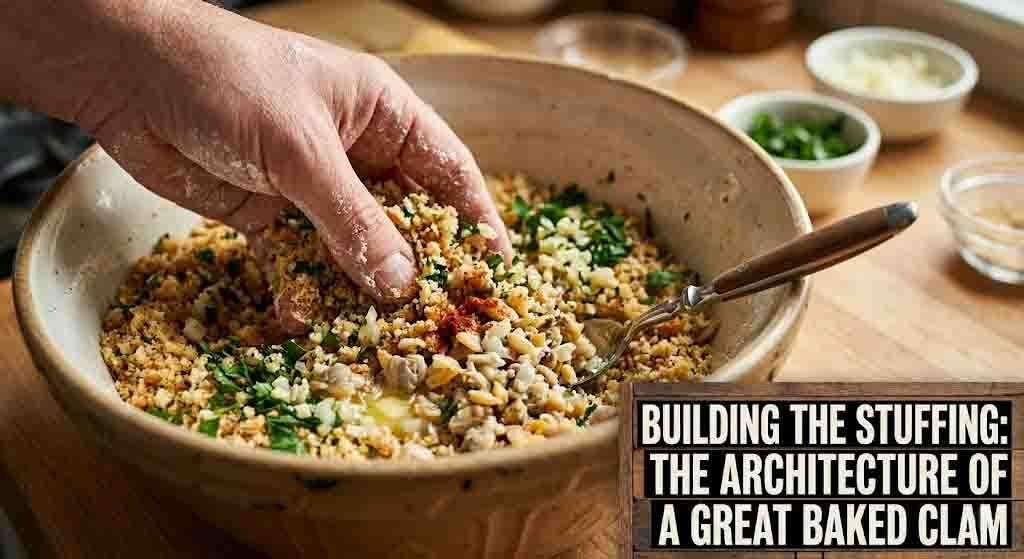
The foundational architecture is this: finely diced onion, minced garlic (generous), flat-leaf Italian parsley, Italian-seasoned breadcrumbs, a small pour of dry white wine, the reserved clam broth, unsalted butter, a squeeze of lemon, and the chopped clam meat. Grated hard cheese — Pecorino Romano has the right saltiness and sharpness to cut through the richness of the butter without overwhelming the clam — goes in last, along with a pinch of crushed red pepper if you want a whisper of heat.
The texture of the stuffing before it goes into the shell matters. It should be moist and cohesive — if you press a handful together, it should hold its shape without crumbling — but never wet or sodden. Add the clam broth slowly, tablespoon by tablespoon, until the mixture comes together. If it gets too wet, more breadcrumb. If it stays too dry and stiff, more broth or a touch more melted butter.
Sauté the onion and garlic in butter over medium-low heat until softened and translucent, without browning — browning here introduces bitterness. Add the white wine and let it reduce by half. Remove from heat, fold in the breadcrumbs, parsley, cheese, red pepper, and clam broth. Add the chopped clam meat last, folding gently to keep the pieces intact.
The stuffing should rest for a few minutes before going into the shells. This allows the breadcrumbs to absorb fully and gives the flavors time to knit together.
The Fill and the Bake: Patience Meets Heat
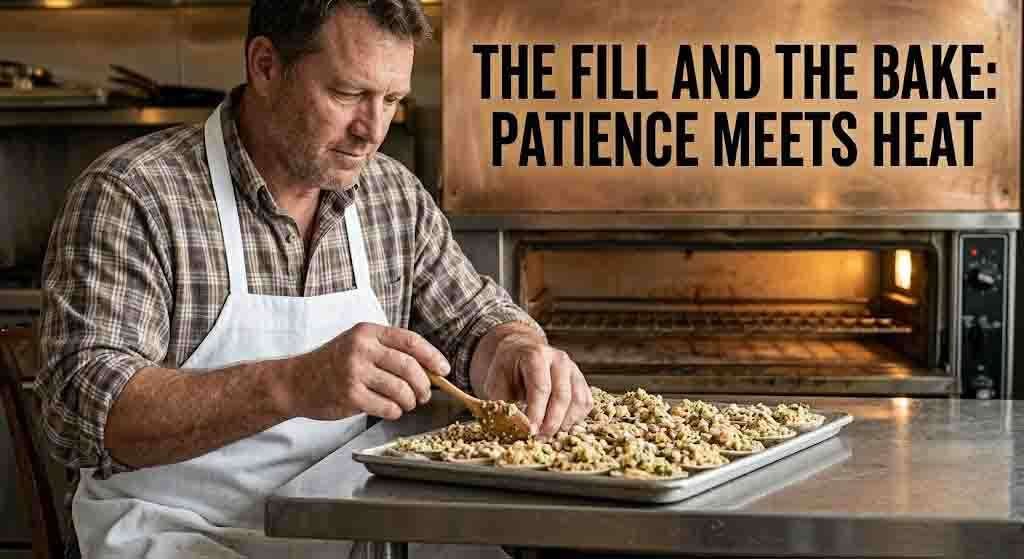
Mound the stuffing generously into each shell. Long Island baked clams are not dainty objects. They are full, rounded, almost volcanic — a dome of stuffing that extends above the lip of the shell. Pack it firmly so it doesn’t crumble apart in the oven, but don’t compress it so tightly that it bakes into a dense disk. You want it to hold together while still having some interior airiness.
Arrange the filled shells on a sheet pan. A small amount of coarse salt or crumpled foil under each shell will keep them level. Drizzle lightly with olive oil over the top of each clam — this helps the surface brown without drying out. A dusting of paprika is optional but traditional, and adds a warmth of color that signals the finished dish before it even reaches the table.
Bake at 400°F for 15 to 20 minutes, until the tops are deeply golden and the edges of the stuffing are crisped. If you want more color, a quick pass under the broiler for the final two minutes will give you the kind of charred, crackling crust that is the visual signature of a great baked clam.
Serve immediately, with lemon wedges. The lemon is not a garnish — it is a necessary acid that brightens the briny richness of the clam and cuts through the butter in the stuffing. A few dashes of hot sauce on the table honor the old clam bar tradition and are never wrong.
At The Heritage Diner, where we’ve been serving the North Shore for 25 years, baked clams are a dish I approach with enormous respect — not because they are technically complicated, but because their simplicity leaves no room to hide. The quality of the clam, the restraint in the steam, the care in the chop: every decision shows up in the finished result.
The Long Island Tradition: Why This Dish Endures
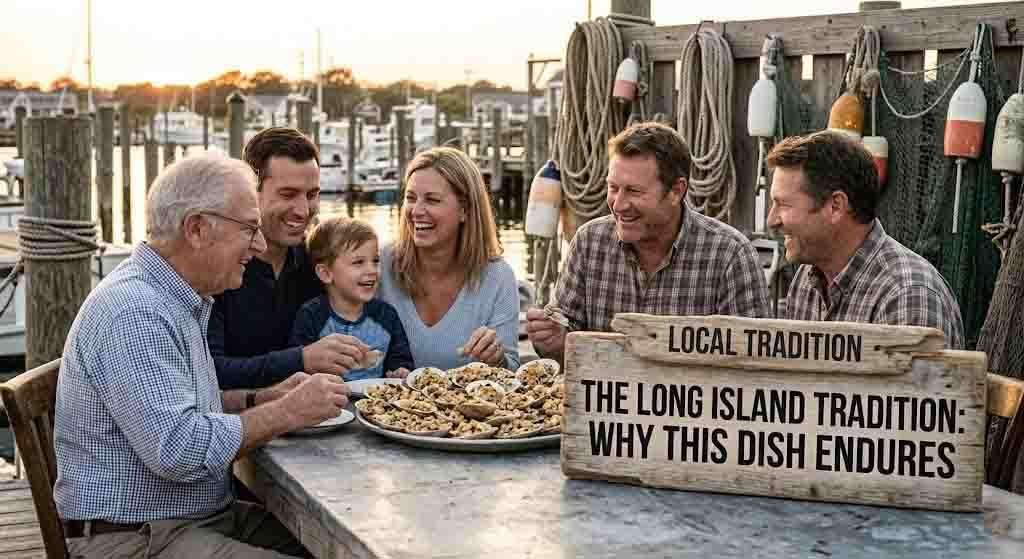
There is a reason the baked clam has never gone out of fashion on Long Island. It is not nostalgia, though there is plenty of that attached to it. It is because the dish is honest. It takes one of the most abundant, affordable, and deeply flavored ingredients in the local water and honors it with a technique that amplifies rather than obscures. Butter, breadcrumb, garlic, and parsley do not compete with the clam. They frame it.
The quahog has been feeding people on this island for at least 11,000 years. The Algonquin-speaking tribes who left those shell mounds along the North Shore understood something that the best clam bars and home cooks still understand today: this bivalve, handled with intelligence and respect, needs very little help to become extraordinary.
The shell is the same. The tidal flat is the same. The ocean is the same. What you bring to it is your attention.
Sources:
- Quahog: A Brief History of Our Clam — Little Egg Harbor Chamber of Commerce
- How the Quahog Became a Rhode Island Icon — New England Historical Society
- Hard Clam — Wikipedia
- The Tribes of Long Island — Native Long Island
- How to Make Stuffed Quahogs — On The Water
- New England Stuffed Clams — Kitchen Dreaming
- A History of Hard Clamming — ScienceDirect