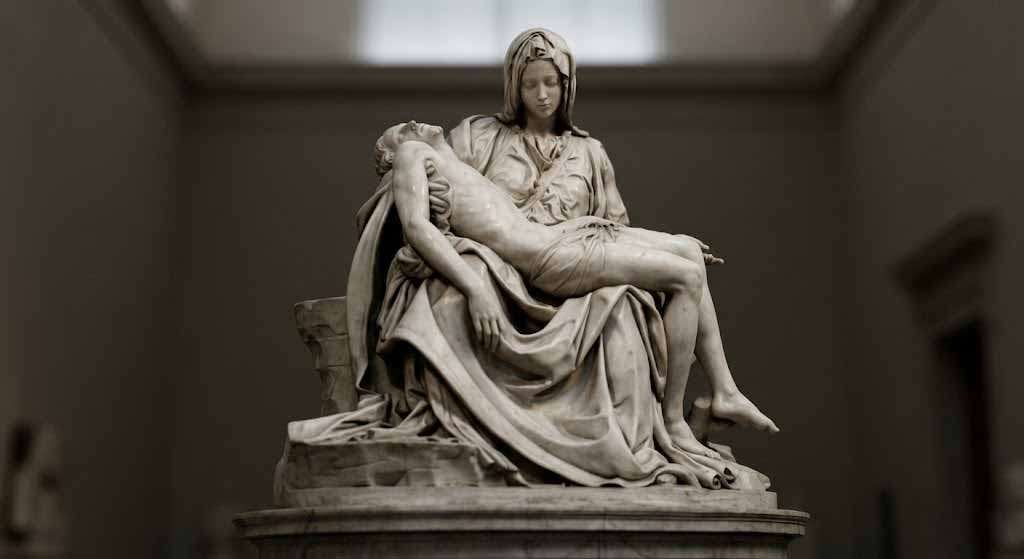
She’s holding a grown man’s corpse in her lap and the marble makes it look weightless. That’s not technique. That’s theology.
Stand in front of Michelangelo’s Pietà — housed in St. Peter’s Basilica in Vatican City behind its bulletproof glass since a geologist took a hammer to it in 1972 — and you will feel something before you understand anything. The feeling is the point. The understanding comes after, and when it does, it compounds the feeling rather than replacing it. That’s the rarest thing in art: technical mastery so complete it becomes invisible, so all you’re left with is the emotional fact of the thing.
Michelangelo was 24 years old when he finished it. Let that sit for a second.
The Problem He Had to Solve
Before you can appreciate what Michelangelo accomplished, you have to understand what he was up against. A dead adult male — Christ was approximately 33 at the crucifixion — draped across a seated woman’s lap. The physics of this are brutal. A grown man’s body is roughly 170 pounds of dead weight, and dead weight is the hardest kind to carry or support. In life, a person distributes their own mass through posture and muscle tension. In death, gravity wins completely. The body slumps, the limbs fall away, the weight becomes concentrated and unmanageable.
Michelangelo solved this with drapery. Not as decoration. As architecture.
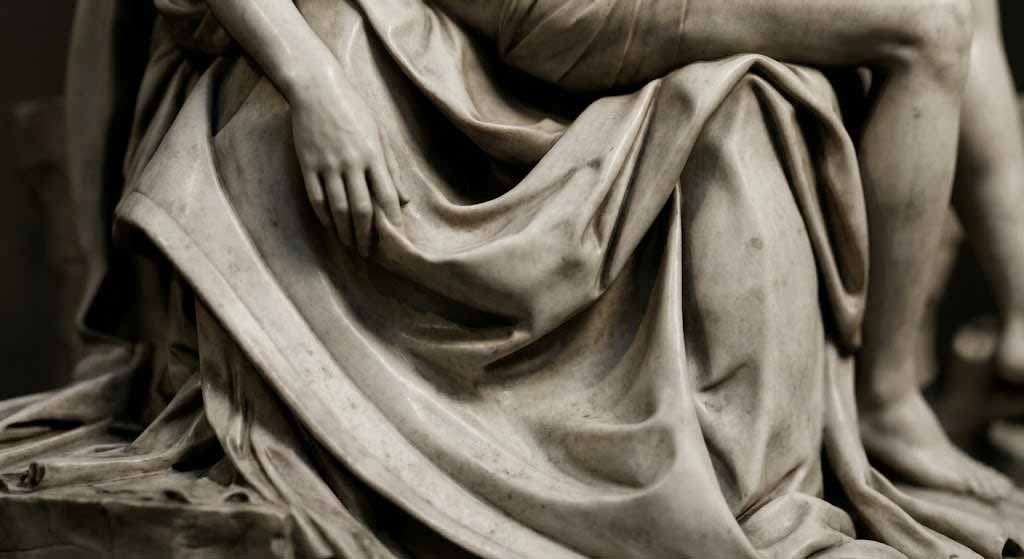
Mary’s robes cascade down in broad, sweeping folds that serve as ledges, cradles, and concealed supports for Christ’s body. The fabric creates a visual logic that your eye accepts before your brain can protest: of course a body can rest like that, look at how the cloth holds it. The drapery is doing structural work that the human body could not plausibly do alone. Michelangelo understood that the eye follows fabric the way water follows a slope, and he used that understanding to redirect attention away from the impossible toward the believable. It is one of the great sleights of hand in the history of Western art, and it is executed in stone.
The cloth itself is carved with a precision that defies the material. The ridges catch light and cast shadows that shift as you move around the sculpture. Some of those folds are so deeply undercut that the marble between them is thinner than your finger — carved from the inside, a technique that required Michelangelo to work with tools he could barely see the tips of, guided by touch as much as sight. When I work a piece of leather — pulling an edge, burnishing a seam — I understand at some small scale what it means to coax a resistant material into compliance through patience and pressure. What Michelangelo did to Carrara marble is something else entirely. It is the difference between knowing a language and writing The Iliad.
The Pyramid and the Calm Inside the Storm
Stand back far enough and the Pietà reveals its compositional geometry. The two figures together form a pyramid — Mary’s head at the apex, the base spreading wide across the bottom of the marble block. This was not accidental. Renaissance artists understood pyramidal composition as an instrument of psychological stability, a structure the eye reads as grounded and resolved even when the subject matter is not.
And the subject matter here is anything but resolved. A mother is holding her dead son. The most final and irreversible thing that can happen to a parent. The scene is, by any human measure, a catastrophe.
But the pyramid holds it. The geometry performs what the theology promises: that this grief is contained within something larger. That the structure of the universe can absorb even this. You feel the weight of the moment and simultaneously the stillness around it, and that double sensation — devastation and calm coexisting — is not an accident of composition. It is the entire argument of the sculpture made physical. Michelangelo didn’t depict grief. He built an environment in which grief could be held.
This is worth comparing to what other artists did with the same subject. Earlier Pietà compositions — German and Northern European versions from the 14th century — tend toward raw, contorted expressionism. The pain is on the surface: the wounds exaggerated, the bodies angular and anguished. They want you to feel the horror. Michelangelo made a different choice. He wanted you to feel the mystery. I wrote about something adjacent to this tension when I looked at Rembrandt’s Aristotle with a Bust of Homer — how a great artist can load an image with emotional complexity through restraint rather than declaration, through what is withheld as much as what is shown. Michelangelo’s Pietà is the same principle carved into three dimensions.
Mary’s Face: The Controversy That Never Fully Died
When the Pietà was unveiled in 1499, people noticed immediately: Mary looks too young. By the time of the crucifixion, the Virgin Mary would have been in her late forties or early fifties. Michelangelo gave her the face of a woman barely past adolescence. Smooth. Serene. Unmistakably young.
He addressed the criticism directly, and his answer is one of the most revealing statements any Renaissance artist left us. He said, in effect, that a woman who is chaste and pure does not age as other women do. That her spiritual state is expressed in her physical form. That Mary’s youth is not a biological fact but a theological one.
This is not just apologetics. It is the operating theory behind the entire sculpture, stated plainly. Michelangelo was not making a documentary. He was making an argument about the nature of divine beauty — and that argument required a Mary who looked the way divinity looks, not the way human biology looks.
There is also a compositional logic to the choice. If Mary had appeared her historical age, the visual relationship between the two figures would have shifted dramatically. An old woman holding a younger man’s body would be a pietà of a different emotional register — more naturalistic, more earthly, more ordinary. By making Mary young, Michelangelo preserved the sense that she and Christ exist outside of time, suspended in a moment that is simultaneously historical and eternal. Mother and son, but also something else. Something harder to name.
What Twenty-Four Means
He signed the Pietà. He is the only major work Michelangelo ever signed — reportedly because he overheard visitors crediting the sculpture to another artist. He carved his name across Mary’s sash: MICHEL·ANGELUS·BONAROTUS·FLORENT·FACIEBAT. Michelangelo Buonarroti, Florentine, made this. He later said he regretted the vanity of it, that pride had briefly overtaken him.
He was 24. He had been given a block of Carrara marble, a commission from a French cardinal, and roughly two years. What he produced is considered by many scholars the most technically perfect marble sculpture in history — not the most emotional, not the most ambitious, but the most technically perfect. The drapery has never been surpassed. The transition from cloth to skin, the way the veins in Christ’s arm seem to have merely ceased pumping rather than never having existed, the handling of the hand hanging limp from Mary’s grasp — these are not the accomplishments of a prodigy still developing. They are the accomplishments of a master at the absolute top of his form.
Except he was 24. So what does that mean for the rest of the categories we use to understand artistic greatness — experience, maturity, accumulated wisdom? The Pietà is a useful wrench thrown into almost every theory we have about how mastery is built. It suggests that whatever Michelangelo had was not primarily a product of time. It was structural. It was the way he was wired.
This is part of what makes the work unsettling in a way that transcends its subject matter. You are not just confronted with grief. You are confronted with a reminder of your own limits.
Neoplatonism and the Beauty That Points Past Itself
Michelangelo was steeped in Florentine Neoplatonism — the intellectual framework championed by Marsilio Ficino and the Platonic Academy that Lorenzo de’ Medici hosted during Michelangelo’s formative years. He absorbed it as a teenager in the Medici household, alongside the finest humanist minds of the 15th century. It shaped not just what he believed but how he made.
The Neoplatonist idea, traced from Plato through Plotinus and reactivated in the Renaissance, holds that physical beauty is not an end in itself. It is a rung on a ladder. When you encounter genuine beauty — the kind that stops you, that makes the noise go quiet — you are not simply receiving sensory pleasure. You are being pointed toward something the physical world can only approximate. Beauty, on this account, is theology by another name. It is the material world’s way of gesturing toward the immaterial.
This is the philosophical engine running underneath the Pietà‘s serenity. The scene depicted is the worst thing that could happen to a mother. And yet the sculpture is overwhelmingly, undeniably beautiful. Not beautiful despite the grief — beautiful through it. The beauty does not deny the suffering. It holds it and transforms it into something that the eyes and the mind and whatever you want to call the third thing can all receive at once.
Michelangelo believed — and spent his career demonstrating — that the way to represent divine truth was through physical perfection. Not idealization in the cheap sense, not the removal of all humanness, but a heightening of the human until it becomes a window. Christ’s body in the Pietà is anatomically precise and physically beautiful in a way that does not soften the fact of death but reframes it. The beauty is the argument. It says: even this. Even in this, something eternal is legible.
This connects to the philosophical questions I find myself circling in other contexts — Jacques-Louis David’s Death of Socrates works in adjacent territory: a man facing death with a composure that the painting insists is not resignation but affirmation. The examined life meeting its conclusion with open eyes. Both David and Michelangelo understood that the way you depict death tells you everything about what you believe life means.
The Glass and the Distance
The bulletproof barrier installed after the 1972 attack has changed the experience of the Pietà in ways that are worth naming. You cannot get close. You cannot stand at the level of the figures. You see it from a slight distance, slightly below, which is actually not far from where Michelangelo calculated you would be — he tilted Mary’s face downward at an angle calibrated for a viewer approaching from the nave of the Basilica. He designed the sight lines. The distance, in other words, is not entirely wrong.
But the glass introduces a mediating layer. A reminder that the object needs protecting. That it is both extraordinarily durable — five centuries of existence, survived transportation, survived the hammer — and extraordinarily fragile. It is the only Pietà. There is no version two.
That is true of all great made things. The bespoke object — the painting, the sculpture, the hand-built case — exists as a single instance. It carries the decisions and the errors and the corrections of the person who made it, and those cannot be replicated, only approximated. What Michelangelo understood, cutting into that first block of Carrara with his chisels at 22 or 23, is that making something truly means committing. Every cut removes material that cannot be returned. Every decision forecloses others. You make the thing by the irreversibility of your choices. And when it’s done, it either holds or it doesn’t.
The Pietà holds. It has held for 526 years. It will outlast everything we argue about today, and probably everything we argue about tomorrow. That kind of duration is its own kind of answer to grief — not a consolation, exactly, but a demonstration. Things made with full attention, made to last, made in service of something larger than the maker’s reputation or the patron’s satisfaction — those things have a way of surviving their moment. The marble endures. The grief endures. And somehow, impossibly, so does the beauty.
You Might Also Like: Rembrandt’s Aristotle with a Bust of Homer — A Portrait of the Mind in Conflict | Jacques-Louis David’s The Death of Socrates — Conviction, Hemlock, and the Price of the Examined Life
Sources
- William E. Wallace, Michelangelo: The Artist, the Man and His Times (Cambridge University Press, 2010) — cambridge.org
- Charles de Tolnay, Michelangelo: Sculptor, Painter, Architect (Princeton University Press, 1975)
- Marsilio Ficino, Commentary on Plato’s Symposium on Love, trans. Sears Jayne (Spring Publications, 1985) — foundational Neoplatonist text Michelangelo absorbed in the Medici circle
- Ross King, Michelangelo and the Pope’s Ceiling (Bloomsbury, 2002) — extensive biographical context on Michelangelo’s formation and method
- Vatican Museums official page on the Pietà — museivaticani.va
- James Beck and Michael Daley, Art Restoration: The Culture, the Business and the Scandal (John Murray, 1993) — covers the 1972 attack and subsequent conservation
Tags: sculpture, arts, Philosophy, painting
Category: Fine Art