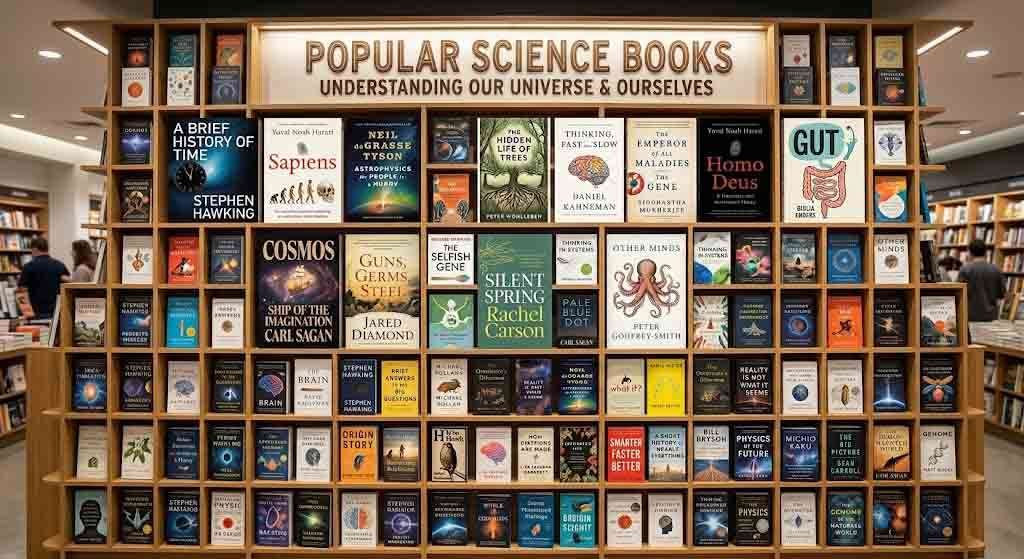
Every library is an autobiography. Not the polished kind — the real kind, with the receipts. The books you kept, the ones that left marks, the ones you dog-eared and went back to three years later and found that you’d underlined the wrong sentence the first time.
This is that list. Fifty books. Not the fifty most important books ever written, though some of them might be. These are the fifty books that landed in a specific life — Greek immigrant household in Brooklyn, long stretches behind a diner counter on the North Shore, years stitching leather briefcases by hand — and did something permanent. Changed the angle. Cracked something open. Refused to leave.
They’re organized loosely by the chapter of life they belong to, though the honest truth is most of them don’t stay in their lane. The existentialists showed up in the kitchen. Darwin showed up at the workbench. The philosophers showed up everywhere, mostly uninvited.
If you want the full review of any book on this list, every title links to a dedicated post. The list below is the map. The reviews are the territory.
The Foundation: Who You Are Before You Know It
These are the early books — the ones that arrived when the world was still mostly confusion, when the categories hadn’t hardened yet.
Thus Spoke Zarathustra by Friedrich Nietzsche — Start here if you start with Nietzsche. Not because it’s the most rigorous — it isn’t — but because it is the most alive. Zarathustra doesn’t argue; he proclaims. The Overman, the will to power, eternal recurrence — these are not academic propositions. They are demands. The book asks what you are building yourself toward, and it does not accept comfortable answers.
The Gay Science by Friedrich Nietzsche — This is where Nietzsche announces that God is dead — not triumphantly, but in mourning. The madman in the marketplace is not celebrating. He is warning. What do we replace the anchor with? The question has been running for 140 years and nobody has a clean answer yet.
The Complete Works of Friedrich Nietzsche — Oscar Levy Translation — Reading the complete works is a different experience than reading the highlights. You see the thinking evolve, contradict itself, recover. Nietzsche is more humane in full than he appears in excerpts. More uncertain. That uncertainty is the part worth keeping.
Five Dialogues by Plato — Euthyphro, Meno, Phaedo, the Apology, the Crito. Socrates in the early work, before Plato’s own voice overtakes him. The man who claimed to know nothing turned out to know more than anyone. The dialectical method — press the assumption, follow the implication — is the most valuable intellectual tool in the library. Start here before you start anywhere else.
A Kierkegaard Anthology, edited by Robert Bretall — Kierkegaard fights back. Where Hegel builds systems, Kierkegaard breaks them. The single individual against the crowd, the leap of faith, the three stages of existence. He is the most personal philosopher — he writes about his own anguish and calls it philosophy, which it is. Bretall’s anthology is the right entry point: curated, sequenced, livable.
Nineteenth-Century Philosophy, edited by Patrick Gardiner — The century that produced Marx, Nietzsche, Mill, Schopenhauer, Kierkegaard, and Darwin cannot be reduced to a single paragraph. Gardiner’s anthology doesn’t try. It shows the arguments developing in real time, responding to each other, colliding. Philosophy as a living argument rather than a museum exhibit.
The Existentialists: Living Without the Net
This is the cluster that does the most practical damage. Practical in the sense that you cannot read these books and then look at your life the same way.
Exploring the Existentialist Philosophy in Albert Camus’ The Stranger — Meursault kills a man on a beach and feels nothing in particular about it. The trial that follows is less about the murder than about his refusal to perform the expected emotions. Camus is asking what authenticity costs when it costs everything. It’s the shortest philosophical education you can get.
Lyrical and Critical Essays by Albert Camus — The essays are where Camus breathes. The fiction puts him in a cage; the essays let him move. His Algeria, the Mediterranean light, his refusal to choose between political commitment and aesthetic pleasure — this is the Camus most readers miss. Worth the search.
The Plague: A Powerful Exploration of the Human Condition in Times of Crisis — Oran is quarantined. The plague is a literal plague and also every other thing that seals a people inside a crisis — political, existential, moral. Rieux keeps working. That is Camus’ answer to absurdity: you keep working, not because it will ultimately matter, but because it is the right thing to do while you are here.
No Exit by Jean-Paul Sartre — Three people in a room. No windows. No exits. Hell is other people — but read the play before you use that line, because what Sartre means is more specific and more devastating than the quote. The version of yourself that other people freeze in place is a kind of death. The play is 45 pages. It will stay for years.
Anti-Semite and Jew by Jean-Paul Sartre — The philosophical anatomy of a prejudice. Sartre argues that anti-Semitism is not a mistake — it is a choice, a way of fleeing the anxiety of freedom by fixing the world into solid categories. He gets important things right and some things wrong. Both are instructive.
Civilization and Its Discontents by Sigmund Freud — Written in 1929, it reads like it was written last week. Freud’s argument: civilization is built on the suppression of instinct, and this suppression produces neurosis at the individual level and aggression at the collective level. The twentieth century then proceeded to prove his point in several hundred million different ways.
Steppenwolf by Hermann Hesse — Harry Haller lives between two natures — the bourgeois and the wolf. He cannot belong fully to either and the tension is destroying him. Hesse’s solution is stranger and more interesting than most readers expect. The Magic Theatre in the final act is not a reward. It is a diagnosis.
Exploring the Self: Hermann Hesse’s Siddhartha — Read after Steppenwolf. Where Steppenwolf tears apart, Siddhartha reassembles. The river. The ferryman. The long patience of becoming. These are not ideas — they are images that live in the body after the words are gone.
Darwin, Dawkins, and the Architecture of Life
The evolution shelf changed the way everything else looked. Once you understand natural selection as a mechanism, it becomes a lens. You see it everywhere — in markets, in cultures, in languages, in the leather trade. It does not make the world cold. It makes it stranger and more interesting.
On the Origin of Species by Charles Darwin — Read it. Not a summary of it. The actual book. Darwin is a careful writer — he anticipates every objection, walks through the evidence slowly, never claims more than the evidence supports. The revolution is so quietly stated that you have to pay attention to feel it arriving. When it arrives, it does not leave.
The Selfish Gene by Richard Dawkins — The gene’s-eye view of evolution. Organisms are vehicles. Genes are the replicators. The selfishness is not metaphorical — it is mechanical. The book also introduces the meme, which is the concept that keeps paying dividends: ideas as replicators, spreading and mutating through culture the way genes spread and mutate through populations.
The God Delusion by Richard Dawkins — Whatever you think going in, this book will clarify your position. Dawkins is precise, thorough, and genuinely concerned with getting the question right. The chapter on the meme theory of religion is worth the whole book.
Thought Contagion by Aaron Lynch — Lynch applies memetics systematically. He asks which kinds of beliefs spread most effectively and why. The answer is not “the true ones.” The answer is the ones that are most contagious — which produces a framework for understanding cultural dynamics that explains a great deal about religion, politics, and every other arena where ideas compete for minds.
Darwin Among the Machines by George Dyson — Dyson traces the idea that machines evolve — not metaphorically but mechanically — from Samuel Butler in 1863 through Turing and von Neumann to the present. The book argues that artificial intelligence is not an interruption of natural history. It is a continuation of it.
Demonic Males: Apes and the Origins of Human Violence by Richard Wrangham & Dale Peterson — Why are males violent? Not a rhetorical question — an evolutionary one. Wrangham and Peterson go to the primates and come back with an unsettling answer. The book is careful, the evidence is solid, and the conclusions are the kind you want to argue with but can’t quite dismantle.
Evolution’s Workshop: God and Science on the Galápagos Islands by Edward J. Larson — The Galápagos as contested ground — scientific, theological, ecological. Larson is a historian of science with a Pulitzer on his shelf and the writing shows it. The islands are the laboratory where Darwin’s idea was born and where it has been tested, debated, and revised ever since.
The Machines: Technology, Mind, and What Comes Next
The New Media studies years produced this shelf. The argument running through all of it is that every technology is also a philosophy — it does not simply transmit content, it reorganizes the mind that receives it.
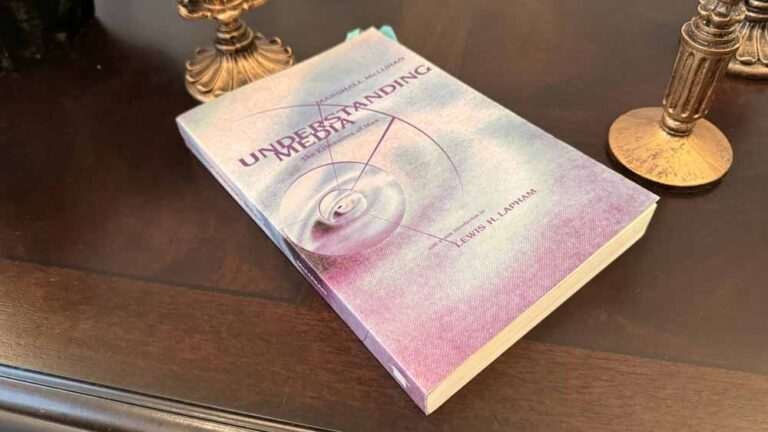
Understanding Media: The Extensions of Man by Marshall McLuhan — The medium is the message. Not a slogan — a structural claim about how every communication technology rewires the sensory ratios of its users. McLuhan was writing about television and radio in 1964 and somehow describing the internet before it existed. Read it slowly. Don’t expect it to be linear. That’s the point.
The Gutenberg Galaxy by Marshall McLuhan — The companion volume. Where Understanding Media ranges across all technologies, The Gutenberg Galaxy focuses on the printing press and the civilization it built. Linear thought, private reading, nationalism, the modern self — McLuhan traces them all back to Gutenberg. Read this one first if you want the argument in sequence.
Technics and Civilization by Lewis Mumford — Published 1934. Still definitive. Mumford traces the development of Western technology not as a neutral progression but as a series of philosophical choices — about time, about nature, about what human beings are for. The clock, not the steam engine, is where modern civilization begins. That argument alone is worth the price.
The Feeling of What Happens by Antonio Damasio — Consciousness is not reason floating above the body. Consciousness is the body’s felt report on its own states. Damasio’s neuroscience dismantles the Cartesian split without replacing it with something easy. The feeling of what happens is the beginning of the self — and it is more fragile than any of the philosophical systems built on top of it.
A Universe of Consciousness by Gerald Edelman and Giulio Tononi — How does a brain produce a self? Edelman and Tononi attack the hard problem of consciousness from a neurobiological angle — not by dissolving the question but by building a model rich enough to take it seriously. Dense but rewarding.
Flesh and Machines by Rodney Brooks — The MIT roboticist makes the case that we are, in the end, machines — and that this is not a demotion. Brooks has built robots that behave in complex ways without containing anything we would call a mind, and his argument about what that implies for human consciousness is neither comforting nor dismissable.
History, Power, and the Long View
The Iliad, translated by Robert Fagles — Achilles is not the hero of the Iliad. Grief is. The poem is about what it costs a man to be a warrior — the rage, the loss, the moment when Achilles finally weeps with Priam over the body of a son, enemy and enemy’s father holding each other in the dark. 2,700 years old. Nothing in it has become less true.
Discourses Concerning Government by Algernon Sidney — Sidney was executed in 1683 for writing this. The manuscript was used as evidence of treason. The ideas went on to seed the American founding documents — Jefferson read him; so did Adams. What happens to a philosopher who writes the truth before the world is ready for it? Sidney happened.
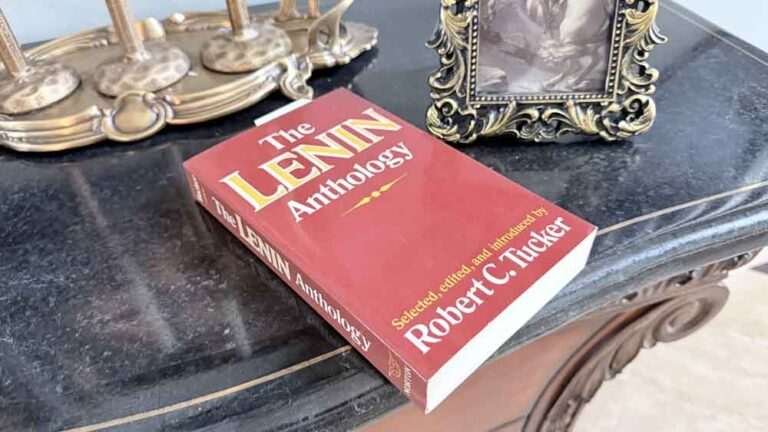
The Lenin Anthology, edited by Robert C. Tucker — Read the enemy’s texts. Not to endorse them — to understand how a worldview assembles itself into a program. Lenin is a master of the ruthlessly practical. The vanguard party, the professional revolutionary, the theory of imperialism as the highest stage — these ideas moved the twentieth century. They deserve to be understood directly, not through summaries.
The City of God by Augustine — Written as Rome was falling. Augustine’s answer to the question of what endures when civilization collapses is the City of God — not the political city, but the community of those oriented toward the transcendent. Whether you accept the theology or not, the question is permanent. What do you build that lasts?
War and Peace by Leo Tolstoy — The longest book on this list. Also one of the most necessary. Tolstoy’s argument — embedded in a thousand pages of history, society, and love — is that great men do not make history. History makes itself, and the great men are carried by it like everyone else. Pierre Bezukhov stumbling through Napoleon’s Russia is more historically honest than any biography of Napoleon.
Craft, Work, and the Bespoke Life
These are the books that live closest to the workbench. Not trade manuals — philosophical arguments for why making something well, slowly, and honestly is not a backward impulse but a resistant one.
The Ghost in the Machine: Descartes, Dennett, and the Mind That Built the Modern World — Arthur Koestler’s 1967 diagnosis of what went wrong with the Western mind. The split between the ghost (consciousness, soul, intention) and the machine (body, mechanism, matter) produced every major pathology of modernity. The craftsman’s answer to this split is the hand — the place where the mind becomes matter and the matter becomes meaningful.
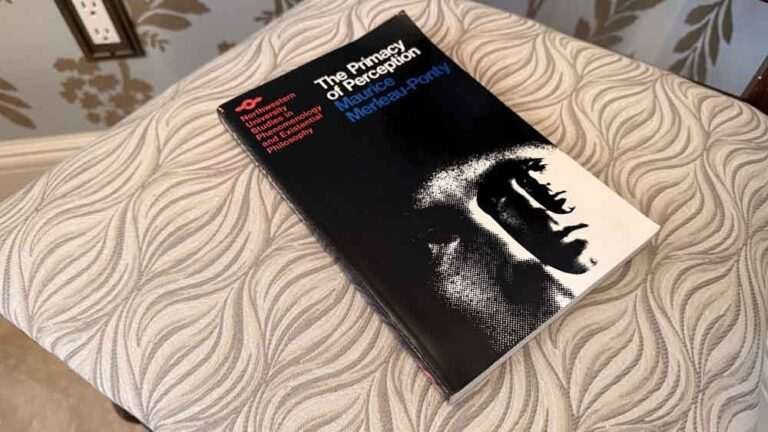
The Primacy of Perception by Maurice Merleau-Ponty — The body knows before the mind does. That is not mysticism — it is phenomenology. Merleau-Ponty restores the body as the primary site of intelligence. For anyone who has learned a physical skill — stitching leather, throwing a punch, working a grill — this rings true on the first page.
Utopia by Thomas More — Short enough to read in an afternoon. Capacious enough to carry for years. More’s island has no money and no private property and very little misery, which raises questions that his contemporaries found dangerous and which we have not finished answering. The irony is always in the name: Utopia means no place. Whether that is optimism or warning depends on the reader.
The Lives of a Cell: Notes of a Biology Watcher by Lewis Thomas — Thomas writes about biology the way a craftsman writes about material — with wonder and precision at once. The cells of a human body are not a collection of individual units; they are a community, negotiating, cooperating, occasionally failing. The metaphor radiates outward to everything else. A diner, a neighborhood, a civilization — all the same negotiated community at different scales.
The Outer Edge: Books That Don’t Fit the Categories
Every honest library has a section where the organizational system breaks down. These are those books.
The Portable Atheist, edited by Christopher Hitchens — Hitchens as curator. Lucretius to Rushdie, with stops at Hume, Twain, Einstein, and Orwell. A case built from multiple angles. The anthology format is the right format for this argument — no single voice is enough; you need the chorus.
Grimm’s Fairy Tales — They survived because they map something real in the structure of experience — the danger of the forest, the cruelty of the powerful, the unlikely rescue, the transformation that comes from the worst place. These are not children’s stories. They were collected from adults.
No Gods No Masters by Daniel Guérin — The anarchist tradition recovered from the word that was made to mean chaos. Bakunin, Kropotkin, Proudhon — these are serious thinkers with serious arguments about authority, hierarchy, and the conditions under which human beings might govern themselves. The arguments have not been defeated. They have been ignored, which is different.
The Life of Wagner by Ernest Newman — The greatest biography of an artist who was also a problem. Newman gives you Wagner whole — the genius, the anti-Semitism, the vanity, the revolutionary politics, the music that moved the nineteenth century. The book raises the question every honest biography eventually raises: what do you do with greatness that comes packaged with genuine evil?
Memory Distortion, edited by Daniel L. Schacter — Memory is not a recording. It is a reconstruction — subject to suggestion, emotion, and the passage of time. Schacter’s collection of research papers is not light reading, but the implications are enormous. Every autobiography is fiction. Every court testimony is partly confabulation. The self is built on a foundation of edited footage.
Also in the Library
These didn’t make the featured thirty — not because they’re lesser books, but because a list has to end somewhere. Each has its own full review at the link.
An Introduction to Logic and Scientific Method by Morris R. Cohen & Ernest Nagel — The bones of rigorous thinking. The Age of Access by Jeremy Rifkin — Ownership replaced by subscription, twenty years before anyone was talking about it. Evolving Brains by John Allman — The deep history of the thinking organ. In Search of the Big Bang by John Gribbin — Cosmology for people who want the physics without the condescension. Just Six Numbers by Martin Rees — Six constants that determine everything. Darwin’s Worms by Adam Phillips — Psychoanalysis meets natural history. The Evolution of Primate Behavior by Alison Jolly — The social intelligence hypothesis with field evidence. Fuzzy Logic by Daniel McNeill and Paul Freiberger — The mathematics of degrees. Newton’s Tyranny — What institutional power does to inconvenient discoveries. Bots: The Origin of New Species by Andrew Leonard — Software agents as a new form of life. Darwin’s Audubon by Gerald Weissmann — Where biology and aesthetics meet. Three Dialogues Between Hylas and Philonous by George Berkeley — The idealist argument, pursued to its logical end. The Grapes of Wrath — Steinbeck knew what poverty does to a family’s dignity. Explorations by W.B. Yeats — The essays, where the poet thinks on the page. Chasing the American Mirage — Thompson’s report from the edge of the dream. Suspensions of Perception by Jonathan Crary — Attention as a cultural battlefield. Who Killed Homer? by Victor Davis Hanson and John Heath — The murder of classical education and who’s responsible. The Satanic Bible by Anton LaVey — Not what you think. Read the review before you decide. Edison’s Eve by Gaby Wood — The history of automata as a history of obsession. Get a Grip on Evolution by David Burnie — The clearest introduction to evolutionary biology in print.
The full reviews are there if any of these pulls you further. Some of them are long. Some of them argue. A few of them changed the framing on everything else in the library.
That is what the good ones do.
You Might Also Like:
- The Selfish Gene by Richard Dawkins — The Book That Unlocked Darwin for Me
- Thus Spoke Zarathustra by Friedrich Nietzsche — The Book That Rewired My Understanding of Everything
- Five Dialogues by Plato: The Book That Teaches You How to Question Everything
Sources:
- Plato. Five Dialogues. Trans. G.M.A. Grube. Hackett Publishing, 2002. https://hackettpublishing.com
- Nietzsche, Friedrich. Thus Spoke Zarathustra. Trans. Walter Kaufmann. Penguin, 1978. https://www.penguinrandomhouse.com
- Dawkins, Richard. The Selfish Gene. Oxford University Press, 1976. https://global.oup.com
- Camus, Albert. Lyrical and Critical Essays. Trans. Ellen Conroy Kennedy. Vintage, 1970. https://www.penguinrandomhouse.com
- Darwin, Charles. On the Origin of Species. John Murray, 1859. Full text available at Project Gutenberg: https://www.gutenberg.org/ebooks/1228
- McLuhan, Marshall. Understanding Media. McGraw-Hill, 1964. https://mitpress.mit.edu
- Mumford, Lewis. Technics and Civilization. Harcourt, Brace & World, 1934. https://www.press.uchicago.edu
- Freud, Sigmund. Civilization and Its Discontents. Trans. James Strachey. Norton, 1961. https://wwnorton.com
- Merleau-Ponty, Maurice. The Primacy of Perception. Ed. James M. Edie. Northwestern University Press, 1964. https://nupress.northwestern.edu
- Homer. The Iliad. Trans. Robert Fagles. Penguin Classics, 1990. https://www.penguinrandomhouse.com