Marcus Aurelius wrote that the universe is transformation. Standing alone in the Siq at midnight, holding a paper lantern, you begin to understand what he meant — and why it terrifies you.
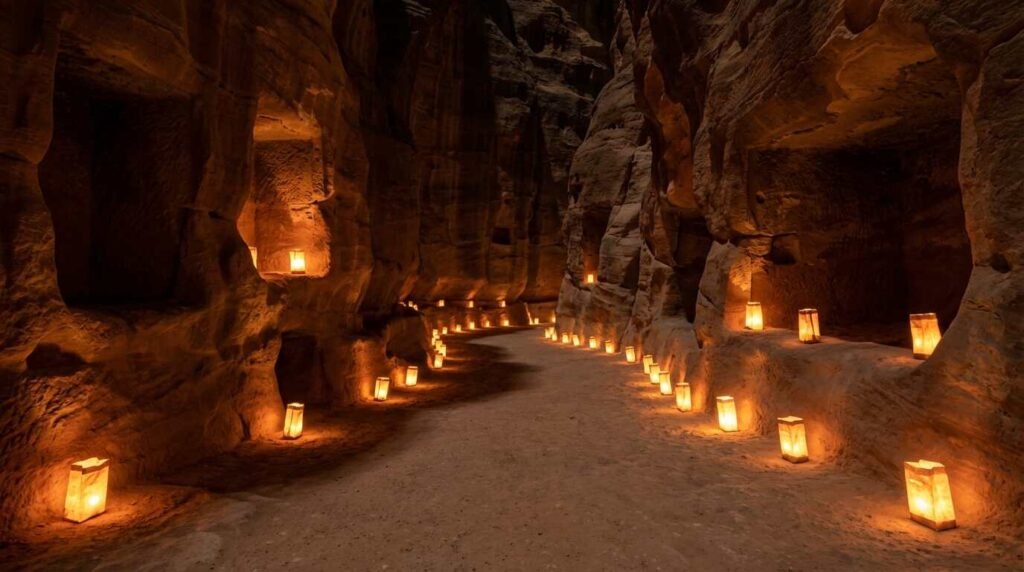
The ticket costs twenty-two Jordanian dinars. They collect it at a booth near the main gate and direct you into a line with two hundred others. You walk the Siq — the 1.2-kilometer sandstone canyon that the Nabataeans carved, or rather that time and water carved for them, which the Nabataeans had the intelligence to use — and the canyon walls at night are a different thing entirely from the canyon walls at noon. They press in. They hold the dark the way stone holds cold.
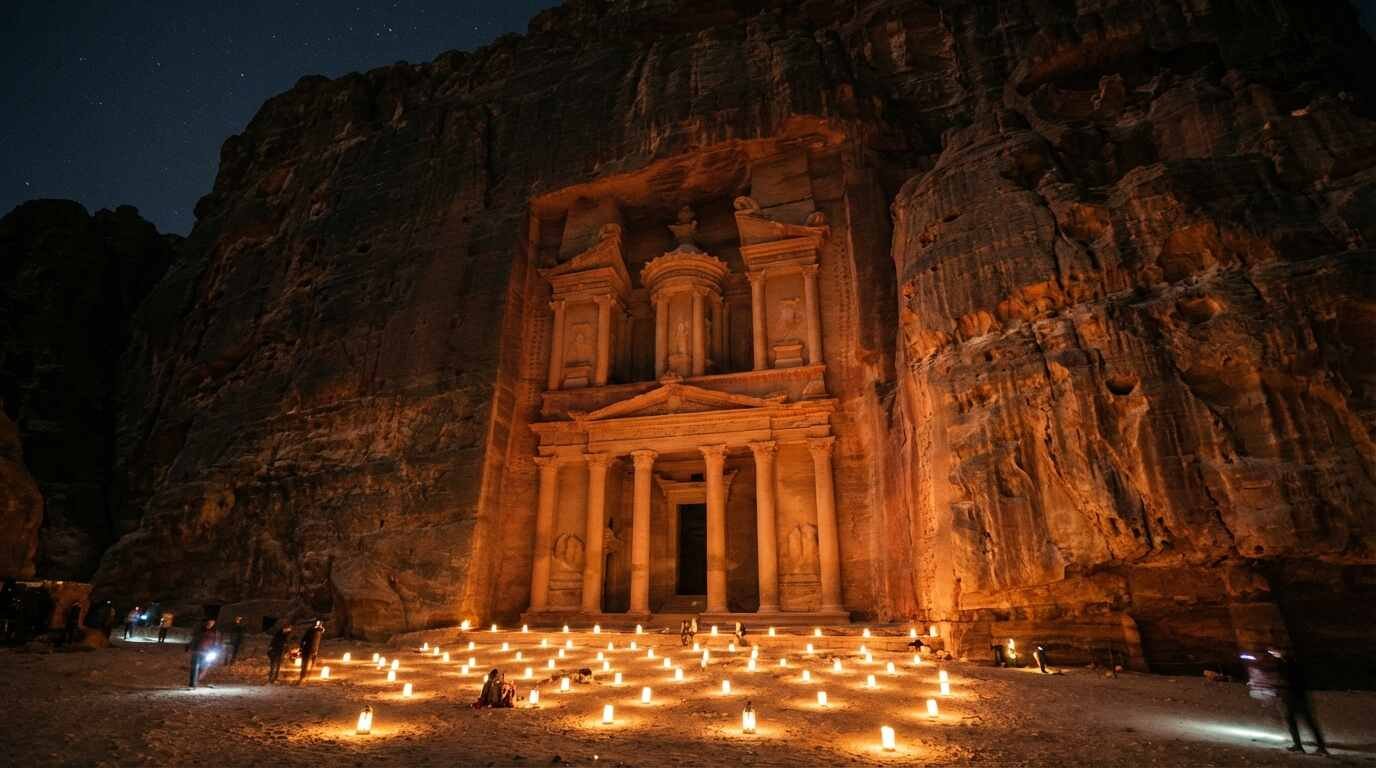
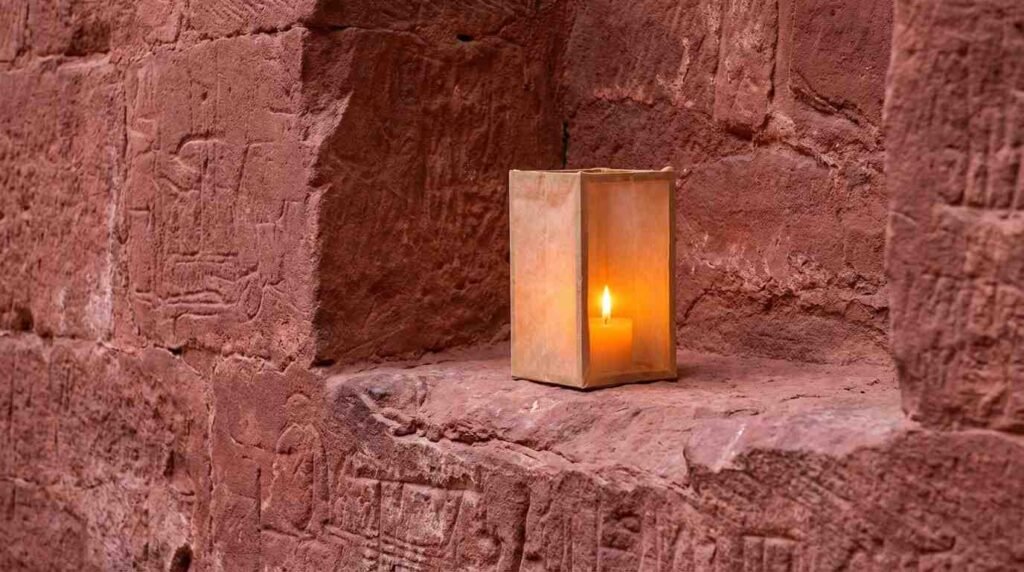
At intervals along the path, small paper bags shelter candle flames. Fifteen hundred of them, according to the Jordan Tourism Board. The math works out to one candle every eighty centimeters or so. Enough to see your feet. Enough, barely, to see the person ahead of you.
The Treasury at Night
The Treasury — Al-Khazneh, the Nabataean tomb built into the rose-red cliff face sometime in the 1st century BC — appears at the end of the Siq the way all thresholds appear when they have been anticipated too long: smaller than the imagination, larger than any photograph. Candlelight does something to the carved facade that daylight doesn’t. It loses its postcard quality. The upper urns and broken pediments dissolve into shadow, and what remains is pure mass — the sheer intention of cutting that deep into sandstone, of making something that size in a place that remote, for reasons that scholars still argue over.
Judith McKenzie, whose The Architecture of Petra remains the most rigorous treatment of the site’s construction, notes that the Nabataeans were integrating Hellenistic, Egyptian, and local architectural traditions simultaneously. The Treasury is not derivative of any single source. It is its own thing. Standing before it at midnight, the weight of that originality is what the darkness gives back.
Then the music starts.
On the Failure of Manufactured Transcendence
The Petra by Night experience — and it is explicitly marketed as an experience, which should be the first signal — culminates in a Bedouin music performance. A man plays an instrument called the rababa. Tea is served. A narrator speaks about Nabataean history in three languages. The crowd shifts on the stone seats. Children, who have no obligation to perform reverence they don’t feel, ask when they can leave.
The Condé Nast Traveler has described Petra by Night as “magical.” The Guardian was less convinced, noting that the candlelit procession had become a managed spectacle better suited to marketing materials than to genuine encounter with antiquity. Both assessments are correct and beside the point.
What most visitors want — and this is the thing worth examining — is to be moved. To feel the specific emotional response that a place this old and this improbable ought to produce. They arrive at Petra with a demand: that it deliver a feeling. When the feeling does not arrive on schedule, the more useful thing happens in its place.
What the Meditations Actually Say About This
Marcus Aurelius, in Book IV of the Meditations, is relentless on one corrective: stop demanding that the world arrange itself around your expectations. “You have power over your mind, not outside events. Realize this, and you will find strength.” The formulation sounds like a motivational poster because it has been converted into one, stripped of the context that makes it demanding rather than comforting. What he is actually describing is a discipline — the practice of meeting things as they are, without the overlay of what you wanted them to be.
Petra, the actual UNESCO World Heritage Site that has been carved, inhabited, abandoned, rediscovered, archaeologically studied, and turned into a ticketed attraction across roughly 2,400 years of continuous historical pressure, was not consulted on anyone’s preferences.
The site was the capital of the Nabataean Kingdom from approximately the 4th century BC — a civilization of extraordinary engineering and commercial sophistication. They built an elaborate water management system that fed a city of perhaps thirty thousand people in what is, technically, a desert. They cut their dead into cliffsides and built temples and traded incense and spice along routes connecting the Mediterranean to the Arabian Peninsula. Then the Romans absorbed them, the trade routes shifted, and Petra emptied. That is the actual history — rise, function, obsolescence, abandonment. Not tragedy. Not triumph. Just the shape that things take when they run their course.
The Nabataeans didn’t build Al-Khazneh so that anyone would have a feeling about it in the 21st century. They built it because they needed a tomb and had the skill to cut it from rock. Demanding a transcendent experience from a tomb is a category error.
The Pilgrimage and the Pilgrim
There is a long tradition of travel as spiritual exercise — and an equally long tradition of confusing the exercise with the destination. Santiago de Compostela issues Compostelas to pilgrims who have walked the required distance, certifying the journey. Petra sells tickets. The impulse behind both is not entirely different: to make a physical effort that mirrors an inner aspiration, to arrive somewhere that feels worth arriving at.
But arrival is the smallest part of the thing. The Siq at midnight, before the crowd assembles and before the music begins — that part most visitors are not prepared for. The sandstone walls in the dark have a presence that can only be described as geological. You are walking through something formed 50 million years ago, shaped over millennia by wind and water, modified by humans for their purposes, and now being walked through by two hundred people who paid twenty-two dinars each. All of that is simultaneously true, and none of it resolves into a feeling on command.
What it resolves into, if you stop demanding it be something else, is awareness. The specific, unromantic awareness of being a person moving through a place that was here before you and will be here after, that the candle in your hand is a paper bag and a tea light and also the descendant of something people have been doing in dark places for as long as there have been dark places to walk through.
The Useful Gift of Disappointment
Marcus Aurelius on disappointment: “If you are distressed by anything external, the pain is not due to the thing itself but to your estimate of it; and this you have the power to revoke at any moment.”
This is not a consolation. It is an instruction.
The Petra by Night experience, as packaged and sold, does not deliver the feeling most visitors came for. What it delivers instead is the occasion to notice that you came for a feeling — which is already a kind of tourism of the self, a spectacle-seeking that has nothing to do with Petra and everything to do with a hunger for the remarkable. The place is simply there. The place has been simply there for 2,400 years. It has absorbed more human expectation than any site should reasonably be asked to absorb — through Roman annexation, Byzantine Christianity, Muslim conquest, Crusader mapping, Ottoman governance, Bedouin habitation, Swiss explorer rediscovery in 1812, and seven decades of UNESCO oversight.
And it is fine. It is fine in the way that things that have survived a very long time are fine — through indifference, through the sheer weight of their own existence, through a complete absence of investment in whether any particular visitor finds it adequate.
That indifference, by midnight, is the most interesting thing in the canyon.
Standing in the Dark
After the performance ends and the crowd files back through the Siq, the Peristyle empties. For perhaps twenty minutes — if you stay, if you are willing to simply stand — the plaza before the Treasury holds its candles and its quiet. The Treasury is cut stone in the dark. A bat moves against the sky. Somewhere in the distance, a dog barks — probably from the village of Wadi Musa, the modern settlement that exists because this ancient one existed. Life continuing in the vicinity of its own past. The ordinary persistence of things.
Marcus Aurelius died in 180 AD in a military camp on the Danube, having spent most of his reign managing problems he had not sought and could not entirely solve, writing to himself about how to do it with some integrity. He never visited Petra. He probably would not have found it transcendent either. He was, by all historical accounts, a man who had learned to distrust the promise of the remarkable.
What the Siq gives you, on a quiet night with paper lanterns going dark and the canyon walls pressing in, is not transcendence. It is something more demanding: the simple, unornamented fact of being present in a place that has no investment in your response to it.
That turns out to be enough. It turns out, in fact, to be more than enough — and the thing most worth traveling for, if you know how to receive it. Which mostly means knowing how to stop demanding something else.
You Might Also Like: The Montreal–Maine–Maritime Loop: A 1,200-Mile Fall Foliage Circuit You Can Drive in Five Days
Sources
- Jordan Tourism Board official documentation: visitjordan.com
- UNESCO World Heritage listing for Petra: whc.unesco.org/en/list/326
- McKenzie, Judith. The Architecture of Petra. Oxford University Press, 2005.
- Marcus Aurelius. Meditations. (Gregory Hays translation, Modern Library, 2002)
- The Guardian on Petra by Night: theguardian.com
- Condé Nast Traveler on Petra: cntraveler.com