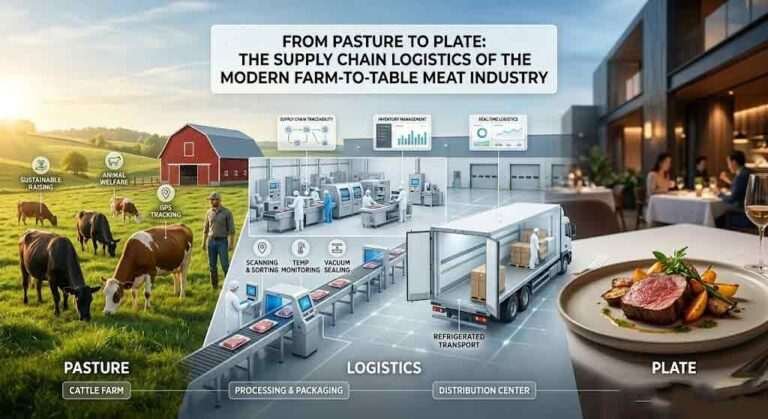
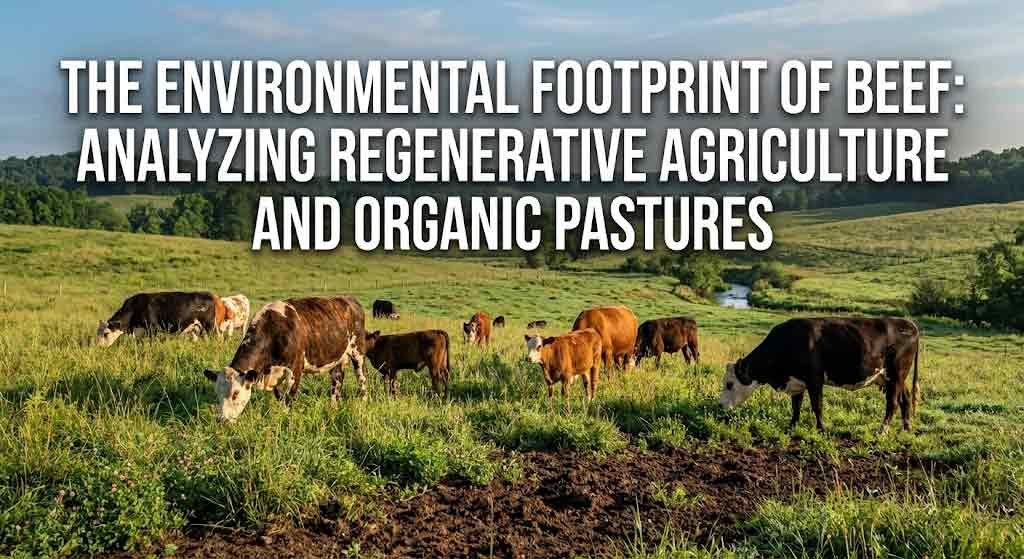
Somewhere between the field and the plate, a question has been quietly building into one of the defining debates of modern food culture: can beef exist in a world that is serious about its climate commitments? The answer — and this is where it gets interesting — is not a straight line from pasture to guilt. It is a story about soil, sequestration, and the difference between how we have been raising cattle and how the best ranchers in the world have learned to raise them differently.
Beef’s reputation as an environmental villain is not without justification. According to the United Nations Food and Agriculture Organization (FAO), livestock production contributes approximately 14.5 percent of global greenhouse gas (GHG) emissions, with beef alone responsible for 41 percent of that figure (FAO, 2023). The average American consumes roughly 55 pounds of beef annually — approximately three hamburgers per week — and the USDA projects that number to increase by about 3 percent in coming years (One Earth, 2024). The methane produced through enteric fermentation, the nitrous oxide from manure, the carbon released by degraded, overgrazed soil — these are real and measurable problems at industrial scale.
But a growing body of peer-reviewed research is complicating that narrative in ways that deserve serious attention. When cattle are managed not as a factory input but as an ecological force — moved deliberately across land, mimicking the great migratory herds of pre-industrial grasslands — the relationship between beef and carbon begins to invert. This is the science behind regenerative agriculture, and it is changing what serious eaters and serious food operators need to understand about the beef they choose.
What Regenerative Agriculture Actually Means
The term “regenerative agriculture” has become a marketing umbrella wide enough to shelter almost anything, which makes precision critical. At its core, it refers to a set of land management practices designed to restore rather than deplete ecosystem function. Cover cropping, minimal tillage, managed rotational grazing, and the avoidance of synthetic fertilizers and pesticides all fall under its canopy. The underlying logic is the same in each case: work with biological systems rather than around them.
For beef specifically, the dominant regenerative practice is known as Adaptive Multi-Paddock (AMP) grazing. Rather than allowing cattle to roam continuously across the same land — which depletes forage, compacts soil, and releases stored carbon — AMP grazing moves herds through a series of paddocks at carefully timed intervals, allowing each section of land extended recovery periods between grazing events. The high-density, short-duration model mimics how wild bison and ungulates historically moved across the American prairie: arriving, grazing intensively, and moving on before plants were stripped to the root.
The distinction is not aesthetic. It is biochemical. When grassland plants are grazed at the right intensity and then allowed to recover, root systems are stimulated, microbial communities in the soil proliferate, and organic carbon is drawn down from the atmosphere and stored in the soil profile — sometimes deep into the ground, where it remains stable for decades.
The Soil Carbon Equation
The most compelling data on regenerative cattle farming comes not from advocates, but from peer-reviewed research institutions running rigorous comparative studies.
A 2024 study published in the Journal of Environmental Management by researchers at the University of Guelph compared AMP-grazed pastures to continuously grazed land in southern Ontario. The findings were unambiguous: AMP pastures sequestered soil organic carbon at a rate of 0.957 Mg C per hectare per year, nearly double the 0.507 Mg C per hectare per year rate found in continuously grazed pastures. When that sequestration was factored into the full lifecycle GHG intensity of beef production — without it, the figure stands at 13.10 kg CO₂eq per kilogram of live weight — the carbon footprint of AMP beef was reduced by 65 percent compared to standard production methods (Mehre et al., Journal of Environmental Management, 2024).
Earlier benchmark research from Michigan State University, examining AMP grazing during the finishing phase of beef production, found even more dramatic results. When soil organic carbon sequestration was incorporated into the GHG calculation, finishing emissions under AMP dropped from 9.62 to −6.65 kg CO₂-equivalent per kilogram of carcass weight — a net carbon sink. Conventional feedlot finishing, by contrast, showed emissions that barely changed: 6.09 to 6.12 kg CO₂e, due to soil erosion from feedlot operations (ScienceDirect, Rowntree et al., 2018).
The gold-standard case study remains White Oak Pastures, a multi-species regenerative farm in Georgia that has been converting conventional cropland to perennial pasture under holistic management for over two decades. A life cycle assessment conducted by Quantis — one of the world’s most respected environmental research firms — found that White Oak’s pasture-raised beef had a carbon footprint 66 percent lower than conventional commodity beef production. More significantly, when looking at cattle alone, the farm’s carbon sequestration in soil fully offset 100 percent of the emissions produced by raising the animals, making the operation carbon-negative for beef specifically (White Oak Pastures / Quantis LCA, 2019; Peer-reviewed replication, CSU Chico, 2021).
Preliminary data from Arizona State University’s ongoing multi-institutional study across dozens of ranches adds further texture. AMP grazing operations are sequestering a measured 12.1 tons of CO₂-equivalent per hectare per year — compared to just 2.9 tons under conventional grazing systems. That difference is equivalent to the carbon released by the annual electricity use of two homes, per hectare, every year (TIME, 2024).
Where the Science Is Still Contested
Intellectual rigor demands we engage the counterarguments, and they are not trivial.
A 2025 study published in PNAS found that grass-fed beef in the U.S. is approximately as carbon-intensive as industrial beef when the full land-use footprint is accounted for — and roughly ten times more GHG-intensive than comparable plant-based protein sources. The researchers noted that while regenerative practices can reduce emissions per unit of land, they require significantly more land per unit of beef produced. White Oak Pastures’ own peer-reviewed reanalysis, for instance, confirmed the 66 percent lower GHG footprint but found the regenerative approach required 2.5 times more land than conventional production (PNAS, Diaz de Otalora et al., 2025; Civil Eats, 2021).
Soil scientists at Yale and elsewhere have raised concerns about the permanence of sequestered carbon. Organic matter in soil is metabolically active — microorganisms continuously break it down and release it as CO₂. The long-term stability of carbon stored under AMP grazing remains an open and important question (NPR, Slessarev, Yale University, 2024).
The Breakthrough Institute, in a 2024 analysis, concluded that while certain regenerative systems can produce low-climate-impact beef, they cannot currently scale to meet global demand — which is rising, not falling. Meaningful emissions reductions will require both improved production practices and shifts in consumption patterns simultaneously (The Breakthrough Institute, 2024).
This is not a settled science. It is a rapidly evolving one. The weight of evidence currently favors well-managed regenerative grazing as a meaningful improvement over industrial feedlot production, particularly when full soil carbon accounting is included. But the magnitude of those benefits, their permanence, and their scalability remain subjects of genuine scientific inquiry.
Organic Pastures and the Nutritional Argument
The environmental case for regenerative and organic pasture beef is reinforced — though distinct from — the nutritional case. They are different certifications representing different things, and consumers deserve clarity.
Organic beef, under USDA standards, guarantees that animals were raised without antibiotics or synthetic hormones and fed certified organic feed. It does not, by itself, guarantee pasture access or grass finishing. Grass-fed beef certifies the animal’s diet. Pasture-raised indicates the animal spent meaningful time outdoors on grass — at minimum 120 days per year under current USDA guidelines. The ideal designation, from both environmental and nutritional standpoints, is 100% grass-fed, grass-finished, organic and pasture-raised — all at once.
The nutritional differences are well-documented. Grass-fed, pasture-raised beef contains up to 10 times more omega-3 fatty acids (EPA and DHA) than grain-fed beef, and two to four times more conjugated linoleic acid (CLA), a fatty acid linked to reduced inflammation, improved body composition, and lower risk of chronic disease (REP Provisions, citing van Vliet et al., 2021; Daley et al., Nutrition Journal, 2010). The omega-6 to omega-3 ratio in grass-fed beef averages approximately 2:1 — compared to roughly 9:1 in conventional grain-fed beef. That ratio matters because excess omega-6 relative to omega-3 is associated with systemic inflammation, a driver of cardiovascular disease, metabolic disorders, and cognitive decline.
B vitamins — particularly niacin (B3), pantothenic acid (B5), and B6 — are two to three times higher in grass-fed beef, with niacin specifically measuring nine times higher in some studies, due to the animal’s active grazing of growing forages (Duckett et al., Journal of Animal Science, 2009). Grass-fed beef also carries higher concentrations of vitamin E, beta-carotene, and antioxidants generally.
A 2024 randomized clinical trial from Montana State University directly compared the postprandial metabolomic response of human subjects consuming organic grass-fed beef versus conventional grain-fed beef, finding measurable differences in metabolite profiles — a signal that the downstream health implications of these production differences extend beyond nutrient composition into how the body processes the food at a cellular level (PMC / NCBI, Spears et al., 2024).
Antibiotic resistance is a separate but related concern. A 2015 study testing 300 packages of ground beef found antibiotic-resistant bacteria in 18 percent of conventional grain-fed samples — compared to just 6 percent of grass-fed samples (WebMD, citing Consumer Reports research, 2015).
Decoding the Label: A Practical Guide
The gap between marketing and reality on beef labels is significant, and navigating it requires more than trusting packaging.
“Grass-fed” without further qualification does not mean the animal was exclusively grass-fed. Under current USDA guidelines, the term is not subject to federal standards in the same rigorous way that “organic” is. An animal can be labeled “grass-fed” while having been finished on grain. “Grass-finished” closes that loophole and confirms the animal ate only grass and forage through its entire life.
“Organic” confirms feed, antibiotic, and hormone standards but says nothing about how much time the animal spent outdoors or what it ate specifically. A cow can be raised in a feedlot on certified organic corn and qualify.
“Pasture-raised” is more meaningful as a welfare and environmental indicator but still allows for grain supplementation.
Third-party certifications offer the most reliable guidance: the American Grassfed Association seal verifies cattle were raised on pasture eating only grass and never given antibiotics or hormones. The PCO 100% Grassfed Certification requires that producers also be certified organic. These are the marks worth seeking when the commitment is real.
Regenerative beef represents only an estimated 3 percent of U.S. production at present — a nascent but rapidly growing market sector driven by consumer demand and, increasingly, by the economic case ranchers themselves are making. AMP grazing operations report saving upwards of $50,000 annually by eliminating synthetic nitrogen fertilizer inputs, while simultaneously supporting larger stocking densities than continuous grazing allows (TIME, Byck, Arizona State University, 2024).
The Question of Scale
The legitimate tension in this conversation is not whether regenerative beef is better — the evidence that it is, environmentally and nutritionally, is now substantial. The tension is whether it can be produced at sufficient scale to matter.
Global beef demand is rising, driven by economic development in the Global South where protein consumption tracks income growth. Meeting that demand through regenerative methods would require vastly more land than is currently devoted to pasture, or dramatically lower per-capita beef consumption in wealthy nations, or both. The Breakthrough Institute’s analysis concludes that regenerative practices can lower the emissions intensity of existing production meaningfully, but cannot solve the structural problem of a world eating ever more beef from an ever-larger herd.
This is where the food system’s long-term trajectory will be determined: not in the labs or on the well-managed regenerative ranches, but in the aggregate choices of billions of consumers. What regenerative agriculture demonstrably offers is a pathway by which beef, consumed at more moderate levels, produced under managed grazing systems, can move from being a net carbon emitter to something closer to neutral — or even, under the best conditions currently documented, to a net carbon sink.
That is not a license to eat more beef. It is a reason to eat better beef, sourced more carefully, and valued more seriously.
What This Means for the Thoughtful Eater
The environmental footprint of beef is not a fixed number. It is a variable determined by land management, grazing practice, feed composition, soil health, and the presence or absence of genuine regenerative stewardship. A feedlot-finished steer and a White Oak Pastures steer are not the same product environmentally, nutritionally, or ecologically — despite wearing similar labels in a supermarket case.
For the consumer willing to look past the packaging, the calculus has become clearer than it was a decade ago. Source from certified grass-finished, organic, or AMP-grazed producers when possible. Pay the premium, which reflects the true cost of doing this correctly. Consume at moderate quantities. And push the conversation forward — with butchers, with chefs, with farmers at local markets — because the demand signal that reaches producers is the most direct lever consumers hold.
The science of regenerative agriculture is still being written. But the direction of the data is unmistakable: managed well, grass and cattle and soil can function as an integrated system that produces food, sequesters carbon, rebuilds topsoil, protects biodiversity, and generates nutritionally superior protein. That is not idealism. It is agronomy. And it is a story that deserves to be understood by every serious person who eats.
Sources
- Food and Agriculture Organization of the United Nations (FAO). Tackling Climate Change Through Livestock, 2023. https://www.fao.org/3/i3437e/i3437e.pdf
- One Earth. Can Responsible Grazing Make Beef Climate-Neutral? 2024. https://www.oneearth.org/can-responsible-grazing-make-beef-climate-neutral/
- Mehre, J., Schneider, K., Jayasundara, S., Gillespie, A., Wagner-Riddle, C. Adaptive Multi-Paddock Grazing Increases Soil Carbon Stocks and Decreases the Carbon Footprint of Beef Production in Ontario, Canada. Journal of Environmental Management, Vol. 371, 2024. https://www.sciencedirect.com/science/article/pii/S0301479724032419
- Rowntree, J.E. et al. Impacts of Soil Carbon Sequestration on Life Cycle GHG Emissions in Midwestern USA Beef Finishing Systems. ScienceDirect, 2018. https://www.sciencedirect.com/science/article/pii/S0308521X17310338
- White Oak Pastures / Quantis. Life Cycle Assessment of White Oak Pastures Beef, 2019. https://blog.whiteoakpastures.com/blog/carbon-negative-grassfed-beef
- CSU Chico Center for Regenerative Agriculture. Multi-Species Pasture Study, 2021. https://www.csuchico.edu/regenerativeagriculture/blog/multi-species-pasture-study.shtml
- Civil Eats. A New Study on Regenerative Grazing Complicates Climate Optimism, 2021. https://civileats.com/2021/01/06/a-new-study-on-regenerative-grazing-complicates-climate-optimism/
- TIME. These Cattle Farmers Are Cutting Emissions, Boosting Nature, 2024. https://time.com/collection/time-co2-futures/6835547/regenerative-cattle-farming/
- Diaz de Otalora, X. et al. US Grass-Fed Beef Is as Carbon Intensive as Industrial Beef. PNAS, 2025. https://www.pnas.org/doi/10.1073/pnas.2404329122
- NPR. Plant-Based Restaurants Are Adding Beef. Does the Climate Math Add Up? 2024. https://www.npr.org/2024/05/19/1252350796/sweetgreen-adds-beef-climate-impact-regenerative-agriculture
- The Breakthrough Institute. More and More, Beef (And Less Climate Impact), 2024. https://thebreakthrough.org/issues/food-agriculture-environment/more-and-more-beef-and-less-climate-impact
- Daley, C.A. et al. A Review of Fatty Acid Profiles and Antioxidant Content in Grass-Fed and Grain-Fed Beef. Nutrition Journal, 2010.
- Duckett, S.K. et al. Effects of Winter Stocker Growth Rate and Finishing System on Tissue Fatty Acid, Vitamin, and Cholesterol Content. Journal of Animal Science, 2009.
- Spears, M. et al. Comparative Impact of Organic Grass-Fed and Conventional Cattle-Feeding Systems on Beef and Human Postprandial Metabolomics. PMC/NCBI, October 2024. https://pmc.ncbi.nlm.nih.gov/articles/PMC11509860/
- Understanding Ag. Nutritional Comparisons Between Grass-Fed Beef and Conventional Grain-Fed Beef, 2022. https://understandingag.com/nutritional-comparisons-between-grass-fed-beef-and-conventional-grain-fed-beef/
- REP Provisions. 7 Benefits of Grass-Fed Beef vs Conventional Meat, 2025. https://repprovisions.com/blogs/rep-provisions-blog/7-benefits-of-grass-fed-beef-vs-conventional-meat
- Mosier, S. et al. Adaptive Multi-Paddock Grazing Enhances Soil Carbon and Nitrogen Stocks. Journal of Environmental Management, 2021. https://rootssodeep.org/images/published_research/pdfs/1_Sam_Mosier_JEMA_paper-4_7_2021.pdf