
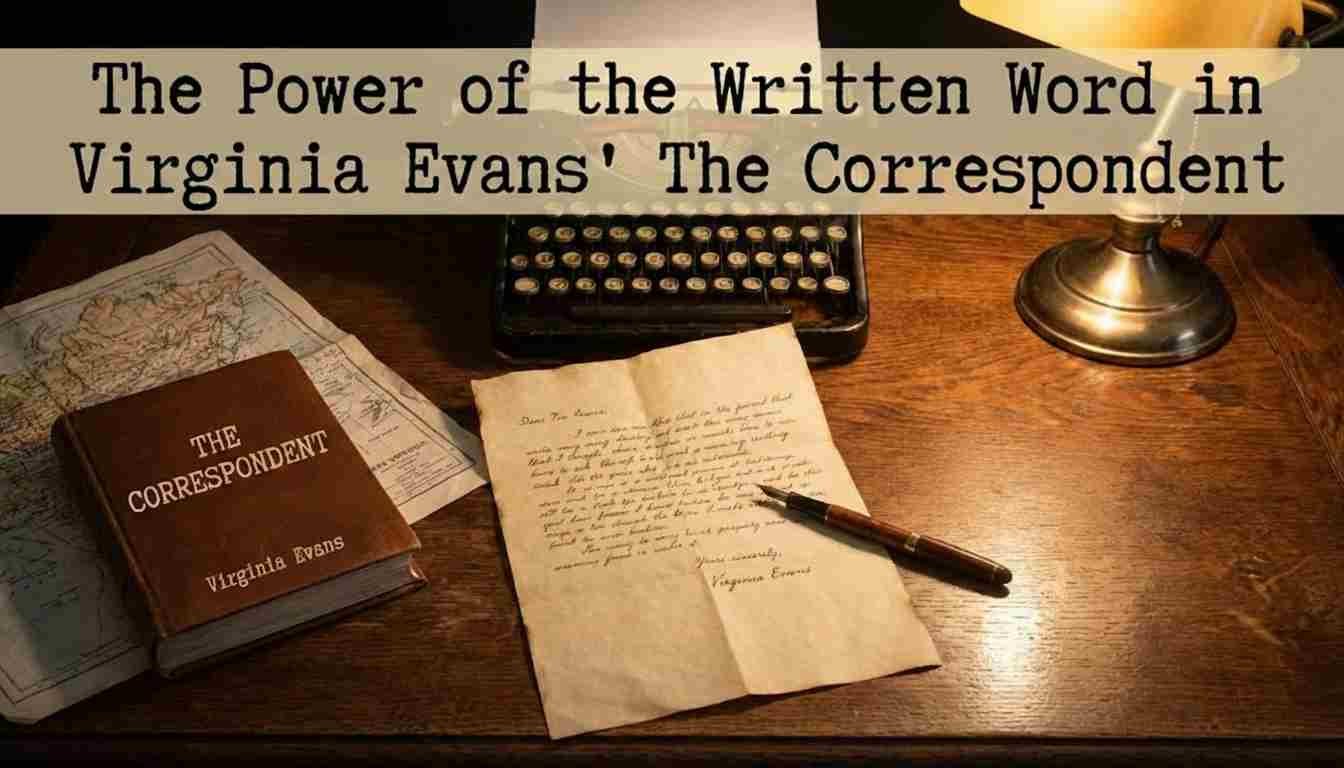
Long before the novel had a name, human beings understood that a letter was not merely a message — it was a monument. A letter carried weight in ways the spoken word never could. It demanded intention. It required the writer to slow down, to think before committing ink to page, to consider the receiver as a living presence sitting across from the written word. In that deliberate act of composition, something irreplaceable happened: a self was revealed, not performed.
Virginia Evans understands this. Her debut novel The Correspondent — published in April 2025 by Crown and somehow arriving at the top of the New York Times bestseller list by December of that same year — is built entirely from letters. There is not a single line of traditional third-person narration. No omniscient author watching from above. What we have instead is Sybil Van Antwerp: a septuagenarian lawyer and divorcée who writes letters the way other people breathe, addressing everyone from her brother to her best friend to Joan Didion and Larry McMurtry, telling them what she thinks of their books. She writes, most mornings, around half past ten.
What Evans has done — quietly, without fanfare, in a publishing culture addicted to plot mechanics and thirty-second attention spans — is revive a form that many assumed was buried somewhere alongside the fountain pen. She has reminded us that the epistolary novel is not a quaint antique. It is, in fact, one of the most psychologically honest narrative forms ever devised. And in an age where the average text message contains eleven words and the average email is engineered to extract a response rather than provoke thought, The Correspondent lands not as nostalgia but as a corrective.
A Form Older Than the Novel Itself
To understand what Evans has accomplished, it helps to understand what she has inherited.
The epistolary novel traces its modern origins to Samuel Richardson’s Pamela; or, Virtue Rewarded, published in 1740 — one of the earliest forms of novel to be developed in English, and one of the most popular up to the 19th century. Britannica Richardson’s insight was profound in its simplicity: a letter written “in the heat of a present distress” captures psychological truth in ways a retrospective narration cannot. The form presents an intimate view of a character’s thoughts and feelings without interference from the author, and conveys the shape of events with dramatic immediacy. Britannica
What Richardson understood in the 18th century, Evans has rediscovered in the 21st. The letter form is not a limitation. It is a constraint that forces authenticity. When Sybil Van Antwerp writes to her estranged family members, to a Syrian pen pal, to famous authors who may or may not write back, she cannot hide behind a narrator’s distance. Every comma, every diplomatic evasion, every moment she writes a letter and does not send it — all of it is character revelation happening in real time.
Richardson called this technique “writing to the moment,” in which his characters record their thoughts and actions in what seems like real time, adding realism, immediacy, and even suspense to the genre. Oregon State University Evans works from the same principle, with a contemporary sensibility layered on top. She includes emails alongside the handwritten letters — and notably, Sybil admits that she often behaves with less civility over email. That single observation is worth an entire essay on its own.
The Architecture of Vulnerability
What separates the epistolary form from every other narrative mode is the quality of its exposure. In a conventional third-person novel, the author controls what we know and when we know it. The characters can be filtered, softened, managed. In an epistolary novel, the character is the author of their own record. They cannot be protected from their own words.
Evans drops the traditional all-knowing narrator and hands all the puzzle pieces to the reader. As readers, we play detective, piecing together Sybil’s life from shifting dates, subtle changes in greetings, and scattered hints — a slow, piecemeal reveal that feels fresh and immersive, even voyeuristic. Goodreads
This is the architecture of genuine vulnerability. Sybil is prickly, opinionated, occasionally imperious. She can be wrong. She is wrong. And because the epistolary form gives us only her letters — plus the letters she receives — we must do the interpretive work ourselves. We must read between the lines, as we do in life. We must infer what she feels from what she chooses not to say.
This is a level of trust in the reader that contemporary commercial fiction rarely extends. Most novels explain themselves. The Correspondent withholds. It respects the reader enough to let silence do the work that sentences cannot.
Why the Form Fell Out of Fashion — and Why That Was Always a Mistake
Ann Patchett, one of the novel’s most prominent champions, admitted she initially doubted the book’s staying power because epistolary novels “usually don’t work.” Slate Patchett’s skepticism is understandable and worth examining, because it reflects a broader cultural assumption: that the letter form is inherently limiting, that it reads as gimmick, that readers will grow impatient with the indirection.
This assumption mistakes difficulty for failure. The epistolary form demands more of its reader than a conventional novel does — more inference, more patience, more willingness to sit with incompleteness. In a culture that has optimized every reading experience for frictionless consumption, that demand began to feel like a burden. Streaming platforms train us to expect exposition on demand. Social media rewards the immediate revelation. The slow accumulation of meaning through letters written over years — the way a life assembles itself through its correspondence, the way character is disclosed through what one chooses to put in an envelope and what one chooses to burn — this requires a different kind of attention than most contemporary readers are practiced in giving.
Which is precisely why it matters.
The Correspondent appeals to the hearts of readers who feel like they were born just a little too late, condemned to operate in a world where interpersonal communication is so omnipresent as to have lost its glamour. Slate There is a generation — perhaps several — that carries a quiet grief for depth. For the kind of communication that required effort and therefore carried weight. For the experience of receiving a letter and knowing that someone sat down, thought of you specifically, and committed time and thought to the act of reaching across the distance between two lives.
Evans has written a novel for those people. But more importantly, she has written a novel that creates those people in its readers — that reminds anyone who finishes it of what careful written language can do.
The Long Road of Virginia Evans
There is a biographical dimension to The Correspondent that cannot be separated from its meaning. Evans published the book as a debut author who had previously written seven unsold novels, and it did not reach the top of the New York Times bestseller list until December 2025 — eight months after its April publication. Slate As she has described it: “I’m breezing over 20 years of querying book after book, year after year, rejection upon rejection. Some people approach me as if this is my first book. This is my ninth novel.” Southern Review of Books
Twenty years of letters into the void. Twenty years of writing toward an audience that had not yet found her. There is something almost unbearably appropriate about a woman who spent two decades writing letters that went unanswered eventually publishing a book about the power of the written word to transform both the writer and the receiver. Life has a way of encoding its meaning in the very form of its unfolding.
Evans holds a master’s of philosophy in creative writing from Trinity College in Dublin — the same city where Joyce recomposed the English sentence and Beckett taught silence to speak. That lineage shows. The Correspondent is a philosophical text dressed in the clothing of a quiet domestic novel. Its subject is not really Sybil’s letters. Its subject is what it means to keep writing toward others despite the absence of a guaranteed reply.
The Handwritten Against the Algorithmic
We are living through a moment that should concern anyone who values the written word as a form of genuine human expression. Large language models now generate competent prose by the megabyte. Email is autocompleted. Text messages offer suggested responses before the receiver has finished reading. The communication infrastructure of contemporary life is rapidly being optimized for efficiency at the direct expense of presence.
Into this context, Evans drops Sybil Van Antwerp — a woman who writes to the university president demanding to be allowed to audit a class, who writes to dead authors and living celebrities, who composes letters she never sends to the person she most needs to address. Sybil is not a Luddite. She is a woman who has chosen depth over velocity. Who understands, perhaps intuitively, that the act of writing a letter is not merely a means of transmitting information. It is a method of thinking. Of becoming. Of remaining present to the texture of one’s own life.
There is a craft parallel I cannot ignore. Working at the bench on a Marcellino NY briefcase — hand-stitching English bridle leather at eight to ten stitches per inch with waxed linen thread — I have come to understand what it means to communicate through making rather than through efficiency. The machine can produce what appears to be the same object in minutes. But the patina that develops over decades, the way the leather responds to the owner’s particular life, the fact that another human being spent hours in deliberate contact with the material — these things carry meaning that no machine can replicate. Sybil’s letters are like that. They carry the body heat of their writer. They are irreproducible by algorithm.
The Revival That Was Always Waiting
The Correspondent did not succeed by accident. Its publisher Amy Einhorn noted that there was not one specific thing that propelled the book’s success Slate — which is often the honest answer when a book earns its audience through genuine quality rather than through marketing machinery. The novel built its readership the way good things tend to build their reputations: one person telling another person, an act of correspondence in its own right.
The epistolary novel has never truly died. Alice Walker used it in The Color Purple. Bram Stoker used it in Dracula. Fyodor Dostoevsky used it in Poor Folk. The form has demonstrated extraordinary resilience across centuries because it solves a problem that no other narrative mode fully solves: how to let the reader inside a consciousness without the mediating presence of a narrator standing between the character and the page. The epistolary novel’s reliance on subjective points of view makes it the forerunner of the modern psychological novel. Britannica It was always ahead of its time. Evans has simply proven that it remains ahead of ours.
What she has given us, finally, is not just a beautiful novel about an extraordinary ordinary woman. She has given us a reminder that the written word — committed to paper with intention, sent across the distance between one life and another, received by a reader willing to slow down and really attend — remains one of the most sophisticated technologies human beings have ever invented. Not despite its slowness. Because of it.
The letter knows something the algorithm does not: that meaning is not transmitted. It is built. Word by word, sentence by sentence, over years. And it is worth every moment of the waiting.