Every generation gets an art movement it didn’t ask for but desperately needed. The Impressionists pulled painting out of the studio and into the light. The Abstract Expressionists dragged emotion onto a canvas that had no business being that raw. And now, quietly but with gathering force, an entirely different kind of shift is underway — one that doesn’t ask you to walk into a gallery at all, but rather turns the street, the park, the sidewalk, and the abandoned warehouse into the gallery itself.
Immersive contemporary art walks — open-air district events built around vibrant murals, kinetic installations, pop-up galleries, and interactive public sculpture — are no longer fringe happenings. They have become one of the defining cultural expressions of the 2020s: part neighborhood festival, part philosophical intervention, part economic engine. From the neon-lit corridors of Manhattan’s Chelsea to the cobblestone blocks of Huntington village on Long Island’s North Shore, the movement is reshaping how communities understand themselves and how visitors decide where to go, eat, linger, and return.
This is not simply art. It is place-making at its most powerful.
The Architecture of Experience: What an Art Walk Actually Is
Strip away the Instagram posts and the press releases, and an art walk is a deceptively simple concept: a designated geographic area, a concentration of artistic works, and an invitation to move through them at your own pace. What changes with the contemporary iteration is scale, technology, and ambition.
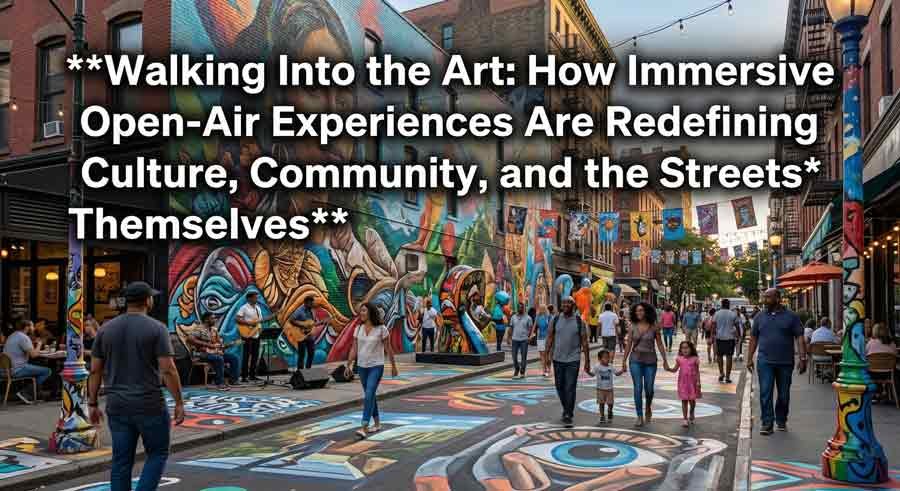
Where a traditional art walk once meant peeking into small galleries on a Friday evening — white walls, plastic cups of wine, polite conversation — today’s immersive format reaches into every available surface. Murals stretch across entire building facades. Projection mapping transforms a brick wall into a living canvas after dark. Sculptural installations anchor intersections and demand you walk around them, through them, under them. Pop-up galleries inhabit former storefronts, vacant lots, even repurposed shipping containers. The art is not behind glass. It is in the air.
Organizations like ARTECHOUSE, which describes itself as “the nation’s first innovative art organization dedicated to the intersection of art, science and technology,” have helped define what large-scale immersive art can feel like in dense urban environments. Their SUBMERGE series at Chelsea Market’s century-old boiler room transforms the space into what they call “a vivid, cinematic world where audiences can experience bold new stories crafted with the tools of tomorrow.” (ARTECHOUSE, 2025) That language — cinematic, immersive, bold — is increasingly the vocabulary of the entire movement.
But the most interesting developments are not inside controlled environments. They are happening outside, on the street, without a ticket.
From Graffiti to Galaxy: The Historical Arc
To understand why immersive public art walks feel so urgent right now, it helps to understand where they came from. The lineage runs directly through the graffiti-soaked walls of 1970s and 80s New York, when the city’s economic decline paradoxically ignited one of the most explosive artistic movements in American history. Spray paint and subway cars became canvases for a generation that had no other platform. The art was unauthorized, charged with identity, and impossible to ignore.
By the 1990s and early 2000s, cities began to recognize that tension between art and public space as something worth harnessing rather than criminalizing. The concept of “creative placemaking” entered urban planning vocabulary. According to a landmark handbook published by Americans for the Arts, more than 90 cities across the United States have now planned or implemented cultural districts, positioning the arts at the center of their revitalization efforts. Their research found that the presence of arts enhances property values, increases the profitability of surrounding businesses, and expands regional tax bases. (Americans for the Arts, 2019)
The data that followed was difficult to dismiss. A 2025 study published in Frontiers in Sustainable Cities, examining the conversion of an industrial heritage site in Aarhus, Denmark into an arts and culture center, found that neighborhood property prices rose by 2.3 to 3 percent relative to the rest of the city following the transformation — representing a welfare gain of between €17.5 and €21 million for the local community. (Matthiesen, Lautrup & Panduro, Frontiers in Sustainable Cities, 2025) Multiply that logic across a thriving art district, and the numbers become a conversation that city planners and developers cannot avoid.
On Long Island’s North Shore — in communities like Huntington, Port Jefferson, and yes, the broader Mount Sinai corridor — these conversations are beginning to happen. They should happen faster.
NYC as the Living Laboratory
Nowhere in the country does the immersive art walk find a more natural ecosystem than New York City, which functions simultaneously as the world’s greatest gallery and its most demanding critic. The city does not tolerate mediocre art for long. It absorbs it, transforms it, or discards it.
What has emerged in recent years is a landscape of extraordinary creative density. The Public Art Fund’s program has placed outdoor installations across Central Park, Brooklyn Bridge Park, and City Hall, where sculptural works become part of the daily commute for millions of residents. On the High Line, Ivan Argote’s Dinosaur — a colossal, hyper-realistic aluminum pigeon — challenges the grandeur of traditional monuments by canonizing the city’s most overlooked resident. It is funny, provocative, and entirely at home in a city where the unexpected is the baseline.
Further downtown, ARTECHOUSE’s Chelsea space has hosted experiences that regularly dissolve the boundary between viewer and artwork. In their SUBMERGE series, twelve bold, hyperreal experiences ranging from meditative surreal landscapes to an industry-first immersive concert experience expand what digital art can mean when audiences are literally surrounded by it.
Meanwhile, Time Out New York notes that immersive exhibits, events, and experiences are popping up all over the city, from theatrical experiences to trippy digital art taking over massive spaces. At Rockefeller Center, d’strict — the Korean art collective responsible for the viral digital WAVE installation — transformed the iconic rink level into what has been described as a labyrinth of light, sound, and touch. Mercer Labs, at 21 Dey Street in Lower Manhattan, offers fifteen sensory rooms and a 4D sound gallery that invites visitors into what the studio calls “surreal and thought-provoking immersive environments designed by contemporary artists.”
This is not a trend. It is a restructuring of how the city presents itself.
The North Shore Opportunity: Why Long Island Belongs in This Conversation
There is a tendency, understandable but mistaken, to view Long Island’s North Shore as a passive spectator to the cultural movements playing out in Manhattan and Brooklyn. That view misreads the landscape entirely.
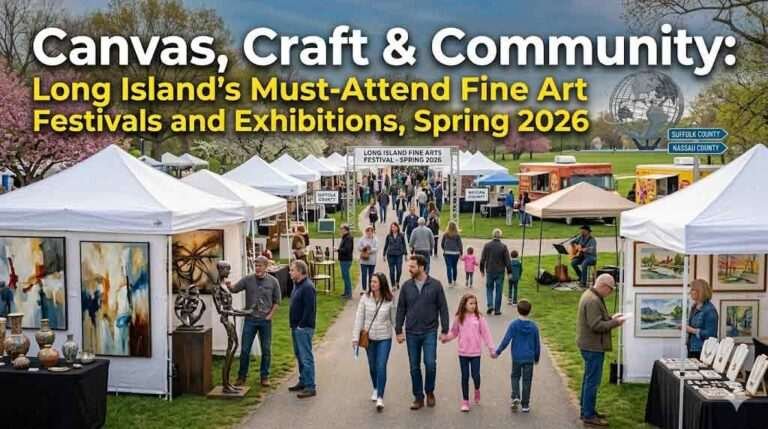
Huntington village has operated one of the most respected Art Walk programs on the island for years, with the Huntington Art Center coordinating open gallery evenings that draw visitors to fotofoto gallery, local sculpture exhibitions, and rotating artist showcases in the historic 1892 Soldiers and Sailors Memorial building. (Huntington Art Center, 2024) Port Jefferson’s village center, with its maritime character and sloped streets, is a natural amphitheater for outdoor installation art — the kind of geography that European festival organizers spend millions to simulate.
The communities along the North Shore sit on something rare: authentic historical identity, walkable village centers, proximity to water, and a population increasingly aware of what cultural investment can do to neighborhood value. The parallel is not subtle. Research from the Americans for the Arts shows that arts and cultural districts contribute over $166 billion annually to the US economy, supporting 4.6 million jobs nationwide. The 2024 Public Art Network survey found that communities with active public art programs report 31 percent higher resident satisfaction and increased civic engagement.
For any community on the North Shore with an eye on long-term identity — and long-term real estate value — that is not a footnote. It is a blueprint.
The Global Inspiration: What the Best Art Walks Do
The Edinburgh Art Festival remains one of the world’s great templates for what an open-air, immersive art experience can achieve at civic scale. More than 300,000 people attend annually — more than the combined attendance of the Edinburgh Fringe and the International Festival. The philosophy is stripped of pretension: no velvet ropes, no price tags on the art, no barrier between the work and the person walking past it. In 2025, one of the festival’s most talked-about pieces, The Weight of Memory by Korean artist Jisoo Park, filled the Grassmarket with 1,200 hanging lanterns, each containing a handwritten note from a local resident about a lost loved one. By the festival’s end, the lanterns collectively weighed over 400 kilograms. A whole neighborhood’s grief, made visible, made beautiful.
That is what the best immersive art walks accomplish that no indoor gallery can replicate: they make the community the subject of the art. The street is not a backdrop. It is a collaborator.
Globally, this philosophy has taken root in unexpected places. The Desert X AlUla installation brought contemporary art to Saudi Arabia’s ancient desert landscape. ENESS, the Australian design studio, has installed inflatable rock formations — inspired by the Japanese concept of Iwagumi — in urban plazas in Melbourne, where visitors walk through canyon-like passages while native bird sounds activate around them. Each project shares a core ambition: to make the experience of being somewhere inseparable from the experience of encountering art.
The Economics No One Is Ignoring
Art walks and immersive installations are not acts of charity. They are investments, and the people who understand real estate and hospitality have known this longer than the culture journalists have been writing about it.
The logic is straightforward: a vibrant, walkable cultural district generates foot traffic. Foot traffic creates demand for food, drink, lodging, and retail. Demand increases the commercial and residential desirability of surrounding blocks. Desirability raises values. The feedback loop runs in both directions — more residents who value culture support more cultural programming, which attracts more visitors, which raises values further.
Cities around the world have increasingly turned to art and culture as powerful tools for urban revitalization, a transformative force that improves aesthetic appeal while driving economic growth and fostering community engagement. In Boston, observers have noted how immersive pop-up art shows breathe new life into underutilized spaces, transforming empty retail units and old warehouses into vibrant cultural hubs. A January 2025 policy brief from SPUR noted that cultural districts have been used effectively to drive economic revitalization, attract tourists, preserve historical neighborhood character, and streamline arts investment — particularly in areas facing the pressures of rapidly rising real estate costs. (SPUR, January 2025)
For a community like Mount Sinai or the broader North Shore, the lesson is applicable and immediate. The infrastructure is already there. The character is already there. What is needed is the curatorial vision to activate it.
What Comes Next: The Immersive Art Walk as a Living System
The most sophisticated contemporary art walks are evolving beyond single-night events or seasonal festivals. They are being designed as permanent, evolving cultural ecosystems — systems that layer murals on buildings that fade and get repainted, rotate pop-up gallery tenants through commercial vacancies, commission new public sculpture on three-year installation cycles, and pair outdoor works with indoor programming at partnering restaurants, cafes, and shops.
Staten Island’s North Shore Art Trail, backed by state Downtown Revitalization Initiative funding, is planning to install more than 30 pieces of public art along the Bay Street corridor from St. George to Stapleton, integrating murals, sculptures, street painting, and digital installations with a specific focus on sustainability and community identity. That same model — state-supported, community-rooted, aesthetically ambitious — is replicable along any of Long Island’s North Shore village corridors.
Technology is deepening the experience further. Projection mapping allows a building facade to become a different artwork every night. Augmented reality apps let a visitor point a phone at a blank wall and see a hidden layer of the artwork activate. QR codes embedded in outdoor installations connect viewers to the artist’s process, their studio footage, their statement of intent. The physical and the digital are no longer in competition. They are collaborators in the same experience.
What the best immersive art walks understand — what separates the ones that endure from the ones that are forgotten — is that the art must serve the place as much as the place serves the art. A mural that references local history is not a history lesson painted on a wall. It is a declaration that this block has a story worth telling, and that the people walking past it every morning are part of that story.
The Walk Is the Point
Somewhere between the desire to consume and the desire to belong lies the specific pleasure of the art walk: the feeling of moving through a familiar place and suddenly seeing it differently. A building you passed a thousand times becomes strange and beautiful. A public square you treated as a thoroughfare becomes a destination. The neighborhood you thought you knew reveals a layer you had never seen.
That is not a small thing. In an era when so much of our experience of beauty and culture is mediated through a screen — curated, algorithmic, pre-digested — the immersive open-air art walk offers something genuinely resistant to commodification: the unrepeatable experience of being in a specific place, at a specific moment, with art that could only exist there.
The cities and communities that understand this — that invest in creative placemaking not as decoration but as infrastructure — are building something more durable than foot traffic statistics or property value increases, though those follow reliably. They are building the kind of cultural memory that makes a place worth living in, worth returning to, worth protecting.
The walk is the point. And on the North Shore, the path is right there, waiting to be drawn.
Sources
- ARTECHOUSE NYC. (2025). SUBMERGE: Beyond the Render. artechouse.com
- Americans for the Arts. Cultural Districts: The Arts As a Strategy for Revitalizing Our Cities. americansforthearts.org
- Matthiesen, L.L., Lautrup, M., & Panduro, T.E. (2025). From industry to center for arts and culture: the impact of industrial heritage transformation on neighborhood house prices. Frontiers in Sustainable Cities, 7. doi.org/10.3389/frsc.2025.1522520
- SPUR. (January 2025). How Arts and Culture Districts Can Drive Economic Revitalization. spur.org
- Huntington Art Center. ArtWalk Program. huntingtonartcenter.com
- Edinburgh Art Festival. (2025). Fifeserve Feature Profile. fifeserve.com
- Time Out New York. (2025). 13 Incredible Immersive Experiences to Do in NYC Right Now. timeout.com
- Staten Island Economic Development Corporation. North Shore Art Trail. siedc.org
- Kang, M. (2025). Street Art for Urban Regeneration: Cultivating Community Identity, Social Cohesion & Economic Growth. Journal of Student Research, 14(1). doi.org/10.47611/jsrhs.v14i1.8860
- HSC Communities. (2024). Art and Culture: Powerful Catalysts for Urban Revitalization. hscommunities.com
- NYC Parks. Art in the Parks: Current Exhibitions. nycgovparks.org