
There is a moment, repeated roughly 384,000 times each weekday morning across the Long Island Rail Road network alone, when a professional reaches for a bag before stepping out the door. The choice is rarely conscious. It has already been made—by decades of habit, by the quiet calculus of identity, by what that person believes work is. On the 7:14 from Port Jefferson, you can read the entire sociology of the New York professional class without anyone opening their mouth. You just have to look at what they carry.
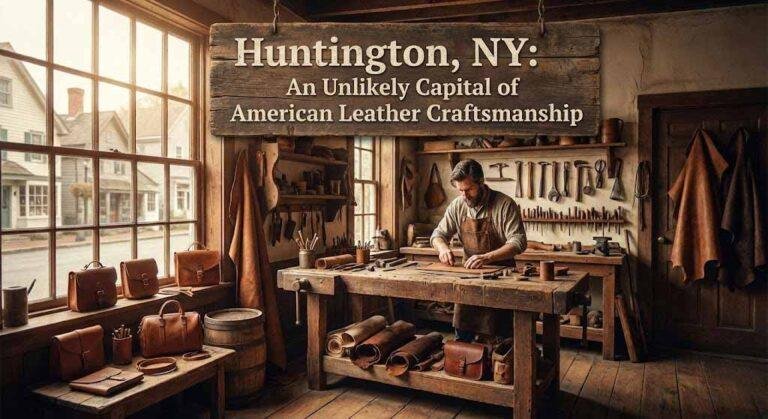
I have spent the better part of three decades studying this ritual from two vantage points that most people would never think to connect. From behind the counter of The Heritage Diner in Mount Sinai—where I have watched North Shore commuters file in for coffee and eggs before catching their trains since the late 1990s—and from behind the cutting table in my home workshop, where I build English bridle leather briefcases by hand under the Marcellino NY name. One life taught me how people fuel themselves for the performance of professionalism. The other taught me how they costume it. Both taught me the same lesson: the unseen details are what define a person.
The Gray Flannel Uniform and Its Leather Shadow
The modern briefcase, as a cultural object rather than a mere container, was born on Madison Avenue. Not the advertising industry that borrowed the street’s name, but the physical corridor itself—that twelve-block stretch between 40th and 52nd Streets where, by 1937, fully thirty-seven percent of the American Association of Advertising Agencies’ New York members kept their offices (WARC, 2018). In the postwar years, the briefcase became the leather shadow of the gray flannel suit. Sloan Wilson’s 1955 novel gave the uniform its name, but Brooks Brothers—whose Madison Avenue flagship had been open since 1915—gave it its form. The briefcase was the final punctuation mark on a sentence that read: I belong here (National Museum of American History, 2020).
What those Madison Avenue men carried was almost always a rigid, box-frame attaché case. Typically constructed from stiff cowhide stretched over a wooden or steel skeleton, it communicated discipline, order, and a portable authority. The attaché was, in essence, a traveling desk—pen wells, document dividers, and a locking clasp that suggested the contents within were of consequence (Gentleman’s Gazette, 2025). When LIFE magazine sent photographers inside the ad agencies in 1958, the resulting images showed a world where a man’s case was as carefully chosen as his tie. There was no irony in this. A briefcase that scuffed too easily or whose hardware tarnished was a professional liability, a crack in the performance.
The Patina Principle: Why Leather Ages Like Reputation
Here is where the diner and the workshop converge. At The Heritage, I have a cast-iron skillet that has been in continuous use for over two decades. Its surface is black, glassy, and frictionless—the accumulated result of thousands of meals, each one depositing a molecular layer of seasoning that, over time, becomes the pan’s defining characteristic. You cannot buy this. You cannot shortcut it. You can only earn it through daily use and consistent care.
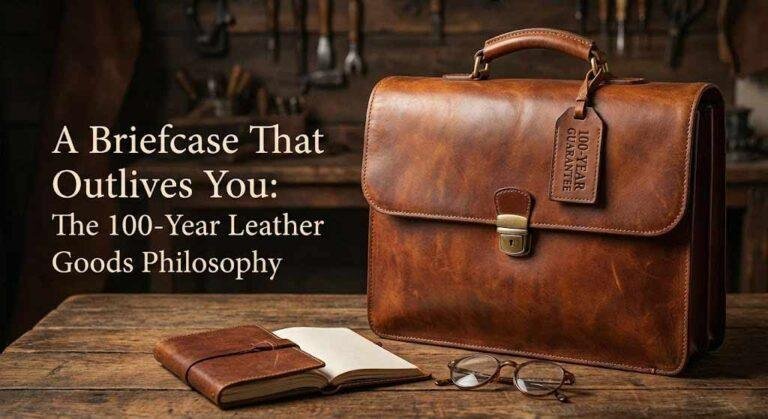
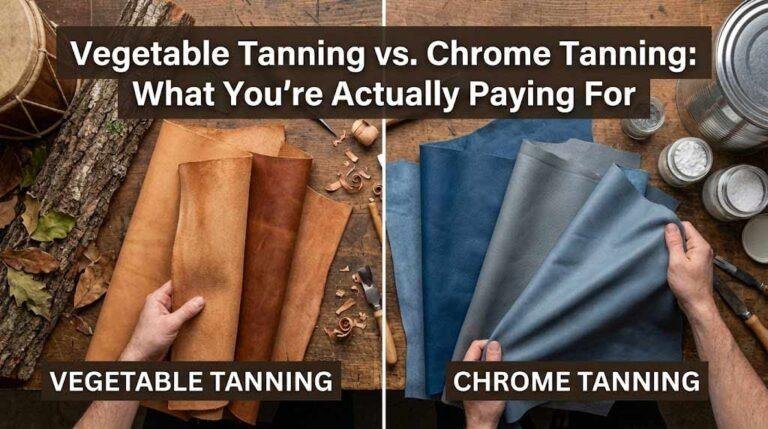
English bridle leather operates on the same principle. Unlike chrome-tanned hides—which account for roughly eighty to ninety percent of global leather production and can be processed in a single day—vegetable-tanned bridle leather requires a minimum of six weeks in solutions of natural tannins derived from mimosa and quebracho bark (Wickett & Craig, 2024). The hides are then drum-dyed for color and hot-stuffed with waxes, oils, and tallows. The result is a material that begins its life stiff and almost austere, but over months and years of daily handling develops what the leather trade calls patina—a deepening of color, a softening of texture, a surface that records the specific history of its owner’s hands.
At Marcellino NY, where I have been building briefcases since 1995, I call this the Patina Principle. A briefcase that looks the same on day one thousand as it did on day one is not a quality briefcase. It is a vinyl imitation of one. The New York professional who understands this—and there are more of them on the LIRR than you might expect—is telling the world something specific: I am not here for the short term. I am building something that compounds.
The Five Briefcases of the New York Commute
Ride the Port Jefferson Branch from its terminus to Penn Station and you will encounter, with remarkable consistency, five archetypes of professional carry. Each one communicates a philosophy about work, status, and self-regard that is as legible as a business card—and considerably harder to fake.
The Nylon Commuter Bag. Ubiquitous, practical, and anonymous. It says: I optimize for function and I do not wish to be noticed. There is nothing wrong with this. But there is nothing memorable about it, either. In real estate terms—and my wife Paola, who brokers properties across the North Shore and into Manhattan, would confirm this—it is the equivalent of a competent but unremarkable listing photo. It gets the job done. It does not get the premium.
The Designer Logo Tote. Purchased for the name stamped on the exterior rather than the quality of what lies beneath it. The leather is often corrected-grain or bonded, meaning the natural surface has been sanded away and replaced with an artificial coating. This is the McMansion of bags: impressive square footage, questionable craftsmanship. In my experience, the professionals who carry these tend to be early in their careers, still confusing visibility with authority.
The Tech Backpack. The Silicon Alley signal, increasingly common even in law firms and financial offices post-pandemic. It communicates informality and a rejection of traditional hierarchy. But it also, inadvertently, communicates something about the relationship between the carrier and their work: everything is digital, nothing requires the careful physical organization that a structured case provides. Whether this is liberation or loss depends on your philosophy.
The Vintage Attaché. Inherited or found at an estate sale, often showing significant wear. When genuine, this is one of the most powerful professional signals available. It says: I come from substance, or I have the taste to recognize it. When affected—purchased already distressed from a boutique—it says something far less flattering. The difference, like the difference between a genuinely seasoned cast-iron skillet and one sprayed with a factory-applied nonstick coating, is detectable to anyone who knows what to look for.
The Bespoke Leather Briefcase. Made by hand from full-grain vegetable-tanned or English bridle leather, typically by a single craftsman or a very small workshop. This is the rarest object on the train. It says: I have considered this carefully. I have chosen quality over convenience, longevity over trend, and I understand that the things I carry are an extension of the work I do. This is, of course, the Marcellino standard—but I am biased, and I will own that bias openly.
The Commuter’s Case as Real Estate for the Self
There is an argument to be made—and Paola and I have been making it as we prepare to launch our boutique real estate venture on the North Shore in 2026—that the relationship between a professional and their briefcase mirrors the relationship between a homeowner and their property. Both are investments in identity. Both appreciate or depreciate based on the quality of their construction. Both communicate, to anyone paying attention, a set of values that the owner may not even be consciously aware of projecting.
Consider the parallel. A home built with solid bones—proper framing, quality materials, thoughtful layout—will gain value over decades even as its aesthetic details evolve with the times. A home built cheaply, with pressed-board behind the drywall and vinyl masquerading as hardwood, will begin its decline the moment the warranty expires. The North Shore luxury market, which Paola navigates daily, rewards authenticity and punishes pretense. Buyers in communities like Mount Sinai, Stony Brook, and Port Jefferson are increasingly drawn to properties with what we might call material honesty: real wood, real stone, real craftsmanship (Architectural Digest, 2024). They are, in essence, looking for the residential equivalent of full-grain leather—something that will age with integrity.
A briefcase operates on the same logic, only on a more intimate scale. It is real estate for the self—the portable territory in which you organize the tools of your professional life. When that territory is well-built, it projects competence and intentionality into every room you enter. When it is disposable, it projects disposability. The closing of a real estate deal and the curing of a leather hide share a structural kinship: both require patience, expertise, and an understanding that the final result will only be as good as the materials and care invested at every stage.
Why the Briefcase Survived the Death of Retail
I have watched, from the windows of The Heritage Diner, as the commercial landscape of the North Shore has shifted over twenty-five years. Storefronts that once held independent shops now rotate through a cycle of openings and closures with disheartening regularity. The National Restaurant Association reported that independent restaurants continue to face intense margin pressure from rising costs and shifting consumer habits (National Restaurant Association, 2024). And yet, The Heritage persists. And the briefcase persists.
The reason, I believe, is the same in both cases. The Heritage Diner has survived for a quarter-century not because it adapted to every trend, but because it committed to a permanent standard: good food, honest service, and a space that functions as what the sociologist Ray Oldenburg famously called a third place—neither home nor work, but a communal ground where identity and community intersect (Oldenburg, 1989). The briefcase survives for the same reason. In a world of cloud storage and digital documents, the leather case is no longer strictly necessary. But necessity was never the point. The point is that human beings require physical objects that anchor their professional identity in something tactile, something real, something that the hand can hold and the eye can admire.
This is not nostalgia. This is neuroscience. Research in embodied cognition has consistently shown that physical objects influence how we think, feel, and perform. A study in the Journal of Experimental Social Psychology found that wearing formal clothing, including carrying formal accessories, increased abstract thinking and broadened cognitive categorization (Slepian et al., 2015). The briefcase is not a relic. It is a cognitive tool.
The Marcellino Standard and the Future of Bespoke
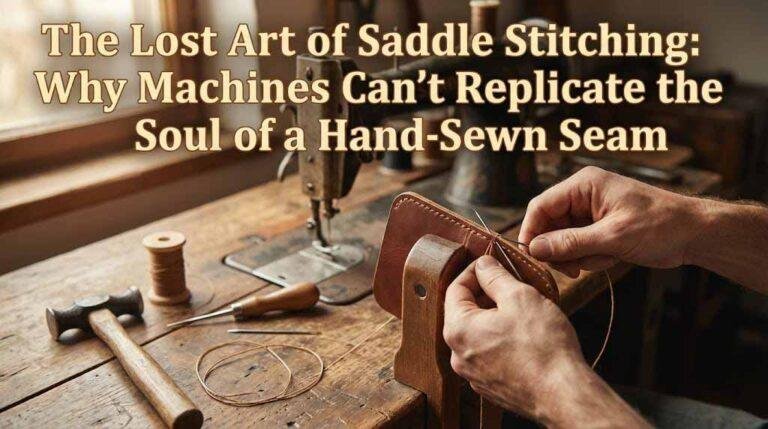
Every Marcellino NY briefcase—from the Jürgen Habermas style to the Alfred Wallace to the 2025 Achilles line—begins with a single hide of English bridle leather, selected for the uniformity of its grain and the absence of surface imperfections. The vegetable tanning process that produced that hide took six weeks. The hand-stitching that will hold the case together, at five-millimeter intervals using waxed thread and a saddler’s needle, takes approximately sixteen hours. The entire process, from pattern cutting to final edge finishing, requires the better part of a week. I do this alone, in my workshop, because the alternative—outsourcing to a factory, scaling production, chasing volume—would violate the principle on which the entire enterprise is built: that a briefcase made for one person, by one person, carries a weight that no assembly line can replicate.
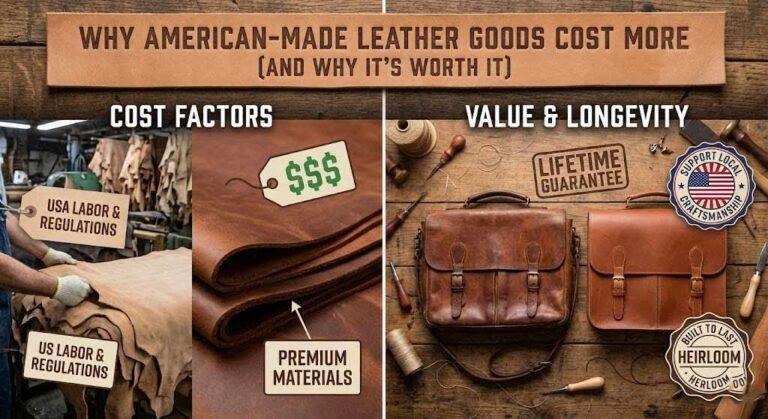
This is not a scalable business model. It is, deliberately, the opposite of one. And that is precisely why it resonates with a specific kind of New York professional—the attorney who has tried every mass-produced option and found them wanting, the physician whose daily carry must project both authority and care, the executive who understands that in a room full of identical suits, the briefcase is the only object that can speak with an individual voice.
The philosopher Martin Heidegger wrote about the difference between objects that are merely present-at-hand—things we notice and examine—and those that are ready-to-hand—things so well-suited to their purpose that they become transparent extensions of the self (Heidegger, 1927). The highest compliment a briefcase can receive is to become ready-to-hand: so perfectly fitted to its owner’s life that it disappears into use, becoming not an accessory but an organ of professional function. That transformation requires materials that respond to the body’s warmth and pressure over time. It requires construction that does not fail at the stress points. It requires the kind of attention to unseen details—the quality of the lining, the smoothness of an edge that no one else will ever touch—that separates craft from manufacturing.
As I look ahead to what 2026 holds—the boutique venture with Paola, the continued evolution of the Marcellino line, another year of breakfast service at The Heritage—I am struck by how the same principle governs all three enterprises. The diner, the briefcase, and the home are all containers for human life. Their value is determined not by what is visible on the surface, but by the integrity of what lies beneath it.
Multimedia Reference:
For readers interested in the craft of vegetable-tanned leather and the tradition of hand-stitching, the following offer excellent visual context:
- Wickett & Craig Tannery Process: https://www.youtube.com/watch?v=_2aDjRBOYEQ — A look inside one of America’s last remaining vegetable tanneries, operating in Curwensville, Pennsylvania since 1867.
- Gentleman’s Gazette — Attaché Case Guide: https://www.youtube.com/watch?v=YKnATq0IBHE — A comprehensive exploration of the history and construction of the attaché case, and how it differs from other professional carry options.
This article was written for The Heritage Diner Blog (heritagediner.com/blog) by the founder of Marcellino NY, a 25-year restaurateur, master leather craftsman, and North Shore real estate visionary. For bespoke briefcase inquiries, visit marcellinony.com.