E.O. Wilson believed that the sacred was biological all the way down. Altruism, morality, religious feeling itself — all of it, in his account, traced back to kin selection, gene-level competition, and the evolutionary pressures that shaped eusocial species over millions of years. He was not hostile to religion in the way that a polemicist is hostile; he was more unsettling than that. He treated religious behavior as a fascinating biological phenomenon, an adaptation worth studying, a product of the same forces that produced the architecture of ant colonies and the division of labor in naked mole rats. He thought this was the most honest account available, and he spent fifty years saying so.
The Vatican did not agree. But here is what surprises people who assume they know how that sentence ends: the Vatican’s response was not to reject evolutionary biology. It was to out-think Wilson on his own terrain.

The Consilience Project and Its Discontents
Wilson’s 1998 book Consilience: The Unity of Knowledge was his most explicit statement of the position. He argued that all human knowledge — the natural sciences, the social sciences, the humanities, and by extension ethics and religion — could eventually be unified under the explanatory framework of the natural sciences, and ultimately of biology. This was not reductionism in the crude sense of saying that everything is “merely” chemistry. Wilson was too good a naturalist for that. But he was arguing that the causal arrows run from matter to mind, from gene to culture, from evolutionary history to moral intuition, and not the other way around. The sacred, in this view, is a downstream product.
The book drew sharp responses from across the intellectual spectrum. Stephen Jay Gould, Wilson’s Harvard colleague and frequent sparring partner, rejected the framework on methodological grounds — arguing that biology and the humanities occupy different explanatory levels that cannot simply be merged. Religious thinkers raised a different objection: that Wilson had not shown that meaning, purpose, and moral obligation could be generated by a purely material account of their evolutionary origins, even in principle. The fact that altruism has a genetic explanation does not explain why we ought to be altruistic, or why the experience of moral obligation feels categorically different from a preference for salt.
Mariano Artigas, a philosopher of science at the University of Navarra with doctorates in both physics and philosophy, pressed this point at length in his work on the relationship between scientific knowledge and metaphysics. His The Mind of the Universe (1992) argued that the natural sciences are themselves dependent on metaphysical commitments — about the intelligibility of nature, the reliability of inference, the existence of objective structures — that science cannot generate from within itself. Wilson’s consilience project, in Artigas’s view, was not eliminating metaphysics but smuggling it in through the back door. You cannot derive the unity of knowledge from within knowledge alone without making prior assumptions about what knowledge is for.
This is not the argument most people expect from a Catholic intellectual. It is not an appeal to revelation or to scriptural authority. It is a philosophical critique conducted entirely on the terrain of epistemology and the philosophy of science — and it is one Wilson’s published work does not fully answer.
Cold Spring Harbor and the Long Island Thread
The connection to Long Island in Wilson’s story runs through Cold Spring Harbor Laboratory, located on the harbor of the same name on the North Shore — a research campus with a history that includes some of the most consequential and most troubling chapters in twentieth-century biology. James Watson, who served as director and then president of Cold Spring Harbor from 1968 to 2007, was a documented admirer of Wilson’s work, and the laboratory’s summer symposia during the 1970s and 1980s were among the venues where sociobiology’s claims were most seriously debated by working scientists. Wilson visited and lectured at the laboratory during the peak years of the sociobiology controversy, roughly 1975 through the early 1980s. His Sociobiology: The New Synthesis (1975) had triggered one of the most heated scientific debates of the postwar era, with critics — including fellow Harvard biologists — arguing that his extension of evolutionary theory to human social behavior was both scientifically premature and politically dangerous.
The Vatican’s 2008 Plenary Session
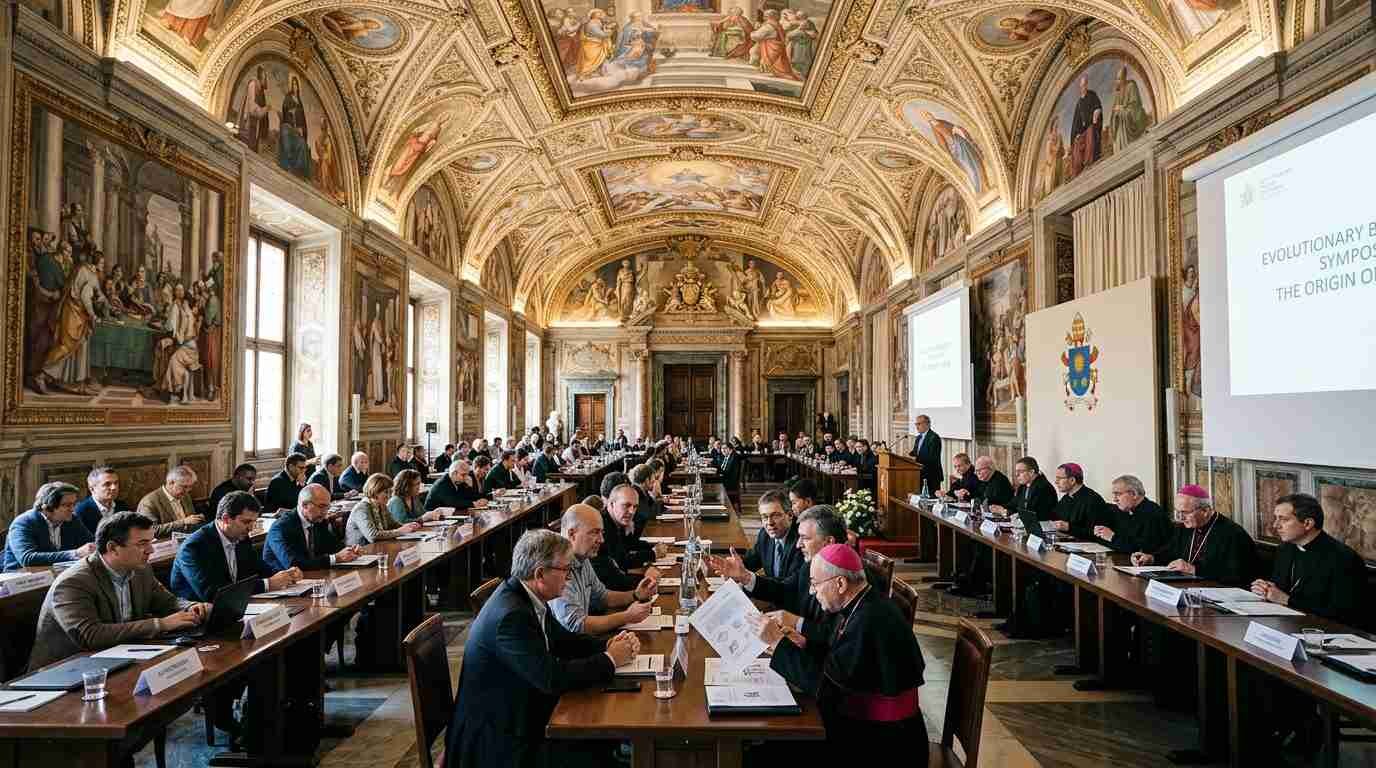
In the autumn of 2008, the Pontifical Academy of Sciences held a plenary session from October 31 through November 4 on the theme Scientific Insights into the Evolution of the Universe and of Life. The proceedings were published by the Vatican as Acta 20 in 2009. This is a verified, documented event — forty-five Academy members and fourteen invited guests, lectures by thirty-one scientists, and an opening address by Pope Benedict XVI himself.
What made the session remarkable was its deliberate exclusion of Intelligent Design advocates. The Academy’s scientific members engaged directly with evolutionary biology as it is actually practiced — not as a theological threat to be managed, but as a body of knowledge to be understood and, where necessary, responded to on philosophical rather than empirical grounds. The distinction matters enormously. Intelligent Design attempts to reopen empirical questions that evolutionary biology has answered. The Thomistic evolutionary biology tradition represented at the Vatican session does something fundamentally different: it accepts the empirical findings in full and argues about what they mean.
Pope Benedict, in his address, framed the question in terms that cut directly against Wilson’s consilience thesis: the intelligibility of nature, he argued, is not something that evolutionary biology explains — it is something that evolutionary biology presupposes. The cosmos, he said, “resembles an ordered book” whose legibility is prior to any scientific account of how its contents came to be. This is a genuine philosophical challenge. Wilson’s response would have been that the intelligibility of nature is itself an evolved capacity — that brains shaped by natural selection to navigate a law-governed physical environment will tend to find that environment legible. But this moves the question rather than answering it: why is the environment law-governed in the first place, in ways that permit mathematical description?
Eusociality, Altruism, and the Limits of Reduction
In The Social Conquest of Earth (2012), Wilson’s most ambitious late-career synthesis, he turned his attention to the evolutionary origins of eusociality — the form of social organization, found in ants, bees, termites, and, he argued, in humans, in which individuals routinely sacrifice individual reproductive fitness for the benefit of the group. He made a controversial move: he argued that eusociality is explained not primarily by kin selection but by multilevel selection, in which selection acts simultaneously on individuals and on groups. This put him in conflict not only with religious thinkers but with his most prominent secular colleagues — Richard Dawkins called the book’s central argument “a disgrace.”
The Vatican scientists, watching this dispute from the outside, drew a different conclusion than either camp. For the Thomistic evolutionary biologists, the debate between kin selection and multilevel selection was evidence that the reductive program had not succeeded — that altruism, even in biological terms, could not be fully explained by the behavior of selfish genes. The emergent properties of eusocial organization, in this view, point to something that a gene-level account alone cannot capture. Wilson might have agreed that emergence was real while disagreeing about what it implied. The Vatican position was that genuine emergence — novelty that cannot be derived from the properties of lower-level components — carries metaphysical implications that a purely materialist ontology struggles to absorb.
Where the Evidence Actually Points
Wilson, to his credit, never stopped engaging these questions directly. He wrote in The Social Conquest of Earth that the conflict between science and the humanities — between the reductive and the interpretive — was the central intellectual tension of contemporary culture, and that it could not be resolved by either side simply declaring victory. His secular reductionism was not triumphalist; it was genuinely uncertain at its edges, as he acknowledged in interviews throughout his final decade.
The Vatican scientists shared, in their own way, that intellectual humility. Francisco Ayala, a biologist and Dominican priest who contributed to the 2008 session and has written extensively on evolution and theology, argued consistently that evolutionary biology does not require atheism and that its findings, properly understood, are more compatible with a theistic account of creation than the Intelligent Design movement’s interventionist God would suggest. A God who creates through evolutionary processes is, in Ayala’s framing, more impressive than a God who patches the gaps with miracles.
Wilson would have been skeptical of the inference, even while respecting the argument. He tended to think that any God who worked through natural selection was doing something indistinguishable from no God at all — that the gap between natural process and divine creation had been closed from the wrong direction. But he engaged the question. That is the thing that made him worth reading, and worth arguing with.
I’ve written about related territory — the relationship between evolutionary thinking and consciousness, and the question of what emergence means at the boundary of science and philosophy — and the Wilson-Vatican exchange illuminates both. The debate is not over. But it is more interesting than either its secular promoters or its religious critics usually acknowledge.
You Might Also Like
- The Selfish Gene by Richard Dawkins — The Book That Unlocked Darwin for Me
- The Theory of Evolution by John Maynard Smith — A Review
- The Extended Phenotype: How Your Genes Build Structures Beyond Your Body
Sources
- Wilson, E.O. (1998). Consilience: The Unity of Knowledge. Knopf.
- Wilson, E.O. (2012). The Social Conquest of Earth. Liveright/W.W. Norton.
- Wilson, E.O. (1975). Sociobiology: The New Synthesis. Harvard University Press.
- Artigas, M. (1992). The Mind of the Universe. Templeton Foundation Press.
- Pontifical Academy of Sciences. (2009). Scientific Insights into the Evolution of the Universe and of Life (Acta 20). Vatican City. pas.va
- Ayala, F.J. (2009). “Evolution Beyond Biology.” Theology and Science, 7(4), 379–390.
- Cold Spring Harbor Laboratory. Archives. cshl.edu
- Long Now Foundation. E.O. Wilson lecture, “The Social Conquest of Earth” (2012). longnow.org
- Peters, T. (2013). “E.O. Wilson’s Conquest of Earth: Theology and Science.” Theology and Science, 11(2). tandfonline.com