Every morning, roughly 250,000 people board a train on the Long Island Rail Road and head toward Manhattan. They carry coffee cups, laptops, and the quiet calculation of someone who has done the math: the commute is the cost of admission to something better — more house, better schools, open sky, a yard with grass, and a life that doesn’t feel like it’s happening entirely indoors. Long Island has been that bargain for New York City professionals since the very first LIRR locomotive ran from Jamaica to Greenport in 1844, making it one of the oldest commuter rail lines on the continent.
But the bargain looks different in 2026. Grand Central Madison — the $11.1 billion crown jewel of the LIRR’s East Side Access project — opened in February 2023 and rewired the commuting calculus for thousands of Long Island professionals working on the East Side of Manhattan. Hybrid work schedules have expanded the definition of ‘reasonable commute distance’ further east than ever before. And a housing market in which Nassau County median prices touch $849,000 has sent buyers hunting for value further along the LIRR’s 700-mile network of tracks and 126 stations.
This guide cuts through the noise with real commute times, real price data, and real lifestyle intel on Long Island’s best commuter towns — from the gold-standard 30-minute express stations of Nassau’s western edge to the surprisingly compelling value plays along the North Shore of Suffolk. If you are a NYC professional weighing where to plant roots on Long Island, this is the map you’ve been looking for.
1. The LIRR: The Busiest Commuter Railroad in North America
Before diving into specific towns, it helps to understand the machine that makes Long Island commuting work. The Long Island Rail Road — known universally as ‘the LIRR’ — is not just a train line. It is, by a wide margin, the busiest commuter railroad on the North American continent, carrying approximately 250,000 customers each weekday on 947 daily trains (MTA.info, 2025). Its tracks stretch 120 miles from Penn Station in Manhattan to Montauk on the easternmost tip of Long Island, threading through 126 stations across Nassau and Suffolk counties, Queens, and Brooklyn.
For most of its existence, the LIRR delivered commuters to exactly one Manhattan destination: Penn Station on the West Side, near Midtown West, 34th Street. That was fine if you worked near Midtown West — but a headache if your office was on Park Avenue, in the 50s or 60s, or anywhere on the East Side. Commuters destined for those neighborhoods faced a walk, a taxi, or an additional subway leg after arrival at Penn Station.
The opening of Grand Central Madison on January 25, 2023, changed all of that. A two-mile tunnel extension from Queens to a brand-new underground terminal beneath Grand Central Terminal — the largest passenger rail terminal built in the United States in 67 years — now deposits Long Island commuters directly in the heart of Midtown East. The project’s engineering scope was staggering: eight miles of tunneling across three boroughs, 40 miles of new track, two new tunnels between Manhattan and Queens that increased LIRR capacity to New York City by 50%, and a 700,000-square-foot passenger concourse with 47 escalators (Jacobs Engineering, 2023; Wikipedia). By November 2023, approximately two out of five LIRR commuters to Manhattan were already traveling through Grand Central Madison (Wikipedia).
“The new LIRR service to Manhattan’s East Side is the most transformative change to Long Island Rail Road service in over a century.” — MTA.info
The practical impact: if you work anywhere near the United Nations, Rockefeller Center, the hospitals on the Upper East Side, or the financial firms clustering around Park and Lexington Avenues, Grand Central Madison effectively shortens your door-to-door commute by 20–40 minutes compared to the Penn Station era. That time savings — multiplied across 250 working days — is life-altering. It is also quietly reshaping property values in towns along the LIRR’s Main Line, which connects to Grand Central Madison.
LIRR Daily Ridership: ~250,000 weekday customers (MTA.info 2025)
LIRR Daily Trains: 947 (MTA.info 2025)
LIRR Stations: 126 across Nassau, Suffolk, Queens, Brooklyn, Manhattan (MTA.info)
Grand Central Madison Opening: February 27, 2023 (full service) (MTA / Wikipedia)
GCM Project Cost: $11.1 billion (MTA / Jacobs Engineering)
Capacity Increase to NYC: +50% via new tunnels (Empire State Passenger Association)
One more fact worth knowing before choosing your town: the LIRR uses a zone-based fare system. There are eight fare zones (numbered 1, 3, 4, 7, 9, 10, 12, and 14), with Zone 1 covering Penn Station and Grand Central Madison. The farther east you live, the higher your zone number — and your monthly pass cost. Monthly and weekly tickets increased 4.5% effective January 4, 2026 (MTA Board approval, September 30, 2025), though the MTA confirmed that monthly fares will not exceed $500 regardless of distance. Nassau County stations generally fall in Zones 4–7, while Suffolk County spans Zones 9–14.
2. Hybrid Work Rewrites the Rules: How Much Does Commute Time Really Matter?
The question ‘how long is the commute?’ used to have exactly one correct answer: as short as possible. The old real estate calculus was brutally simple — minimize commute, maximize everything else within that constraint. But the hybrid work revolution that crystallized between 2020 and 2025 has scrambled that formula permanently, and Long Island buyers are among those who stand to benefit most.
Penn IUR (University of Pennsylvania’s Institute for Urban Research) published landmark research establishing that long-term, work-from-home levels are stabilizing at approximately 20% of full workdays — triple the pre-pandemic baseline of 5%. Employer expectations for hybrid employees have settled at roughly 2.5 days per week in the office, per the same research (Penn IUR Policy Brief, 2022). In practical terms for a Long Island buyer: if you commute to Manhattan 2–3 days per week instead of 5, a town that once felt ‘too far’ suddenly becomes entirely viable.
The numbers back this up nationally. Redfin’s 2024 report found a 25% increase in home searches in suburban areas compared to urban centers. Research from the Federal Reserve Bank of San Francisco found that remote work may have been responsible for as much as 60% of total housing price growth during the pandemic period. Among remote workers planning to move in 2025, 49% are heading to suburban areas versus only 29% to urban settings (Howdy.com Remote Work Migration Report, 2025). And 12% of remote workers are putting off purchasing a home specifically because of uncertainty around return-to-office mandates — which tells you just how central work schedule flexibility has become to housing decisions.
For Long Island, this means that a town 55 minutes from Penn Station on an express train — previously a stretch for a daily commuter — now falls comfortably within range for someone commuting twice or three times a week. It also means that the ‘door-to-door’ calculation matters more than the raw train time: a town with abundant parking at the station, or a walkable village that eliminates the car entirely, may beat a theoretically closer town where station access is a daily hassle.
“People are making real estate choices based on lifestyle preferences, not just proximity to a cubicle. The old trade-off between a reasonable commute and an affordable home is losing its grip.” — OffTheMRKT.com, February 2026
One historical analogy is instructive here: when the Brooklyn Bridge opened in 1883, the New York Times predicted that Brooklyn would be ‘absorbed’ into Manhattan within a generation. Instead, the bridge made Brooklyn desirable as a distinct place to live — accessible enough to maintain economic ties to Manhattan, but separate enough to have its own identity. Grand Central Madison and hybrid work schedules are doing the same thing for Long Island’s middle reaches: making towns like Huntington, Smithtown, and even Mt. Sinai genuine contenders for professionals who previously limited their search to Nassau County.
3. The Gold Standard: Nassau County Express Towns
Nassau County’s western towns represent the purest expression of the commuter town model — walkable downtowns, express trains, and established communities where leaving a Manhattan apartment for ‘the suburbs’ requires the least psychological adjustment. The trade-off is cost: Nassau’s median single-family listing price reached $849,000 in late 2024, and western Nassau’s most desirable villages push well above that benchmark.
| Garden City | 🚂 Train: ~35 minutes to Penn Station | Direct LIRR (Hempstead Branch)🏡 Home Range: $950K–$1.8M✨ Vibe: Classic suburban perfection — leafy streets, family-first, bikeable, strong schools |
Garden City: The Benchmark
Garden City is the town that defines the aspirational Long Island commuter dream. Laid out in 1869 by department store magnate Alexander Turney Stewart as a planned model town — one of the first planned communities in American history — it has maintained an almost impossibly curated appearance for over 150 years: wide boulevards lined with cathedral oaks, Tudor Revival architecture, manicured village greens. The Cathedral of the Incarnation, completed in 1885, remains one of the finest Gothic Revival structures in the Northeast.
The commute is among Long Island’s best: express trains to Penn Station in approximately 35 minutes. The LIRR’s Garden City station, combined with the nearby Hempstead branch, provides multiple departure options during peak hours, reducing the ‘what if I miss the 7:42’ anxiety that plagues commuters at single-frequency stations. Garden City also sits minutes from Roosevelt Field Mall and the major job cluster of Nassau’s central business district — meaning many residents can work locally without ever touching the LIRR at all.
Home prices reflect the premium. Typical listings run $950,000 to $1.8 million for single-family homes, with the higher end commanding large Colonial-era properties on oversized lots. Schools are consistently strong, with Garden City Union Free School District ranking highly in state assessments. The major watch-out, noted repeatedly by buyers’ agents, is cultural homogeneity — Garden City is beautiful but can feel less diverse than many NYC transplants are accustomed to. Visits on a weekend afternoon are strongly recommended before committing.
| Rockville Centre | 🚂 Train: ~36–40 min to Penn Station | No Jamaica transfer required (Babylon Branch)🏡 Home Range: $819K–$954K✨ Vibe: Vibrant downtown, one-seat ride, competitive schools, the “sweet spot” pick |
Rockville Centre: The Sweet Spot
Rockville Centre (known locally as ‘RVC’) occupies a unique position: it delivers express commute times competitive with Garden City’s while offering a genuinely walkable, vibrant downtown that rivals small city neighborhoods. The key technical advantage, noted by Educators Realty’s 2025 commuter guide, is that the Babylon Branch bypasses Jamaica Station entirely — meaning RVC commuters don’t face the systemic delays and transfer anxiety that affect other LIRR corridors.
In November 2025, Rockville Centre’s median home sale price was $879,000 (Redfin), with NeighborhoodScout data pegging the median at $954,047 — placing it in the top tier of Long Island municipalities by home value. Homes sold in an average of 25 days in late 2025, down from 28 days the year prior, indicating sustained demand. Village lots are a particularly notable advantage: residents of the incorporated village get access to resident-only commuter parking permits, an ‘exclusive club’ for homeowners that adds tangible, measurable value to properties within village boundaries versus unincorporated areas just outside.
The downtown on Sunrise Highway and adjacent streets hosts a genuine concentration of restaurants, coffee shops, boutiques, and nightlife that makes non-commuting evenings and weekends feel full rather than empty. Strong schools, competitive sports leagues, and an active village social calendar round out the package. For professionals moving from Brooklyn or Queens, RVC often registers as the most ‘city-like’ of Long Island’s commuter villages — a genuinely warm landing zone.
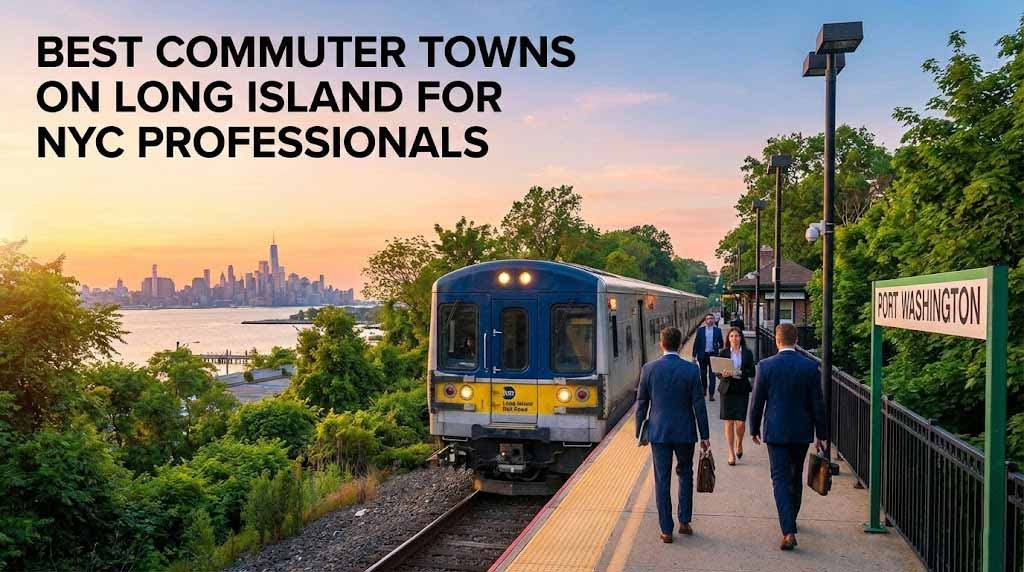
| Port Washington | 🚂 Train: ~30–40 min to Penn Station & Grand Central Madison | One-seat ride (Port Washington Branch)🏡 Home Range: $750K–$2M+✨ Vibe: Waterfront elegance, harbor views, Great Gatsby country, culinary destination |
Port Washington: Gold Coast Elegance
Port Washington holds a singular place in American literary history: F. Scott Fitzgerald not only lived on Long Island but drew direct inspiration from Port Washington’s Sands Point Reserve for the setting of Jay Gatsby’s mansion — the fictional ‘West Egg’ of The Great Gatsby (1925). The connection is not merely decorative. Like Gatsby’s Long Island, Port Washington radiates a certain effortless elegance, its harbor dotted with sailboats and its Main Street lined with the kind of restaurants that make dinners feel like destinations.
The Port Washington Branch offers one of Long Island’s most prized commute experiences: a true ‘one-seat ride’ to both Penn Station and Grand Central Madison that bypasses Jamaica entirely. Express trains reach Midtown Manhattan in 30–40 minutes, and Cities to Suburbs’ 2026 analysis places the monthly Zone 4 LIRR pass at $264.25. Homes sell rapidly — average of 16–28 days on market in late 2025 — in a market where a persistent 23% decrease in available inventory has sustained strong competition (Redfin, Realtor.com cited in Cities to Suburbs, January 2026). Prices range from $750,000 to well over $2 million for waterfront properties.
For professionals who work near Rockefeller Center, the United Nations, Memorial Sloan Kettering, or any of the major institutions on the Upper East Side, Grand Central Madison makes Port Washington’s commute unusually efficient. The parking situation requires homework: Port Washington is a collection of several villages (Great Neck Plaza, Port Washington proper, Plandome, Manhasset), each with its own residential parking district. Knowing exactly which jurisdiction your potential home falls under — and what parking access it confers — is non-negotiable before making an offer.
4. The Mid-Island Middle Ground: Balance, Value, and Space
The towns of central Nassau and western Suffolk occupy the market’s most contested terrain: far enough from the city to offer meaningfully larger homes and lots, but close enough to preserve a workable daily commute even on hybrid schedules. For buyers priced out of Garden City and RVC, or simply seeking more house for the money, these are the most interesting trade-offs.
| Mineola | 🚂 Train: ~30–35 min to Penn Station | Multiple LIRR lines converge🏡 Home Range: $650K–$900K✨ Vibe: Urban walkability, rapid redevelopment, great transit access, upwardly mobile |
Mineola: The Undiscovered Urban-ish Option
Mineola has a secret: it is one of the most transit-rich communities on Long Island, with multiple LIRR lines converging at its station and some of the fastest peak-hour service to Penn Station anywhere in Nassau County. Yet its home prices lag behind adjacent communities with comparable commute times, making it a genuine value play for buyers who prioritize connectivity over prestige.
The Mineola village core has undergone significant transformation over the past decade, with new restaurant and retail openings, transit-oriented apartment development, and a downtown renaissance that feels authentically urban rather than suburban. Nassau County government functions — courts, hospitals, county offices — cluster here, creating a self-contained local economy that keeps the area economically resilient independent of its Manhattan relationship. Garden City’s schools are technically adjacent and accessible in some zones, though buyers should verify district lines carefully.
| Hicksville | 🚂 Train: ~45–50 min to Penn Station | Main Line hub with express options🏡 Home Range: $550K–$750K✨ Vibe: Affordable, diverse, transit hub, great for hybrid workers on a budget |
Hicksville: The Practical Professional’s Pick
Hicksville is where LIRR’s Main Line reaches a critical junction — making it a transfer hub and giving it frequent service patterns that outperform many ‘closer’ stations in terms of actual train frequency. The commute to Penn Station runs approximately 45–50 minutes, manageable for 2–3 day/week office schedules. Home prices in the $550,000–$750,000 range make Hicksville one of the most accessible entry points to Long Island homeownership for young professionals, and its diversity — reflecting decades of immigration from South Asian, Latin American, and Middle Eastern communities — gives it a cultural richness that more homogeneous Long Island towns lack.
Major employers including the federal and county courthouse complex, aerospace and defense contractors along Long Island’s Route 110 corridor, and proximity to the Bethpage community (home of Grumman’s former campus and Northrop Grumman’s continuing operations) make Hicksville genuinely viable as a non-commuting base. For Manhattan commuters who need to be in the city only occasionally, the math is compelling.
5. The North Shore Value Play: Suffolk’s Hidden Commuter Stars
Perhaps the most underappreciated story in Long Island commuter real estate in 2026 is the emergence of Suffolk County’s North Shore as a legitimate destination for NYC professionals — not just as a weekend escape, but as a full-time base. The catalyst is a combination of hybrid work flexibility, Grand Central Madison’s extended reach, and a price differential that is genuinely significant: while Nassau’s median listing price touches $849,000, comparable homes in North Shore Suffolk communities trade at 20–30% discounts with comparable school quality.
| Huntington | 🚂 Train: ~55–65 min to Penn Station / Grand Central Madison (Huntington Branch)🏡 Home Range: $550K–$1.2M+✨ Vibe: One of LI’s great downtowns — live music, restaurants, arts scene, harbor access |
Huntington: The Lifestyle Leader
Huntington is Long Island’s most culturally vibrant town beyond the Hamptons, and it isn’t close. The Paramount — a legendary 1,600-capacity venue that has hosted everyone from The Beach Boys to LCD Soundsystem — anchors a downtown music and entertainment district that gives weekends a pulse genuinely comparable to a mid-sized city. The Heckscher Museum of Art, live theater programming, craft cocktail bars, farm-to-table restaurants, and a harbor lined with marinas make the non-commuting hours in Huntington feel distinctly un-suburban.
‘Huntington has an extremely vibrant downtown village area, so it sort of resembles city life, but you’re still in suburbia,’ says Gina DeMaio, a licensed real estate salesperson at Berkshire Hathaway HomeServices who has sold homes there for six years (Homes.com, 2025). The median home price in Huntington proper sits around $875,000, though the broader town of Huntington — which encompasses several distinct hamlets — offers median prices closer to $817,000–$838,000 (Rocket Homes, 2025).
The commute is the key variable to negotiate. The Huntington Branch of the LIRR reaches Penn Station and Grand Central Madison in approximately 55–65 minutes with transfers, or closer to 55 minutes on direct service. For 5-day-a-week office commuters, this sits at the outer edge of what most people willingly sustain. For hybrid workers commuting 2–3 days per week, it becomes entirely reasonable — particularly when the payoff is a home near five harbors, nine town beaches, and a downtown that makes weekends genuinely exciting. In 2023, Huntington Station received a $10 million state grant to revitalize the area surrounding the LIRR station, including walkability improvements and mixed-use development. A separate $66 million sewer infrastructure project, expected to complete by late 2027, is expected to unlock significant new commercial development near the station.
| Smithtown / St. James | 🚂 Train: ~65–75 min via LIRR (Port Jefferson Branch) | Express options available🏡 Home Range: $500K–$850K✨ Vibe: Top schools, North Shore Long Island Sound access, strong community character, emerging value |
Smithtown and St. James: The North Shore’s Rising Stars
The Smithtown-St. James corridor represents perhaps the most compelling emerging value proposition for hybrid NYC professionals on Long Island in 2026. A community built around Richard Smythe’s legendary 1663 land grant — the story goes that Smythe acquired as much land as he could ride around in a single day on his bull, and the bull is commemorated by a bronze statue still standing in the town center — Smithtown has maintained a strong sense of local identity across four centuries.
Smithtown Union Free School District consistently ranks among Suffolk County’s strongest, with high graduation rates and competitive academic outcomes. Home prices in the $500,000–$850,000 range buy meaningfully more house and land than comparable Nassau County properties. The North Shore setting — with access to Long Island Sound beaches, Cold Spring Harbor State Park, and Caumsett State Historic Park just to the west — gives residents the kind of natural beauty that coastal communities typically price at extreme premiums.
The LIRR’s Port Jefferson Branch serves Smithtown, St. James, and the adjacent village of Kings Park with service requiring a transfer at Jamaica or Hicksville for Grand Central Madison-bound commuters. Total transit times to Midtown Manhattan run 65–80 minutes depending on connections — squarely in ‘hybrid work’ territory. For professionals commuting 2–3 days per week, the commute math is workable; for daily commuters, it demands genuine commitment. Route 25A and the I-495 (Long Island Expressway) provide highway alternatives for those who prefer to drive into Queens or further.
📍 Looking for homes in Smithtown, Mt. Sinai, Miller Place, or anywhere along Long Island’s beautiful North Shore? Browse current listings at heritagediner.com/properties/ and connect with Paola Meyer, Associate Broker at Realty Connect USA — a trusted guide to North Shore Suffolk real estate.
▶ Search North Shore Long Island Properties — Heritage Diner Real Estate
Mt. Sinai: Where Community Meets Convenience
Just east of Port Jefferson, the hamlet of Mt. Sinai offers one of Long Island’s most underrated combinations of lifestyle quality and relative affordability. Perched above Long Island Sound on the North Shore’s bluff-lined coastline, Mt. Sinai is known for its tight-knit community culture, strong middle and high school offerings within the Mount Sinai School District, and easy access to the Sound’s beaches — including Cedar Beach and Mount Sinai Harbor, a protected inlet popular with boaters and kayakers.
For the hybrid professional, Mt. Sinai makes genuine sense: a 15-minute drive to Port Jefferson’s LIRR station connects to Penn Station in roughly 80–90 minutes, or a shorter drive to Stony Brook puts you on the same branch with slightly less travel. The payoff is a quiet, coastal community where $600,000–$850,000 buys a four-bedroom home with a backyard, often with Sound views — a value proposition simply unavailable anywhere in Nassau County at those price points. The Heritage Diner has been a gathering place for Mt. Sinai families for generations, and its presence on Route 25A speaks to the kind of durable, community-rooted character that makes the hamlet a genuine home rather than merely a ZIP code.
6. The South Shore’s Wild Cards: Long Beach and Patchogue
Long Island’s South Shore has its own distinct commuter culture — beach-oriented, somewhat more affordable in spots, and increasingly energized by a demographic of younger professionals seeking a lifestyle that no inland suburb can replicate. Two towns in particular deserve attention.
| Long Beach | 🚂 Train: ~50–55 min to Penn Station (Long Beach Branch)🏡 Home Range: $450K–$1.2M✨ Vibe: Beachfront city, boardwalk running, Atlantic Ocean, surfer-meets-finance energy |
Long Beach: The Beachfront Anomaly
Long Beach is the only city on Long Island proper that sits on a barrier island, flanked by the Atlantic Ocean on one side and Reynolds Channel on the other. Its commuter profile is unique: a direct LIRR branch delivers residents to Penn Station in approximately 50–55 minutes, with no Jamaica transfer. But the lifestyle draw is what sets it apart from every other town in this guide — Long Beach residents can literally run along the boardwalk at sunrise, surf before work, and bike to the LIRR station. This is not a metaphor. People do this.
The Beacon Team’s 2025 guide for young Long Island professionals identified Long Beach as the ideal pick for professionals ‘who want year-round vacation vibes,’ noting that the LIRR gets you to Penn Station in under an hour and evenings are spent at the beach, the boardwalk, or at established gathering spots in the downtown. After Superstorm Sandy’s devastating 2012 damage, Long Beach underwent a significant rebuilding effort that resulted in a more modern, resilient housing stock and infrastructure. Prices range from condos around $450,000 to waterfront homes exceeding $1.2 million.
| Patchogue | 🚂 Train: ~70–80 min to Penn Station (Montauk Branch) | Best for hybrid workers🏡 Home Range: $300K–$650K✨ Vibe: Revitalized arts downtown, craft breweries, waterfront dining, emerging creative scene |
Patchogue: The Comeback Story
Patchogue has undergone what may be Long Island’s most dramatic downtown transformation of the past decade — from a declining commercial center to one of the most energized arts and dining districts on the Island. Blue Point Brewing Company, which started in Patchogue before being acquired by Anheuser-Busch, put the town on the craft beer map and anchored a broader revival that now includes waterfront restaurants, live music venues, art galleries, and a thriving social scene that draws visitors from across Suffolk County on weekends.
For NYC hybrid professionals, Patchogue represents a value calculation with a significant lifestyle upside. Home prices in the $300,000–$650,000 range — among the lowest accessible commuter town prices on Long Island — make homeownership genuinely attainable for younger buyers or single professionals who might be priced out of Nassau entirely. The commute (70–80 minutes on the Montauk Branch) is squarely in ‘hybrid work’ territory: challenging for daily commuters but entirely reasonable for 2-day office schedules. The town’s ongoing development pipeline, including waterfront mixed-use projects, suggests that today’s Patchogue price is tomorrow’s equity.
7. How to Choose Your Town: The Framework Every Commuter Buyer Needs
Choosing a Long Island commuter town is not simply about selecting the shortest train ride. It is a multi-variable optimization problem, and the variables are deeply personal. Here is the framework that experienced buyers’ agents use to guide the decision.
Step 1: Know Your Real Office Schedule
Not the schedule you intend to maintain — the schedule you actually maintain. Be honest about how many days per week you realistically expect to be in the office over the next 3 years. 5 days/week firmly anchors your search west of Hicksville. 3 days/week opens the entire Nassau County map. 2 days/week or fewer makes the entire North Shore of Suffolk viable. Return-to-office mandates are evolving: 12% of remote workers in 2025 are delaying home purchases specifically over this uncertainty (Howdy.com). Factor this into your planning horizon.
Step 2: Identify Your Manhattan Destination
Penn Station serves West Side destinations — Midtown West, Hudson Yards, the financial district via subway. Grand Central Madison serves East Side destinations — Midtown East, the Upper East Side, hospitals on York Avenue, and has connections to Metro-North for destinations in Westchester, Connecticut, and the Bronx. Know which terminus serves your office before you select a town or train line. The Port Washington Branch, which goes to both Penn and Grand Central Madison, is particularly valuable for professionals with East Side offices.
Step 3: Calculate the Full Commute Cost
Monthly LIRR pass + annual parking permit at the station + any NYC subway fare to your office from the train terminal = your true commute cost. Nassau Zone 4 monthly passes run approximately $264.25. Suffolk Zone 9–10 passes approach $300–$350. Add $200–$400/year for resident parking permits in most communities (though resident parking is often the most under-researched variable in the commuter home search). Some premium towns — Great Neck, Port Washington — charge $800/year for park district permits. These are real costs that compound into thousands of dollars annually.
Step 4: Visit the Station at Rush Hour
Before signing a contract, take the commute at rush hour. Stand on the platform. Walk from the parking lot (or the downtown, if you plan to walk). Board the train. Change at Jamaica if your line requires it. Note the crowd levels, the reliability, the transfer timing. A 35-minute train time that requires a 20-minute parking search and a chaotic Jamaica transfer can easily become a 90-minute door-to-door experience. Conversely, a theoretically longer ride that starts in a quiet parking garage with direct platform access may be dramatically more livable. Educators Realty’s 2025 commuter guide puts this perfectly: ‘The train ride is the easy part. The hard part is parking your car.’
Step 5: Look for Towns with Walkable Stations
The rise of hybrid work has increased the value of walkable station neighborhoods dramatically, because people who commute 2–3 days per week care more about the quality of the non-commuting days than daily commuters do. A walkable station that lets you walk to dinner, the farmers market, and weekend errands without a car is not a luxury — it is a genuine lifestyle multiplier. Rockville Centre, Port Washington, Huntington Village, and Patchogue all qualify. Hicksville and Deer Park are more car-dependent.
📍 Paola Meyer, Associate Broker at Realty Connect USA, specializes in helping NYC professionals navigate the North Shore Long Island market — from understanding school districts to evaluating commute corridors. Reach out to start your search: heritagediner.com/properties/
Quick-Reference Commuter Town Snapshot
| Town | Train Time | Price Range | County | Best For |
| Garden City | ~35 min | $950K–$1.8M | Nassau | Families, prestige |
| Rockville Centre | ~38 min | $820K–$960K | Nassau | Young professionals |
| Port Washington | ~35–40 min | $750K–$2M+ | Nassau | East Side commuters |
| Mineola | ~30–35 min | $650K–$900K | Nassau | Value + fast commute |
| Hicksville | ~48 min | $550K–$750K | Nassau | Budget-conscious buyers |
| Huntington | ~60 min | $550K–$1.2M+ | Suffolk | Arts/culture seekers |
| Smithtown | ~70 min | $500K–$850K | Suffolk | Hybrid workers, schools |
| Mt. Sinai | ~80 min | $600K–$850K | Suffolk | Coastal lifestyle, value |
| Long Beach | ~52 min | $450K–$1.2M | Nassau | Beachfront lifestyle |
| Patchogue | ~75 min | $300K–$650K | Suffolk | Budget + arts/vibe |
Note: Train times are approximate peak express times. Home prices reflect late 2025 / early 2026 market data. Sources: Redfin, Rocket Homes, NeighborhoodScout, EXIT Realty Premier, Cities to Suburbs. Always verify with a licensed local real estate professional.
Essential Resources for Long Island Commuter Buyers
▶ MTA Long Island Rail Road — Schedules, Fares, and Station Information
▶ LIRR Fare Tables (Effective January 4, 2026)
▶ Grand Central Madison — Everything You Need to Know (MTA)
▶ MTA 2026 Fare Changes Overview
▶ Penn IUR Policy Brief: How Remote Work Is Affecting Real Estate Markets
▶ Suburban Jungle: The Long Island Commuter’s Guide (2026)
▶ Educators Realty: The 45-Minute Rule — Top 5 Long Island Towns for NYC Commuters
▶ Howdy.com: 2025 Remote Work Trends and Migration Report
▶ Redfin: Long Island Town Housing Markets (Updated Regularly)
▶ Heritage Diner Real Estate — Search Long Island Listings Now
Video Resources:
▶ 📺 Grand Central Madison: Inside NYC’s New $11 Billion Train Terminal — CNN
▶ 📺 LIRR East Side Access: What It Means for Long Island Commuters — NY1
▶ 📺 Best Long Island Towns to Live — The Real Estate Market Breakdown
▶ 📺 F. Scott Fitzgerald and The Great Gatsby’s Long Island — Literary Documentary
The Right Town Is the One That Fits Your Life
Long Island has been solving the NYC professional’s housing problem for over 180 years, and it has never been more capable of doing so than right now. Grand Central Madison shortened the psychological and physical distance between the Island and Manhattan’s East Side. Hybrid work schedules have stretched the viable commute zone further east than any prior generation of commuters has dared to look. And a housing market that remains challenging — but meaningfully more accessible in Suffolk than Nassau — means that the buyers who do their homework and move decisively can still find real value in real communities.
The LIRR’s 126 stations are not 126 interchangeable commuter stops. Each is a portal to a distinct community with its own character, downtown, school district, and lifestyle. Garden City is not Huntington. Patchogue is not Port Washington. Mt. Sinai is not Mineola. The professionals who thrive on Long Island are the ones who visit before they buy, understand the commute in both directions, walk the downtown at 7 PM on a Tuesday, and ultimately choose a town they want to live in — not merely a commute time they are willing to tolerate.
Whether you are drawn to the effortless elegance of Port Washington’s harbor, the cultural vitality of Huntington Village, the coastal quiet of Mt. Sinai’s Long Island Sound bluffs, or the emerging energy of Patchogue’s revitalized downtown, Long Island in 2026 is full of the right answers. The question is which one is right for you.
Ready to find your commuter town? Search Long Island properties at heritagediner.com/properties/ or connect directly with Paola Meyer, Associate Broker at Realty Connect USA — an experienced guide to Long Island’s North Shore communities including Mt. Sinai, Smithtown, Miller Place, and beyond.
Search current listings: heritagediner.com/properties/
Sources & Citations
1. MTA Long Island Rail Road. “About the LIRR.” mta.info, 2025.
2. Wikipedia. “East Side Access.” Updated 2025. en.wikipedia.org
3. Wikipedia. “Grand Central Madison.” Updated January 2026. en.wikipedia.org
4. Jacobs Engineering. “Grand Central Madison Project Overview.” 2023. jacobs.com
5. MTA. “Long Island Rail Road Service to Grand Central.” mta.info, 2023.
6. Empire State Passenger Association. “LIRR Service to Grand Central Madison Inaugurated.” esparail.org, 2023.
7. MTA Board. “MTA Board Adopts Fare and Toll Increases to Take Effect January 2026.” mta.info, September 30, 2025.
8. MTA. “MTA/LIRR Station Fares — Effective January 4, 2026.” mta.info.
9. 516Update.com. “How Much is a LIRR Monthly Ticket?” December 2025.
10. LIRR Schedule Info. “LIRR Zones.” lirrschedule.info, 2025.
11. Penn IUR. “Policy Brief: How Remote Work is Affecting Real Estate Markets.” University of Pennsylvania, 2022.
12. Howdy.com. “2025 Remote Work Trends and Migration: 1 in 5 Remote Workers Plan to Relocate.” 2025.
13. Educators Realty. “Best Long Island Towns for NYC Commuters: The 45-Minute Rule.” November 2025. educatorsrealty.com
14. Cities to Suburbs. “Best Port Washington Branch Commuter Towns.” January 2026. citiestosuburbs.com
15. Suburban Jungle Group. “The Long Island Commuter’s Guide.” January 2026. suburbanjunglegroup.com
16. Lifestyle Moving. “Best NYC Suburbs for Families & Professionals.” January 2026. lifestyle-moving.com
17. The Beacon Team. “Best Neighborhoods for Young Professionals on Long Island.” 2025. thebeaconteam.com
18. Redfin. “Rockville Centre Housing Market.” November 2025. redfin.com
19. Redfin. “Huntington Housing Market.” October 2025. redfin.com
20. NeighborhoodScout. “Rockville Centre, NY Real Estate.” 2025. neighborhoodscout.com
21. Rocket Homes. “Town of Huntington Housing Market Report.” 2025. rocket.com
22. Homes.com. “Huntington Station City Guide.” 2025. homes.com
23. Galluzzo Team. “Top Long Island Commuter Towns for NYC Workers in 2025.” galluzzoteam.com
24. Liberty Moving. “Best Towns on the LIRR to Commute into Manhattan.” October 2025. libertymoving.com
25. OffTheMRKT. “How Flexible Work Is Changing the Way We Think About Real Estate.” February 2026.
26. Realty School. “How Remote Work is Changing Real Estate.” August 2025.
27. Van Nieuwerburgh, S. “The Remote Work Revolution: Impact on Real Estate Values and the Urban Environment.” Volcker Alliance / Real Estate Economics, 2022.
28. Federal Reserve Bank of San Francisco. “Remote Work and Housing Demand.” September 2022. frbsf.org
29. Redfin. “2024 Suburban vs. Urban Home Search Trends.” redfin.com
30. CBS New York. “Frustrated LIRR Riders Say New Schedule Will Make Commutes Longer.” February 2023. cbsnews.com