A particular kind of restaurant does not simply occupy a spot on a street — it inhabits the memory of a place. The Linwood Restaurant and Cocktails, which opened its doors on June 18, 2019, at the eastern terminus of Bay Shore’s Main Street, was built upon exactly this kind of historical inhabitation. Named for the Linwood Hotel — a South Shore destination lodge established around 1888 by John B. Pullis on the corner of South Clinton Avenue and Linden Place — the restaurant carried forward a legacy of hospitality that stretches back to the Gilded Age, when Manhattan’s overheated professionals fled south across the Great South Bay to find air, light, and the particular quiet that only proximity to open water can offer (Bay Shore Historical Society, 2024). The Linwood Hotel housed World War I naval aviators from the Bay Shore Aero Station while their barracks were still under construction, feeding and sheltering the men who trained a thousand strong on any given day at one of the nation’s earliest naval air bases (Greater Long Island, 2018). The hotel was destroyed by fire on October 11, 1925, but its spirit — that specific alchemy of warmth, service, and community stewardship — was resurrected nearly a century later inside the plush velvet booths and beneath the crystal chandeliers of 150 East Main Street.
From behind the griddle at The Heritage Diner in Mount Sinai, where I have spent twenty-five years reading the soul of a neighborhood through what people order at seven in the morning, I recognize what Drew Dvorkin and his partners built at The Linwood. It was not simply a restaurant. It was an argument — made in seared protein, hand-shaken cocktails, and impeccable service — that a community’s dining room is its living room, its confessional, its town square. That argument proved persuasive for nearly six years, and its echo now continues under a new name.
The Founders and Their Vision
The Linwood was born from the partnership of three men whose backgrounds converged on a single conviction: that fine dining need not be exclusionary. Co-owner Drew Dvorkin, a serial restaurateur who had spent decades building hospitality concepts across New York City and Long Island — including the beloved T.J. Finley’s Public House, The Penny Pub, and Local Burger Co., all on Bay Shore’s Main Street — brought an operator’s instinct for what a community actually wants versus what it thinks it wants (Greater Long Island, 2019). His partner Greg Mogil shared the vision and became instrumental in translating the boutique hotel ethos into a restaurant context. The third pillar was Executive Chef Henry Freidank III of Greenlawn, a quietly brilliant cook who had spent eight years as the executive chef at the acclaimed Nonnina Italian Bistro in West Islip before that establishment closed (Culinary Agents, 2015). Freidank brought not only technical precision but a philosophy of approachable excellence that would define The Linwood’s kitchen identity.
Dvorkin described the concept in terms borrowed from the luxury hospitality industry. The team intended to take the personalized, detail-oriented service model of a boutique hotel and apply it to a neighborhood restaurant — delivering a five-star experience without the five-star price tag or the attendant pretension (Greater Long Island, 2019). This is an approach I understand intimately. At Marcellino NY, my leather workshop in Huntington, I hand-saddle stitch briefcases for lawyers, physicians, and executives who have grown weary of the mass-market compromise. The Linwood operated on an identical principle: that craftsmanship at a human scale, whether applied to English bridle leather or a Tuesday night prix fixe, creates a loyalty that no corporate chain can replicate.
The Kitchen of Chef Henry Freidank
Chef Freidank’s menu at The Linwood was what the trade calls “chef-driven” — a term that, at its worst, signals ego plating and at its best indicates a kitchen where every dish reflects a specific human sensibility. Freidank’s sensibility leaned toward comfort refined rather than comfort disguised. His signature dishes included the Cavatelli Bolognese à la Nonnina, a direct homage to his years at the West Islip bistro, and the Rigatoni with cauliflower, Italian sausage, garlic, ricotta, and breadcrumbs — a dish that balanced rustic heft with textural sophistication. Protein-forward offerings such as Rohan Duck Breast, buttermilk-brined Fried Chicken, and Seared Seasonal Fish demonstrated a kitchen comfortable across the entire spectrum of American gastronomy.
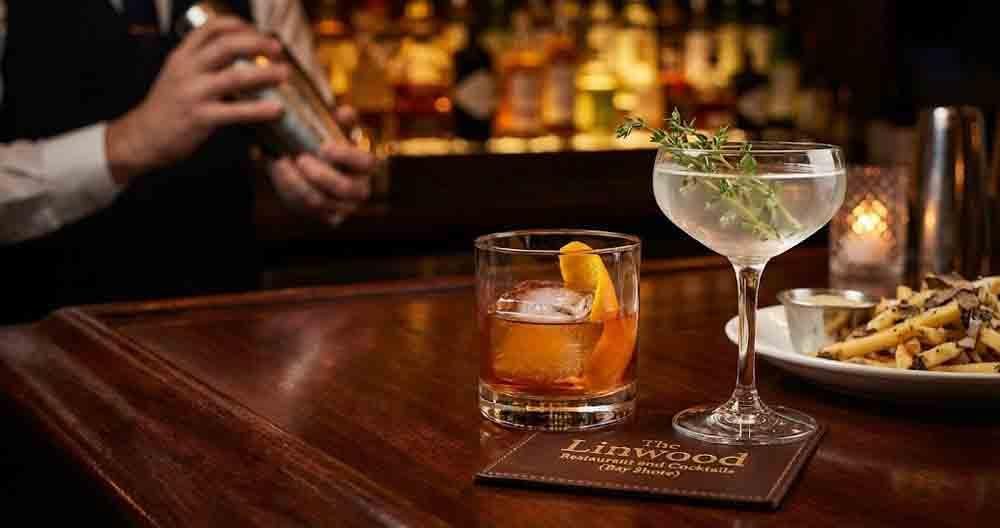
The cocktail program, developed by veteran mixologist Tracy Johanna of Babylon, operated with the same intentionality. Johanna approached the bar as a kitchen in miniature, treating each cocktail as a composed dish with its own architecture of flavor, texture, and visual presentation. The craft cocktail and beer list highlighted local options alongside a thoughtful wine selection and an inventive roster of non-alcoholic cocktails — a forward-looking move that recognized the growing sober-curious movement well before it reached mainstream saturation.
The Linwood’s weekly programming became a signature draw. Tuesday Prix Fixe at forty-five dollars per person offered a three-course experience with available upgrades. Wednesday Steak and Martini Night — a fourteen-ounce Angus ribeye paired with a martini of choice, unlimited fries, salad, and a cookie for thirty-nine dollars — became something of a South Shore institution. Thursday Date Night packaged a shared appetizer, two entrees, live music, two glasses of wine or prosecco, and a shared dessert for ninety-five dollars per couple, transforming a midweek evening into an event.
The Room Itself
Walk into certain restaurants and the space tells you immediately what the proprietors think of you. A room paneled in reclaimed barn wood and lit by Edison bulbs tells you one thing. A room upholstered in plush velvet with crystal chandeliers overhead tells you something else entirely. The Linwood’s interior communicated respect — for the guest’s time, for the occasion, and for the historical lineage the restaurant claimed. The design evoked the warmth and intimacy of the boutique hotel it was named after, creating an environment that was simultaneously elegant and approachable. The aesthetic was, as Dvorkin put it, comfort without pretension — the kind of room where a couple celebrating an anniversary and a group of coworkers unwinding after a hospital shift could occupy adjacent tables and both feel perfectly at home.
The building at 150 East Main Street had its own layered history. Before The Linwood, the space briefly housed Fatwood Southern Kitchen, a barbecue concept also developed by Dvorkin and Mogil alongside renowned chef Marc Bynum of Hush American Bistro in Farmingdale — the same chef whose chipotle ribs had graced the cover of Oprah’s O Magazine (Greater Long Island, 2021). Before Fatwood, the address hosted the Even Flow bar. Each iteration represented a different hypothesis about what Bay Shore’s eastern Main Street corridor needed. The Linwood proved to be the most durable answer.
Bay Shore’s Main Street Renaissance
To understand The Linwood’s significance, one must understand the street it lived on. Bay Shore’s Main Street has undergone one of Long Island’s most remarkable downtown revitalizations over the past two decades. Town of Islip Supervisor Angie Carpenter, who spent twenty-five years fielding residents’ complaints about the corridor’s decline, has described the transformation with justified pride: the construction of Shoregate, a four-hundred-plus unit transit-oriented apartment complex near the Fire Island ferry terminal and LIRR station; the proliferation of serious dining destinations like Salt and Barrel, Verde Kitchen, and ITA Kitchen; and the return of the kind of pedestrian street life that suburban Long Island had all but abandoned in the mall era (News 12 Long Island, 2024). The Linwood was both a product and a catalyst of this renaissance, contributing to the gravitational pull that drew residents and visitors alike to Bay Shore’s eastern reaches.
This pattern is not unfamiliar to those of us who have watched the North Shore’s corridors evolve from similar positions. In Mount Sinai, along Route 25A, The Heritage Diner has served for a quarter century as precisely this kind of anchor — not because we are the fanciest operation on the road, but because we have been here, every morning, without fail, for twenty-five years. Consistency, in the restaurant business, is the rarest form of luxury. The Linwood understood this. As Paola and I prepare to launch Maison Pawli, our boutique real estate venture on the North Shore in 2026, we study communities like Bay Shore closely. The correlation between a thriving independent dining scene and residential property values is not theoretical — it is measurable, repeatable, and one of the most reliable indicators of neighborhood vitality that any broker can track.
The Community Dimension
The Linwood’s relationship with its surrounding community extended well beyond the dining room. The restaurant hosted private events, bridal showers, birthday celebrations, and corporate gatherings with the same attentiveness it applied to a two-top on a quiet Tuesday. General Manager Sarah Garcia became a recognized figure in Bay Shore’s hospitality ecosystem, known for her professionalism and her genuine investment in each guest’s experience. Reviews across platforms — the restaurant maintained a 4.7 rating on Google with over 320 reviews and a 4.8 on Birdeye with more than 1,200 reviews — consistently cited not just the quality of the food and cocktails but the warmth of the staff, the sense of being genuinely welcomed rather than merely processed.
Drew Dvorkin’s broader investment in Bay Shore’s social fabric deserves note. During the COVID-19 pandemic, when his own restaurants were shuttered except for takeout and delivery, Dvorkin launched a campaign through T.J. Finley’s to purchase gift cards for the roughly 1,400 nurses at nearby Southside Hospital — a gesture that reflected his stated belief that a restaurant’s job is to be a facilitator of comfort and connection (Greater Long Island, 2020). The Linwood, named for a hotel that once sheltered servicemen during wartime, was always animated by this same ethic of care.
A New Chapter: The Linwood Becomes Bar Lucy
In February 2025, The Linwood team announced that the restaurant would serve its final dinner on March 29, 2025, and would reopen following renovations as Bar Lucy — a concept described as a neighborhood Italian restaurant serving red sauce classics, modern Italian dishes, artisanal pizzas, and hand-crafted cocktails (Greater Long Island, 2025). The name derives from the Italian word “lucia,” meaning light, and the stated mission is to send love and light to the community through exceptional hospitality and inspired cuisine. Critically, the ownership remains the same, Chef Henry Freidank III continues to lead the kitchen, and Sarah Garcia remains at the helm as General Manager. The Greater Bay Shore Chamber of Commerce welcomed Bar Lucy with a ribbon-cutting ceremony in the summer of 2025, with Chamber President Eddie Fraser calling the new concept an elevation of Bay Shore’s dining scene.
This evolution — not a death but a metamorphosis — is among the most sophisticated moves a restaurant group can make. Rather than running a beloved concept into the ground through repetition, Dvorkin, Mogil, and Freidank read the changing character of their community and responded. It is the same instinct that led Dvorkin to transform the seventeen-year-old T.J. Finley’s into Goody Two Shoes in 2023 — not out of failure but out of an entrepreneurial restlessness that refuses to let comfort become complacency (Long Island Restaurants, 2023). In the leather trade, we call this understanding when a hide has been fully worked — when the grain has taken all the treatment it can absorb and it is time to cut the pattern and begin the next piece.
Essential Information
The Linwood Restaurant and Cocktails (Now operating as Bar Lucy)
Address: 150 East Main Street, Bay Shore, NY 11706
Telephone: (631) 665-1256
Website: thelinwoodbayshore.com | bar-lucy-restaurant.com
Online Ordering: Available via DoorDash
Reservations: tableagent.com/new-york-city/the-linwood
Social Media: @thelinwood on Instagram
Bar Lucy Hours: Monday–Thursday: 3:00 PM – 10:00 PM Friday: 3:00 PM – 11:00 PM Saturday: 4:00 PM – 11:00 PM Sunday: 4:00 PM – 9:00 PM
Parking: Lot available in the rear of the building, plus metered street parking on Main Street.
Private Events & Catering: Available — contact directly for packages and pricing.
The Linwood was never merely a restaurant. It was a thesis about what a community deserves from its gathering places — a thesis argued in velvet, crystal, seared duck breast, and a perfectly balanced Thursday night cocktail. That thesis has not been abandoned. It has been translated into Italian, renamed for light, and opened for a new chapter on the same corner of East Main Street where John B. Pullis once welcomed travelers escaping the heat of Manhattan. The hospitality continues. The fire, this time, is only in the kitchen.