There’s a moment every home cook knows: you’ve spent $30 on a beautiful ribeye, you’ve fired up the pan, and ten minutes later you’re staring at a steak that’s gray on the outside, overcooked around the edges, and somehow still cold in the center. Meanwhile, the $58 version you had at that steakhouse last month was perfect—a mahogany crust shattering under your knife, pink and juicy from edge to edge, with a flavor so deep and complex it seemed almost unfair. The difference isn’t magic, and it isn’t just better beef. It’s a handful of techniques that professional chefs consider second nature but that most home cooks have never been taught.
The gap between restaurant steak and home-cooked steak is narrower than you think, but it’s real—and it comes down to science. In 1912, a French chemist named Louis-Camille Maillard published a paper describing the chemical reaction between amino acids and reducing sugars that produces the browned, complex flavors we associate with perfectly seared meat. More than a century later, that reaction—now bearing his name—remains the single most important concept separating a forgettable steak from an extraordinary one. According to NC State University food scientist Gabriel Keith Harris, the Maillard reaction proceeds rapidly at surface temperatures above 300‘F to 350‘F, and muscle tissue is uniquely suited for it: “Not every amino acid chain has this amine group hanging off of it, but enough of them do in most proteins that you can get a good browning reaction going. Certainly in beef, plenty of amine groups are there, ready to go.” Understanding how to harness that reaction—along with a few other chef-grade principles—is what this guide is about. Whether you’re grilling on the patio of your new Long Island home or searing in a cramped apartment kitchen, these techniques will transform your results.
It Starts at the Butcher Counter: Why Chefs Are Obsessed with Sourcing
Ask any professional chef what the most important step in cooking a great steak is, and the answer is almost always the same: buying the right meat. Wolfgang Puck, the legendary Austrian-American chef behind CUT steakhouses, puts it bluntly: “The most important thing is to get the best meat purveyor possible, somebody who hand-selects the meat for you. At the end of the day, if the steak is not tender, people are going to complain no matter what you put on it.” Hilary Henderson, chef de cuisine at CUT by Wolfgang Puck in Beverly Hills, told Robb Report that CUT maintains a long-running relationship with Snake River Farms in Idaho, whose American Wagyu is hand-selected for the restaurant. You can replicate this at home by building a relationship with your local butcher—or by ordering from specialty purveyors who ship nationally.
What should you look for? Marbling—those white flecks and streaks of intramuscular fat running through the lean muscle—is the single best visual indicator of flavor and juiciness. The USDA grading system ranks beef as Prime (most marbling), Choice (moderate), and Select (least), and only about 8—9 percent of all graded beef earns the Prime designation. Most steakhouses use upper Choice or Prime; your grocery store likely carries Choice and Select. Chef Thomas Odermatt, founder of Roli Roti Food Trucks, advises looking for even marbling throughout: “Well-marbled cuts are forgiving in a pan or on the grill, and don’t demand fancy technique. With a hot skillet, some salt, and maybe a knob of butter, you can turn out a steak that rivals what you’d order at a steakhouse.”
As for cuts, the classic steakhouse lineup—ribeye, New York strip, and filet mignon—dominate for good reason. Multi-Michelin-starred chef Alain Ducasse favors a thick-cut rib eye, claiming it “certainly has the best flavour.” Jamie Oliver’s go-to is the flat iron (feather) steak, while the late Anthony Bourdain famously preferred “the rib cuts, the perfect balance of fat and meat, followed by the sirloin.” But don’t overlook what butchers call “butcher’s cuts”—hanger, flat iron, Denver, and teres major steaks that offer outstanding flavor at a fraction of the price. Jason Kennedy, a meat expert with Verde Farms, recommends choosing vacuum-packed options at retail, noting that while the meat may not display that bright cherry-red color (because there’s no oxygen in the packaging), the anaerobic environment actually allows natural enzymes to continue wet-aging the beef, improving tenderness.
The Dry Surface Doctrine: Moisture Is the Enemy of a Great Crust
Here is perhaps the single most important piece of knowledge that separates restaurant steaks from home-cooked ones: a wet steak cannot form a proper crust. The science is straightforward. Water boils at 212‘F; the Maillard reaction doesn’t begin in earnest until surface temperatures reach approximately 285${lsq}F to 330${lsq}F, according to research compiled by Wikipedia and food scientists at NC State University. As long as there’s moisture on the surface of the meat, the energy from your pan goes into evaporating water rather than browning protein. The result: steaming instead of searing, a gray exterior instead of a mahogany crust, and a steak that tastes boiled rather than grilled. As Harris explains, “Water holds down the temperature of the meat, so as it leaves, surface temperatures rise to around 350 degrees Fahrenheit and beyond. That’s really where Maillard happens quickly and efficiently.”
The British steakhouse group Hawksmoor—widely considered among the best steak restaurants in the UK—is unequivocal on this point: a wet steak will “struggle to form a decent crust and can pick up some unpleasant boiled-meat flavours.” Their instruction is to pat every steak thoroughly dry with paper towels before it goes anywhere near heat. Professional kitchens take this a step further. Many chefs dry-brine their steaks: salting them generously and leaving them uncovered on a wire rack in the refrigerator overnight. The salt initially draws moisture to the surface through osmosis, but over the next 45 minutes to several hours, that moisture is reabsorbed into the meat along with the dissolved salt, seasoning the steak from within. The surface dries out in the refrigerator’s circulating air, creating the ideal starting condition for a hard sear. J. Kenji L‘pez-Alt, the James Beard Award-winning author of The Food Lab, recommends this overnight salting as the single best pre-cooking step for steak.
If you’re cooking tonight and don’t have time for an overnight dry-brine, the minimum effective approach is this: remove the steak from packaging, pat it aggressively dry on all sides with clean paper towels, season with kosher salt and pepper, and let it sit uncovered at room temperature for 30—45 minutes before cooking. Some chefs, including Chef David Rose of Omaha Steaks, recommend pulling steaks from the fridge one to three hours before cooking, though recent food science suggests that the actual temperature change in that time is minimal—the real benefit is surface drying. The bottom line: the drier the surface, the faster the crust forms, and the less time the interior spends overcooking while you wait for browning to happen.
The Heat Gap: Why Your Home Kitchen Can’t Match a Steakhouse (and What to Do About It)
Here’s the uncomfortable truth about cooking steak at home: your kitchen was not designed for it. A typical home oven maxes out at 500—550‘F. A home gas range produces roughly 7,000—12,000 BTUs per burner. Meanwhile, according to Taste of Home${ap}s steakhouse exposé, a restaurant’s wood-fired grill can reach upwards of 700‘F, and high-end steakhouses use infrared broilers that exceed 1,000${lsq}F—sometimes reaching 1,200‘F or more. Peter Luger, the legendary Brooklyn steakhouse, cooks its porterhouses under a salamander broiler so hot that the steaks develop a crust in under two minutes. Ruth’s Chris famously plates on 500‘F sizzle plates so the steak continues cooking tableside. You simply cannot replicate these conditions with a standard home range.
But you can close the gap. The first tool in your arsenal is cast iron. A well-seasoned 12-inch cast-iron skillet, preheated over medium-high to high heat for 8—10 minutes, can achieve surface temperatures approaching 600‘F—far hotter than stainless steel or non-stick pans. Cast iron’s thermal mass means it holds that heat even when a cold steak hits it, preventing the dramatic temperature drop that causes steaming. Chef John Tesar, a Michelin-starred restaurateur behind multiple steakhouses and author of the pan-cooking philosophy for steak, explains to Eat This, Not That! that cooking in a pan actually has an advantage over grilling: “The meat’s fat isn’t lost into the charcoals but instead is preserved and becomes a part of the cooking medium, a powerful agent in building flavor.”
If you have access to an outdoor grill, a chimney starter loaded with charcoal creates a concentrated heat source that can exceed 700‘F. For the hottest possible home sear, some adventurous cooks use a handheld propane torch (like the GrillBlazer or Searzall attachment) or even the afterburner technique (searing directly over glowing charcoal with no grate). But for most home cooks, the cast-iron-and-high-heat method remains the most practical path to a restaurant-quality crust. Start the oil in a cold pan, use a high-smoke-point oil (avocado oil at 520‘F smoke point is ideal; avoid olive oil and butter for the initial sear), and let the pan preheat until a drop of water evaporates instantly on contact.
The Reverse Sear Revolution: How One Technique Changed Everything
For decades, the standard advice for cooking steak was: sear first over high heat “to lock in the juices,” then finish in the oven. It sounded intuitive. It was also wrong. The “searing locks in juices” myth has been debunked by every serious food scientist who has tested it—Harold McGee in On Food and Cooking, Meathead Goldwyn in Meathead: The Science of Great Barbecue and Grilling, and most prominently J. Kenji L${lsq}pez-Alt in his Food Lab column at Serious Eats. Searing creates flavor through the Maillard reaction, not a moisture barrier. A seared steak actually loses more moisture than an unseared one because the high heat drives off water from the outer layers.
The technique that has quietly revolutionized home steak-cooking is the reverse sear—and it flips the traditional method on its head. Instead of searing first and finishing in the oven, you start low and finish hot. Here’s how it works: place a thick-cut steak (1.5 inches or thicker is ideal) on a wire rack over a sheet pan in a low oven, typically 200‘F to 275‘F, and cook it slowly until the internal temperature reaches about 10—15‘F below your target doneness. Then pull the steak, heat a cast-iron skillet until it’s screaming hot, and sear for about 60—90 seconds per side. The result: edge-to-edge pink with virtually no gray overcooked band, topped with a deeply browned, shatteringly crisp crust.
L‘pez-Alt, the James Beard Award-winning pioneer of the method, explains the science: “By starting steaks in a low-temperature oven, you wind up with almost no overcooked meat whatsoever. Juicier results are your reward.” Becky Krystal of The Washington Post adds that the low oven dries the surface before searing, so “the heat and energy can focus on the meat rather than on driving off moisture.” This is the same principle behind sous vide cooking—a technique where chefs vacuum-seal steak and cook it in a precisely controlled water bath—but the reverse sear achieves similar results with nothing more than an oven, a meat thermometer, and a cast-iron pan. No special equipment required.
One additional benefit that makes the reverse sear particularly valuable for home cooks: you don${ap}t need to rest the steak after searing. In traditional high-heat cooking, resting allows the temperature gradient across the meat to equalize, redistributing juices from the center outward. But because the reverse sear cooks the steak gently and evenly from the start, there’s no significant temperature gradient to equalize. You can cut and serve immediately after the sear—a meaningful advantage when you’re trying to get dinner on the table.
The Butter Baste and the Finishing Touch: What Happens in the Last 60 Seconds
There’s a reason steakhouse steaks have a glossy, almost lacquered appearance that home-cooked steaks rarely achieve. The secret, as steakhouse chefs freely admit, is butter—and lots of it. According to Taste of Home${ap}s steakhouse investigation, “even the dishes that aren’t served with a pat of butter on top are likely doused with a ladle of clarified butter to give the steak a glossy sheen and a rich finish.” The technique is called basting, and it’s one of the easiest restaurant secrets to replicate at home.
Here’s how it works: during the final 30—60 seconds of searing, add two tablespoons of unsalted butter, a couple of crushed garlic cloves, and a few sprigs of fresh thyme or rosemary to the pan. As the butter melts and froths, tilt the skillet slightly toward you and use a large spoon to continuously ladle the foaming, aromatic butter over the top of the steak. This process—known as arroser in classical French technique—accomplishes several things simultaneously. The butterfat conducts heat to the top surface of the steak without flipping it, accelerating browning. The milk solids in the butter undergo their own Maillard reaction, adding nutty, caramelized notes. The garlic and herbs infuse their volatile aromatics into the hot fat, which then coats the steak’s surface. The result is a layer of complex, compound flavor that no amount of pre-seasoning can replicate.
The finishing touch matters, too. Henderson at CUT sprinkles flaky Maldon sea salt or fleur de sel over the steak just before serving—the large, irregular crystals provide bursts of salinity and a satisfying crunch that complements the seared crust. Hawksmoor recommends seasoning “more than you probably think sensible,” arguing that generous salt helps build the caramelized crust and that a final sprinkling intensifies flavor. For an additional layer, many chefs finish with a drizzle of high-quality extra-virgin olive oil, a dollop of compound butter (butter mixed with herbs, garlic, and sometimes blue cheese or anchovy), or a quick pan sauce made by deglazing the fond—those caramelized bits stuck to the bottom of the skillet—with a splash of wine or stock.
Temperature, Timing, and the Most Important $15 Tool in Your Kitchen
Professional chefs develop an almost supernatural ability to judge steak doneness by touch—pressing the meat with their fingertips and reading its firmness like Braille. As one steakhouse chef told Taste of Home, “After you prepare hundreds of steaks, you just know what medium rare feels like when you poke the meat with your finger.” You have not prepared hundreds of steaks, and that’s perfectly fine, because you have access to a tool that’s arguably more accurate than any chef’s fingertip: an instant-read digital meat thermometer. It is, without exaggeration, the single most important kitchen purchase you can make if you care about steak.
The USDA Food Safety and Inspection Service recommends cooking beef steaks and roasts to a minimum internal temperature of 145${lsq}F (medium), followed by a three-minute rest. However, most chefs and steak enthusiasts target temperatures well below that for optimal flavor and texture. The Certified Angus Beef doneness chart, widely used in the industry, defines the levels as follows: Rare at 120—130‘F (cool red center), Medium Rare at 130—135‘F (warm red center—the sweet spot for most chefs), Medium at 135—145‘F (warm pink center), Medium Well at 150—155‘F (slightly pink), and Well Done at 160‘F and above. The critical concept to understand is carryover cooking—the fact that a steak’s internal temperature continues to rise 5—10‘F after it’s removed from heat, as the hotter outer layers continue radiating energy inward. This means you should always pull your steak when the thermometer reads 5—10‘F below your target.
Research confirms what chefs have long known: relying on visual cues alone is unreliable. A 2011 study by the USDA found that the color of meat and the color of its juices are not accurate indicators of doneness. Ground beef may turn brown before reaching a safe temperature, and steak can appear pink at temperatures well above medium. Chef Greg Mueller, BBQ expert and Director of Culinary Innovations at recteq, counsels home cooks to invest in a quality instant-read thermometer and trust the numbers, not their eyes. The best models (ThermoWorks Thermapen, for example) read accurately to within one degree and display results in two to three seconds—fast enough to check without significantly dropping your pan temperature.
Putting It All Together: The Step-by-Step Restaurant Method for Your Home Kitchen
Let’s synthesize everything above into a practical, restaurant-caliber protocol that any home cook can follow. This method combines the reverse sear technique with professional seasoning, searing, and finishing practices. It works for any thick-cut steak—ribeye, strip, porterhouse, or filet—and requires only an oven, a cast-iron skillet, and a meat thermometer.
The Night Before (or Morning Of): Remove the steak from its packaging. Pat dry with paper towels on all sides. Season generously with kosher salt—roughly one teaspoon per pound of meat. Place on a wire rack set over a plate or sheet pan, and refrigerate uncovered for 8—24 hours. This dry-brine step seasons the interior, tenderizes the muscle fibers, and creates a desiccated surface that’s primed for the Maillard reaction.
One Hour Before Cooking: Remove the steak from the refrigerator. Add freshly cracked black pepper (and any additional seasonings you prefer—Henderson at CUT uses granulated onion and garlic, which char slightly during cooking and contribute to the crust). Let the steak sit at room temperature while you preheat.
The Low Cook: Set your oven to 250‘F. Place the steak on a wire rack over a rimmed sheet pan and slide it into the oven. Insert an oven-safe probe thermometer into the thickest part of the meat (or check periodically with an instant-read). Cook until the internal temperature reaches 115—120‘F for a medium-rare finish (accounting for carryover). This typically takes 30—50 minutes depending on thickness.
The Sear: While the steak rests briefly out of the oven, place your cast-iron skillet on the highest burner setting. Add one tablespoon of avocado oil and heat until it just begins to smoke. Carefully lay the steak in the pan. Sear for 60—90 seconds without moving it—as Chef Tesar advises, “Avoid checking or messing with your steak too much. Trust your timer.” Flip once and sear the other side for 60—90 seconds.
The Baste: In the final 30 seconds, add two tablespoons of butter, two crushed garlic cloves, and a sprig of thyme. Tilt the pan and baste continuously, spooning the foaming brown butter over the steak. If there’s a fat cap, hold the steak on its edge with tongs and render it against the hot surface for 15—20 seconds.
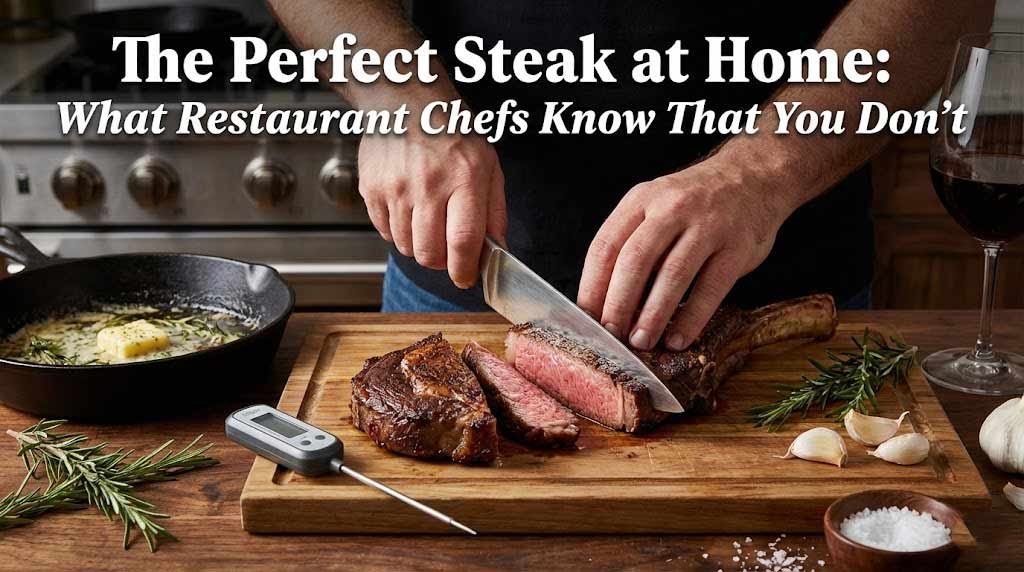
The Finish: Transfer to a cutting board. Sprinkle with flaky finishing salt (Maldon or fleur de sel). If you used the reverse sear method, no extended rest is necessary—you can slice and serve within a minute. Cut against the grain for maximum tenderness. Plate, drizzle with any accumulated juices, and serve.
The $58 steakhouse steak is not $58 because the chef possesses some inaccessible gift. It’s $58 because the restaurant has invested in superior sourcing, a 1,000‘F broiler, a staff that cooks 200 steaks a night, and—yes—a lot of butter. But the techniques behind that steak—the dry surface, the patient low cook, the screaming-hot sear, the aromatic baste, and the relentless use of a thermometer—are available to anyone with a cast-iron pan and a willingness to understand the science. Louis-Camille Maillard figured out the chemistry in 1912. John Hodge at the USDA mapped the full mechanism in 1953. J. Kenji L‘pez-Alt codified the reverse sear in the mid-2000s. You’re the beneficiary of more than a century of accumulated knowledge about what makes meat taste extraordinary.
The difference between a good home steak and a great one isn’t talent—it’s information. Dry your steak. Salt it early. Cook it low. Sear it hot. Baste it with butter. Trust the thermometer. These six principles, practiced consistently, will produce results that rival or exceed most restaurants. And there’s a final advantage that no steakhouse in the world can offer: when you cook a perfect steak in your own kitchen, or on the grill in the backyard of your Long Island home, you get to eat it exactly when it’s at its best—straight from the pan to the plate, no waiting for the server, no sharing with the table. That’s a luxury no restaurant can match.
Sources & Further Reading
• NC State University: The Science of Steak on the Grill (Maillard Reaction)
• Wikipedia: Maillard Reaction (Louis-Camille Maillard, 1912)
• Robb Report: A Michelin-Star Chef Explains How to Cook the Perfect Steak at Home
• Taste of Home: 10 Secrets a Steakhouse Chef Will Never Tell You
• Eat This, Not That!: 9 Secrets for Cooking the Best Steak That Only Chefs Know
• Eat This, Not That!: 8 Secrets for Cooking the Best Steak Chefs Know (2025)
• Serious Eats: How to Reverse Sear (J. Kenji López-Alt)
• Food Network: How to Reverse Sear a Steak
• The Washington Post: Cooking Steak Indoors — Embrace the Reverse Sear (2019)
• USDA FSIS: Doneness Versus Safety (Internal Temperature Guidelines)
• Certified Angus Beef: Degree of Doneness Temperature Chart
• Chicago Steak Company / Steak University: Maillard Reaction Steak
• MasterClass: How to Reverse Sear a Steak (2025)
• LoveFood: Top Chefs Reveal Their Secrets for the Perfect Steak
• Sullivan’s Steakhouse: Steak Temperature Guide to Rare, Medium, and Well-Done
Video Resources
J. Kenji López-Alt: The Reverse Sear, Explained — The James Beard Award-winning food scientist and author of The Food Lab demonstrates his pioneering reverse sear technique, explaining the science of why low-and-slow followed by a hard sear produces edge-to-edge medium-rare perfection with a better crust than traditional methods.
Watch: https://www.youtube.com/watch?v=pO8TUuDj4gI
Chris Young (Modernist Cuisine): Two Extreme Ways to Sear a Steak (and 3 Easy Ones) — Co-author of Modernist Cuisine Chris Young demonstrates five different searing methods, breaking down the science of heat transfer, surface temperature, and crust formation in an accessible and visually compelling format.
Watch: https://www.youtube.com/watch?v=IZY8xbdHfWk
Guga Foods: Extreme Dry-Aging and Steak Experiments — Brazilian-born YouTube creator Gustavo “Guga” Tosta (3.4+ million subscribers) pushes the boundaries of steak preparation with creative aging experiments, side-by-side comparisons, and entertaining taste tests that have made him one of the internet’s most popular meat-cooking personalities.Watch: https://www.youtube.com/watch?v=1o7GTADAo1g