Somewhere between the smell of vegetable-tanned hide and the quiet rhythm of a hand-stitching needle pulling waxed linen through thick English bridle leather, there is a philosophy at work. Not a mission statement drafted in a boardroom. Not a brand story assembled by a marketing agency. Something older. Something that predates the venture-backed “heritage” aesthetic that floods the luxury goods market today — a philosophy forged over decades, by hand, one briefcase at a time.
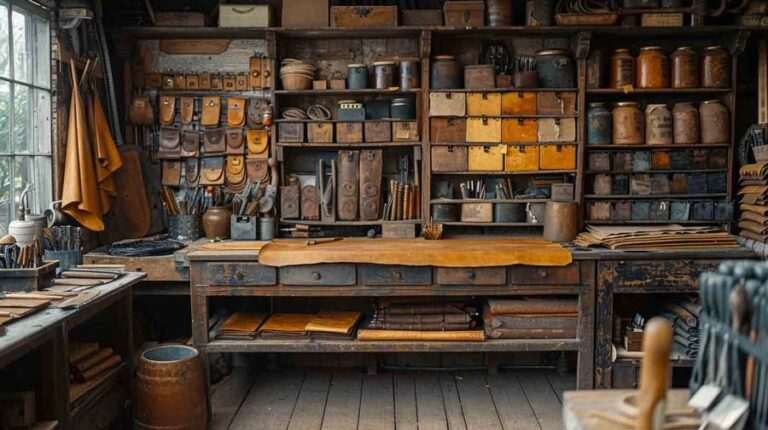
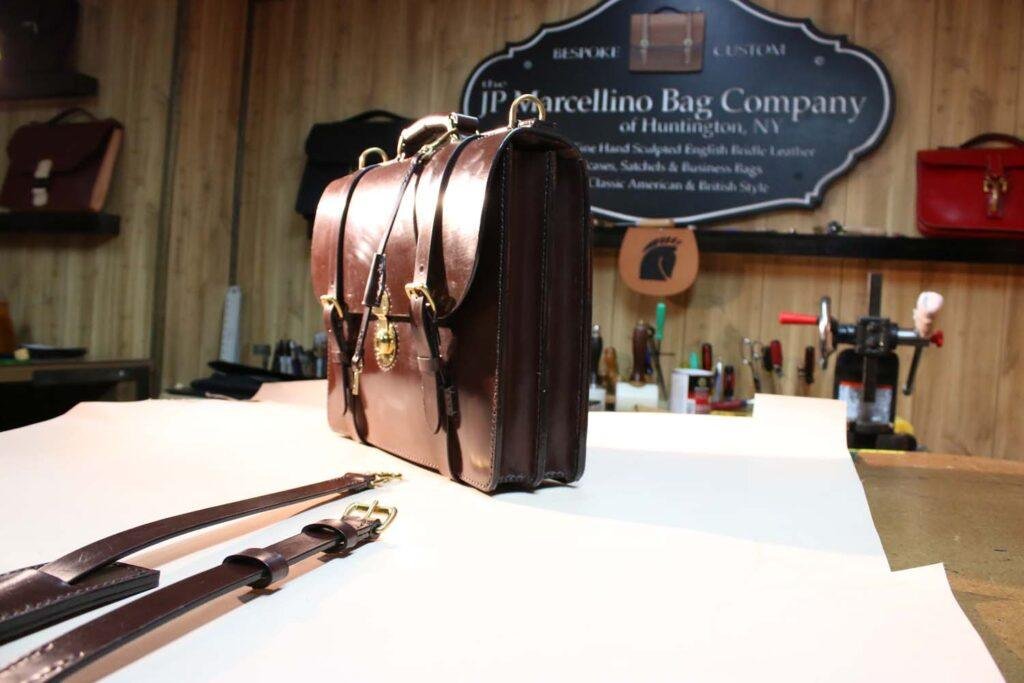
Marcellino NY is not a fashion brand. It is not a lifestyle company. It is the workshop of a master craftsman — a Long Island-based artisan who has spent thirty years developing the kind of skill that cannot be acquired through a course or a YouTube tutorial. It is, by any serious measure, one of the last American operations of its kind: a one-man atelier producing bespoke English bridle leather briefcases using old-world hand methods, for clients who understand that the best things are never rushed.
In an era where the global luxury leather goods market is projected to reach $65 billion by 2033 (Business Research Insights, 2024), and where even established fashion houses now outsource construction to factories producing tens of thousands of units per season, Marcellino NY exists as a quiet counter-argument. The brand’s lead time exceeds six months. Every piece is cut, stitched, and assembled by one set of hands. Clients — lawyers, surgeons, executives, and billionaires — wait without complaint. That is the nature of the commission.
The Origin of the Craft: From Hobby to Calling
The story of Marcellino NY begins not with a business plan, but with curiosity. The brand’s founder, Peter Joseph, grew up in Brooklyn, the son of Greek immigrant parents who understood the value of skilled, unglamorous labor. His mother waited tables; his father cooked. Neither career came with prestige. Both came with the understanding that mastery of a craft — any craft — was the foundation of a dignified life.
Peter came to leatherworking through the side door, the way most serious craftsmen do: through genuine fascination rather than strategic calculation. Around 1995, he began experimenting with leather in his personal workshop, learning the material’s properties the hard way — through failed cuts, overworked edges, and the humbling realization that bridle leather demands patience above everything else. By 2010, what had been a deeply personal pursuit had become something undeniable: a body of work so refined that it could no longer be kept private.
Marcellino NY launched not with fanfare, but with word of mouth. One attorney saw a briefcase. Then another. Then the referral calls started coming from the kinds of professionals who know that a $400 bag from a department store says nothing about who they are, while a hand-stitched English bridle leather commission from a Long Island craftsman says everything. The brand grew quietly, deliberately, on its own terms — exactly the way a great hide cures in a pit-tanning vat: slowly, under pressure, until it becomes something extraordinary.
The Material Science: Why English Bridle Leather Is in a Class of Its Own
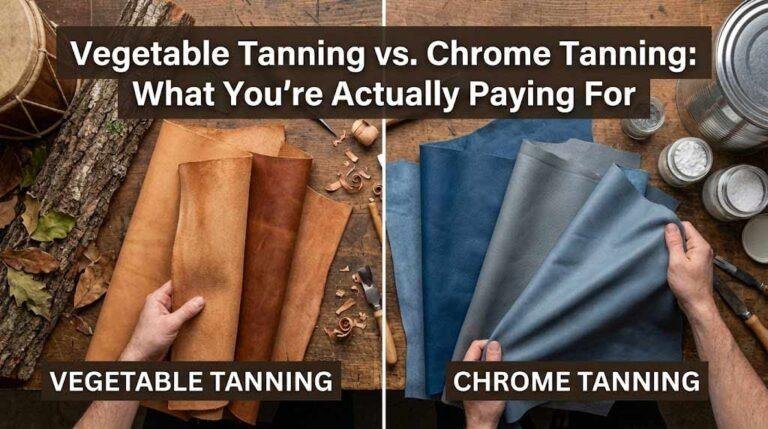
To understand what Marcellino NY builds, you must first understand the material at its core. Not all leather is equal. The spectrum runs from the chrome-tanned, fast-processed, factory-finished hides that fill the floors of department stores — material that looks acceptable on day one and degrades without character — to the elite category of vegetable-tanned, full-grain English bridle leather, a material with centuries of proven performance in the most demanding applications equestrian use has ever required.
English bridle leather from J&E Sedgwick & Co. — one of Marcellino NY’s primary suppliers — has been produced with the same methods since 1900. Using century-old vegetable tanning techniques, the process takes over three months from start to finish. The final stages are completed by hand, ensuring the highest quality output.
Marcellino NY sources exclusively from the upper tier of this supply chain. Only Grade A full-grain vegetable-tanned English bridle leather from American tanneries and imported UK English bridle leather is used, depending on availability. The UK bridle leather is stiffer, waxier, and has a greasy top coat — eventually, when it softens and gets drier, it becomes similar to the American bridle leather received new.
This distinction matters enormously to anyone commissioning a briefcase meant to last a lifetime. The waxy bloom that coats the surface of freshly cut Sedgwick bridle leather — the material’s characteristic white haze — is not a cosmetic feature. It is the visual evidence of oils and tallows that have been worked into the hide during the tanning process, building a deep reservoir of conditioning agents that will feed the leather for decades. That bloom occurs when the natural oils and waxes rise to the surface — and it is the mark of genuine English bridle leather.
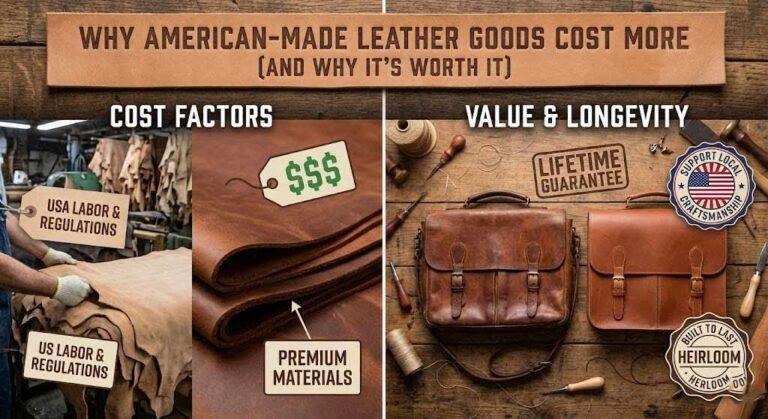
In contrast, chrome-tanned leather — the dominant method in mass-market production — is processed in days rather than months, using chromium salts to stabilize the hide rapidly. The resulting material is softer and more pliable from the start, but lacks the structural integrity and long-term patina development that vegetable-tanned bridle leather produces. It does not age. It deteriorates.
For Marcellino NY’s clients, this is not a technical abstraction. It is the entire point. A briefcase commissioned from Peter Joseph’s workshop is designed, in the most literal sense, to outlive its owner.
The Architecture of a Briefcase: Inside the Bespoke Process
Walk through the Marcellino NY bespoke section and you encounter something rare in contemporary commerce: complete transparency about construction. Every component is explained. Every decision has a rationale. There are no hidden economies, no corners cut to improve margins, no design choices made by committee.
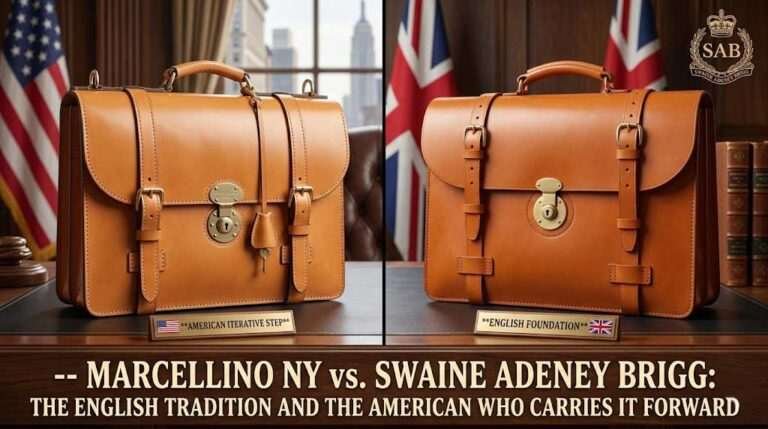
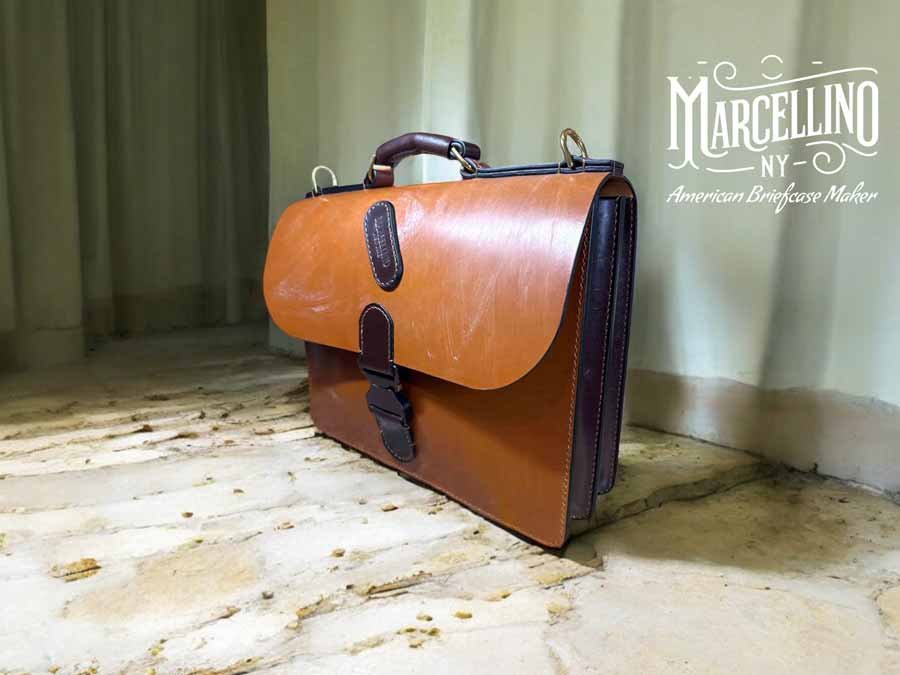
The signature briefcase lines — the Alfred Wallace, the Jürgen Habermas, the Achilles, the Woodhull, and the Verrier — each take their names from historical figures whose work embodied a combination of intellectual rigor and practical achievement. The Alfred Wallace, named for the Victorian naturalist, is the most classically English of the collection: hand saddle-stitched with a solid brass key lock installed with real rivets, it reads like a direct artifact from a different century. The Habermas, named for the German philosopher of communicative reason, was originally designed for New York lawyers — a case that projects disciplined authority while carrying the tools of argument.
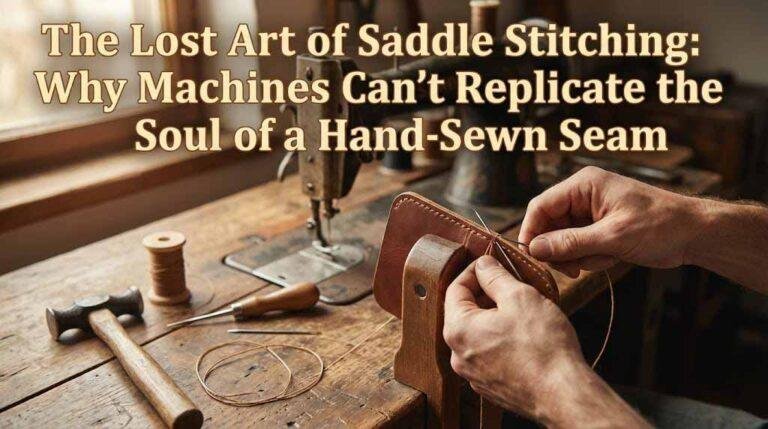
The construction sequence is uncompromising. Every briefcase begins as raw, Grade A full-grain bridle leather that Peter cuts himself. The stitching is saddle-stitching — a two-needle technique that has been the standard for load-bearing leather goods for centuries, where each stitch locks independently, so that if one thread breaks, the seam holds. Machine-stitched leather goods use a single thread in a chain that can unravel from a single failure point. The difference is not aesthetic. It is structural.
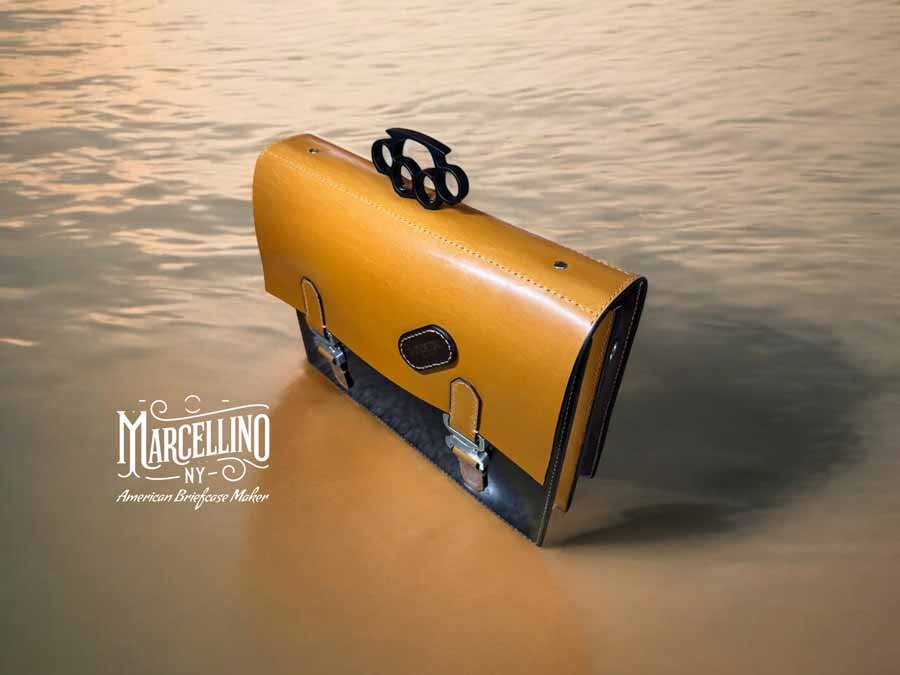
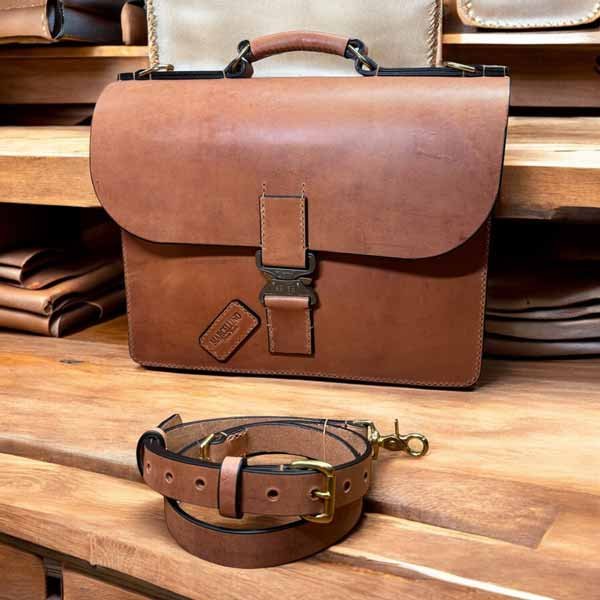
Hardware is sourced and, in many cases, made by hand: solid brass locks, custom Marcellino latches — a proprietary closure system that has become one of the brand’s defining signatures — and on select models, the extraordinary brass knuckles handle, a steel-and-aluminum construction permanently secured to the flap that transforms the act of carrying a briefcase into something deliberate and physical. Lining options run from natural, unlined leather — favored by clients who want the interior to develop its own patina over time — to full Italian calf suede, hand-cut and fitted to the interior with the care of a tailored jacket.
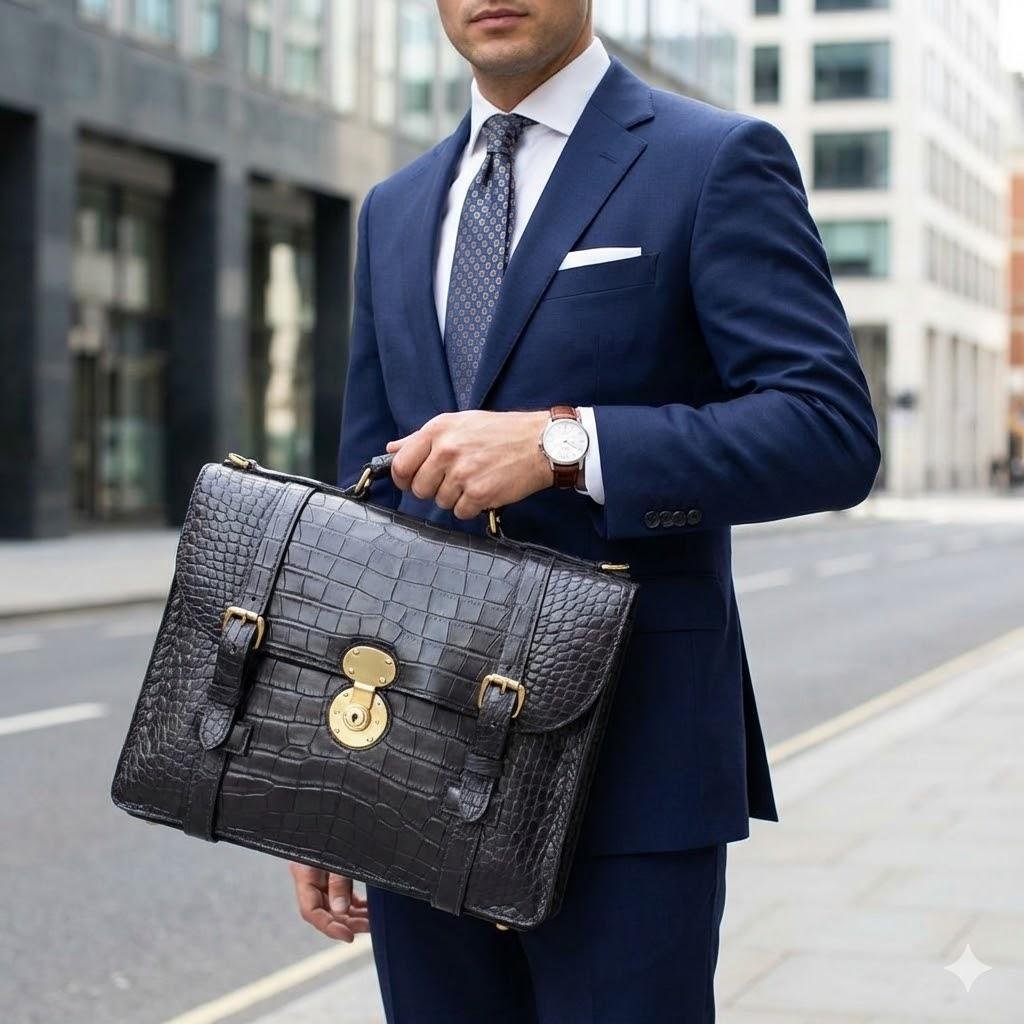
The range in price reflects the range in specification: the Habermas 2071 in harness leather starts at $2,300, while the Wallace in American alligator reaches $12,000. Every price point represents material cost plus an honest accounting of time — not the perceived value inflation that luxury conglomerates apply to their products through branding multipliers, but the actual cost of one craftsman’s hands working one piece from raw hide to finished object.
The Tilman Fertitta Commission: When a Billionaire Comes to the Workshop
There is a moment in any craftsman’s career that clarifies everything. For Marcellino NY, that moment came when Tilman Fertitta — the billionaire chairman of Landry’s Inc., owner of restaurant and hotel empires across the country — found his way to Peter’s workshop.
Fertitta personally came to Joseph’s workshop to evaluate his leathercraft goods for a retail partnership. After a lengthy negotiation process — first in Huntington, NY, then at the Golden Nugget Hotel in Atlantic City, and finally at the Landry’s corporate headquarters in Houston — Joseph successfully negotiated a major deal with Landry’s to carry his handmade leather goods at many of their hotels and resorts across the country.
This is not a detail that Marcellino NY broadcasts loudly. It doesn’t need to. The type of client the brand attracts understands the significance without amplification. When a man worth billions — who controls hospitality properties across the country and could commission leather goods from any atelier on earth — chooses to fly a craftsman out to Houston to close a deal, it speaks to a level of quality that no marketing department can manufacture.
The Fertitta partnership is emblematic of how Marcellino NY has always grown: through the quiet approval of people who know what they’re looking at. The brand does not advertise in the traditional sense. Its work travels through professional networks, through the moment a partner at a law firm sets his case on a conference table and a colleague asks where it came from, through the measured recommendation of one high-net-worth individual to another. In the luxury world, this is the most credible form of distribution that exists.
The Market Context: Why Bespoke Is Winning While Fast Fashion Fails
The timing of Marcellino NY’s rise is not coincidental. It mirrors a broader shift in luxury consumer psychology that market analysts have been tracking with increasing certainty for the past decade.
The global artisan luxury leather goods market surpassed $4 billion in 2024 and is expanding at a compound annual growth rate of 10.5%, with projections reaching $8 billion by 2033. The primary driver is not economics. It is values. Over 40% of luxury consumers globally expressed a preference for customized products in 2023. The demand for handcrafted leather goods increased by 26% since 2022, reflecting a consumer shift towards artisanal quality. Men’s luxury leather accessories saw a 19% growth in demand year-over-year.
This is a cultural correction as much as a market trend. For a generation that grew up watching fast fashion deteriorate, watching luxury conglomerates commoditize their own heritage, and watching “authentic” brands pivot to mass production the moment venture capital arrived — the appeal of a craftsman who still does it the way it was done a hundred years ago, who still puts his hands on every piece, who tells you upfront the wait is six months — is precisely that it refuses to participate in the disposability economy.
Marcus Aurelius, in the Meditations, makes an observation that applies here with uncomfortable precision: the value of a thing is determined not by what it costs to acquire, but by how it functions in service of the good life. A briefcase that lasts three years and is replaced is not an asset. A briefcase that lasts thirty years, that deepens in color and character with every decade, that carries the marks of a life’s work pressed into its surface — that is an object with a philosophical claim on your attention.
Marcellino NY understands this. It is the entire premise of The 100 Year Briefcase — the brand’s articulation that a properly constructed English bridle leather briefcase, built to full specification, is not a consumer product. It is a generational object.
The Catalog: A Tour Through the Current Collection
The Marcellino NY briefcase catalog as of 2025 represents the most complete expression of the brand’s technical range. Each line occupies a distinct position in the quality and character spectrum.
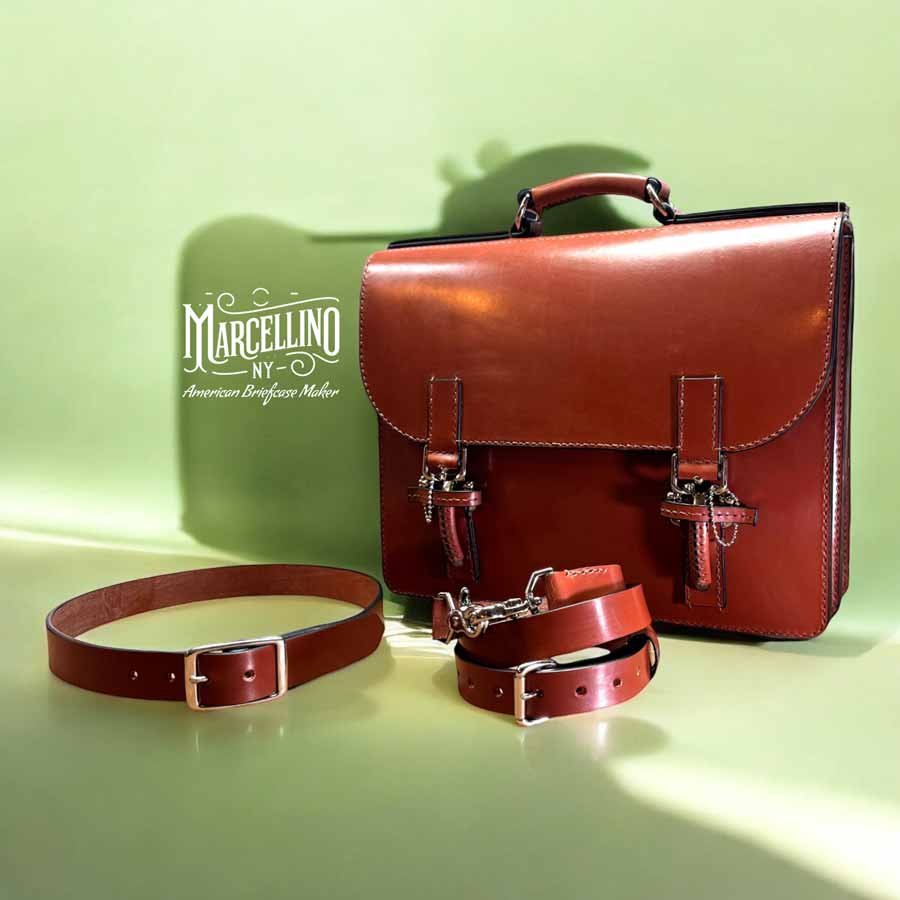
The Alfred Wallace is the brand’s most purely English expression: classic proportion, brass key lock, hand-stitched edges, available in both UK English bridle and American bridle leather. The Wallace 2220 in UK Tan with suede lining at $4,000 is among the most complete expressions of the form the brand currently offers.
The Jürgen Habermas line — originally conceived for New York lawyers — offers a more compact profile with the brand’s signature Marcellino latch hardware. The Habermas 2067 in UK English bridle with Italian calf suede lining at $3,500 is one of the most refined pieces in the catalog, pairing the structural authority of Sedgwick bridle leather with the tactile luxury of a hand-fitted suede interior.
The Achilles introduces the knuckle handle — a steel-and-brass grip construction that gives the briefcase a distinctive physical presence without sacrificing proportion. For the professional who wants something that reads as classic but carries an unmistakable edge, this is the line.
The Woodhull and Verrier expand the collection into additional silhouettes, while the Mini Cases and Portfolios offer entry points for clients who want the Marcellino construction quality in a smaller format.
For those who want to go beyond any existing catalog style, the full bespoke process opens every variable: leather type, color, size, hardware, lining, handle configuration, pocket layout, and edge finishing. This is where the lead time extends most significantly — and where the results become, in the truest sense, one-of-a-kind.
The Philosophy Behind the Brand: Craft as Counter-Culture
There is a tendency in contemporary commerce to mistake aesthetic nostalgia for genuine craftsmanship. Brands can now purchase the visual language of heritage — aged leather finishes, brass hardware photography, workshop imagery — without the underlying substance. The market is saturated with product that looks like it was built by hand and was, in fact, assembled in a factory.
Marcellino NY is categorically not that. The distinction is not in the photography. It is in the physics. You cannot machine-stitch a saddle-stitch and call it equivalent. You cannot rush vegetable tanning. You cannot substitute chrome-tanned leather for English bridle leather and expect the same result in ten years. The material reality of the craft resists shortcut. That is, in its own way, the deepest thing the brand communicates.
There is also a kind of philosophical honesty in the one-man workshop model that deserves attention. When Peter Joseph completes a briefcase, there is no ambiguity about who built it. No production line. No quality control department reviewing someone else’s work. No layers of delegation between the craftsman’s intention and the finished object. The case that ships is the case that one person decided, at every stage, was right. That accountability — that unbroken chain of authorship — is precisely what clients are paying for when they commission a Marcellino NY piece. They are not buying a brand. They are buying a craftsman’s full attention, for the months it takes to build something that will outlast the decade.
Heidegger, in his lectures on technology, drew a distinction between the craftsman’s relationship with material and the factory’s relationship with raw resource. The craftsman works with the grain of the material, discovering its possibilities. The factory processes inputs into outputs. The distinction is not merely romantic. It produces different objects. A Marcellino NY briefcase and a factory-produced leather bag are not the same category of thing. One is a manufactured good. The other is a made thing — made in the full, Heideggerian sense, where the maker and the material are in genuine conversation.
Visiting Marcellino NY: How to Commission
Marcellinony.com functions as both a catalog and a commission portal. Clients can browse the current briefcase styles — each of which serves as a starting point for customization — and place orders directly through the site with notes specifying preferred options. Peter Joseph also accepts direct inquiry at jp@marcellinony.com for clients who want to discuss bespoke specifications before committing.
Progress photography is posted to Instagram at @briefcasemaker, where the construction sequence of current commissions documents the process in real time. For clients in New York, the workshop is available by appointment.
Lead times currently exceed six months. This is not a sales tactic. It is the honest arithmetic of one craftsman’s hands working one piece at a time, without compromise.
Thirty years into a craft that the industry said was dying, Marcellino NY has done something rarer than building a successful business: it has built a body of work. Briefcases carrying the marks of its maker’s hands are in law offices in Manhattan, in hotel suites operated by one of America’s most prominent hospitality empires, in the possession of individuals who understand that the most durable things are made slowly, with full attention, from materials selected for permanence rather than economy. That is the argument Marcellino NY makes with every stitch. And the market, increasingly, is listening.