Every serious pursuit I’ve ever undertaken — whether it was learning to hand-saddle stitch English bridle leather, building a diner menu from scratch on a Route 25A stretch that had no business surviving thirty years of chain restaurant competition, or studying Heidegger at 2 a.m. while most of Brooklyn was asleep — demanded one thing before all else: cardiovascular resolve. Not the metaphorical kind philosophers love to invoke. The literal, measurable, physiological kind. The kind that shows up in your VO2 max number.
That number, expressed in milliliters of oxygen consumed per kilogram of bodyweight per minute, is increasingly understood by exercise scientists not as an athletic benchmark but as a longevity marker. Research from the Journal of the American College of Cardiology has confirmed that each incremental increase in cardiorespiratory fitness — measured via VO2 max — is associated with an 11.6% reduction in all-cause mortality, 16.1% in cardiovascular mortality, and 14% in cancer mortality. American College of Cardiology Put plainly: the more oxygen your body can process under duress, the longer and better you are likely to live. From a public health perspective, cardiorespiratory fitness is a stronger predictor of mortality than hypertension, smoking, or obesity. Wiley Online Library
Here on the North Shore of Long Island — where I’ve spent the better part of my adult life cooking, building, and thinking — we happen to sit atop one of the most physiologically demanding training environments in the Northeast. Not the Rockies. Not the Alps. But these glacially sculpted hills between Mount Sinai and Port Jefferson, shaped by the last Ice Age’s retreat, are no joke when you’re running them at threshold pace.
The Geology That Makes You Work
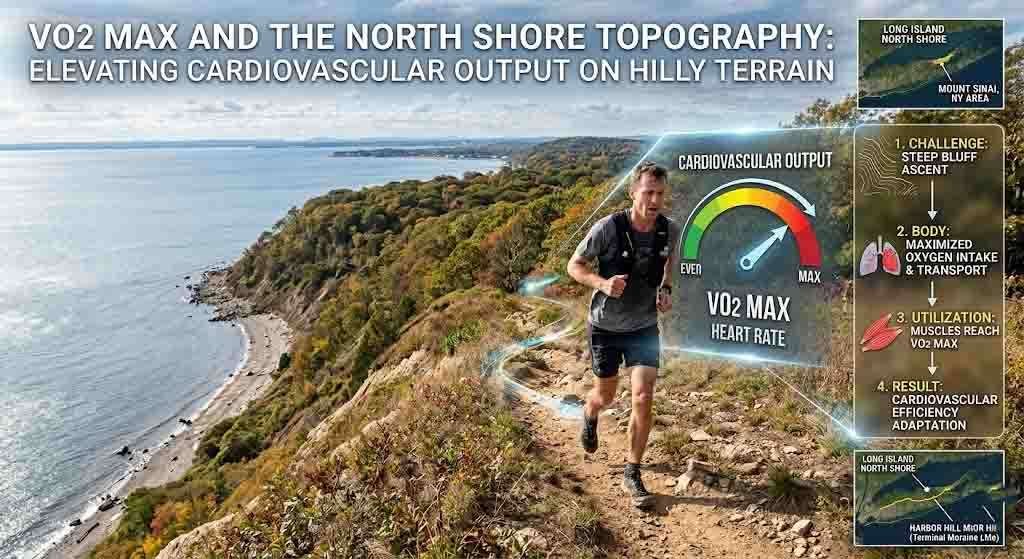
Before I explain what happens to your mitochondria on a hill, it’s worth understanding what these hills actually are. Long Island’s most prominent landforms are two lines of hills known as terminal moraines — glacial debris pushed ahead of and incorporated within the continental ice sheet — reaching maximum altitudes of approximately 400 feet above sea level. USGS The northern spine, the Harbor Hill moraine, runs directly through the North Shore communities of Mount Sinai, Miller Place, and Port Jefferson. The uplands here take the form of ridges perpendicular to the Sound, with valleys or hollows carved by streams that long since dried up, now followed by roads like Crystal Brook Hollow and Pipe Stave Hollow. Mount Sinai School District
Near Port Jefferson, the Harbor Hill terminal moraine crowns the north-shore scarp, with bluffs ranging from 100 to 140 feet of elevation at points like Herod Point. GovInfo What that means practically for anyone running North Country Road, Shore Road, or the back roads threading through Cedar Beach toward the Sound: you are not running flat. You are running moraine. Ice-age architecture, expressed as lung-burning grade.
This matters enormously for VO2 max development.
What VO2 Max Actually Measures — and Why Hills Accelerate It
VO2 max is the maximum volume of oxygen your body can effectively take in, transport, and utilize during one minute of intense exercise — measured in milliliters of oxygen per kilogram of bodyweight per minute. Think of it as the horsepower of your body’s metabolic engine. Thinkvida The higher that ceiling, the more your cardiovascular system can deliver oxygen to working muscles, and the more efficiently those muscles can convert it into ATP — the body’s actual energy currency.
Hills force a faster and more complete engagement of this system than flat terrain. When grade increases, oxygen demand spikes disproportionately relative to pace. Your heart rate responds, cardiac output increases, and you train — whether you intend to or not — in a zone that resembles structured high-intensity interval work. The climb is the interval. The descent is the recovery. Repeat for six miles through Rocky Point or up and down Miller Place Road, and you’ve run something physiologically far more valuable than a flat eight-miler at the same pace.
Research confirms that a rise of one metabolic equivalent in VO2 max is associated with a 10 to 25 percent improvement in survival, making exercise training one of the most potent preventive medicines available to otherwise healthy adults. PubMed Central The question isn’t whether to pursue VO2 max improvement. The question is how efficiently you want to get there. And the North Shore answers that question with topography.
The Science of Hill Training and Cardiac Adaptation
High-intensity interval training, or HIIT, has been established in the scientific literature as the most time-efficient method of improving VO2 max. Extensive research has shown that HIIT can significantly increase maximal oxygen uptake, accelerate fat metabolism, and improve cardiovascular capacity, with its superior time efficiency making it particularly valuable when protocols are tailored to the individual. PubMed Central What the hills of the North Shore do — somewhat remarkably — is impose HIIT structure on what might otherwise be a casual distance run.
The mechanism is straightforward. Hill running demands greater muscle recruitment, particularly from the glutes, hamstrings, and posterior chain, while simultaneously taxing the cardiovascular system at intensities that approach or exceed the threshold where VO2 max adaptations occur. Research indicates that training at or greater than roughly 60% of VO2 max improves maximal oxygen uptake, with higher-intensity training able to elicit comparable increases in significantly shorter training bouts and lower total volumes than moderate-intensity training. PubMed Central The uphill sections of roads through Mount Sinai regularly push a recreational runner well above that threshold without a single structured interval protocol in place.
Studies using interval training have reported mean increases in VO2 max of up to approximately 1.0 liter per minute PLOS — improvements that translate directly into measurable longevity and performance gains. Hill running provides much of this stimulus naturally.
The Polarized Model and North Shore Route Design
The most durable framework in current endurance science is polarized training: roughly 80% of weekly volume performed at low intensity, with 20% in the high-intensity zone. This 80/20 model combines foundational endurance work with targeted high-intensity efforts, and is the most effective framework for raising the VO2 max ceiling. Thinkvida Polarized training has shown potential benefit over other modalities for VO2 max improvement in trained athletes, while longer intervention durations positively influence both VO2 max and time-trial performance. ScienceDirect
Designing a North Shore training week around this model is natural given what the terrain provides. Easy days follow the North Shore Rail Trail — a 10-mile asphalted path running east to west from Crystal Brook Hollow Road in Mount Sinai to Wading River along the former Wading River railway line, with slight inclines and well-marked crossings Timesreview — which offers a genuinely flat, contemplative running surface ideal for aerobic base building at conversational effort. Hard days move onto the moraine: North Country Road south from the Sound, the roller sections of Miller Place Road, the brutal pitch near the bluff edge above Cedar Beach.
This is not incidentally smart training design. It is geography doing the programming for you.
Leather, Sourdough, and the Cardiovascular Ethic
I think about VO2 max the same way I think about the bridle leather I source for Marcellino NY from traditional English tanneries: the process cannot be rushed without degrading the outcome. J&E Sedgwick in Birmingham still produces their leather through vegetable tanning processes that take months rather than days. The hide has to endure repeated stress before it acquires the density and character that makes it worth anything. Cardiac adaptation follows a structurally identical logic. The heart thickens its left ventricular wall. Mitochondrial density in working muscle increases. Capillary beds expand. These are not changes that happen over a weekend. They accumulate across months of consistent exposure to appropriate stress — exactly the kind of stress the North Shore terrain provides, hill by hill, season by season.
The sourdough bread we bake fresh daily here at The Heritage Diner operates on the same principle. A slow fermentation — 24 to 48 hours of microbial activity before the loaf ever sees heat — produces structural and nutritional complexity that industrial bread simply cannot replicate. The cardiovascular system, like the crumb structure of a well-fermented loaf, rewards patience and process over shortcuts.
Practical Application: A North Shore VO2 Max Week
For those living between Stony Brook and Wading River who want to use the terrain intelligently rather than accidentally, the structure is simple. Monday and Wednesday become easy aerobic days on the North Shore Rail Trail — 45 to 75 minutes at a pace where you can sustain full sentences, building the base that makes hard efforts recoverable. Thursday becomes the hill work: six to eight miles through the rolling moraine roads north of Route 25A, using the climbs as natural intervals and the descents as active recovery, with total effort capped at 90 minutes including warm-up. Saturday is the long run — again easy, back on the Rail Trail or along Shore Road toward Cedar Beach — building total aerobic volume.
Research suggests optimal HIIT protocol work durations of around 140 seconds with work-to-rest ratios near 1:1, findings that align well with the typical duration of a sustained North Shore hill climb. PubMed Central You don’t need a track. You need a moraine.
Sunday belongs to recovery. On the North Shore, that means a slow walk down to the harbor at Cedar Beach, watching the Sound. Marcus Aurelius wrote in his Meditations that one should accept what the natural order provides and work within it rather than against it. The North Shore provides hills, salt air, and distance from the noise. Work within that. The VO2 max will follow.
The Long View
Peter Attia, the physician-author who has done more than almost anyone to popularize VO2 max as a longevity metric, argues that the goal is not elite performance — it is adding quality decades to a life. Research at the American College of Cardiology confirms that cardiorespiratory fitness shows a dose-response relationship with longevity and cardiovascular disease prevention, with the highest fitness levels associated with the greatest longevity benefits. American College of Cardiology Every MET increase counts. Every hill you run instead of walking counts.
There is something philosophically clarifying about training on terrain shaped by a glacier. The Harbor Hill moraine was deposited not by anything human, not by intention or design, but by the blind kinetic energy of a continental ice sheet retreating northward twelve thousand years ago. It left behind ridges that now serve as a cardiovascular training ground for anyone willing to use them. Heidegger called this kind of encounter with the natural world Gelassenheit — a letting-be, a receptive openness to what the world actually offers rather than what we wish it offered. The North Shore offers hills. Let them work on you.
I’ve built three businesses on this stretch of Long Island — a diner, a leather workshop, and now a boutique real estate venture with my wife Paola — because I understood early that what this place offers isn’t obvious from a highway. You have to get off Route 25A. You have to walk or run into the moraine. What you find there, whether you’re looking for property value or cardiovascular output or just clarity of thought, is a quality of texture that flat terrain and flat thinking will never produce.