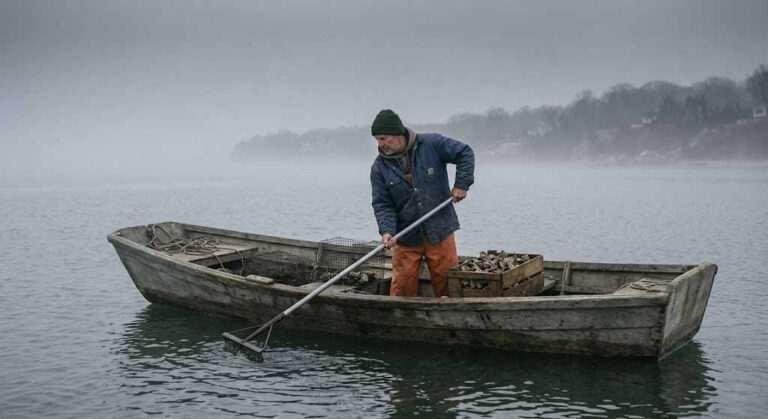
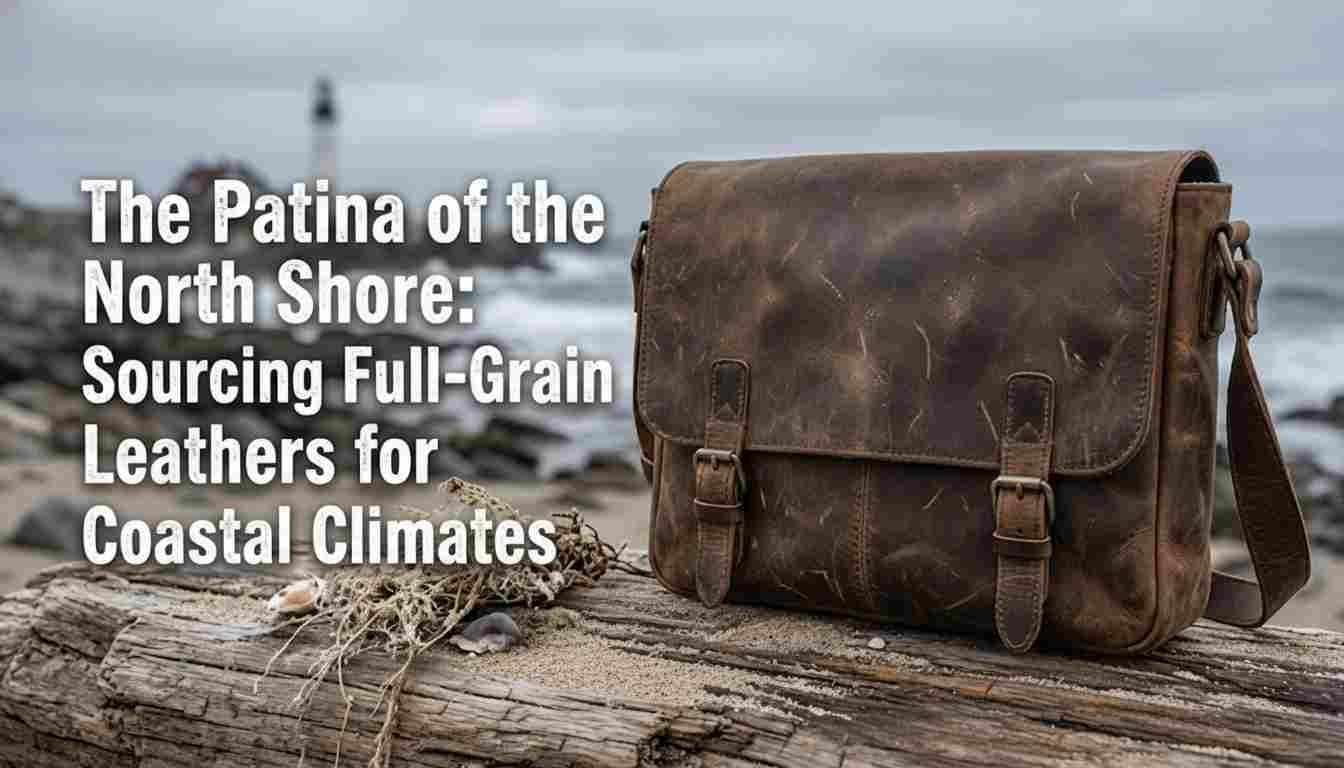
Walk the bluffs above Mount Sinai Harbor in late July and you will feel it before you can name it — that particular quality of air that belongs only to the North Shore. Not the blunt humidity of the deep South, nor the dry heat of the interior, but something in between: a marine warmth carrying salt particulate off Long Island Sound, pressing against everything that dares to be porous. Wood swells. Iron weeps rust at the joints. And leather — real leather, not the laminated simulacrum passing as such in department stores — breathes it all in, responding the way any living material responds to its environment: slowly, honestly, and without appeal.
This is the climate I have worked in for over two decades. The North Shore is not gentle on materials, which means it is extraordinarily honest about quality. What survives here, survives everywhere.
What the Sound Does to a Hide
Long Island’s North Shore occupies a climate classification meteorologists call Cfa — warm temperate, with summers that run hot and humid and winters that arrive cold and salt-edged from the Sound. Relative humidity in June peaks at roughly 76 percent; the thermometer pushes into the upper seventies and low eighties through July and August. That particular combination — heat plus ambient moisture plus microscopic salt particles carried on the prevailing southwesterlies — is among the more demanding environments a leather good can inhabit.
Leather is a collagen matrix: a dense, organized network of protein fibers that were originally structured to keep an animal protected from exactly this kind of environment. The tanning process, at its best, preserves and enhances that structural intelligence. At its worst — in the chrome-tanned, drum-processed, split-and-corrected leathers that constitute the majority of the global market — it strips the hide of its natural defenses and replaces them with synthetic coatings designed to look good in controlled retail lighting.
Salt particles carried by a coastal breeze deposit on leather surfaces and hardware, drawing moisture and causing corrosive effects — the salt attracts ambient moisture, exacerbating dampness issues, while hardware may corrode faster in salty environments, weakening attachments over time. This is not theoretical. It is the physics of the place. Every craftsman who has spent serious time working and wearing leather on the North Shore has seen it: the white salt-bloom on seams after a summer of daily carry, the way cheap zippers oxidize from the inside, the silent degradation of corrected-grain surfaces as their polyurethane topcoat begins to separate from the base hide. None of this happens to a properly sourced, properly structured full-grain hide. The difference is not a matter of aesthetics. It is structural engineering.
The Hierarchy of Hides — And Why It Matters Near Salt Water
The leather trade operates on a quality hierarchy that most consumers never encounter because retailers have an incentive to obscure it. At the bottom sits bonded leather: ground leather fiber reconstituted with adhesive binders and rolled onto a fabric backing, the particleboard of the hide world. Above that, split leather — the lower layers of a hide, lacking the natural grain surface and consequently lacking tensile strength. Then corrected-grain leather, where the genuine grain has been sanded smooth to erase defects, then embossed with an artificial pattern and coated in pigment. Then top-grain, which retains the actual grain surface but has been buffed and sealed.
And then, at the summit, full-grain — the hide exactly as it came from the animal, tanned and finished without abrasion or correction, its natural surface entirely intact. Full-grain leather is the most durable variety, retaining its natural texture and strength, making it less susceptible to damage from high humidity than any grade below it. This is because the tight, interlocked fiber structure of the natural grain surface acts as a semi-permeable membrane: it breathes, allowing moisture to move through the hide rather than accumulating on or beneath a synthetic surface. Corrected and coated leathers trap humidity at the interface between the topcoat and the base hide. Full-grain releases it.
For coastal carry — briefcases commuted in and out of Port Jefferson or Cold Spring Harbor, bags set down on boat decks, wallets pulled from a pocket in the summer rain — this distinction is not a luxury consideration. It is the entire question.
Bridle Leather and the Coastal Intelligence of Its Origins
English bridle leather did not arrive at its present composition by accident. It was engineered for centuries of outdoor equestrian service in the maritime climate of England — a country whose atmosphere is arguably the dampest in the temperate world. Every technical decision made by tanners in Walsall, in Sedgwick’s workshops, in the pit houses of Devon, was made in dialogue with weather: rain, salt air, the cold sweating of metal hardware against hide.
The tanning process takes three months at minimum. Using century-old vegetable tanning techniques, the process takes over three months from start to finish, with the final stages completed by hand to ensure the highest quality. The hides are vegetable-tanned using bark extracts — oak, chestnut, mimosa — in open pits that allow the tannins to penetrate deep into the fiber structure rather than merely coating the surface, as chrome tanning does in a fraction of the time. After tanning, the leather undergoes hot-stuffing: the bridle leather is infused with natural cod oils and tallow fats driven deep into the fiber structure, lubricating the fibers so they do not dry out — a self-replenishing system of internal moisture that has no equivalent in chrome-tanned goods.
A special wax blended with tallow, cod oil, and beeswax is brushed repeatedly onto the leather’s surface; the distribution of beeswax is adjusted depending on the season, producing the characteristic bloom that is the signature of authentic English bridle leather. That bloom — the white haze that rises to the surface of a new bridle hide — is not a defect. It is evidence of the deep wax treatment, and it polishes away with friction, sealing the grain and beginning the patina process that makes a well-used briefcase singular within a season of daily carry.
This is why, at Marcellino NY, the material selection begins and ends with English bridle leather. Grade A full-grain vegetable-tanned English bridle leather sourced from both American tanneries and imported UK English bridle leather depending on availability: the UK bridle leather is stiffer, waxier, and has a greasy top coat, while both share the same high-quality steer hide and the same fundamental construction philosophy. J & E Sedgwick & Co., founded in 1900 in Walsall, England — the historic capital of the British equestrian leather trade — remains one of the definitive sources precisely because its process has not been rationalized or accelerated for volume. The leather takes as long as it takes. That investment of time is embedded in every fiber.
Sourcing for Climate: The Variables That Actually Matter
When sourcing full-grain leather for carry in a coastal environment, three variables dominate the selection: fiber density, fat content, and grain integrity.
Fiber density determines how resistant the hide will be to the cyclical swelling and contraction caused by fluctuating humidity. Leather is a highly porous material, and because of this, excessive or reduced air moisture can make leather vulnerable to damage if not cared for properly — humidity at the ideal amount between 30 and 50 percent can help keep leather soft and supple, while humidity above or below that range can cause problems. The North Shore summer regularly pushes ambient humidity above 70 percent. A chrome-tanned hide with compromised fiber density will absorb this moisture unevenly, causing the fibers to swell at different rates, producing the soft distortion that eventually ruins shape in cheaper bags. A dense, heavily tanned full-grain hide absorbs and releases moisture through the entire cross-section, maintaining structural integrity.
Fat content — the oils and waxes driven into the hide during tanning — functions as a buffer against this cycling. A hide with deep fat saturation does not immediately respond to atmospheric humidity changes; its internal moisture balance is relatively stabilized by the oil matrix already present. This is why bridle leather, with its hot-stuffed tallow and cod oil content, performs measurably better in coastal conditions than even high-quality full-grain hides that lack the deep stuffing treatment. The oils also create a natural barrier against salt penetration: the wax surface of a Sedgwick hide does not invite salt particulate to bond with exposed collagen fibers the way an unsealed or lightly finished hide does.
Grain integrity is the third axis. The natural grain surface of a full-grain hide is the hide’s original weather barrier — the system the animal evolved to manage exactly the kind of environmental variability a North Shore summer offers. Maintaining that grain intact, without sanding or correcting it, preserves that evolutionary engineering. Corrected-grain hides, by definition, have had this barrier removed and replaced with an inferior synthetic substitute.
The Patina Argument: Why Coastal Aging Is Not Damage
Here is the conceptual inversion that separates those who truly understand leather from those who merely consume it: on the North Shore, the salt air, the humidity, the cycling between ocean-dampened summer and dry heated winter — these are not threats to quality leather. They are the authors of its most distinguished chapter.
Heidegger wrote about Dasein — being-in-the-world — as fundamentally constituted by its situatedness, its embeddedness in a specific context of relations. A leather good of genuine quality is similarly constituted by its use-world. It is not a static object meant to be preserved unchanged in tissue paper. It is a thing that becomes itself through encounter with weather, with hands, with the friction of daily existence in a specific place. Experts recommend stable relative humidity, ideally in the 45–55 percent range, as the foundation of leather care — not because humidity is the enemy, but because instability, not moisture itself, is what stresses the collagen matrix. A consistently managed coastal environment, with thoughtful seasonal conditioning, does not degrade quality leather. It matures it.
The patina that develops on a vegetable-tanned full-grain briefcase carried daily on the North Shore for five years is irreproducible. The darkening at the corners where it meets a desk. The shift in color at the handle where the leather has been gripped in summer and winter alike, the seasonal humidity cycling slowly deepening the base tone. The slight slicking of the grain where it sits against a jacket. These are not signs of wear. They are the record of a life. No new object, however expensive, carries this record. You cannot purchase it. You can only earn it, one crossing of the Sound at a time.
Seasonal Maintenance for the North Shore Carrier
The knowledge of what to source is incomplete without the practice of care. For full-grain and English bridle leathers carried on the North Shore, the seasonal rhythm is relatively simple once understood.
In spring and early summer, as humidity begins its climb, the risk is oversaturation — too much ambient moisture combined with over-conditioning creates a soggy, slow-drying hide that becomes a substrate for mildew. Over-conditioning in humid climates is a genuine risk; too much oil in moist air causes sogginess and attracts dirt, so the instinct to condition aggressively in wet weather is counterproductive. The correct approach is light, infrequent conditioning with a wax-based product appropriate to bridle leather — applied thinly, allowed to fully absorb, and buffed. For bridle leather specifically, the existing wax and oil content means the hide often needs nothing more than a horsehair brush and a wipe-down. The internal oil system is self-replenishing.
In late summer and fall, the rotation reverses. The long dry periods, combined with coastal salt accumulation, begin to pull moisture out of the hide. Very low humidity pulls oils and moisture out of the leather, leaving it dry, stiff, and prone to cracking — a lack of ambient moisture means the hide must rely solely on conditioning to maintain flexibility. This is the season for a more deliberate application: a proper conditioning with a neutral wax or a quality neatsfoot oil compound, followed by buffing and rest before returning the bag to service.
Hardware deserves its own attention in coastal environments. Solid brass is non-negotiable; the plated hardware ubiquitous in mid-market goods begins to oxidize within a single North Shore summer. Proper English bridle leather briefcases — Marcellino included — are built with solid brass or bronze hardware precisely because the environmental calculus of coastal use demands it. A corroded buckle does not merely look cheap. It transfers corrosive compounds to the hide at the contact point, accelerating localized deterioration.
What Survives
Twenty-five years of operating a kitchen teaches certain permanent lessons about materials. The cast-iron that outlasts the stainless. The copper pot that develops a patina no polishing should remove. The sourdough culture maintained in a ceramic crock, fed on schedule regardless of what else demands attention. The principle is consistent across contexts: materials that were made correctly, from the right raw inputs, by processes that respected the time required — these things do not merely endure. They compound. They become something the new version of themselves could not be.
English bridle leather from Walsall, pit-tanned and hot-stuffed and hand-finished, carried daily in the maritime air of Long Island’s North Shore, will not degrade if treated with the basic competence it deserves. It will graduate. The briefcase that comes to you waxy and stiff and carrying that particular scent of tallow and oak bark will, in five years of honest coastal carry, be a darker, softer, richer thing than it was on the day it was completed — closer to its final form than it could ever have been on the bench. The North Shore will have made it what it is.
The question of where to source your leather, then, is inseparable from the question of where you intend to live with it. The climate does not threaten quality. It reveals it. Find the hide built for the weather you actually inhabit, and what you will discover is that the coast was never the problem. The coast was the point.