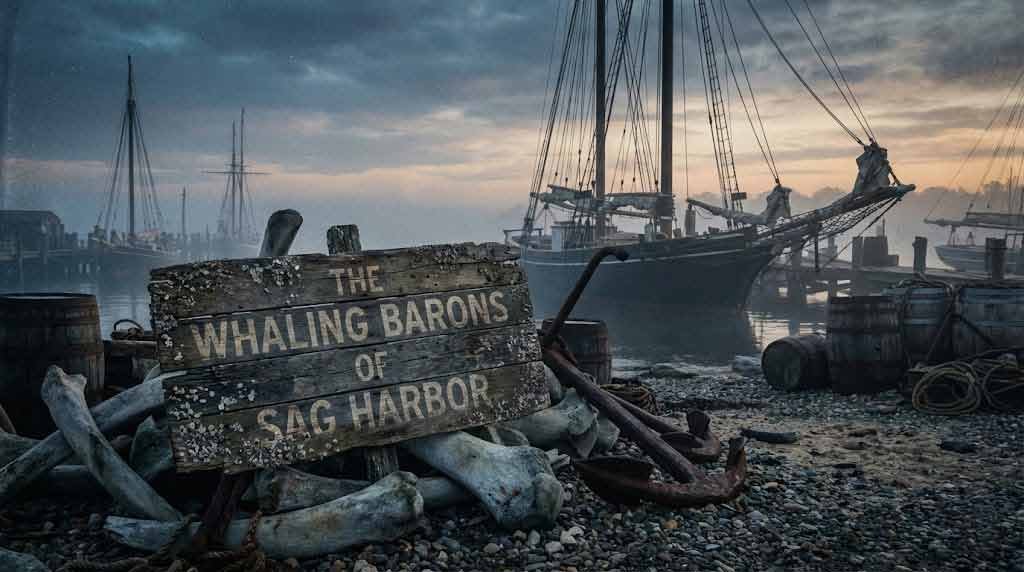
Long before the Hamptons became a byword for hedge funds and summer estates, a small, wind-scarred village on the eastern tip of Long Island was generating wealth that would have made any Wall Street baron pause. In the first half of the nineteenth century, Sag Harbor, New York was one of the most consequential commercial ports on the American continent — a place where fortunes were made in the span of a single voyage, where men returned from multi-year journeys to the Pacific with holds full of oil worth tens of thousands of dollars, and where the architecture of success was built quite literally from whale bones and blubber.
The history of Sag Harbor’s whaling empire is a story that most Americans have never heard, yet it touched nearly every corner of the globe, shaped the development of Long Island, and helped fuel an Industrial Revolution that ran, in no small part, on the oil rendered from the bodies of sperm whales and right whales hunted across the earth’s most remote and dangerous seas.
A Harbor Born for Commerce
Geography, as it so often does, determined destiny. Sag Harbor’s naturally deep harbor — the best anchorage on eastern Long Island — gave it an early and decisive commercial advantage. The village traces its European settlement to roughly 1730, when residents of surrounding towns recognized the strategic value of the deepwater inlet on Gardiners Bay. By 1789, the port had grown so significant that the new American federal government designated Sag Harbor as the first official Port of Entry in the State of New York — one day before New York City itself received that designation. The customs house erected there, managed by Henry Dering, still stands today. (Sag Harbor Village official history, sagharborny.gov)
From that moment on, Sag Harbor wasn’t simply a Long Island fishing village. It was an international gateway.
Deep-sea whaling hadn’t yet become the port’s dominant industry, but the foundations were already being laid. Shore whaling — a practice taught by the indigenous Montaukett and Shinnecock peoples to European colonists as far back as 1644 — had established a cultural and economic baseline. The kill, the try-pots, the rendered oil: these were not foreign concepts on the East End of Long Island. What changed in the post-Revolutionary era was scale.
Benjamin Huntting and the Birth of an Industry
The name Huntting appears throughout any serious account of Sag Harbor’s whaling history, and for good reason. In 1785, business partners Benjamin Huntting I and Stephen Howell underwrote the voyages of two ships — the Lucy and the America — to the coast of Brazil. They returned with between 300 and 500 barrels of oil each. By the standards that would follow, this was a modest haul. But the profit was sufficient to prove the model and encourage expansion. (Sag Harbor Express, January 2020)
What made the Huntting operation genuinely revolutionary was an innovation that changed the economics of the entire industry: the onboard try-pot. Prior to Huntting’s insistence on equipping vessels with brick furnaces capable of rendering whale blubber into oil at sea, ships had to haul raw blubber back to port, where it would spoil, smell, and complicate the accounting. With try-pots aboard, crews could process their catch during the voyage itself, extending the range and profitability of every expedition. Benjamin Huntting I is widely credited as the father of Long Island’s deep-sea whaling industry for precisely this reason. (Stony Brook University / SoMAS, 2017)
His son, Benjamin Huntting II, continued and expanded the family business, ultimately commissioning the architect Minard Lafever — the same man who designed the Old Whaler’s Church two blocks away — to construct a grand Greek Revival mansion on Main Street in 1845, at a cost of $7,000. The building’s roofline was decorated with carved blubber spades and whale’s teeth, a deliberate homage to the source of the family’s fortune. That building today houses the Sag Harbor Whaling and Historical Museum, a certified National Treasure listed on the National Register of Historic Places. (Sag Harbor Whaling and Historical Museum, sagharborwhalingmuseum.org)
The Huntting family held the record for the most sponsored whaling voyages out of Long Island by the time the industry concluded. The story of the Huntting mansion — later purchased by philanthropist Mrs. Russell Sage as a “summer cottage,” then transformed into a Masonic Temple, and finally into the museum it is today — tracks the arc of Sag Harbor itself: from raw industrial power to cultural institution.
The Golden Age: Sixty-Four Ships, Global Reach
The numbers tell a remarkable story. By 1839, thirty-five whaling ships were registered in Sag Harbor. Just six years later, at the peak of the industry in 1845, that number had grown to sixty-four vessels — a fleet that made the village one of the largest whaling ports in the United States, rivaling Nantucket and second in New York only to the great port city itself. (27East.com, Long Wharf History, 2020)
In 1847, Sag Harbor’s busiest year on record, ships brought in 3,910 barrels of sperm oil, 63,712 barrels of right whale oil, and 605,340 pounds of whalebone — materials that would be converted into lamp fuel, industrial lubricants, corset stays, parasol ribs, and soap for consumers across Europe and North America. At the industry’s Long Island peak in that same year, the total output reached an extraordinary 672,971 barrels of whale oil. (Jhonatan Bonilla, Long Island and the Whaling Industry, jhonatanbonilla.law.blog)
Ships departed Sag Harbor and were at sea for two to four years at a stretch, circumnavigating the globe in search of prey. They traced routes from the North Atlantic to the coast of Brazil, across to the Azores, down the African coast, into the Indian Ocean, and eventually into the Pacific — following the trade winds and the whale populations with equal determination. The longest recorded voyage out of Sag Harbor lasted eleven years. (Stony Brook University / SoMAS, 2017)
The captains and financiers who organized these ventures were, as the Sag Harbor Partnership has described them, “the oil barons and high-risk hedge fund moguls of their day.” During the industry’s peak years from 1829 to 1847, they reigned as financial, cultural, and political potentates on the East End of Long Island — building churches, funding civic institutions, and constructing grand homes that still shape the streetscape of Sag Harbor’s historic district. (Sag Harbor Partnership, sagharborpartnership.org)
Thomas Welcome Roys and the Opening of the Arctic
No figure in Sag Harbor’s whaling history cuts a more dramatic silhouette than Captain Thomas Welcome Roys. Born around 1816 to a farming family in upstate New York, Roys came to Sag Harbor at seventeen and spent the better part of his life attempting to rewrite the rules of whaling.
On July 23, 1848, commanding the Sag Harbor bark Superior, Roys sailed through the Bering Strait and into the Arctic Ocean — a route no American whaler had attempted before. He navigated under thick fog, reportedly with a pistol at his side to manage a crew on the edge of mutiny. What he found on the other side was, in his own words, an abundance of “new fangled monsters.” These were bowhead whales — massive, slow-moving creatures so thick with blubber that in two months of hunting, Roys and his crew filled the Superior with 1,600 barrels of oil. The equivalent of three years’ catch in sixty days. (Thomas Welcome Roys, Wikipedia; NOAA Ocean Exploration)
The following summer, fifty ships — forty-six American, two German, two French — sailed north through the Bering Strait on the strength of Roys’s single voyage. By 1852, 220 ships were hunting bowheads in the Arctic, killing 2,682 in a single season. (Whaling in the United States, Wikipedia) Roys had discovered the most important new whaling ground of the nineteenth century, and Sag Harbor had sent him there.
His later years were marked by restless, often ill-fated innovation — he developed and patented whaling rockets, established shore stations in Iceland, experimented with explosive harpoons — and he died in 1877 in Mazatlan, Mexico, penniless and reportedly disoriented. It was the fate, perhaps, of the man who looked too far past the horizon to find his footing on the ground beneath his feet.
A Floating United Nations: The Crews of Sag Harbor
One of the most overlooked dimensions of Sag Harbor’s whaling era is the extraordinary diversity of the men who actually crewed the ships. As the fleet grew and the local labor pool was exhausted, captains drew sailors from across the world. The streets of Sag Harbor during the industry’s peak echoed with English, Algonquin, Chinese, Portuguese, and languages from every inhabited continent. (Stony Brook University / SoMAS, 2017)
At least 25 percent of the men who shipped out of Long Island’s whaling ports were people of color, according to Jennifer Anderson, an associate professor of history at Stony Brook University. The local Shinnecock and Montaukett peoples — whose ancestors had first taught European colonists to hunt whales — continued to crew these vessels in significant numbers. African American sailors, both free men and escaped slaves, found in whaling one of the few professions where skill could temporarily override racial hierarchy. As Anderson observed: “Captains needed skilled whalers. They acquired a level of social status on board ship that they didn’t have back home. At sea, it was most important how good your skills were.” (Suffolk Times Archives, March 2018)
Among the most remarkable of these sailors was Pyrrhus Concer, born the son of an enslaved man in 1814, who sailed aboard the Manhattan in 1843 and became one of the first Americans — and almost certainly the first Black American — to visit Tokyo Bay, more than a decade before Commodore Perry’s famous mission. After his sailing career ended, Concer established a ferry business in Southampton and amassed $5,000, much of which he donated to the First Presbyterian Church upon his death in 1897. (Suffolk Times Archives, March 2018)
The community of Eastville in Sag Harbor was built substantially by Black whalers and Native American sailors who returned from sea with money, skills, and a measure of the independence that the water had given them. Streets in Sag Harbor still bear names honoring this heritage — Cuffee Drive, named for prominent African American whaler Paul Cuffee; Walker and Milton, named for Black whalers. The sea was one of the few places in nineteenth-century America where a man might be judged by his competence before his complexion. Herman Melville, who visited Sag Harbor and mentioned it in Moby Dick, understood this — his Pequod was crewed with precisely this multicultural reality in mind.
The Architecture of Wealth
The money that whale oil produced didn’t stay in the holds of ships. It built a village. The Sag Harbor of the 1840s was a place of concentrated, highly visible prosperity: whale merchants and successful captains commissioned Greek Revival homes along Main Street, funded the construction of the Old Whaler’s Church in 1843 (its steeple once the tallest structure on Long Island, at 185 feet), and established civic institutions that still anchor the community today.
The Huntting mansion was only the most famous of these projects. Throughout the village, carpenters, caulkers, sailmakers, blacksmiths, coopers, riggers, and boat builders all thrived in the ecosystem created by the fleet. A ship in port was a ship not earning money, which meant every return triggered an economic burst of repairs, re-provisioning, and re-crewing that benefited the entire community. (Whalebone Magazine, whalebonemag.com)
Novelist James Fenimore Cooper, visiting a relative in Sag Harbor, was so taken with the industry’s energy and lore that he invested in a local whaling firm — though the investment ultimately returned a loss. The tales of Long Island captains, particularly the celebrated Captain David Hand, influenced his literary work directly. (PBS American Experience, Whaling History)
Even Ephraim Byram, the son of a local carpenter who became the village’s foremost mechanical genius — building nautical instruments, tower clocks, and a room-sized model of the solar system that won him a gold medal at the American Institute Fair in 1836 — owed his opportunity to the whaling economy. The fleet created the demand; the demand created the ecosystem; the ecosystem produced its own unexpected forms of excellence.
The Collapse: Kerosene, Gold, and the End of an Era
The decline was as swift as the rise had been gradual. In 1845, the fleet stood at sixty-four ships. Five years later, it had been cut to twenty-four. By 1871, a single vessel remained: the brig Myra, captained by Henry A. Babcock, crewed by eighteen men not a single one of whom was from Long Island. She sailed and never returned, condemned in Barbados in 1874 as too worn to make the passage home. (Whalebone Magazine; Sag Harbor Whaling Museum)
Several forces converged to destroy the industry. The California Gold Rush of 1849 lured away the adventurous young men who might otherwise have signed onto whaling voyages — the very temperament that whaling required was suddenly in demand elsewhere, for better pay and with better odds of survival. The Atlantic had been overfished, pushing ships farther into the Pacific and the Arctic, where voyages stretched to three and four years, eroding profit margins until many voyages returned at a loss. Edwin Drake’s discovery of petroleum in Titusville, Pennsylvania, in 1859 introduced a cheaper and more abundant source of lamp fuel that would render whale oil economically obsolete within a generation. And Confederate raiders during the Civil War targeted Yankee whaling ships specifically, further decimating an already weakened fleet. (Sag Harbor Whaling Museum; PBS American Experience)
By 1872, a local resident described the village as “Dozeville.” The wharves rotted. The cooperages and oil yards closed. The streets emptied of the boisterous, multilingual crews that had once crowded them. The wealth condensed into a few surviving families and institutions — and, eventually, into the architecture that tourists now admire on Main Street without fully understanding what built it.
What Remains
The Sag Harbor Whaling and Historical Museum at 200 Main Street — housed in the Huntting mansion, designated a National Treasure in 1998 — holds the largest collection of whaling equipment in New York State: harpoons, flensing knives, try pots, scrimshaw, ship figureheads, whale vertebrae, and nearly 200 pieces of carved whale ivory. It has been open to the public in some form since 1936. (Sag Harbor Whaling and Historical Museum, sagharborwhalingmuseum.org)
The Old Whaler’s Church still stands on Union Street. The Custom House, one of the oldest surviving federal buildings in America, remains accessible. Cuffee Drive still curves through the Eastville neighborhood, bearing witness to the men who shipped out with the fleet and came home to build a life on land. And the harbor itself — the same deep, sheltered water that gave the village its reason for being — still opens onto Gardiners Bay, still clear, still wide, still pointed toward the open sea.
Long Island’s North Shore and the East End have evolved considerably from the days when whale oil was civilization’s primary light source. But the infrastructure of those decades — the civic institutions, the historic streetscape, the cultural memory encoded in the village’s architecture — is a direct inheritance from an industry that once made a village of a few thousand people a player in global commerce. The whaling barons of Sag Harbor built something that outlasted the whales, the oil, and the industry itself. That is no small thing.
Sources:
- Sag Harbor Village Official History — sagharborny.gov
- Sag Harbor Whaling and Historical Museum — sagharborwhalingmuseum.org
- Sag Harbor Historical Museum — sagharborhistoricalmuseum.org
- Whaling Tales, Whalebone Magazine — whalebonemag.com
- Long Wharf History, 27East.com — 27east.com
- PBS American Experience: Whaling History — pbs.org
- Thomas Welcome Roys, Wikipedia — wikipedia.org
- Whaling in the United States, Wikipedia — wikipedia.org
- Long Island and the Whaling Industry, Jhonatan Bonilla — jhonatanbonilla.law.blog
- Long Island Whalers of Color, Suffolk Times Archives — suffolktimes.archive.timesreview.com
- Sag Harbor Whaling Museum, Art & Architecture Quarterly — aaqeastend.com
- New York’s Whaling Industry, New York Almanack — newyorkalmanack.com
- Descendants of Whaling Pioneer, Sag Harbor Express — sagharborexpress.com
- Stony Brook University / SoMAS, Coastal Cultural Experience — you.stonybrook.edu
- NOAA Ocean Exploration: Lost Whaling Fleets Background — oceanexplorer.noaa.gov
- Sag Harbor Partnership, Captains, Mates and Widows — sagharborpartnership.org