
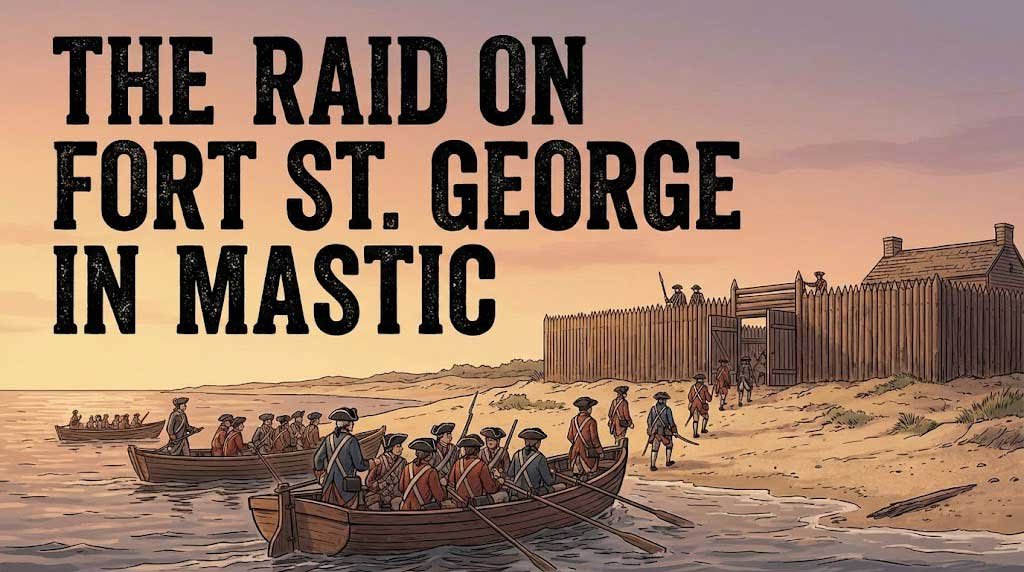
Eight whaleboats pushed off from the Connecticut shore at roughly four in the morning on November 21, 1780. The men inside them — eighty dismounted dragoons of the 2nd Continental Light Dragoons — did not speak above a whisper. The commander at the bow was twenty-six-year-old Major Benjamin Tallmadge, Yale graduate, intelligence chief for General George Washington, and the architect of the most effective spy network of the Revolutionary War. He was crossing Long Island Sound in the dark, heading toward occupied territory, carrying axes and bayonets and the weight of a half-failed war.
What unfolded over the next forty-eight hours at a fortified British supply depot on the south shore of Long Island — a place called the Manor of St. George, in what is now Mastic Beach — was not a grand set-piece battle. It was a textbook raid: surgical, silent until it wasn’t, and devastatingly effective. The British garrison never saw it coming. By dawn on November 23rd, the fort had fallen, 54 prisoners were in American hands, and a man named Elijah Churchill had performed acts of valor so remarkable that decades later, George Washington would create a medal specifically to honor him. That medal became the Purple Heart.
The Raid on Fort St. George was one of the lesser-known engagements of the American Revolution. It deserves a far wider audience — particularly here on Long Island, where the ground it was fought on still exists, and where the strategic brilliance behind it continues to ripple through military history.
The Strategic Landscape: Long Island Under British Occupation
Long Island had been in British hands since August 1776, when the Battle of Long Island — still the largest battle of the entire Revolutionary War — ended in a humiliating rout of Washington’s forces at Brooklyn Heights. The British used Long Island not merely as a garrison but as an operational hub: a depot for provisions, a harbor for the Royal Navy, and a staging ground for raids deep into New England.
Fort St. George, erected at the Manor of St. George near the south coast of Suffolk County, exemplified this function. After the British captured Long Island in 1776, Fort St. George was used as a supply base for their forces, erected near the present-day Manor house. From this location they controlled Fireplace Neck in Bellport, where fires were set at night to guide sailing vessels to shore. The fort also afforded control of the waters along Bellport Bay and the inlet to the Atlantic that then existed at Old Inlet on Fire Island, as well as the Carmens River from which the British could float lumber and supplies.
The fortification itself was formidable for a colonial outpost. Loyalist refugees from Rhode Island were resettled onto Long Island after the British withdrew their forces from Newport in 1779. Some were established at Manor St. George on the southeastern part of the island. They fortified the property, erecting a stockade 12 feet high in a roughly triangular shape around the manor house. The stockade was lined with abatis — tree branches with sharpened points facing out — and a deep ditch. Tallmadge, who had personally reconnoitered the site, described it in his memoirs as consisting of “two large strong Houses, and a fort about 90 feet square, the whole connected together by a very strong Stockade…forming a compleat Triangle, & the Fort & Houses standing in the extrimities of the Angles. The fort consisted of a high Wall & a deep Ditch, encircled with a strong Abbatis, having but one Gate.” (Tallmadge, Memoir, 1858)
Beyond the fort’s walls, the British had stockpiled an estimated 300 tons of hay at a depot in Coram — winter forage for the army’s horses, irreplaceable at that late stage of the year. Destroying it would not just embarrass the British. It would genuinely hurt them.
The Man Behind the Mission: Benjamin Tallmadge
To understand why the Fort St. George raid worked, you have to understand who Benjamin Tallmadge was. He was not simply a cavalry officer. He was the most important intelligence operative in the Continental Army — the architect of the Culper Spy Ring, the network that fed Washington critical information about British troop movements in New York City throughout the war.
Tallmadge transferred as a captain to the 2nd Continental Light Dragoons and received a promotion to major in April 1777. In November 1778, Gen. George Washington directed Tallmadge to organize an intelligence service to operate in British-occupied New York City. The Culper Spy Ring prevented a British fleet from sailing for Rhode Island in July 1780, which would have hindered plans for the Franco-American alliance. The ring also played a role in the exposure of Benedict Arnold’s treachery.
It was, in fact, the Arnold affair that galvanized Tallmadge into action in the fall of 1780. Arnold’s betrayal — the near-surrender of West Point — had shaken the Continental Army to its foundation. In the weeks that followed, Tallmadge wrote in his memoirs that “my former scheme of annoying the enemy on Long Island came fresh upon my mind.” He began gathering intelligence about Fort St. George, at one point crossing the Sound personally to assess the target. (Tara Ross, “This Day in History: Benjamin Tallmadge’s Raid,” taraross.com, November 2025)
Washington authorized the mission. The operational plan was elegant: cross the Sound by night, hide during daylight to avoid British patrols, march south across the island under cover of darkness, strike at dawn.
The Crossing: From Fairfield to Mount Sinai
Major Benjamin Tallmadge put 80 men of the Second Continental Light Dragoons in eight whaleboats. They crossed Long Island Sound from Connecticut, landing at Old Man’s Harbor — now Mount Sinai Harbor — on the north shore of Long Island with their objective to attack Fort St. George at Mastic on the South Shore, occupied by a Loyalist garrison and used as a provisioning depot for the British in Suffolk County.
The choice of Mount Sinai as the landing point was not incidental. The harbor offered concealment and a manageable overland route southward. It was also within Tallmadge’s intelligence network — men he had known from childhood, farmers and tradesmen who had been quietly feeding information to Washington’s camp for years. Poor weather forced Tallmadge’s troops to remain hidden for a day. Eighty armed men, concealed in an occupied landscape for twenty-four hours, relying on local silence and loyalty. It is difficult to overstate how much operational discipline that required.
On the night of November 22nd, the force moved south. They arrived at Fort St. George before dawn on the 23rd. Tallmadge divided his command into three detachments to attack from multiple sides simultaneously — a classic encirclement designed to prevent organized defense or escape. He would personally lead the first detachment. The others were ordered to remain concealed until they heard the initial exchange of fire.
The Assault: Ten Minutes and a Battle Cry
The attack began in the gray pre-dawn of November 23rd. Tallmadge’s column had closed to within forty yards of the stockade when a British sentry spotted them. The sentry issued a challenge — “Who comes there?” — and fired.
The other two detachments joined the fight. The dragoons took the fort within only ten minutes. They were shouting “Washington and glory!” as they basked in victory. They celebrated a tiny bit too soon. Musket fire came from one of the houses: some of the British had barricaded themselves in. Tallmadge and his dragoons made short work of that, capturing the British inside.
The final tally was stark in its one-sidedness. American casualties were one wounded. British casualties were approximately seven killed and 54 captured. As if all that weren’t enough, the Americans also captured a ship spotted just off the coast. Tallmadge set fire to the boat and fort, then he and his dragoons marched back the way they came, taking supplies and prisoners with them.
On the march back north through Coram, Tallmadge ordered the destruction of the 300-ton hay stockpile. It burned to nothing. The Continental force returned to their whaleboats, crossed the Sound, and arrived in Connecticut without losing a single man in the crossing.
Washington’s letter to Tallmadge upon receiving the report was uncharacteristically effusive: “I have received with much pleasure the report of your successful enterprise upon Fort St. George, and was pleased with the destruction of the hay at Coram, which must be severely felt by the enemy at this time. I beg you to accept my thanks for your spirited execution of this business.” (George Washington to Benjamin Tallmadge, quoted in Benjamin Tallmadge — Wikipedia)
Elijah Churchill and the Birth of the Purple Heart
Among the eighty men who stormed Fort St. George that morning, one distinguished himself above all others. Sergeant Elijah Churchill, a member of the 4th Troop, Second Continental Dragoons, led an attack party against the supply depot surrounded by 12-foot-high stockades. Shouting “Washington and Glory!” the men stormed the redoubt and quickly took the fort. Eleven months later, Churchill was wounded while leading a whaleboat raid against Fort Slongo on October 2, 1781. His men destroyed artillery and ammunition and took 21 prisoners in the successful action.
Washington’s commendation for Churchill’s two engagements is worth quoting in full: “At the head of each body of attack he not only acquitted himself with great gallantry, firmness and address; but that the surprise in one instance, and the success of the attack in the other, proceeded in a considerable degree from his conduct and management.” (George Washington, Badge of Military Merit citation for Elijah Churchill, May 3, 1783; Connecticut Sons of the American Revolution, sarconnecticut.org)
Sergeant Elijah Churchill, born in Newington Parish, a member of the 4th Troop of the Second Continental Light Dragoons, was the first recipient of the Badge of Military Merit for his daring bravery in the November 1780 raid on Fort St. George and October 1781 raid on Fort Slongo. That badge — a heart of purple cloth, narrow-laced, bearing the word “Merit” — was awarded to Churchill on May 3, 1783. It was the first military decoration in American history presented to an enlisted soldier rather than an officer. In 1932, President Herbert Hoover revived and redesigned it as the Purple Heart, the decoration still awarded today.
The raid on Fort St. George is therefore not merely a footnote in Long Island’s Revolutionary history. It is the origin story of one of the most recognized military honors in the world.
Strategic Weight: Small Victory, Large Consequences
Military historians have sometimes characterized the Fort St. George raid as tactically minor. The American Battlefield Trust notes that raids like Tallmadge’s, while not particularly important on a tactical level, had a very important strategic effect. These attacks forced the British to allocate their resources, both men and materiel, to holding Long Island, resources that may have been more useful elsewhere.
That assessment is accurate as far as it goes, but undersells the raid’s compounding effects. The destruction of 300 tons of hay in late November was not a symbolic gesture — it was a logistical blow to British cavalry operations entering winter. Beginning in 1777, in what has been dubbed Whaleboat Warfare, a series of raids originating in Connecticut were fought at places like Lloyd Neck, Fort Salonga, and Sag Harbor. The most dramatic raid, however, occurred at Fort St. George in the fall of 1780. The pattern of these raids collectively fractured the British assumption that Long Island was a secure rear area, forcing a constant defensive posture that drained personnel and confidence.
Less than a year after Tallmadge crossed the Sound, Washington would win his decisive victory at Yorktown. The resources the British had committed to holding Long Island — the garrison strength, the supply chains, the naval attention — were resources they did not have in Virginia.
The Ground Still Exists
For readers on Long Island, particularly those on the North Shore, this history is not abstract. Local historians and the Tri-Hamlet 250 Committee say Tallmadge’s raid will play a central role in Long Island’s Semiquincentennial plans in 2026. Events will include reenactments, educational programs, and tours of Revolutionary-era sites such as the William Floyd Estate, the Manor of St. George, and the grave of Patriot Nathaniel Woodhull.
The Manor of St. George in Mastic Beach is open to visitors and maintained as a historic site. The William Floyd Estate, just miles away and managed by the National Park Service, offers additional context for daily life in colonial Suffolk County. Mount Sinai Harbor — the landing point where Tallmadge and his eighty men pulled their whaleboats ashore — is still there, at the end of the same North Shore coastline that has defined this community for centuries.
These are not commemorative markers to distant events. They are the actual terrain where the American republic was fought for, inch by inch, by men who had no guarantee it would hold.
Tallmadge and his dragoons could have stayed on the Connecticut shore and waited for better odds. Every military calculation of 1780 favored caution: the war was going badly, Arnold had just betrayed them, and the British held Long Island in force. Instead, eighty men climbed into eight whaleboats and crossed a dark Sound toward a fortified enemy position, carrying the conviction that surprise, discipline, and precision could accomplish what mass never could.
They were right. The fort fell in ten minutes. The hay burned for hours. Fifty-four prisoners crossed back to Connecticut. Elijah Churchill earned the decoration that would one day be worn by every American soldier wounded in the service of the republic.
The ground between Mount Sinai and Mastic was the ground where that lesson was first learned on this island. It remains worth remembering.
Sources
- American Battlefield Trust, “Fort St. George Battle Facts and Summary,” battlefields.org — https://www.battlefields.org/learn/revolutionary-war/battles/fort-st-george
- Benjamin Tallmadge, Memoir of Colonel Benjamin Tallmadge, 1858 (reprinted 1904)
- Wikipedia, “Battle of Fort St. George” — https://en.wikipedia.org/wiki/Battle_of_Fort_St._George
- Wikipedia, “Benjamin Tallmadge” — https://en.wikipedia.org/wiki/Benjamin_Tallmadge
- Encyclopaedia Britannica, “Benjamin Tallmadge” — https://www.britannica.com/biography/Benjamin-Tallmadge
- New York Almanack, “Long Island Revolutionary History: A Suffolk County Tour” (July 2023) — https://www.newyorkalmanack.com/2023/07/long-island-revolutionary-history-a-suffolk-county-tour/
- New York Almanack, “Maritime Encounters Around Long Island During the American Revolution” (August 2025) — https://www.newyorkalmanack.com/2025/08/american-revolution-long-island/
- Tara Ross, “This Day in History: Benjamin Tallmadge’s Raid,” taraross.com (November 2025) — https://www.taraross.com/post/tdih-tallmadge-raid
- Military.com, “Elijah Churchill: Story Behind the First Purple Heart Recipient” — https://www.military.com/history/elijah-churchill.html
- Connecticut Sons of the American Revolution, “The Badge of Military Merit” — https://www.sarconnecticut.org/the-badge-of-military-merit/
- Military Order of the Purple Heart, “History of the Medal” — https://www.purpleheart.org/HistoryoftheMedal
- George Washington’s Mount Vernon, “Benjamin Tallmadge” — https://www.mountvernon.org/library/digitalhistory/digital-encyclopedia/article/benjamin-tallmadge
- South Shore Press, “Tallmadge Raid Anniversary Highlights Long Island’s Revolutionary Legacy” — https://southshorepress.com/stories/676525149-tallmadge-raid-anniversary-highlights-long-island-s-revolutionary-legacy
- William G. Pomeroy Foundation, “Fort St. George” — https://www.wgpfoundation.org/historic-markers/fort-st-george/