When a tool crosses from novelty to necessity in under three years, the industries it displaces rarely receive adequate warning. Midjourney, the AI image-generation platform that launched in July 2022 with a small Discord server and no marketing budget, has quietly become one of the most economically consequential pieces of software in the history of the creative economy. It reached $50 million in revenue in its first year. By 2025, that figure had climbed to $500 million — a tenfold increase achieved by a company with fewer than 163 employees and zero external venture capital funding (Quantumrun Foresight, 2025). Against that backdrop of machine-scale efficiency, tens of thousands of freelance illustrators are confronting a labor market that has shifted beneath them with unnerving speed.
The central question is no longer whether AI image generation will affect illustration as a profession. That question has been answered, and the answer is measurable. The more pressing inquiry now concerns the nature and permanence of that disruption: which segments of the freelance illustration market are being hollowed out, which are adapting, and what structural forces — legal, economic, and cultural — will determine what remains on the other side.
A Platform Built on Other People’s Work
To understand Midjourney’s market position, it helps to understand how it was built. Like its primary competitors, DALL-E and Stable Diffusion, Midjourney’s visual intelligence was trained on billions of images scraped from the internet — images created, in many cases, by the very professionals now competing against it. The LAION-5B dataset, a 5.85-billion image corpus used to train several leading image generators, contains works that are, by LAION’s own acknowledgment, under copyright. None of the revenue generated per “generation” flows to the artists whose work trained the model (Joseph Saveri Law Firm, 2024).
In January 2023, a coalition of artists — including illustrators Sarah Andersen, Kelly McKernan, and Karla Ortiz — filed a class-action copyright infringement lawsuit against Stability AI, Midjourney, and DeviantArt. The case, Andersen v. Stability AI, cleared a critical threshold in August 2024 when a federal district court ruled that plaintiffs could pursue claims that these systems infringe upon their copyright protections, moving the case into discovery with trial set for September 2026 (NYU Journal of Intellectual Property & Entertainment Law, 2025).
The legal architecture around this dispute remains unresolved, and deliberately so. In January 2025, the U.S. Copyright Office released Part 2 of its Copyright and Artificial Intelligence report, reaffirming that human authorship is the cornerstone of copyright protection — meaning purely AI-generated images cannot themselves be copyrighted. The D.C. Circuit Court of Appeals upheld that position as recently as March 2025. But whether AI companies can continue training on copyrighted works without licensing or compensation remains, in the Copyright Office’s own language, an open question that “some uses will qualify as fair use, and some will not” (Congress.gov, 2025).
For working illustrators, this legal ambiguity is cold comfort while the bills keep arriving.
The Numbers Behind the Narrative
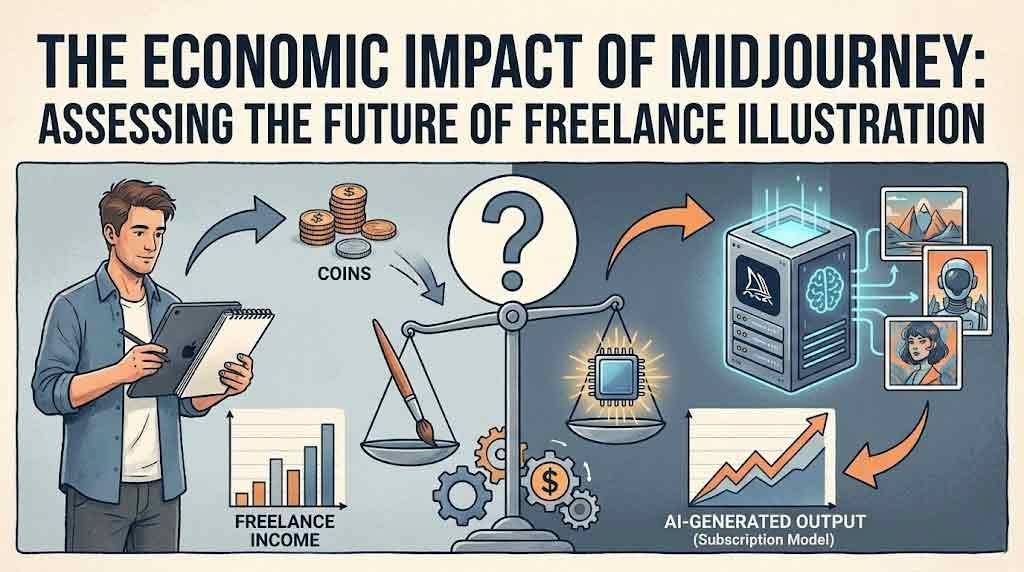
The market data tells a story that anecdotal reports from artist communities have been signaling for two years. A Brookings Institution analysis published in 2025 found that freelancers in occupations most exposed to generative AI experienced a 2% decline in the number of contracts and a 5% drop in earnings following the release of advanced AI tools in late 2022 — with the damage concentrated disproportionately among experienced freelancers offering higher-priced, higher-quality services (Brookings Institution, 2025). That last detail is counterintuitive and important: it was not the entry-level market that absorbed the sharpest hit, but the mid-to-upper tier, where clients had previously paid a premium for quality and reliability.
A peer-reviewed study published in the Journal of Economic Behavior & Organization (Teutloff et al., 2025) found that generative AI cut demand for directly substitutable freelance skill clusters by up to 50% in short-term project roles. A separate SSRN preprint noted a 17% drop specifically in “image generation” gigs on major freelancing platforms — a category that maps directly onto the bread-and-butter work of mid-career illustrators: custom spot illustrations, editorial art, character concepts, and marketing assets (Brookings, 2025).
The State of Illustration 2025 report, produced by Hireillo from 1,500 survey responses across more than thirty countries, documented that income growth has been declining since 2020, that the number of full-time illustrators fell between 2022 and 2024, and that anxiety and mental health concerns among professional illustrators in 2024 surpassed levels recorded during the pandemic. “Being an illustrator is challenging and has never been more so,” the report concluded (Hireillo, 2025).
That finding is not rhetorical. It is empirical.
The ‘Good Enough’ Threshold and the Markets It Swallowed
The mechanism by which AI image generation displaces human illustrators operates less through the creation of superior art than through the satisfaction of a “good enough” standard. For internal corporate decks, preliminary client presentations, social media filler content, website stock imagery, and low-budget editorial placeholders, a Midjourney output achieved in forty-five seconds and at a cost of pennies per image now clears the bar that previously required a freelance commission.
A 3D/2D generalist who spent a decade producing animated supplemental graphics for documentary television — infographics, prehistoric creature recreations, historical scene reconstructions — put it plainly in 2025: “That market has completely dried up” (Blood in the Machine, 2025). A comics and advertising illustrator with more than twenty years of experience in New York described the moment she recognized the shift: in 2023, a client who had previously commissioned original illustrations began asking her instead to create illustrated versions of AI-generated images. After that job, the commissions stopped entirely.
Barcelona-based illustrator Alex Foxley, speaking to Creative Boom in 2024, described a market-wide contraction that had spread beyond individual experience: “It seems to be the case for most people in the industry, which is pretty worrying.” Art director Shanée Benjamin in Brooklyn framed the psychological weight directly: “This has been the hardest year so far. Jobs are scarce, and I’m contemplating going in-house again, which is killing my mental health” (Creative Boom, 2024).
The editorial illustration market — historically one of the more stable segments for freelance artists — has been among the hardest hit. Publications that once commissioned human illustrators for spot art are now openly using Midjourney, a practice that illustrators working in the space have noted with documented regularity (Creative Boom, 2024).
Where the Market Is Holding — and Why
Not every segment of the freelance illustration economy has been equally vulnerable. The same data that documents decline in substitutable work shows stability and even growth in categories where AI remains an inadequate substitute for human judgment, cultural competency, and long-term creative direction.
The Bloomberry study, which analyzed more than five million freelance job postings, found that graphic design postings actually increased approximately 8% following the generative AI surge — a finding that reflects the distinction between high-concept visual strategy work and commodity image production. Complex branding campaigns, UX design, and multi-format advertising creative still require human oversight that no current prompt-to-image system can provide (2727 Coworking, 2025).
There is also emerging evidence of a bifurcation between illustrators who have integrated AI tools into their workflow and those who have resisted or ignored them entirely. Analysts at AlixPartners found that 44% of media and entertainment companies view AI as a significant revenue opportunity — and that this is translating into budget allocations for creators who can direct AI tools effectively rather than simply operate without them (Medium, 2024). Illustrators who have learned to use Midjourney, Adobe Firefly, and similar platforms to accelerate concept development while maintaining authorial control over final outputs are reporting productivity gains of 60–70%, according to industry analysis — gains that can allow them to take on more volume, command premium rates for bespoke direction, and compete on deliverable speed as well as quality (AInvest, 2025).
The emerging consensus in the industry, articulated clearly by analysts studying 2024 income data, is one of stratification: specialists with irreplaceable domain expertise are holding or growing, while generalists whose value proposition was execution speed and technical skill in isolation are losing ground quickly. A fintech writer who achieved a 16% income increase in 2024 described the governing principle: deep niche expertise in a field “heavily dependent on human-crafted, expert content” had insulated their practice from AI substitution entirely (Medium, 2024). The same logic applies to illustrators — those with a singular, recognizable voice and an established client base that values the human relationship and aesthetic identity behind the work are more durable than those who competed primarily on availability and price.
The Legal and Regulatory Horizon
The resolution of Andersen v. Stability AI will be among the most consequential copyright decisions of this decade. If plaintiffs succeed in establishing that training on copyrighted works without licensing constitutes infringement, the economic model underlying every major AI image generator will require structural revision. The implications for Midjourney — which generated $500 million in 2025 from a platform built on a training corpus that remains legally contested — could be significant enough to force a licensing infrastructure that might, in theory, redirect compensation to the creative community (NYU JIPEL, 2025).
Legislative efforts are proceeding in parallel. The Generative AI Copyright Disclosure Act of 2024, introduced in Congress on April 9, 2024, would require AI developers to disclose the datasets used to train their systems — a transparency measure that would at minimum create the infrastructure for future licensing negotiations (IP & Technology Law Society, USC, 2025). The EU’s AI Act, enacted in 2024, imposes additional disclosure obligations on European markets that may establish a regulatory standard with global ripple effects.
What the law has affirmed clearly, however, is that purely AI-generated images carry no copyright protection in the United States. A company that generates an image with Midjourney holds no legal ownership of that image. This creates a peculiar dynamic in the market: the organizations replacing human illustrators with AI-generated art are doing so with outputs they cannot protect. For illustrators who trade in original, copyrightable work, this remains a meaningful competitive distinction — one that has not yet been fully absorbed into client decision-making but will inevitably matter more as the commercial and reputational implications of unprotectable visual assets become better understood.
The Adaptation Calculus
The fundamental tension the illustration industry is navigating is ancient in structure if novel in character: it is the same disruption that photography imposed on portrait painters, that desktop publishing imposed on commercial typographers, and that digital photography imposed on film processing laboratories. In each prior case, portions of the displaced craft survived — elevated, often, into a premium tier defined precisely by its human irreducibility. Portrait painting did not die; it migrated upward and became a luxury. The question now is whether freelance illustration will follow the same arc, and on what timeline.
The honest answer is that the transition will extract real costs from real people before any equilibrium is reached. The State of Illustration 2025 report’s finding that mental health deterioration among working illustrators now exceeds pandemic-era levels is a data point that should register beyond the creative community. These are skilled professionals — many of them with decades of training and established practices — confronting a structural displacement that existing labor policy frameworks were not designed to address. A Brookings analysis concluded that current labor protections are “not fully equipped to support workers, particularly freelancers and other nontraditional workers, in adapting to the disruptions posed by generative AI,” and called for investment in workforce reskilling and updated institutional frameworks for human-AI complementarity (Brookings Institution, 2025).
The AI image generation market itself is projected to expand from $8.7 billion in 2024 to $60.8 billion by 2030 — a compound annual growth rate of approximately 38% (Quantumrun Foresight, 2025). Midjourney alone is forecast to reach a valuation of $191.8 billion by 2032 if its current growth trajectory holds. The capital flowing into these platforms will not reverse. What can change is the legal and ethical framework governing how that capital was earned, and whether the creative labor that trained these systems will eventually participate in the value it helped create.
For the freelance illustrators currently navigating the gap between what the law has not yet resolved and what the market has already decided, that question is not academic. It is the operating condition of their professional lives, measured in declining invoices and rising anxiety, in editorial commissions that vanished overnight and advertising budgets that once sustained careers now allocated to a $30-a-month subscription.
The machine learned from them. Whether it will ultimately be made to account for that remains to be seen.
Sources
- Quantumrun Foresight. Midjourney Statistics. December 2025. https://www.quantumrun.com/consulting/midjourney-statistics/
- AIPRM. 50+ Midjourney Statistics 2025. August 2025. https://www.aiprm.com/midjourney-statistics/
- Brookings Institution. Is Generative AI a Job Killer? Evidence from the Freelance Market. July 2025. https://www.brookings.edu/articles/is-generative-ai-a-job-killer-evidence-from-the-freelance-market/
- Brookings Institution. AI and the Visual Arts: The Case for Copyright Protection. October 2025. https://www.brookings.edu/articles/ai-and-the-visual-arts-the-case-for-copyright-protection/
- Hireillo. State of Illustration 2025. August 2025. https://www.dailycartoonist.com/index.php/2025/08/26/state-of-illustration-2025-anxiety-rising-income-is-not/
- Blood in the Machine. Artists Are Losing Work, Wages, and Hope as Bosses and Clients Embrace AI. September 2025. https://www.bloodinthemachine.com/p/artists-are-losing-work-wages-and
- Creative Boom. Illustrators on the Challenges Facing Them in 2024. May 2024. https://www.creativeboom.com/insight/illustrators-speak-out-on-the-challenges-facing-them-in-2024-and-how-theyre-responding/
- Creative Boom. Algorithms, AI and Income: How Creative Freelancers Are Finding 2024. May 2024. https://creativeboom.com/features/how-creative-freelancers-are-finding-2024-so-far
- Teutloff, O. et al. Winners and Losers of Generative AI: Early Evidence of Shifts in Freelancer Demand. Journal of Economic Behavior & Organization, Vol. 235, July 2025. https://www.sciencedirect.com/science/article/pii/S0167268124004591
- Hui, X., Reshef, O., & Zhou, L. The Short-Term Effects of Generative Artificial Intelligence on Employment. Organization Science, Vol. 35, No. 6, 2024.
- 2727 Coworking. AI’s Impact on Freelancers: Job Trends, Skills & Outlook. https://2727coworking.com/articles/ai-impact-freelancers
- Verdeyen, Eric. How AI Is Actually Affecting Creative Freelancer Income: 2024 Data Analysis. Medium. September 2024. https://medium.com/@EricVerdeyen/how-ai-is-actually-affecting-creative-freelancer-income-2024-data-analysis-1f53484f5a85
- AInvest. Emerging Opportunities in the Creator Economy. December 2025. https://www.ainvest.com/news/emerging-opportunities-creator-economy-unlocking-art-illustration-2512/
- Joseph Saveri Law Firm. AI Art Generator Copyright Litigation. https://www.saverilawfirm.com/our-cases/ai-artgenerators-copyright-litigation
- NYU Journal of Intellectual Property & Entertainment Law. Andersen v. Stability AI: The Landmark Case. 2025. https://jipel.law.nyu.edu/andersen-v-stability-ai-the-landmark-case-unpacking-the-copyright-risks-of-ai-image-generators/
- Congress.gov / Congressional Research Service. Generative Artificial Intelligence and Copyright Law. 2025. https://www.congress.gov/crs-product/LSB10922
- U.S. Copyright Office. Copyright and Artificial Intelligence: Part 2 — Copyrightability. January 2025. https://www.copyright.gov/ai/Copyright-and-Artificial-Intelligence-Part-2-Copyrightability-Report.pdf
- IP & Technology Law Society, USC. AI, Copyright, and the Law: The Ongoing Battle Over Intellectual Property Rights. February 2025. https://sites.usc.edu/iptls/2025/02/04/ai-copyright-and-the-law-the-ongoing-battle-over-intellectual-property-rights/
- Downthetubes. Hireillo’s New State of Illustration 2025 Report. August 2025. https://downthetubes.net/hirellos-new-state-of-illustration-2025-report-points-to-decline-in-illustrator-numbers-as-challenges-rise/