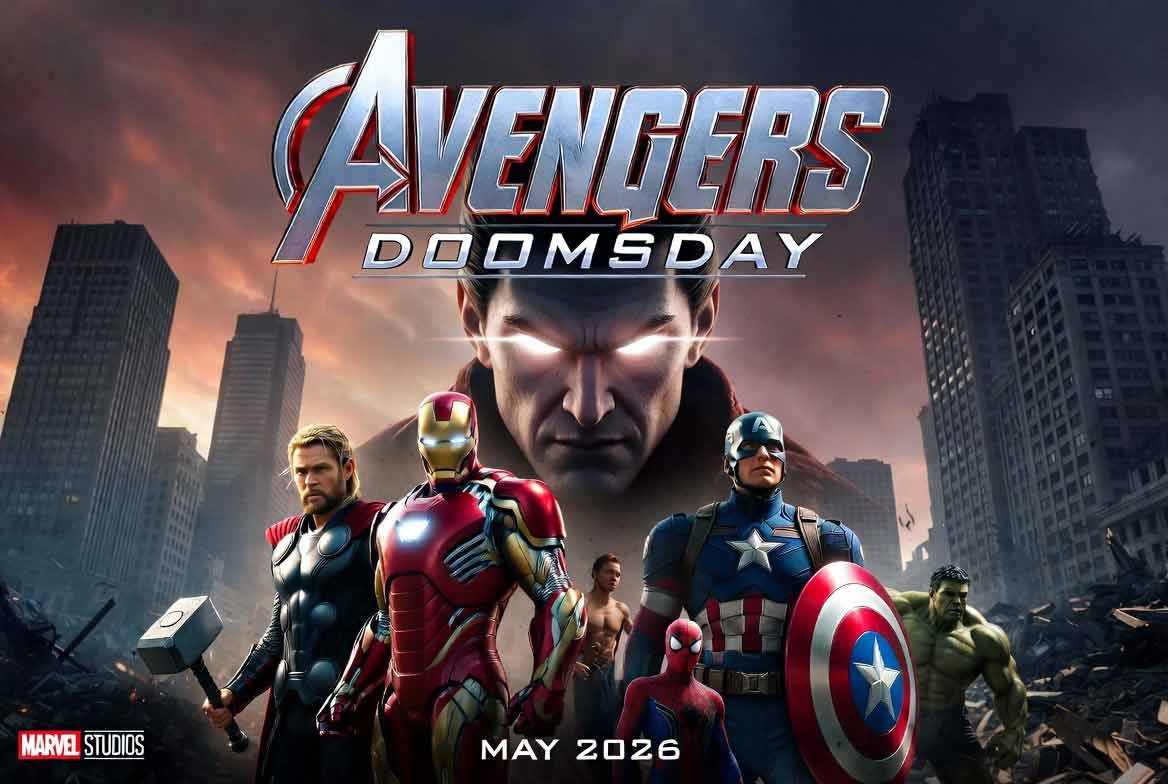
Resurrection, in mythology, is never a simple return. It is a transformation. The figure who emerges from the underworld does not come back the same — they come back changed, carrying the knowledge of darkness, wearing a new face shaped by what they survived. When Marvel Studios president Kevin Feige walked off the Hall H stage at San Diego Comic-Con in July 2024 and Robert Downey Jr. stepped forward from beneath a Doctor Doom mask, uttering the now-famous line “New mask, same task,” the entire entertainment world understood it was witnessing something far more complex than a nostalgic callback. It was witnessing a calculated act of institutional reinvention — a studio betting its most valuable franchise on the audacity of a single casting decision.
The stakes could not be higher. Avengers: Doomsday, set for release on December 18, 2026, is not merely a superhero film. It is a corrective measure, a creative recalibration, and, if executed properly, the opening act of Marvel’s second golden era.
How Marvel Got Here: The Collapse of the Kang Gambit
To understand why the RDJ-as-Doom casting carries such strategic weight, you have to understand the wreckage it was built on.
Following the thunderous conclusion of Avengers: Endgame in 2019 — a film that earned $2.798 billion globally and stands as the second-highest-grossing film in history — Marvel entered what critics and analysts now describe as a prolonged creative trough (Box Office Mojo, 2024). The studio’s Phase Four and early Phase Five output, while commercially viable, failed to generate the cultural electricity of the Infinity Saga. Films like Ant-Man and the Wasp: Quantumania underperformed both critically and commercially, and the television slate, despite individual bright spots, diluted the sense of cinematic event that had defined the franchise’s first decade.
The studio’s original plan for the Multiverse Saga’s climax centered on Kang the Conqueror, played by Jonathan Majors, as the primary antagonist. Majors was introduced in the Loki Disney+ series and positioned as the next Thanos-level threat. The plan unraveled swiftly and publicly. In December 2023, following his conviction on assault and harassment charges, Majors was fired by Marvel, leaving the studio without a villain, without a clear narrative direction, and with two Avengers films already locked into the release calendar (Variety, 2024).
Kevin Feige’s response to that crisis is what separates him from most studio executives. Rather than retrofit a lesser solution — recast Kang, manufacture a new villain from scratch, or delay indefinitely — he reached for something almost counterintuitive: the most beloved character in the franchise’s history, in a completely new role.
The Architecture of a Bold Decision
It was Feige’s idea to reinsert Downey into the MCU as Doctor Doom. The pitch was as elegant as it was daring: the actor who built the Marvel Cinematic Universe from the ground up, who embodied its moral center for eleven years across ten films, would now return as its greatest villain. Not as a ghost of Tony Stark, not as a variant wearing familiar clothing — but as Victor von Doom, one of the most intellectually formidable, morally complex antagonists in comic book history.
Downey made one condition of his own: the Russo Brothers were the only directors he would work with. That condition was not a contractual reflex. It was a creative declaration. After a decade playing Iron Man, Downey understood the gravity of what he was being asked to do — and he understood that only Anthony and Joe Russo, the architects of The Winter Soldier, Civil War, Infinity War, and Endgame, possessed the narrative intelligence to frame the transformation properly.
The Russo Brothers initially said no. They were resistant for a while — even after Downey approached them directly. What ultimately moved them was not the money, though the reported figures are staggering. It was the story itself. Once Stephen McFeely — their longtime writing partner on four MCU films — came to them with a narrative architecture that genuinely excited them, they entered talks to direct both Doomsday and its sequel, Avengers: Secret Wars (Variety, 2025).
The Russo Brothers’ previous Avengers films made over $4.85 billion at the box office combined — a record that defines the commercial ceiling the studio is attempting to reclaim.
Why Doctor Doom Is the Right Character
Victor von Doom is not a villain in the traditional blockbuster sense. He is not chaos for chaos’s sake. He is not nihilism dressed in spectacle. Doom is a sovereign — the absolute ruler of Latveria, a man of towering intellect, technological genius, and a code of honor so rigid it functions almost as its own moral philosophy. He believes, with complete sincerity, that the world would be better under his rule. That conviction is precisely what makes him so dangerous, and so fascinating.
The conceptual overlap between Tony Stark and Victor von Doom is not incidental — it is the entire engine of this casting. Both men are defined by brilliant minds, armored exteriors, and an unshakeable belief in their own supremacy. The difference is the direction that belief points. Stark’s genius was ultimately turned outward, in service of others, at the cost of his life. Doom’s genius turns inward and then expands — in service of himself, and in his own estimation, in service of everyone whether they consent or not.
Casting Downey in this role invites the audience to perform a kind of moral archaeology on the character they loved for a decade. Every scene with Doom will carry the ghost of Tony Stark — not as a narrative crutch, but as a philosophical counterweight. Audiences will be watching, consciously or not, for the moments where the line between heroism and tyranny is thinner than they assumed.
Joe Russo described Downey as “so immersed in it, so dialed in,” noting that he was writing backstory and developing costume ideas — calling it “a real opportunity with the character.” That level of actor ownership over a role is rare in franchise filmmaking, and it signals the kind of performance depth that elevates comic book cinema into something closer to genuine dramatic art.
The Ensemble: A Convergence of Marvel’s Three Eras
Doomsday is not simply about Robert Downey Jr. It is about assembling the full breadth of Marvel’s cinematic history into a single narrative event — and the cast list reads accordingly.
The confirmed cast includes Pedro Pascal, Chris Hemsworth, Vanessa Kirby, Anthony Mackie, Letitia Wright, Sebastian Stan, Florence Pugh, Patrick Stewart, Ian McKellen, Alan Cumming, Rebecca Romijn, James Marsden, and Channing Tatum, among many others. This is not merely a reunion. It is the deliberate fusion of three distinct Marvel cinematic generations: the original Avengers era, the post-Endgame new guard, and the newly integrated X-Men from Fox’s now-absorbed franchise.
Chris Evans was confirmed to be returning as Steve Rogers, with the Russo Brothers stating they could not imagine telling this story without Rogers having a central role. That confirmation carries enormous narrative significance. Rogers and Stark defined the moral architecture of the Infinity Saga together — their alliance and their fracture were the emotional spine of Civil War. Bringing Rogers back into a story where Stark now wears the face of the enemy reframes their entire shared history.
Filming began in April 2025 at Pinewood Studios in England, with location photography also taking place in Bahrain, and wrapped in September 2025. The scale of that production — months of principal photography across international locations — reflects the ambition of the undertaking.
The Business Calculus Behind the Renaissance
Marvel’s decision to restructure the Multiverse Saga around Downey and the Russo Brothers is inseparable from business reality. The studio’s Phase Four and Five output generated criticism for narrative incoherence — too many streaming series, too many characters, too diffuse a storyline to sustain audience investment at the theatrical level (The Hollywood Reporter, 2023).
RDJ is reported to make close to $100 million for Doomsday and Secret Wars combined. The Russo Brothers are reportedly receiving $80 million for both films, not including performance bonuses tied to crossing the $750 million and $1 billion marks at the box office. Those figures, if accurate, represent a studio willing to pay generational money to buy back generational trust.
The strategy is sound. Marvel’s foundational problem in its post-Endgame period was not a lack of content — it was a loss of stakes. When audiences cannot feel the weight of what might be lost, spectacle becomes noise. By returning to the actor who made audiences genuinely grieve a fictional character’s death in 2019, Marvel is not retreating into nostalgia. It is leveraging the deepest emotional investment its audience has ever placed in the franchise as the foundation for something genuinely new and threatening.
The Philosophical Dimension: Transformation as Narrative Strategy
There is a concept in Jungian psychology called enantiodromia — the idea that every force, pushed to its extreme, eventually transforms into its opposite. The hero who never falters eventually becomes the tyrant. The protector who cannot relinquish control becomes the oppressor. Tony Stark spent eleven years bending toward that edge without crossing it. Victor von Doom crossed it long ago — and built a kingdom on the other side.
What Avengers: Doomsday is structurally positioned to explore, if the Russos and McFeely execute with the same precision they brought to Infinity War, is not simply a battle between heroes and a villain. It is a meditation on what it means when the qualities we celebrate in a hero — certainty, intelligence, the willingness to act without consensus — become unmoored from compassion. Doom is not a broken Stark. He is a completed one, a version of the same archetype in which ambition was never tempered by love.
That is not a comic book premise. That is tragedy in the classical sense.
The release of Avengers: Doomsday on December 18, 2026 will be one of the most scrutinized cinematic events of this decade. It carries the weight of a studio’s commercial survival, the expectations of a global audience that loved Tony Stark deeply enough to mourn him, and the creative ambitions of two directors and an actor who have nothing left to prove and everything to create. Whether it succeeds or stumbles, the decision to cast Robert Downey Jr. as Doctor Doom will be studied in film schools and marketing departments for years — as either a masterstroke of institutional reinvention or a cautionary tale about the limits of nostalgia.
The evidence, as it stands today, points toward the former. The armor has been forged. The mask has changed. And the task, as Downey himself put it with characteristic precision, remains the same: make the audience feel something they have never felt before.
Sources
- Box Office Mojo. (2024). Avengers: Endgame worldwide box office. https://www.boxofficemojo.com/title/tt4154796/
- Variety. (2024). Marvel announces Robert Downey Jr. and Russo Brothers return for Avengers: Doomsday. https://variety.com
- Variety. (2025, March). Russo Brothers originally said no to Avengers: Doomsday. https://variety.com/2025/film/news/russo-brothers-said-no-avengers-doomsday-secret-wars-1236345671/
- Variety. (2025, March). Robert Downey Jr. writing Doctor Doom backstory and costume ideas. https://variety.com/2025/film/news/robert-downey-jr-writing-doctor-doom-backstory-avengers-doomsday-1236328335/
- BGR. (2025, December). Robert Downey Jr. agreed to star in Avengers: Doomsday under one condition. https://www.bgr.com/2055294/robert-downey-jr-marvel-avengers-doomsday-condition/
- The Walt Disney Company. (2024). Marvel Studios announces Robert Downey Jr. and the Russo Brothers to return. https://thewaltdisneycompany.com/news/marvel-studios-announces-robert-downey-jr-and-the-russo-brothers-to-return-for-avengers-doomsday/
- Rotten Tomatoes. (2026). Everything we know about Avengers: Doomsday. https://editorial.rottentomatoes.com/article/everything-we-know-about-avengers-doomsday/
- The Hollywood Reporter. (2023). Marvel’s post-Endgame struggles: what went wrong in Phase Four.
- Wikipedia. (2025). Avengers: Doomsday. https://en.wikipedia.org/wiki/Avengers:_Doomsday