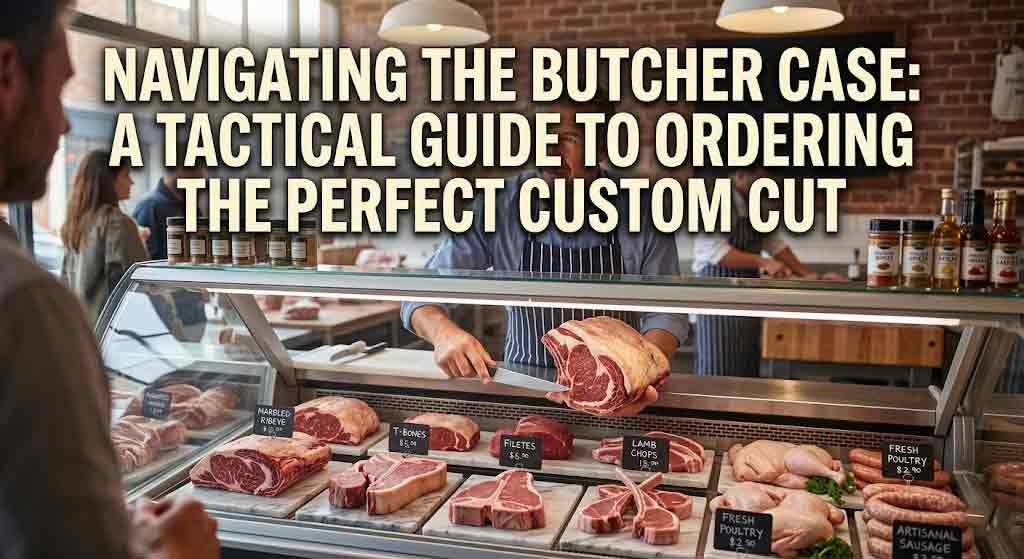
Most people approach a butcher counter the way they approach an unfamiliar wine list — with vague intentions, a low-grade anxiety, and a tendency to default to whatever looks familiar. They point at something behind the glass, mumble a weight, and leave with a vacuum-sealed package that may or may not match what they actually wanted for dinner. It does not have to be this way.
A full-service butcher case is one of the last places in American food retail where genuine expertise is still freely offered across the counter. The butcher behind it has likely spent years — sometimes decades — learning the architecture of an animal, understanding how muscle function shapes flavor, and developing the knife skills to transform a primal into something specific to your needs. The tragedy is that most customers never tap into that knowledge. They treat the butcher as a cashier rather than a craftsman. This guide exists to change that.
Whether you are shopping at an independent neighborhood shop, a farm-direct processor, or the meat department of a high-quality grocer, knowing how to communicate precisely at the butcher case will transform what ends up on your plate.
Know the Structure of the Animal Before You Walk In
Every cut of beef — every steak, roast, and braise — originates from one of eight primal sections: the chuck, rib, loin, round, brisket, plate, flank, and shank. These primals are the large, foundational sections that a side of beef is divided into before individual cuts are made. Understanding their geography is the single most useful piece of knowledge you can carry into a butcher shop.
The front quarter of the animal — the chuck, brisket, shank, and plate — contains muscles that work hard throughout the animal’s life. Hard-working muscle means more connective tissue, more collagen, and more complexity of flavor. These cuts reward patience: low heat, long time, braising liquid. The chuck, which accounts for roughly 28 percent of carcass weight, yields the flat iron, the Denver steak, the chuck roast, and the foundation of a proper ground beef blend. The brisket, pulled from the breast area beneath the chuck, is arguably the most discussed cut in American barbecue culture — and for good reason. Its dense collagen, when broken down slowly over smoke and time, renders into gelatin that produces the unctuous, yielding texture that defines great Texas brisket.
The hind quarter tells a different story. The loin — located just behind the ribs, along the top of the animal — is the least-exercised region of the steer, and therefore the most tender and the most expensive. This is where the short loin lives, source of the T-bone, the porterhouse, the New York strip, and the filet mignon. The rib primal, sitting between the chuck and the loin, is the origin of the ribeye, prime rib, and the tomahawk. These cuts are high in intramuscular fat (marbling), built for dry heat, and at their best when cooked quickly over high flame or searing cast iron.
The round — the rear leg — is lean, firm, and best suited for slow roasting, thin slicing, or grinding. The flank and plate, situated at the animal’s underside, are intensely flavored but require either marinating and high-heat cooking (flank steak, skirt steak) or long braising (short ribs, hanger steak).
A working knowledge of these primals allows you to have a real conversation at the counter. Asking for “something from the chuck that I can grill” signals competence, invites collaboration, and often leads the butcher to suggest cuts you would never have found on your own — like the Denver steak, a seam-butchered cut from the chuck flap with exceptional marbling and the depth of flavor associated with well-worked muscle. (Porter Road, a well-regarded farm-to-table butcher, describes it as a cut that requires skilled seam butchery to properly extract — the kind of labor that independent butchers do, and that most grocery stores simply do not.)
Understand USDA Grades and Aging Before You Ask for Quality
When a butcher or a label uses the word “quality,” it typically refers to two measurable things: USDA grade and the aging method used. Understanding both gives you a concrete vocabulary for expressing what you want.
The USDA grades beef on a scale that rewards marbling — the intramuscular fat distributed throughout the muscle tissue. USDA Prime represents the top of that scale, with the highest degree of marbling, and accounts for only 8 to 10 percent of all beef produced in the United States. USDA Choice, the next tier, offers excellent quality with somewhat less marbling and is the most commonly available grade at quality butcher shops. Select, the third tier, is leaner and less flavorful, appearing most often at supermarkets in the economy cut range.
Aging is a separate conversation. Dry-aging involves holding large primal cuts in a climate-controlled environment — precise temperature, humidity, and airflow — for a period of time, typically 21 to 45 days or longer. During this process, natural enzymes break down muscle tissue, tenderizing the meat while evaporative moisture loss concentrates the beef flavor into something more complex and nutty than fresh-cut product. Wet-aging, by contrast, involves vacuum-sealing the same primal cuts and allowing enzymatic tenderization without moisture loss — a faster, more economical method that improves tenderness but does not deliver the same flavor concentration. Snake River Farms, which partners with Prime Food Distributor in New York, ages all subprimals to a minimum of 30 days under controlled conditions before cutting to order.
When you approach the counter, it is entirely appropriate to ask whether the shop dry-ages its own beef, what grade they carry, and how long a particular primal has been aging. Good butchers will answer without hesitation. Evasion is itself informative.
Speak the Language of Thickness, Portion, and Packaging
Custom ordering is fundamentally about precision in communication. Once you have identified the cut you want, your next task is to specify how it should be prepared for you. Butchers field this kind of request constantly, and the more specific you are, the better the outcome.
Thickness matters more than most home cooks realize. A ribeye cut at three-quarters of an inch will cook through quickly — it can easily overshoot medium-rare on a hot grill. The same ribeye at one and a half to two inches gives you the thermal latitude to develop a proper crust while the interior climbs gradually to temperature. The tomahawk steak — a bone-in ribeye with the long rib bone left intact and frenched for presentation — is typically cut to a thickness of approximately two inches precisely to accommodate the reverse-sear or two-zone grilling approach that its size demands. If you want a steak that works with indirect heat and a finishing sear, ask for it cut thick. If you are feeding a crowd and planning to slice the meat for service, ask for the whole sub-primal roast and let the butcher tie it.
Portions per package is a question worth raising for any custom order. Two steaks per package is the most common configuration, but if you are cooking for one or freezing individual portions, single-wrapping is an available option — usually at a small additional cost due to the extra labor and packaging material involved.
Fat trim level is another variable that rarely gets discussed at the counter. Some cuts — the picanha, for example, a top sirloin cap cut prized in Brazilian churrascaria tradition — are defined by their fat cap. That thick layer of exterior fat is the entire point: it bastes the meat as it cooks, delivers extraordinary juiciness, and should not be trimmed away. Porter Road’s butchers specifically cut picanha along its natural seams to preserve it intact, noting that lazy butchers often leave it connected to the top sirloin and never separate it at all. When you are ordering a cut where fat is a feature rather than a flaw, say so explicitly.
Build a Relationship, Not Just a Transaction
The most useful piece of advice for navigating a butcher case does not involve primal cuts or USDA grades. It involves the human being standing behind the counter.
A skilled butcher is a practitioner of a trade that takes years to master. The industry’s best practitioners understand the full anatomy of the animal, the behavioral differences between breeds, the ways that feed and finishing affect fat composition, and the logistics of whole-animal utilization — turning every part of a carcass into something useful. When you walk in with curiosity rather than a rigid demand list, you open the door to recommendations that you would never have discovered on your own.
Ask what came in fresh that week. Ask what the butcher would cook for themselves if they had to pick one thing from the case today. Ask about the less familiar cuts — the hanger steak, the bavette, the oyster steak, the flat iron — that skilled shops carry and that offer exceptional value relative to their flavor profile. As butcher Kevin Fruth of Goose the Market has said in interviews, “If you don’t see what you want, there’s no harm in seeing if your butcher can order it in or cut something differently.” Most people never ask. Most people leave without knowing what was possible.
Regular customers at independent butcher shops often develop a shorthand with the staff: a weekly call-ahead, a standing order, a relationship built on shared culinary curiosity. That relationship pays compounding dividends — priority on hard-to-get cuts, advance notice when something exceptional comes through, and the kind of personalized service that the grocery store meat department structurally cannot provide.
Plan for Specialty Cuts and Large Orders in Advance
Some cuts require lead time. Dry-aged roasts, tomahawks, whole tenderloins, specialty sausage blends, and cuts like the Denver steak — which requires the skill of seam butchery to properly extract from the chuck flap — may not be sitting in the case on any given afternoon. For these, a call or message ahead of time is not just courteous; it is the difference between walking out with what you wanted and settling for what was available.
For households looking to buy in volume, many independent butchers and farm-direct processors offer quarter or half-animal programs. These arrangements involve a cut sheet — a detailed order form that walks you through every primal and asks you to specify thickness, portion size, packaging preference, and what to do with less familiar sections (soup bones, organ meats, fat for rendering). The cut sheet is not intimidating once you understand the logic of the animal. It is, in effect, a conversation about priorities: more ground beef means less roast; whole brisket instead of half means a single large cook rather than two smaller ones.
Vacuum-sealed freezer packs, properly stored, hold quality for an extended period. The economics of buying in bulk at farm-direct prices, then having the product cut and packaged to your exact specification, often compare favorably to purchasing individual retail cuts at a premium over time.
The Anatomy of a Perfect Request
To consolidate the above into something actionable, consider what a well-framed request sounds like when it comes to the counter.
A vague request: “Can I get a steak?”
A precise request: “I’d like two bone-in ribeyes, cut about an inch and three-quarters thick, with minimal exterior fat trim. If you have anything dry-aged, I’d prefer that. I’m going to reverse-sear them, so the thickness matters.”
The second request gives the butcher everything they need to produce the cut that will actually deliver what you want at the table. It signals that you understand the relationship between thickness and cooking method, that you have a preference about fat, and that you are open to product recommendations within your parameters.
That same specificity applies to roasts, to ground beef fat ratios (80/20 for burgers, 90/10 for meat sauce), to whether you want your brisket whole or split, to whether the rib bones should be left on a standing prime rib or frenched. The butcher cannot read your mind. But they can execute your vision with precision once you give it to them.
The Counter as Classroom
The butcher case, approached correctly, is one of the most educational environments in the food world. Every cut behind the glass has a story — a muscle group, a cooking method, a flavor profile shaped by the animal’s anatomy and the butcher’s decisions. Engaging with that story, rather than bypassing it for the path of least resistance, is how a cook becomes a better cook.
The independent butcher shop is also, in an era of relentless food commoditization, one of the few places where quality is still legible. Where the sourcing is traceable, the cutting is skilled, and the person behind the counter can tell you not just what a cut is, but where it came from, how it was aged, and what you should do with it when you get home.
That conversation starts at the counter. Walk up to it ready to participate.
Sources
- Frazie’s Meat & Market — Custom Butcher Cuts Guide: https://fraziesmeatandmarket.com/custom-butcher-cuts/
- Wild Country Meats — How to Order Meat from a Meat Case: https://www.wildcountrymeats.com/how-to-order-meat-from-a-meat-case-at-your-local-butcher-or-meat-market/
- Neighborhood Butchers — How to Order Custom Cuts Like a Pro: https://neighborhoodbutchers.com/how-to-order-custom-cuts-butcher-guide/
- Feast & Field — Butcher Talk: How to Order at the Meat Counter: https://feastandfield.net/read/meat-and-seafood/butcher-talk-how-to-order-at-the-meat-counter/
- BBQ Guys — Basic Cuts of Beef: Primal Cuts & Best Uses: https://www.bbqguys.com/a/39986/grillabilities/basic/cuts-of-beef
- Christensen Ranch — Beef Cuts Explained: https://www.christensenranch.com/cuts-of-beef/
- Porter Road — Denver Steak: https://porterroad.com/products/denver-steak
- Porter Road — Picanha: https://porterroad.com/products/picanha
- Snake River Farms — Dry-Aged Tomahawk Steak: https://snakeriverfarms.com/products/dry-aged-usda-prime-tomahawk
- Workforce LibreTexts — Primal and Subprimal Beef Cuts: https://workforce.libretexts.org/Bookshelves/Food_Production_Service_and_Culinary_Arts/Meat_Identification_and_Fabrication_(Welsch_and_Thibodeaux)/04:_Beef_Identification_and_Fabrication/4.01:_Primal_and_Subprimal_Beef_Cuts
- Blondie’s Butcher Shop — Custom Cut Sheet Guide: https://blondiesbutchershop.com/blog/basic-cut-sheet-and-meat-processing-order-options/