Before Long Island was a bedroom suburb of New York City — before the Levittown developments poured concrete over what had been open fields, before Route 25A became a corridor of strip malls and traffic lights — it was, above all else, a potato island. By the 1940s, nearly 80% of all farming on Long Island was dedicated to a single crop, the humble spud, with over 70,000 acres under cultivation and more than a thousand farms spanning the North and South Forks into Suffolk County (LongIsland.com, 2020). The land that is now the North Shore’s manicured lawns and vineyard estates was once a working agricultural engine, feeding New York City and much of the Eastern Seaboard one harvest at a time.
Out of that agricultural abundance — and the wartime scarcity that ran alongside it — came a confection that most people today have never heard of: potato candy. It required no oven, almost no skill, and only a handful of ingredients, two of which were nearly impossible to waste. It was born from necessity and refined by ingenuity. And its quiet history is a window into what everyday life tasted like on Long Island during some of the most consequential years of the twentieth century.
The Island That Ran on Potatoes
To understand potato candy, you first have to understand what Long Island’s agricultural identity actually was before the postwar suburban transformation erased it almost entirely. The North and South Forks were ideally suited to potato cultivation. The sandy, well-drained glacial soil, the temperate maritime climate buffered by the Sound and the Atlantic, and the proximity to one of the world’s great urban markets made Suffolk County a potato powerhouse unlike almost anywhere else on the East Coast (Long Island Farm Bureau).
Families like the Wesnofskes — German-speaking Polish immigrants who arrived in the 1870s, settled near the Queens-Nassau border, and eventually pushed east across the island — were emblematic of Long Island’s farming culture. By 1948, their descendants were farming in Melville, using mechanical loaders and early combines, turning the land with the kind of methodical devotion that gets passed down through generations rather than taught in classrooms (Potato News Today, 2020). The first Long Island Potato Festival had already been held in Riverhead in 1937, advertised nationally as a campaign on behalf of Long Island potato growers, complete with a mountain constructed from more than a thousand bushels of spuds (Montauk Library, 2021).
The potato was not just an agricultural product here. It was a cultural anchor.
Wartime Rationing and the Problem of Sweetness
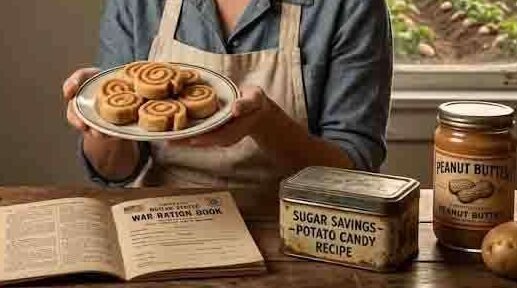
When the United States entered World War II, the federal government established a comprehensive rationing system in 1942 that limited household purchases of sugar, coffee, meat, butter, and other essentials (Living History Farm). Sugar was one of the first and longest-lasting rationed commodities — restrictions began in 1942 and didn’t fully lift until 1947. Each American family received ration books with monthly stamps, and when the sugar stamps ran out, they ran out. There was no workaround, no supplement, no corner to cut — unless you were creative enough to find one (National Women’s History Museum).
The effect on home cooking was profound. Desserts became rare events. Candy — once an everyday indulgence — became something families planned for, saved for, and engineered around. The challenge for farmhouse kitchens across Long Island was particularly sharp-edged: how do you make something sweet when your sugar ration is spoken for, your children are asking, and your pantry is otherwise full of the most neutral-flavored vegetable on earth?
The answer, it turned out, was to make the potato do the work.
The Chemistry of a Humble Candy
Potato candy is not a recipe so much as it is a demonstration of the potato’s chemical versatility. A boiled and mashed potato is essentially a sponge of cooked starch and water. When you begin working powdered sugar into that warm, wet mass, something remarkable happens: the starch absorbs enormous quantities of the sugar — cup after cup — until the moisture is bound up and the mixture transforms into a pliable, workable dough. No baking required. No cream, no eggs, no butter.
The method involves mixing mashed potatoes with large amounts of powdered sugar to create a dough-like consistency, which is then rolled flat, spread with a filling — traditionally peanut butter — and rolled into a log, which is then refrigerated until firm and sliced into pinwheel rounds. The potato itself essentially disappears into the candy. Its flavor is so neutral that a skilled baker could fold in peppermint, coconut, chocolate, or citrus and the potato would offer no resistance, no competing note, no trace of the field it came from. As one Depression-era account described the process, the hotter the potato, the more sugar it would take — children were amazed at how much sugar would disappear into that small bit of potato, and how much dough was made in the end.
Many believe the recipe was introduced by the Pennsylvania Dutch, for whom finding delicious uses for leftover potatoes was a common frugal practice. Broader origins likely trace to European immigrants to the Appalachian region, possibly from Russian, Irish, or German traditions carried to America in the late 18th and early 19th centuries. But origin stories in folk cuisine are slippery things. What matters more than where it started is where it landed — and on Long Island in the 1940s, with potatoes in limitless supply and sugar strictly rationed, it landed squarely in the farmhouse kitchen.
Long Island’s Own Potato Candy Tradition
The evidence that potato candy had roots on Long Island predates the 1940s rationing era by several decades. At a Potato Day dinner in Amagansett in 1915, described by the East Hampton Star, two attendees introduced novelty recipes to wide acclaim — “potato candy,” which was said to deserve the name “ambrosia,” and a potato cake that tasted like a delicious spice fruit cake. That this confection was being served at a celebratory dinner dedicated to the Long Island potato — decades before sugar rationing forced the issue — suggests it was already part of the region’s culinary vocabulary, not a wartime improvisation.
During the 1940s, the conditions simply made that vocabulary more necessary. Sugar rationing during the war years made candy and sweet baked goods rarer treats than they had been before the war, forcing families to either skip desserts entirely, find alternate ways to make them, or carefully save their rations for special occasions like birthdays and Christmas. On Long Island’s working farms, where potatoes were never in short supply but cash and rationed goods certainly were, potato candy offered a solution that required nothing exceptional — just the crop that was already stacked in the root cellar.
The peanut butter filling, which became the most popular variation, carried its own Depression-era logic. Peanuts and potatoes both tolerate and even help replenish harsher soils, and powdered sugar was cheaper than pure cane sugar — making potato candy an ideal sweet for a bitter set of years. By the 1940s, peanut butter was a well-established American pantry staple, affordable and rationing-exempt, and it provided the fat and protein that turned a sweet novelty into something genuinely satisfying.
The Craft of Making It Right
There is a craft dimension to potato candy that gets overlooked when people frame it as Depression-era desperation food. The margin between good potato candy and grainy, sticky, collapsed potato candy is narrow, and it depends entirely on technique.
The potato must be mashed absolutely smooth — lumps translate directly into texture failures in the final candy. The potato must be warm when the powdered sugar is worked in, because heat drives the absorption. The dough must be rolled thin enough that the peanut butter filling creates a visible spiral when sliced, but not so thin that the log collapses when refrigerated. Refrigeration is non-negotiable — without the cold to firm the log, slicing produces a smear rather than a pinwheel. Most sources indicate a shelf life of roughly one to two weeks when properly stored.
Flavor variations were as diverse as the families making them. Accounts from the era describe additions of coconut, chocolate, peppermint, rum extract, banana flavoring, and food coloring for holiday versions — green for Christmas, pink for Valentine’s Day. The base recipe was a template, not a constraint. That improvisational quality is part of what made potato candy durable across generations: it gave cooks something to make their own.
What Happened to Long Island’s Potato Culture
The postwar decades were not kind to Long Island farming. Potato farming reached its apex in the late 1940s with over 70,000 acres and a thousand farmers, but by 1968 that had fallen to 12,450 acres, and by the mid-1990s to approximately 8,600 acres. The Levittown model of mass suburban development consumed farmland at a pace that the agricultural economy could not survive. Farmers sold. Fields became streets. Root cellars became basements. And the kitchen traditions that depended on a surplus of cheap, abundant potatoes faded with the farms that grew them.
Today, Suffolk County remains the fourth most valuable agricultural area in the United States by some measures, and potato farming — though reduced to a fraction of its former scale — continues on the East End (Long Island Farm Bureau). But the cultural centrality of the potato has been replaced by wine grapes, farm stands, and the boutique agriculture of the modern locavore economy. Potato candy has survived only in the memory of families who made it and in the margins of regional food history — a confection too humble to be celebrated, too ingenious to be entirely forgotten.
A Sweet Worth Reviving
What makes potato candy worth revisiting now isn’t nostalgia alone. It’s the lesson embedded in its construction: that the best cooking has always been adaptive. That constraint produces creativity. That a kitchen with one abundant ingredient and a shortage of everything sweet can still produce something worth making.
The farmhouse kitchens of 1940s Long Island didn’t have access to artisan pantries or specialty grocers. They had ration books, root cellars, and a surplus of the most versatile vegetable in the American larder. What they made from those materials — coaxing sweetness from starch, building texture from nothing, creating tradition from necessity — deserves to be remembered not as a curiosity but as a craft. The kind of craft that, at its best, makes something extraordinary out of whatever is at hand.
That instinct — to find what’s already in front of you and make it into something worth sharing — is older than any recipe, and more durable than any trend.
Sources
- LongIsland.com. (2020). Five Crazy Facts From Long Island Food History. https://www.longisland.com/news/10-05-20/five-crazy-facts-from-long-island-food-history.html
- Potato News Today. (2020). Down History Lane: Old Time Pictures of Potato Farming on Long Island. https://www.potatonewstoday.com/2020/02/21/down-history-lane-old-time-pictures-of-potato-farming-on-long-island/
- Montauk Library. (2021). Throwback Thursday – Celebrating the Long Island Potato. https://montauklibrary.org/throwback-thursday-celebrating-the-long-island-potato/
- Long Island Farm Bureau. History of LI Farming. https://www.lifb.com/history-of-li-farming-1
- National Women’s History Museum. Food Rationing and Canning in World War II. https://www.womenshistory.org/articles/food-rationing-and-canning-world-war-ii
- Living History Farm. Rationing in the 1940s. https://livinghistoryfarm.org/farming-in-the-1940s/rationing/
- Wikipedia. Potato Candy. https://en.wikipedia.org/wiki/Potato_candy
- What’s Cooking America. Old Fashioned Mashed Potato Candy Recipe. https://whatscookingamerica.net/candy/potatocandy.htm
- True Treats Candy. The Ever-Mysterious Christmas Potato Candy. https://truetreatscandy.com/blogs/article/the-ever-mysterious-christmas-potato-candy
- HeraldNet. Fond Stories of 1930s Potato Candy. https://www.heraldnet.com/life/fond-stories-of-1930s-potato-candy/