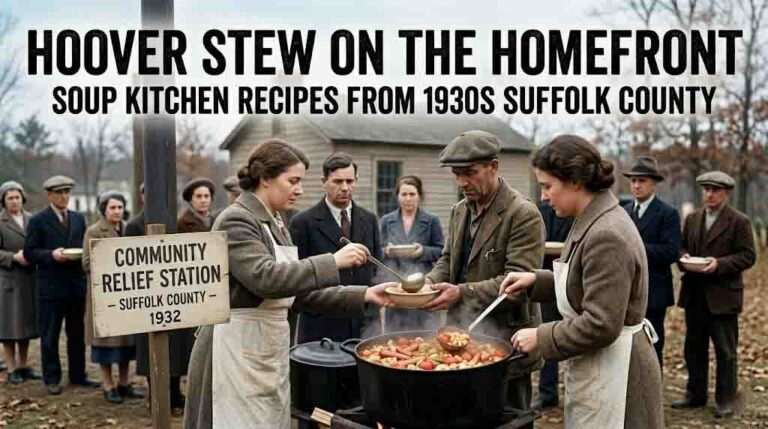
Walking the grounds of Long Island’s Gold Coast today, you would never guess that the same immaculate lawns rolling out beneath century-old oaks were once harvested by hand — not by the gardeners employed to manicure them, but by the very immigrant workers who tended those grounds, stooping low between estate hedgerows to pull up the one crop no one planted and no one could stop from growing: the common dandelion.
The North Shore in the 1930s was a study in contradiction. Behind wrought-iron gates, the great families — the Vanderbilts, the Guggenheims, the Morgans, the Pratts — occupied their sprawling country houses in Sands Point, Oyster Bay, Lloyd’s Neck, and Cold Spring Harbor. But the Depression had cracked even those gilded walls. The estate era was entering its long, irreversible decline, accelerated by income taxes, crumbling fortunes, and the rising costs of maintaining what had been built during the Gilded Age excess of the 1890s and 1920s. Beyond the estate gates, for the Italian immigrants working as landscapers and groundskeepers, for the African American domestics and Greek kitchen staff, for the families tucked into modest houses along Route 25A and the surrounding North Shore hamlets — survival demanded creativity. And in that necessity, the dandelion became one of the great unsung foods of the Depression era.
The Gold Coast at Its Breaking Point
At the height of the Gold Coast era, Long Island’s North Shore held the highest concentration of private wealth anywhere in the country. In the 1910s and 1920s alone, more than 325 country houses of over 25 rooms were constructed between Great Neck and Centerport. Behind the gates, teams of household maids, cooks, groundskeepers, chauffeurs, stablehands, and dairymen attended to the estates’ every need. Many of these workers — particularly Italian immigrants — had arrived on Long Island beginning in the 1880s, initially finding work as landscapers on Gold Coast estates, in the sand mines of the North Shore, and extending the lines of the Long Island Rail Road.
When the Depression struck after the 1929 crash, construction halted nearly overnight across the North Shore. By 1930, the Works Progress Administration and Home Relief offices were opening in Long Island villages. Families of means donated clothes and food to local churches, but for the working poor — the estate gardeners, the domestics, the service workers in the small towns flanking Route 25A — the crisis was immediate and grinding. It was in this context that the deep foraging knowledge brought by immigrant communities became not a quaint Old World habit but an urgent means of nutritional survival.
What the Italians and Greeks Already Knew
Italian immigrants had carried foraging knowledge across the Atlantic as carefully as they carried fig cuttings and grape vine cuttings in steamer trunks. In Italy, foraging was not a hobby but a seasonal rhythm — wild asparagus hunted in April, truffles in autumn, snails and blackberries in summer. When these immigrants arrived in America and saw lawns carpeted in dandelions — cicoria, as they called them — they understood immediately that they were looking at food. Good food. Free food.
Dandelion hunting became a rite of spring in immigrant households across Long Island and the greater New York area. The practice was passed through families like a recipe — Grandmothers who knew which estates had pesticide-free lawns, which roadsides were clean enough to harvest from, which fields along the North Shore offered the most tender early-spring growth. Italian women, returning from work, would stop along the roadside with knives, cutting dandelion heads just below the surface so the whole plant came out cleanly, like a small head of lettuce. The tradition was not lost on Greek families either; Greek immigrants similarly carried deep knowledge of wild plant use, a tradition rooted in Mediterranean necessity stretching back millennia.
The wisdom these communities held was sometimes regarded with suspicion by more “Americanized” neighbors — a skepticism that seems almost comical in retrospect, given that those very neighbors were going hungry while the immigrant families were eating some of the most nutrient-dense food available anywhere in the world.
The Dandelion as a Nutritional Powerhouse
What the Depression-era foragers understood by instinct, modern nutritional science has since confirmed with precision. The dandelion (Taraxacum officinale) is, according to registered dietitian Nancy Geib of the Cleveland Clinic, “probably the most nutritionally dense green you can eat — outstripping even kale or spinach.” A single cup of raw chopped dandelion greens delivers over 100% of the daily recommended value for Vitamin A, significant quantities of Vitamin C, Vitamin K, calcium, iron, and potassium — all for approximately 25 calories.
In a decade when protein was scarce, produce was expensive, and malnutrition was common even in relatively prosperous areas, the dandelion provided what many families desperately needed. Its iron content, enhanced by the presence of Vitamin C in the same plant, was more bioavailable than many other plant sources. Its diuretic properties helped the liver process toxins. Its prebiotic fiber supported the gut health of children and adults who were subsisting on monotonous, low-variety diets of beans, cornbread, and government-issue commodities.
And critically — every part was edible. The leaves went into salads and sautés. The flowers garnished whatever was on the table or were steeped into teas and, among some families, fermented into dandelion wine — particularly valuable during Prohibition, which was still in effect through 1933. The roots were dried and roasted as a coffee substitute when coffee was an unaffordable luxury.
How They Were Prepared: Depression-Era Dandelion Recipes
The dandelion salad of the 1930s was not garnished with shaved Parmesan and dressed with lemon vinaigrette, as we might prepare it today. It was built from what was available: the greens themselves, washed carefully in repeated changes of cold water, dressed with whatever fat was on hand — vinegar, bacon grease, a little rendered lard — and perhaps topped with a sliced hard-boiled egg if the family kept chickens. The goal was not refinement but fortification.
Clara Cannucciari (1915–2013), whose Depression-era cooking was documented on Clara’s Kitchen, described dandelion salad simply and directly: “It’s free, and it’s good for you.” That combination — free and nourishing — was the entire value proposition. There was no waste. Tougher outer leaves were wilted in a pan with olive oil and garlic, a preparation that leached out some of the bitterness while delivering the full mineral content of the cooked green. Young inner leaves were eaten raw. The whole plant served a family.
The Joy of Cooking (1931, Irma S. Rombauer), one of the defining cookbooks of the era, included frugal recipes using foraged greens — a quiet acknowledgment that what immigrant families had been doing for decades was now a mainstream survival strategy. The Depression democratized the dandelion across class lines in a way that nothing else had.
The Geography of North Shore Foraging
Not all terrain was equally suitable. The estate grounds themselves — particularly those in Lloyd’s Neck, Oyster Bay, and Cold Spring Harbor — were often treated with fertilizers and chemicals, making their dandelions unsuitable for harvesting. The workers who knew the land understood this intuitively. They foraged instead along the unmanicured edges: the margins of farm fields, the open meadows between estates, the roadsides of what is now Route 25A, the hillsides and wooded lots of the towns that would eventually become places like Mount Sinai, Port Jefferson, Setauket, and Stony Brook.
The North Shore’s glacially carved landscape — hills, harbors, the north-facing bluffs overlooking Long Island Sound — offered a particular ecology: damp, rich soil, partial shade, the kinds of conditions that produced especially lush dandelion growth in early April and May. The immigrant gardeners who worked those estates knew the land on a cellular level. They understood seasonal timing, they knew which roadside verges had never been sprayed, they knew the weeks when the dandelions were young enough to be sweet rather than bitter. Mid-April to early May was the prime window — once the yellow flowers bloomed across the hillsides, the leaves had toughened and the window had closed for another year.
Why This Matters in 2025
The dandelion’s Depression-era story is not a relic. It is an argument.
At a moment when the American food landscape is saturated with ultra-processed products marketed as “health foods,” when supply chain disruptions have exposed the fragility of the industrial food system, when chronic inflammation, poor gut health, and micronutrient deficiency are epidemic — the dandelion that grows unremarked in every backyard and roadside on Long Island remains what it always was: free, extraordinarily nutritious, and almost entirely ignored.
The foragers of the 1930s North Shore — Italian, Greek, African American, working-class families of every background — were not practicing poverty cuisine. They were practicing deep nutritional wisdom in the only context that existed for them. They were sourcing hyperlocal, seasonal, whole-food greens at zero cost, with zero packaging, zero supply chain, and zero processing. Contemporary nutritional science would give them the highest marks available.
Today, dandelion greens appear occasionally at farmers’ markets across Long Island and at specialty grocers, typically in small bundled bunches. They have been rediscovered by the same food culture that rediscovered fermentation, bone broth, and organ meats — foods that fell out of mainstream fashion precisely because they required knowledge, time, and skill rather than convenience. The dandelion asks only that you know when and where to look, and that you remember what the immigrant grandmothers of the North Shore never forgot: that the land provides, if you are willing to meet it on its terms.
Bringing It Back to the Table
Spring on Long Island’s North Shore arrives quietly, usually in the second or third week of April, when the soil warms enough for the first dandelion rosettes to flatten themselves against lawns and unmowed fields. This is the window. For those with access to pesticide-free land — a backyard, a rural property, a maintained meadow — the practice of harvesting a handful of young dandelion greens in early spring is not a survival exercise. It is a connection to something older than the Gold Coast estates, older than the LIRR, older than the European families who built Long Island into what it is. It is the act of reading the land and understanding that abundance does not always come in packaging.
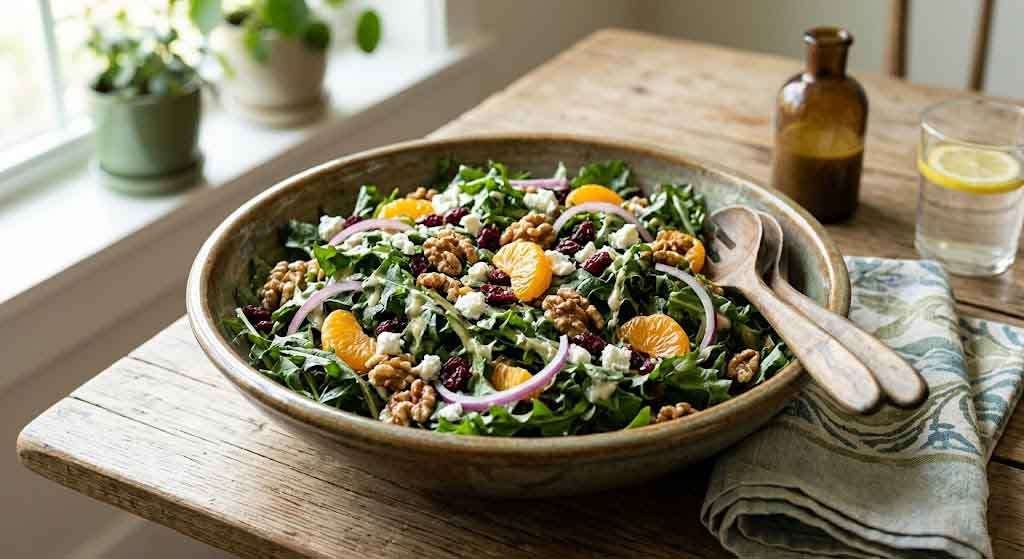
A simple preparation worthy of the tradition: young dandelion leaves, washed well, dressed with good olive oil, a splash of apple cider vinegar, a drizzle of honey, salt, cracked pepper. Toss with whatever is seasonal. Add a soft-boiled egg if you want protein. The flavor is bitter, bright, and alive in a way that nothing grown under artificial light in a warehouse can replicate. It tastes like early spring on the North Shore. It tastes like knowledge.
The people who foraged these grounds during the hardest decade of the twentieth century were not foraging because it was fashionable. They were doing it because they understood something fundamental: that the most valuable things are often the ones no one else has thought to claim.
Sources:
- Spinzia, Raymond E. and Judith A. Spinzia. Long Island’s Prominent North Shore Families: Their Estates and Their Country Homes. Referenced via spinzialongislandestates.com
- Experience Port Washington: 1920s Gold Coast Oral Histories. experienceportwashington.wordpress.com
- Diasporas in Suburbia: Long Island’s Recent Immigrant Past. Long Island History Journal. lihj.cc.stonybrook.edu
- The Italian Garden Project: Foraging for Dandelions. theitaliangardenproject.com
- Homestead Survival Site: Wild Plants People Ate During the Great Depression. homesteadsurvivalsite.com
- Cleveland Clinic: 5 Health Benefits of Dandelions. health.clevelandclinic.org
- Dr. Axe: Dandelion Greens Benefits, Nutrition and Recipes. draxe.com
- Grow Forage Cook Ferment: Dandelion Salad: A Recipe from Grandma’s Time. growforagecookferment.com
- Westport Museum for History and Culture: Dandelion Salad. westporthistory.org
- Wikipedia: History of Long Island. en.wikipedia.org