Eighty years have passed since the last ration book was issued on Long Island, yet the ingenuity born in those wartime kitchens deserves a second look — not as nostalgia, but as instruction. Suffolk County in the 1940s was not just farmland and fishing docks waiting out the war. It was a fully mobilized home front: coastal blackouts, civil defense wardens patrolling Route 25A, victory gardens cut into the same sandy loam that had grown potatoes for generations. And inside those homes, women turned scraps into meals with a resourcefulness that puts today’s “zero-waste cooking” movement to shame.
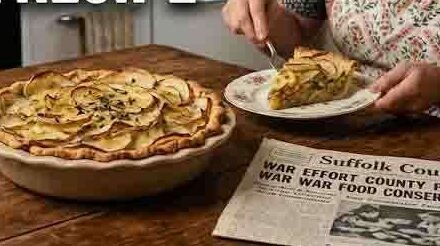
Potato Peel Pie stands as the defining recipe of that era. Utilitarian in its origins, remarkable in what it represents.
The Ration Book Reality: What American Families Actually Faced
When the Office of Price Administration launched the federal rationing program in 1942, it did so with sweeping authority. Every man, woman, and child — including newborns — received ration books containing colored stamps governing what they could purchase. Red stamps covered meat, fish, and dairy; blue stamps handled canned and processed goods. Each adult received 64 red points and 48 blue points per month, a tightly governed arithmetic of sacrifice (National Museum of the Pacific War).
The rationed items read like a pantry inventory: sugar (from May 1942 through 1947 in some regions), coffee, butter, cheese, canned goods, and most cuts of meat. By 1943, a pound of bacon cost both 30 cents and seven ration points — a dual currency that forced families to make choices money alone could not have imposed (National WWII Museum).
For Suffolk County families, many of them still tied to agriculture and the fishing economy of the North Shore and South Fork, rationing landed differently than it did in Brooklyn or Manhattan. Local farms could supplement what the government restricted. A family in Mount Sinai with a half-acre and a decent well was not the same as a tenement household in Flatbush with stamps but no soil. This geographic advantage shaped how Long Island cooks improvised — and potato peel pie was squarely in that tradition.
Origins of the Pie: From Guernsey to the American Kitchen
The history of potato peel pie does not begin on Long Island. It has its clearest roots in the German occupation of Guernsey, a small British Channel Island seized by Nazi forces in June 1940. Cut off from supply lines and facing severe food restrictions imposed by occupying troops, islanders devised the pie as a way to use every part of the potato: the peels pressed into the bottom of a dish to form a rudimentary crust, the flesh boiled and mashed with whatever could be found — beetroot, spring onions, milk when available, salt when it wasn’t (Homesteading Family).
The dish was, by honest account, barely palatable. Diaries from Guernsey residents referred to it plainly as “the desperate pie.” Authentic Guernsey potato peel pie contained only three core ingredients — potatoes, beetroot, and milk — with no butter, no flour, no eggs. What it lacked in taste, it delivered in calories and the psychological comfort of a meal that maintained the ritual of sitting down at a table.
The dish entered wider cultural consciousness through The Guernsey Literary and Potato Peel Pie Society, a novel by Mary Ann Shaffer and Annie Barrows published in 2008 and later adapted as a Netflix film. In the story, the “pie” serves as a cover story — islanders caught breaking German curfew claimed they had been attending a literary society gathering, which they then had to actually create. The pie was the alibi, and the book club became the soul of occupied Guernsey’s resistance (Wikipedia).
Across the Atlantic, a parallel tradition existed in American wartime kitchens, shaped by the same principle of radical frugality. Nothing edible went to waste. Potato peels that would have gone to the compost pile became part of the meal — roasted, incorporated into pies, pressed into fritters. The Ministry of Food’s British approach and the USDA’s American home economics campaigns both arrived at the same philosophy: maximize ingredient potential, treat scraps as ingredients.
Long Island’s Wartime Kitchen: Victory Gardens and the Suffolk Pantry
Suffolk County entered the war years with a fundamental advantage: land. While rationing boards administered point systems in city neighborhoods, North Shore and South Shore families with yards, fields, or even a modest backyard plot could participate in the Victory Garden campaign and meaningfully supplement their rations.
By 1943, an estimated 18 million victory gardens had been planted across the United States, producing vegetables that accounted for roughly 40 percent of the nation’s fresh vegetable supply (National Park Service). On Long Island, where the soil from Riverhead through the North Fork had been farmed commercially for generations, that number is not hard to believe. Families planted kale, cabbage, beets, carrots, and — central to this story — potatoes.
The Suffolk County potato had long been an agricultural staple. Eastern Long Island’s sandy, well-drained soil produces potatoes of exceptional quality, a fact that commercial growers and home gardeners alike understood. During the war years, that local abundance made the potato the anchor of countless wartime meals. And when potatoes are the cornerstone of your pantry, nothing — including the peel — gets discarded.
The USDA’s cooperative extension services, active across New York State during the war, provided guidance not just on planting but on preservation, canning, and resourceful cooking. Women’s magazines of the era — Woman’s Day, Good Housekeeping — ran wartime editions with revised recipes that built entire dishes around what would otherwise be kitchen waste. Potato peel pie, in its American adaptation, fit naturally into that framework.
The Recipe: A Suffolk County Adaptation
The recipe below represents an American adaptation of the wartime original — closer in spirit to what a Long Island household would have assembled from what was available, supplemented by what the victory garden and local farmstand could provide. It honors the frugality of the original while producing something genuinely worth eating.
The Classic Crust
Collect approximately one to one and a half pounds of potato peels — thick-cut, about a quarter inch, from scrubbed potatoes. Toss lightly with a small amount of rendered lard or margarine (both unrationed at various points during the war), salt, and pepper. Press them firmly into a greased pie dish, overlapping at the edges, to form a shell. Bake in a hot oven — 425°F — for fifteen to twenty minutes, until the edges begin to crisp and pull slightly from the sides.
The Filling
Boil the peeled potatoes — the flesh left after making the crust — until fully soft. Drain and mash with whatever richness you can afford: milk if you have the points, a knob of margarine, salt and white pepper. Incorporate sautéed onions or leeks (unrationed, and available year-round in a garden), a tablespoon of sharp mustard if mustard powder was on hand, and fresh herbs — thyme or parsley — from the victory garden. For a heartier version, fold in roasted beets, which were widely grown in Long Island wartime gardens and added a sweetness that cut the starchy density of the mash.
Assembly and Bake
Fill the crisped potato peel shell with the mashed mixture, smooth the top, and return to a 375°F oven for twenty to twenty-five minutes, until the surface begins to color at the edges. Allow to rest before cutting.
This is not fine dining. It was never meant to be. But it is honest, filling, and far more flavorful than the wartime original — a testament to what small improvements in technique and a few additional garden ingredients can accomplish within the same spirit of radical frugality.
The Philosophy of Nothing Wasted
What wartime rationing produced, in the hands of skilled home cooks, was something closer to a cooking philosophy than a collection of recipes. The core principle — maximize every ingredient, treat waste as failure — has been rediscovered in recent decades under the banner of zero-waste cooking and the farm-to-table movement, but it lived in practice in the kitchens of Suffolk County households between 1942 and 1945.
Modern food historians note the irony: surveys conducted during the war found that the average American actually ate a more nutritionally complete diet during rationing than before it, precisely because the scarcity of meat and processed goods pushed families toward vegetables, legumes, and home-grown produce (National WWII Museum). Victory gardens produced an estimated nine to ten million tons of fruits and vegetables annually by the war’s peak — roughly equal to total commercial fresh vegetable production at the time (Wessels Living History Farm).
Potato peel pie, in that context, is not just a recipe. It is a document of values: the belief that good cooking requires attentiveness more than abundance, that resourcefulness is a form of respect for the ingredients, and that sitting down together to a meal — whatever that meal is made of — is an act worth protecting.
Long Island farmers and home cooks of the 1940s understood that instinctively. It is a lesson worth carrying forward.
Updating the Recipe for the Modern Kitchen
A contemporary take on potato peel pie can be genuinely excellent, not merely historically interesting. The architectural logic of the original holds: potato peels as a shell, potato mash as filling. What the modern kitchen adds is flavor.
Rub the peels with good olive oil, flaked sea salt, and fresh rosemary before pressing them into the dish. The mash benefits from quality butter and whole milk, roasted garlic, and a generous hand with freshly cracked black pepper. Consider additions that honor the era’s resourcefulness without replicating its austerity: caramelized leeks folded through the mash, roasted root vegetables from the farmers’ market — parsnips, turnips, or the Long Island-grown Hakurei turnips available through the fall — layered beneath the potato filling before the top is smoothed over.
Finish with a shower of grated sharp cheddar and bake until the surface is deeply golden. Serve with a bitter green salad and a glass of something cold.
The recipe below serves four, and costs almost nothing if the potato peels are a byproduct of another dish. Which, historically, was exactly the point.
What the Pie Teaches Us Now
Austerity cooking is not just a wartime artifact. It resurfaces everywhere that resources are constrained — in economic downturns, in supply chain disruptions, in households that simply choose to live more deliberately. The principles embedded in a recipe like potato peel pie are perpetually relevant: buy whole ingredients, use every part, build skill rather than rely on convenience.
Suffolk County has always had that relationship with the land. The farms along Sound Avenue in Riverhead, the roadside stands that persist through the North Fork, the community gardens that followed the victory garden tradition into the postwar decades — all reflect the same underlying conviction that food grown close to home and cooked with attention is worth more than food shipped from a distance and consumed without thought.
The potato peel pie of 1943 was born of necessity. Made today, it is a choice. And choices made with that kind of awareness — of origin, of waste, of craft — are the ones that leave something behind worth passing on.
Sources
- National Museum of the Pacific War — Rationing on the Homefront
- The National WWII Museum — Rationing During WWII
- National Park Service — Food Rationing on the World War II Home Front
- National Park Service — Victory Gardens on the World War II Home Front
- Homesteading Family — Potato Peel Pie Recipe
- The 1940s Experiment — Guernsey Potato Peel Pie, Recipe No. 194
- Wikipedia — The Guernsey Literary and Potato Peel Pie Society
- Wessels Living History Farm — Victory Gardens
- National Women’s History Museum — Food Rationing and Canning in World War II