The Weight of 275 Years
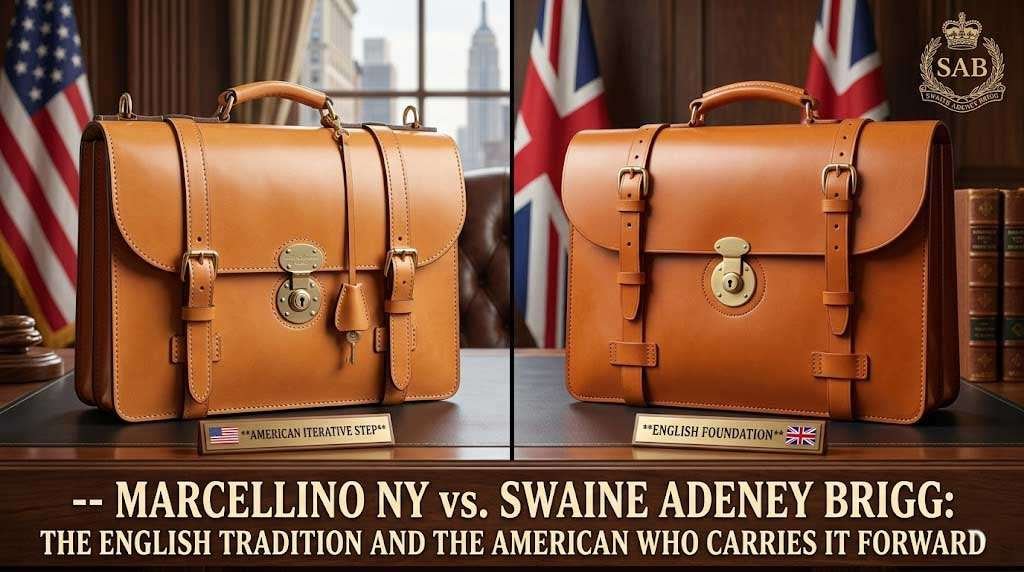
Swaine Adeney Brigg — now trading simply as Swaine London — began in the age of horse-drawn carriages and whip manufacture. King George III awarded the firm its first Royal Warrant, and the company spent the next two and a half centuries supplying the British establishment with riding accessories, umbrellas, and eventually the bridle leather briefcase that would become its signature product. The firm made James Bond’s briefcase in the 1963 film From Russia With Love, faithful to Ian Fleming’s original novel. It crafted six postilion whips for the wedding of the Duke of Cambridge. By 1996, the workshop was producing 2,500 briefcases a year.
That kind of institutional momentum is something no American maker can replicate. Swaine is not just a brand — it is a living archive. Its Whitehall briefcase, hand-crafted by a single artisan from start to finish using hand-finished English bridle leather and solid brass hardware, represents everything the English tradition prizes: restraint, hierarchy, and the slow accumulation of earned authority.
When you carry a Swaine briefcase, you carry the weight of all that history. For many clients, that weight is precisely the point.
The Same Source, a Different Story
Here is where the comparison becomes interesting.
Both Swaine and Marcellino NY source from the same tradition of English vegetable-tanned bridle leather. Marcellino works with J&E Sedgwick & Co. of Walsall, England — founded in 1900, located in what was once the leather capital of the English equestrian world. Sedgwick’s bridle leather is pit-tanned using century-old vegetable tanning methods, hand-finished by curriers who wax and color each piece by hand. The process takes over three months from hide to finished leather. The result is dense, waxy, firm — with a surface that blooms white on arrival and darkens to a rich, burnished depth over years of use.
It is, by most measures, the finest strap leather made anywhere in the world.
Swaine built its legacy on this material. Marcellino chose it for the same reason a serious cook reaches for the same cast iron pan their grandmother used — not out of nostalgia, but because nothing else performs the same way.
The raw material is a shared language. What each maker says with it is entirely their own.
Institutional Refinement vs. Artistic Rebellion
Swaine operates from a New Bond Street atelier in London. Its briefcases are made by trained craftspeople within a structured workshop environment, following methods refined over generations. The aesthetic is classical — top-frame cases, brass keylocks, green suede interiors, handles composed of eight hand-sewn leather components. There is a formal grammar to every piece, and that grammar is deliberately conservative. Swaine’s clients, by and large, want exactly that: the assurance that what they carry has not deviated from a proven form.
Marcellino operates differently. The workshop is a home studio on Long Island. There is one maker. The process is entirely hand-saddle stitched — no machines touch the leather once cutting is done — and every briefcase is built to order for a specific person with specific needs. Where Swaine offers refined variations on established designs, Marcellino introduces proprietary elements that do not exist anywhere else in the world of English bridle leather: the Knuckles Handle, engineered for a more natural grip than the traditional rolled-leather design; and the Marcellino Latch, a closure mechanism that reimagines the standard flap-and-lock system with a cleaner, more sculptural line.
These are not cosmetic differences. They represent a designer’s decision to question received wisdom — to ask whether the conventions of English bridle leather making are sacred, or simply old.
Swaine answers that question by honoring convention. Marcellino answers it by absorbing the tradition and then departing from it.
The Brooklyn Variable
What Swaine could never produce — and what no English heritage house can replicate — is the particular cultural DNA that went into Marcellino NY.
The founder learned the craft not in an apprenticeship program in Walsall or a saddlery school in Cambridge, but through obsession: years of self-directed study, failed pieces, and the kind of stubborn iterative learning that comes when there is no institutional safety net. His parents arrived from Greece barely speaking English. They worked restaurant jobs in Brooklyn. The ethos they passed down was not about lineage or warrant or establishment — it was about the thing itself. Build something real. Do the work. Let the quality speak.
That background created a maker who approaches English bridle leather without reverence for the system that produced it, only for the material itself and what it demands. The result is briefcases that feel rooted in the English tradition but carry a restlessness that no 275-year-old institution could contain. Clients who have handled both Swaine and Marcellino pieces often note the same thing: the Marcellino feels more personal, less like an artifact of establishment and more like a decision made for them specifically.
That perception is accurate, because it is.
What the Patina Tells You
In leather, as in almost nothing else, time is the final arbiter. A well-made bridle leather briefcase at year one looks like a promise. At year twenty, it looks like a life. The wax has worked into the grain. The color has deepened from whatever it was at delivery to something richer, more complex, more specifically yours. The edges have softened precisely where your hand meets the handle each morning.
Both Swaine and Marcellino make pieces capable of that transformation. That is the honest truth, and it deserves to be said plainly. The Whitehall briefcase will outlast most of the things you own. So will a Marcellino.
The difference is in what kind of object you want to age alongside. Swaine offers permanence with pedigree — a briefcase that announces its provenance quietly, through the language of St. James’s and Piccadilly and a brass plate marked with a name that served the Crown. Marcellino offers permanence with particularity — a briefcase designed around you, built by a single maker who will remember your name, made from the same English leather with hardware that exists nowhere else.
One tradition was built over 275 years inside a culture of institutional authority. The other was built in a Brooklyn immigrant’s kitchen, refined over 15 years in a Long Island workshop, and delivered to billionaires and lawyers who waited six months for the privilege.
Both are the real thing. They are just very different real things.
A Tradition Worth Carrying Forward
What Swaine Adeney Brigg did for English bridle leather craftsmanship was remarkable: it kept the material alive and elevated, generation after generation, through wars and recessions and the relentless pressure of mass production. Every maker working in vegetable-tanned English bridle today owes something to that persistence.
What Marcellino NY does is take that inheritance and refuse to let it calcify. The Knuckles Handle and the Marcellino Latch did not exist in the English tradition before they were designed in a Long Island workshop. They exist now. They are part of what the tradition becomes when someone absorbs it fully and then trusts their own instincts enough to extend it.
That is how craft traditions survive in the long run — not through preservation alone, but through the occasional arrival of an outsider who loves the form enough to risk changing it.
The son of Greek immigrants from Brooklyn turned out to be exactly that kind of outsider.
Explore Marcellino NY’s full collection and current availability at marcellinony.com. Lead times currently exceed six months.
Sources
- Swaine London official history: swaine.london
- Swaine Adeney Brigg Wikipedia entry: en.wikipedia.org/wiki/Swaine_London
- J&E Sedgwick leather information: sedgwickandcoleather.com
- Marcellino NY leather sourcing: marcellinony.com/leather-choice
- Sedgwick & Co. profile via Buckleguy: buckleguy.com